Roti Canai.
Flaky Malaysian Griddled Flatbread
Roti canai · say it: ROH-tee cha-NIGH
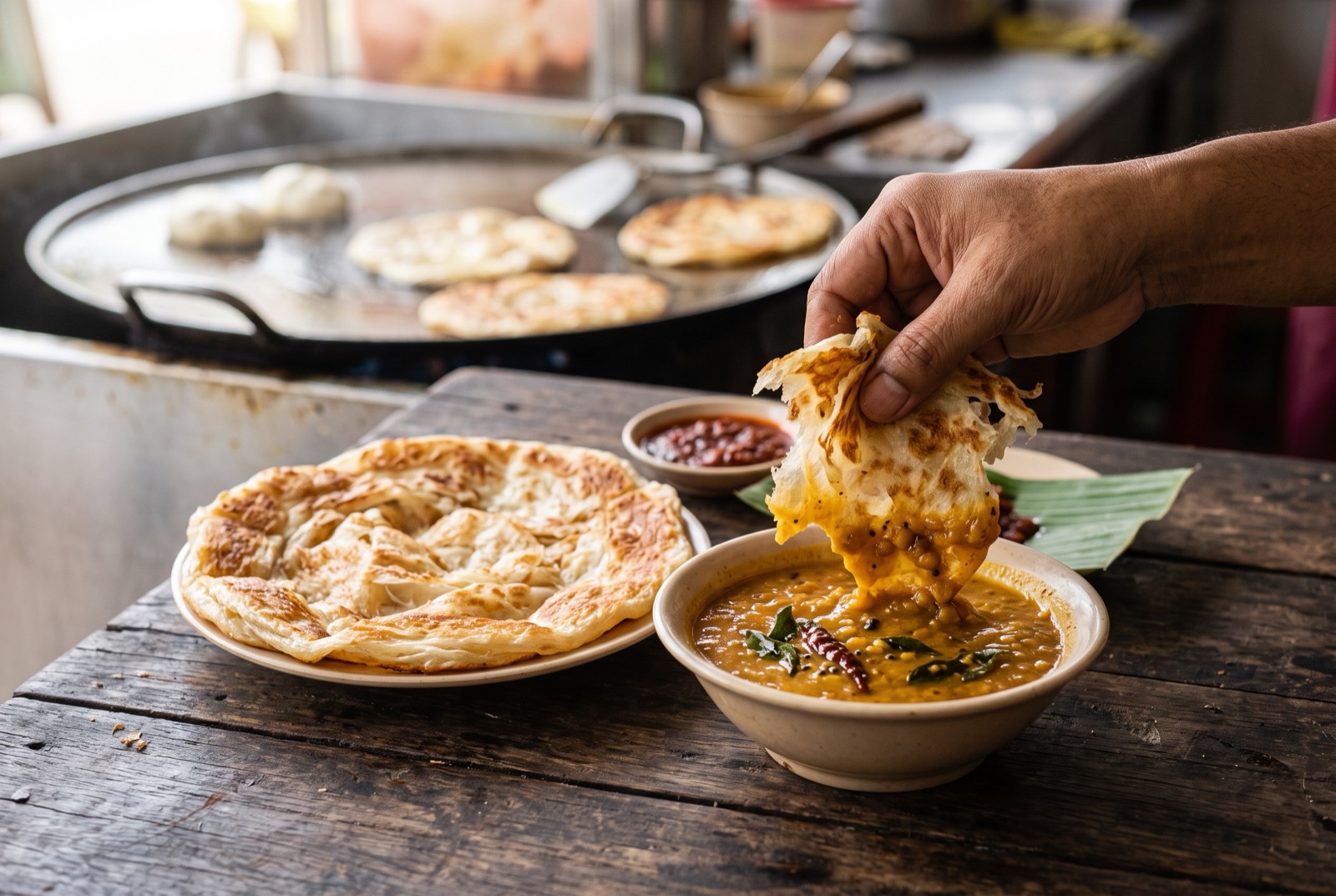
Roti canai is a flatbread built from air. A soft, heavily oiled dough is rested for hours until it becomes slack enough to stretch to the size of a table and thin enough to read through, then coiled or folded so that the fat trapped between the layers turns to steam on the griddle and blows them apart. Eaten straight off the heat it is crisp on the outside, chewy in the middle, and shatters into flakes when you clap it between your palms — which is not showmanship but the standard way of loosening the layers before you tear it. Malaysians eat it for breakfast, dipped in dhal or fish curry, with a glass of sweet tea.

- Gate
- Malaysia
- Prep
- 40 min
- Cook
- 30 min
- Total time
- 9 hr 10 min incl. 8 hr rest
- Serves
- 6
- Status
- Takes skill
- Nutrition / serving · estimated
- Calories 480 kcal
- Protein 14 g
- Carbs 62 g
- Fat 19 g
- Fiber 6 g
- Sugar 5 g
- Sodium 640 mg
Why this recipe works.
- A long overnight oil rest, which is the one step that makes the dough stretchable enough to work without tearing.
- A tabletop stretching method for home cooks who cannot throw a roti, giving the same thin sheet without the flying dough.
- A quick dhal to dip into, so the bread arrives with its proper accompaniment rather than on its own.
- Says plainly where home roti falls short of stall roti, and what actually closes most of the gap.
Ingredients.
17 itemsFor the dough
For the dhal
Equipment
- Large mixing bowl
- Flat griddle or heavy frying pan
- Oiled work surface or marble slab
- Small saucepan for the dhal
Instructions.
Mix a very soft dough
Whisk the flour and salt in a bowl, then work in the condensed milk, beaten egg and warm water until you have a shaggy, sticky mass. Knead on an oiled surface for 8–10 minutes until it turns smooth and elastic but still tacky enough to cling to your fingers.
Tip Resist adding flour. A dough firm enough to feel comfortable is a dough that will never stretch thin.
Rest the balls in oil
Divide the dough into 8 pieces and roll each into a smooth ball. Sit them in a container with plenty of space between them, pour over enough melted ghee or oil to coat them completely, cover and leave at room temperature for at least 6 hours or overnight.
Cook the dhal
Simmer the lentils in 700 ml water with the turmeric for 20 minutes until collapsing. Meanwhile fry the mustard seed in 2 tablespoons of oil until it pops, add the curry leaves, onion, garlic and ginger and cook 6 minutes until golden, then stir in the curry powder, tomato and chiles. Tip the lot into the lentils, season and simmer 10 minutes more.
Stretch the sheet
Oil the counter well. Press one ball out flat with your palm, then push outward from the centre with both hands until it thins, lifting and letting the edges hang so it stretches under its own weight. Keep going until the sheet is roughly 40 cm across and translucent enough to see the counter through.
Tip Small holes are normal and do no harm — a sheet with no holes at all is probably still too thick.
Fold in the layers
Brush the sheet with melted ghee, then gather it loosely: fold the sides in like a letter, then roll the strip into a loose coil and tuck the end underneath. Do not compress it — you want trapped air between the folds. Rest the coils 10 minutes while you shape the rest.
Griddle and clap
Flatten each coil to about 15 cm across with your palm and cook on a medium-high griddle for 2 minutes a side, until deep golden blisters form and the roti puffs in patches. Take it off, clap it hard between your palms two or three times so the layers fluff apart, and serve straight away with the dhal.
Tip It should sound papery when clapped. A dull thud means the layers were pressed together too early.
Tips from our kitchen.
- The dough should be noticeably softer and stickier than bread dough. If it feels firm enough to knead comfortably, it is too dry to stretch thin.
- Rest the oiled balls at least 6 hours, preferably overnight. Under-rested dough springs back and tears, and no technique compensates for it.
- Work on a lightly oiled surface, never a floured one. Flour makes the dough grip and tear; oil lets it slide out under your palms.
- Stretch from the middle outward with flat hands, then lift the edges and let gravity pull the last of the thinness. Aim for a sheet you can see your hand through.
- Griddle on medium-high in a dry or barely oiled pan and press the roti only at the end — pressing early flattens the layers before the steam can separate them.
- Clap the hot roti between your palms as soon as it comes off the pan. It loosens the layers and is why stall roti looks fluffed and homemade roti often looks solid.
Substitutions.
- Ghee for layering → Softened butter, or a neutral oil
- Ghee gives the best flavour and browns without burning. Oil alone works and is what many stalls use; the roti is slightly less rich but flakes just as well.
- Condensed milk in the dough → 1 tbsp sugar plus 3 tbsp milk
- Condensed milk adds sweetness and helps the surface brown. The substitution behaves almost identically, so use whichever you already have.
- Red lentils for the dhal → Yellow split peas or toor dal, cooked 15 minutes longer
- Red lentils collapse fastest and are the easiest weeknight option. Toor dal is closer to what a mamak stall uses and has more body.
Variations.
- Roti telur
- An egg beaten and poured over the stretched sheet before folding, so it sets between the layers. The most ordered version at any stall.
- Roti bom
- The dough coiled tight into a small, thick spiral and griddled slowly, producing something denser, buttery and almost pastry-like, often dusted with sugar.
- Roti tisu
- The same dough stretched to tissue thinness, sprinkled with sugar, crisped dry on the griddle and rolled into a tall cone — a dessert rather than a breakfast.
Storage & reheating.
Cooked roti is at its best within minutes and declines noticeably after ten. What you can store is the dough: oiled balls keep 3 days refrigerated and actually improve for the first two, becoming more extensible. Bring them to room temperature for an hour before stretching. Cooked roti can be frozen between sheets of paper and revived in a dry pan over medium heat for a minute a side; it will be good, not great. Dhal keeps 4 days refrigerated and thickens, so loosen with water when reheating.
Serve with
Dhal, fish curry gravy or a bowl of sugar, with hot pulled tea alongside.
The story behind Roti Canai.
Roti canai came to Malaysia with Indian labourers and traders, particularly Tamil Muslims, and it belongs to the same family as the paratha of South India and the roti prata of Singapore. The name is argued about: some say canai comes from Chennai, others from the Malay verb canai, to roll or knead thin, which is the more convincing explanation given what the cook actually does. Either way it stopped being an Indian bread some time ago and became a Malaysian one, sold in every mamak stall in the country and eaten by everybody.
The theatre is real and also functional. A roti man works a marble counter with a rhythm — flatten, oil, slap, spin, catch — throwing the disc so centrifugal force does the thinning that hands cannot do without tearing. Watching one at 6 a.m. is a genuine Malaysian experience, and the fact that customers watch is why stalls put the counter at the front. Underneath the performance, the technique is straightforward: high-hydration dough, plenty of fat, and enough rest for the gluten to relax completely.
The variations are almost a menu of their own. Roti telur has an egg cracked over the sheet before folding. Roti bawang gets sliced onion. Roti pisang has banana. Roti tisu is stretched paper-thin, sugared and coiled into a metre-tall cone. Roti bom is coiled tight and short so it stays dense and buttery. All start from the same dough, and stalls will call out the order as a stream of shorthand. The dipping curry is not fixed either — dhal is standard, but most places set down a small bowl of fish or chicken curry gravy alongside, and asking for extra gravy costs nothing.
Questions, answered.
Why does my dough tear when I stretch it?
Almost always insufficient rest, or a dough that is too dry. Gluten needs many hours submerged in oil to relax to the point where it will thin out instead of snapping back. Give the balls at least 6 hours and preferably overnight at room temperature or in the fridge, and make the dough noticeably softer and stickier than you would for bread.
Do I have to throw the roti in the air?
No. Throwing is how professionals get an even, table-sized sheet quickly, but it takes practice and a lot of floor space to fail in. At home, flatten the ball on an oiled counter, press outward from the centre with flat hands, then lift one edge and let the sheet hang so gravity thins it. The result is nearly as thin and considerably less dramatic.
What is the difference between roti canai and paratha?
They are relatives. Both are layered griddled flatbreads made by folding fat into stretched dough. Roti canai is made from a much wetter, oilier dough stretched paper-thin and then loosely gathered, so it is flakier and lighter, and it is normally eaten with curry gravy for breakfast. Indian parathas are usually rolled rather than stretched and are often stuffed.
Can I make roti canai without ghee?
Yes. Many mamak stalls use margarine or plain oil rather than ghee, and the layering works on fat content rather than on any specific fat. Neutral oil gives a slightly plainer bread; butter browns beautifully but burns faster on the griddle. Use whichever, but do not reduce the quantity — the fat is what separates the layers.
How do I get the layers to separate?
Three things. Stretch the sheet thin enough to see light through, fold or coil it loosely so there is air between the layers rather than compressing them, and clap the finished roti between your palms while it is still hot. Pressing the roti flat with a spatula early in the cooking is the most common mistake, since it seals the layers before the steam can push them apart.
You might also like.
All recipes →
Keep exploring Malaysia.
Malaysia has 9 more dishes in the atlas — Acar Awak and Asam Laksa, and 7 more.
All Malaysia recipes Flour recipes Ghee recipes Lentils recipes breadbreakfastvegetarianhalal friendlyRecipe by The DishRoute Kitchen · published August 20, 2026 · updated August 20, 2026