Mhadjeb.
Algerian Stuffed Semolina Crepes
محاجب · Mhadjeb · say it: m-HAJ-eb
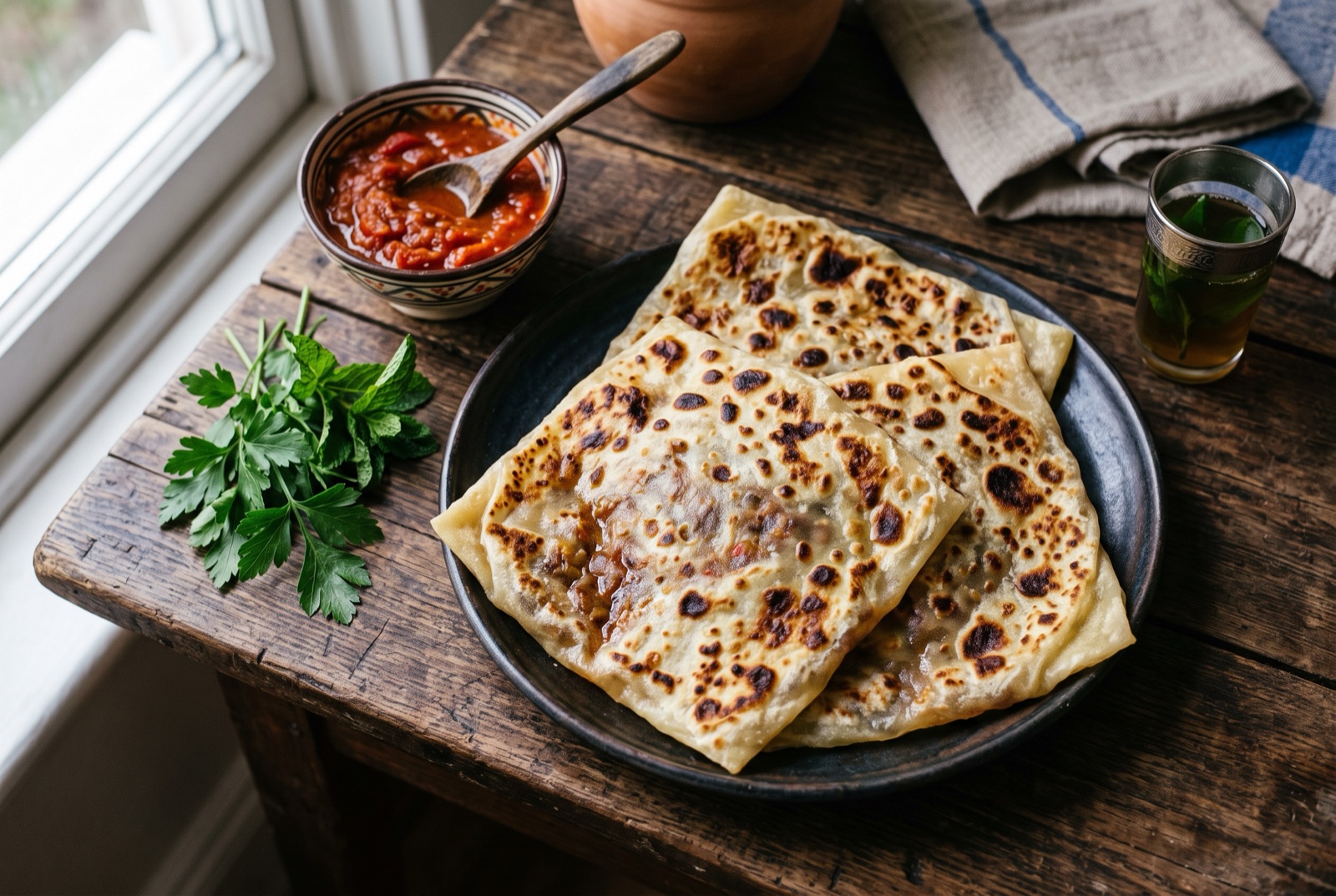
Mhadjeb are semolina crepes stretched so thin the worktop shows through, folded into square parcels around a dark, slow-cooked onion and tomato filling, and cooked dry on a hot pan until they blister and go tender-chewy. There is no yeast, no butter, no eggs — just semolina, water, salt and a lot of oil on your hands. The filling is the flavour: onions taken far past softness until they turn sweet and sticky, tomato reduced until it stops being wet, paprika and cumin, and enough chilli to make you notice. They are sold folded in paper on Algerian streets and eaten standing up, which is exactly how they taste best.

- Gate
- Algeria
- Prep
- 40 min
- Cook
- 50 min
- Total time
- 2 hr incl. 30 min rest
- Serves
- 4
- Status
- Medium
- Nutrition / serving · estimated
- Calories 520 kcal
- Protein 12 g
- Carbs 82 g
- Fat 16 g
- Fiber 7 g
- Sugar 9 g
Why this recipe works.
- The filling is cooked down properly, to the point where a spoon dragged through leaves a clean trail — the single thing that determines whether folding works.
- Oil-and-stretch method explained by feel, so you can tell when the dough is ready to spread instead of guessing.
- Cooked on a dry pan the street way, which gives blistered, chewy layers rather than a greasy fried crust.
- Naturally vegan with no substitutions or apologies, and cheap enough to make a whole batch on a whim.
Ingredients.
15 itemsFor the dough
For the filling
Equipment
- Large heavy frying pan or flat griddle
- A smooth non-porous worktop or large tray
- Small bowl for oil
Instructions.
Make and rest the dough
Stir the salt through the semolina, then add warm water in stages, mixing and then kneading for 8 minutes until you have a soft dough that is just short of sticky. Divide it into 8 balls, coat each one generously in oil, set them in an oiled dish and rest for at least 30 minutes.
Tip The balls can sit oiled for up to three hours and only get easier to stretch.
Cook the filling down
Warm the olive oil in a wide pan and cook the onions and pepper over medium-low heat for 20 minutes, stirring often, until they collapse and turn a soft honey colour. Add the garlic, tomato paste, paprika, cumin, harissa and black pepper and fry for 2 minutes until the mixture smells toasted rather than raw.
Reduce until dry
Stir in the grated tomato and season with salt. Cook uncovered for a further 15–20 minutes, until the filling is dark, glossy and thick enough that a spoon dragged across the pan base leaves a trail that does not fill back in. Spread it on a plate and cool completely.
Tip This is the step people rush. Wet filling equals torn dough equals leaking parcels.
Stretch the dough
Pour a puddle of oil onto a smooth worktop and oil your hands well. Set one ball in the oil and press it outward with the flats of your fingers, working from the centre to the edges in slow sweeps, until you have a rough square roughly 30 cm across with a translucent centre.
Fill and fold
Spoon 2 heaped tablespoons of the cold filling into the middle of the sheet and spread it into a small square. Fold the left and right thirds over it, then the top and bottom, to make a neat sealed parcel about the size of your palm. Press gently to spread the filling evenly to the corners.
Griddle
Cook the parcels on a dry pan over medium heat, 3–4 minutes a side, pressing lightly with a spatula. They are done when brown blistered spots cover both faces, the edges look set rather than doughy, and the parcel feels springy rather than dense. Stack them under a towel as they come off.
Serve hot
Cut each mhadjeb in half on the diagonal so the layers and the dark filling show, and eat immediately while the outside is still chewy and the inside steaming. Put harissa on the table for anyone who wants it.
Tips from our kitchen.
- Keep a bowl of oil beside you and re-oil your hands constantly. Any dry patch on your fingers will grab the dough and rip it.
- The filling must be cool before it touches the dough. Warm filling steams the sheet from the inside and makes it stick and tear.
- Aim for a sheet whose centre is translucent and whose rim is slightly thicker — that rim gives you something to grip when folding.
- A tear is not a disaster. Fold that corner in first so the hole ends up in the middle of the parcel, buried under layers.
- Cook on a genuinely dry, medium-hot pan. Oil in the pan fries the surface before the inside cooks and gives you a crisp shell around raw dough.
- Stack the finished mhadjeb under a clean towel. Trapped steam keeps them soft; left in open air they stiffen within ten minutes.
Substitutions.
- Fine semolina → 250 g fine semolina plus 150 g plain flour
- A part-flour dough is easier to stretch and more forgiving for a first attempt, at the cost of a little of the semolina bite. All-flour dough behaves like pastry and will not stretch the same way.
- Fresh tomatoes → 3 tbsp tomato paste plus 200 ml water
- Out of tomato season this is the better option and is what most street cooks use anyway. Fry the paste until it darkens before adding the water.
- Harissa → Half a teaspoon of chilli flakes plus a pinch of caraway
- Caraway is what gives harissa much of its distinctive character, so adding a little gets you closer than chilli alone.
Variations.
- Mhadjeb with meat
- A few tablespoons of minced beef browned into the onion base before the tomato goes in. Common in home versions and rare on the street, where the vegetable filling is the standard.
- Mhajeb sandwich
- The western Algerian habit of splitting a baguette and stuffing it with a hot mhadjeb, sometimes two, plus harissa and a slice of processed cheese. Absurd and very good.
- Unfilled mlaoui
- The same dough stretched, oiled and folded without any filling, then griddled and eaten with honey or jam at breakfast. Worth making with any leftover dough balls.
Storage & reheating.
Best within an hour of cooking. They keep two days refrigerated, stacked between sheets of paper, and revive on a dry hot pan for a minute a side — never in a microwave, which turns them rubbery. Uncooked filled parcels freeze well for two months: freeze flat on a tray, then bag them, and cook from frozen over lower heat for about eight minutes a side. The filling alone keeps five days refrigerated.
Serve with
Sweet mint tea, and extra harissa thinned with olive oil for dipping.
The story behind Mhadjeb.
Every Algerian city has a mhadjeb spot, usually a narrow shopfront with one person stretching dough and another working three griddles at once, and the queue that forms outside it after dark during Ramadan is a civic institution. The dish belongs to the same family as msemen and mlaoui, the folded semolina breads found across the Maghreb, but where those are usually layered with fat and eaten plain or with honey, mhadjeb are always filled and always savoury. The filling is often called dersa or simply the mahchi, and its consistency matters more than its recipe: it must be reduced almost dry, because any free liquid tears the paper-thin dough during folding.
The stretching technique is the part worth learning. The dough is rested until it slackens, then each ball is not rolled but pressed and pushed outward on a heavily oiled surface with the flats of the fingers, working from the centre to the edge, until it spreads into a thin sheet with a translucent middle. Cooks who do this all day get the sheet to the size of a small tablecloth. At home a large dinner plate is a realistic target and produces the same result once folded, because the folding is what creates the layers.
Mhadjeb are street food rather than ceremonial food, and that shapes how they are eaten: hot, in the hand, often with a smear of harissa, sometimes stacked two deep in a piece of baguette in the west of the country. They also happen to be completely plant-based without anyone having designed them that way — semolina, onions, tomatoes and oil are cheap, and the dish grew out of household economy. In Ramadan they appear on the table beside the chorba, and outside it they are afternoon food, the thing you buy because you are hungry now and dinner is hours away.
Questions, answered.
My dough keeps tearing when I stretch it — why?
Usually it has not rested long enough, or it is too dry. Semolina needs at least thirty minutes to absorb water and slacken, and the dough should feel soft and slightly tacky rather than firm. Also check your hands: if there is no film of oil on them, the dough grips your skin and tears at exactly that point.
How thin is thin enough?
You should be able to see the colour and pattern of the worktop through the centre of the sheet. If it is opaque, keep pushing outward from the middle with flat fingers. A slightly thicker rim is normal and useful, since it holds the parcel together when you fold.
Can I make the filling in advance?
Yes, and it is better if you do. The onion and tomato mixture deepens overnight in the fridge and, more usefully, it will be completely cold when you come to fill the dough, which is what you want. It also gives you an excuse to make double and freeze half for the next batch.
Why do mine come out greasy?
Almost certainly oil in the pan. The dough already carries plenty of oil from the stretching stage, so the pan should be completely dry. If your pan is not reliably non-stick, wipe it with a lightly oiled piece of kitchen paper between batches rather than pouring oil in.
Are mhadjeb vegan?
As written here, yes — the dough is semolina, water, salt and oil, and the filling is vegetables, spices and olive oil. Street versions are usually the same, though a few places add minced meat to the filling or serve them with cheese, so it is worth asking rather than assuming when you buy them.
You might also like.
All recipes →
Keep exploring Algeria.
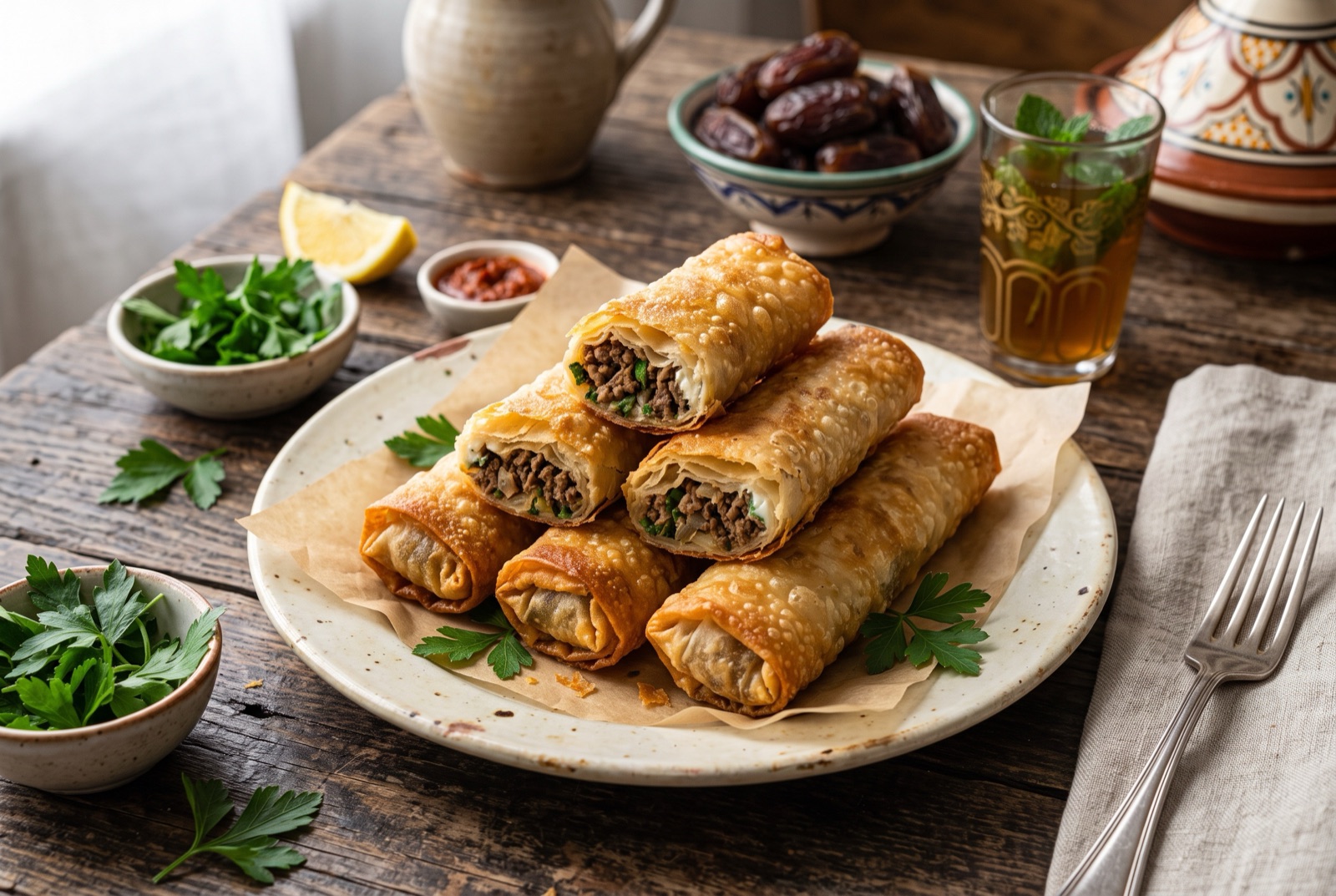
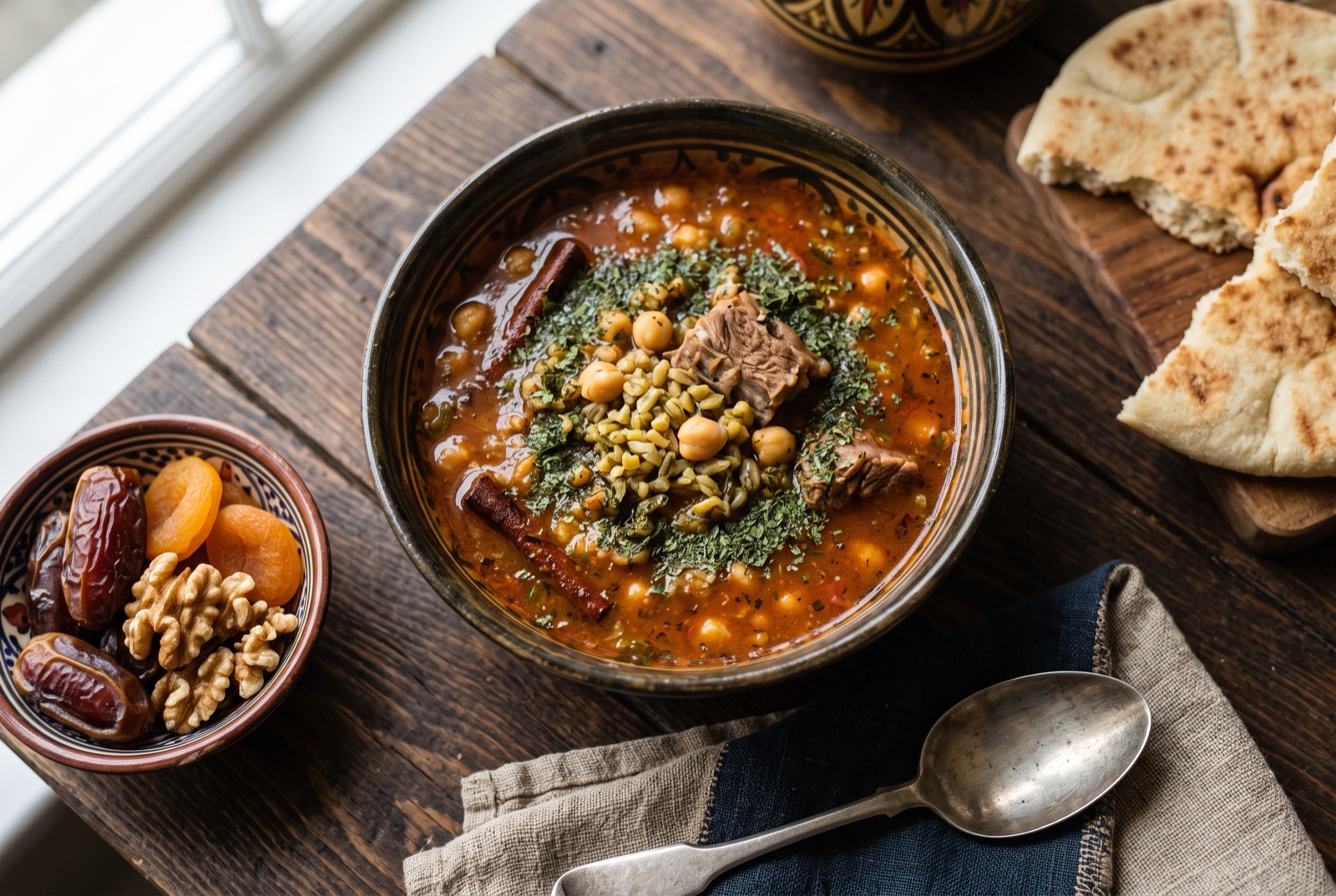
Algeria has 9 more dishes in the atlas — Algerian Chorba Frik and Bourek, and 7 more.
All Algeria recipes Semolina recipes Onion recipes Tomato recipes street foodveganvegetariandairy freenut freeRecipe by The DishRoute Kitchen · published August 20, 2026 · updated August 20, 2026