Multekrem.
Norwegian Cloudberry Cream
Multekrem · say it: MOOL-teh-krem
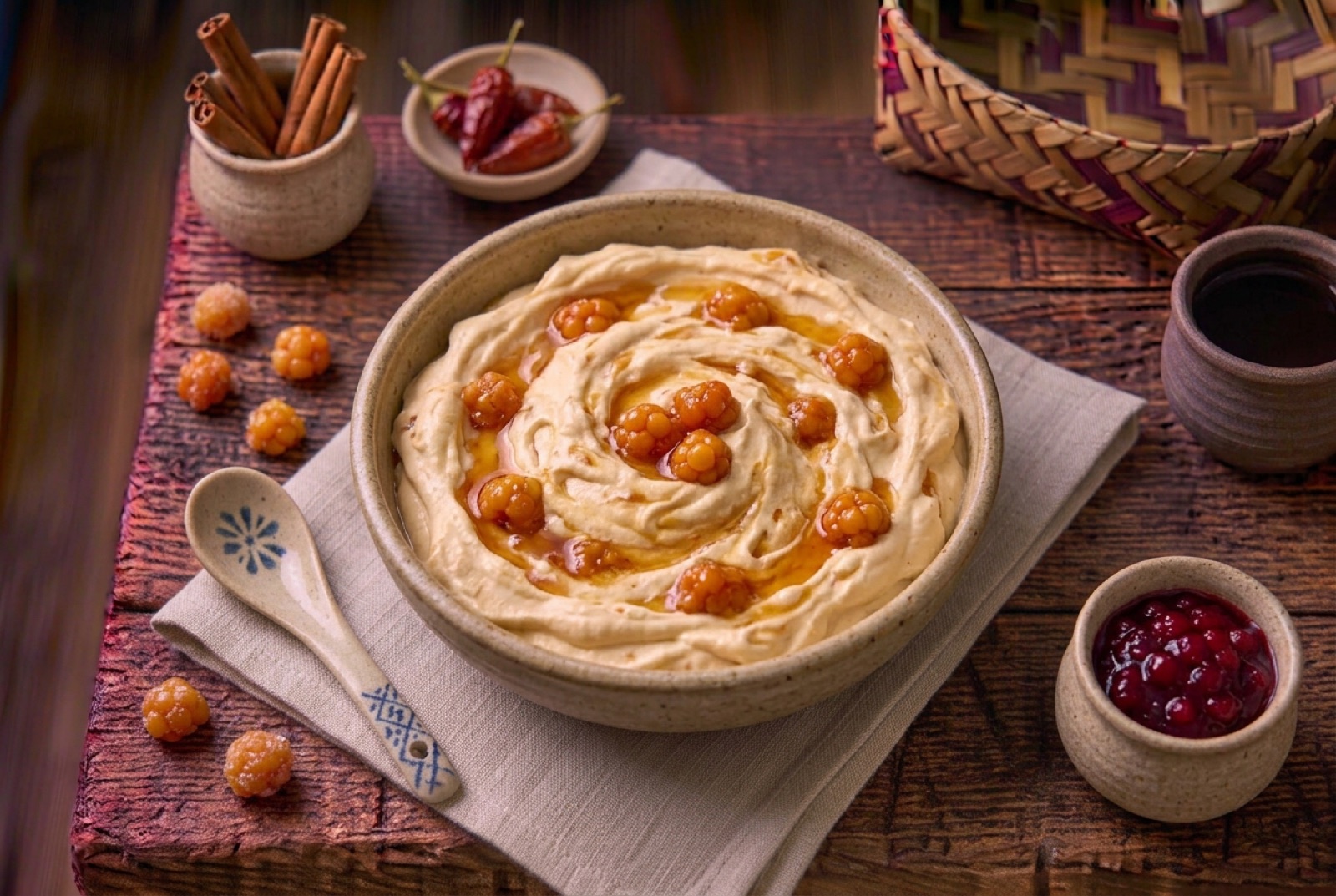
Multekrem is whipped cream folded with sweetened cloudberries, and that is the entire recipe. What makes it a dish rather than an assembly is the berry: cloudberries are tart, faintly resinous and unlike anything else, with a flavour somewhere between apricot, sour apple and honey, and a texture of large soft beads that burst rather than dissolve. Folded into cream they streak it amber and cut its richness immediately. It takes ten minutes, requires no heat, and appears on Norwegian Christmas tables and at summer cabins with equal frequency — usually in a large bowl with a spoon in it, alongside thin crisp krumkake cones.

- Gate
- Norway
- Prep
- 15 min
- Cook
- 0 min
- Total time
- 30 min incl. 15 min rest
- Serves
- 4
- Status
- Easy
- Nutrition / serving · estimated
- Calories 420 kcal
- Protein 3 g
- Carbs 24 g
- Fat 35 g
- Fiber 4 g
- Sugar 21 g
Why this recipe works.
- Macerates the berries briefly first, so the sugar draws out juice and the flavour spreads through the cream instead of sitting in pockets.
- Stops the cream at soft peaks, which keeps the dessert spoonable rather than turning it into a stiff mousse.
- Folds rather than stirs, leaving visible amber streaks and whole berries — the way multekrem is supposed to look.
- Gives an honest verdict on substitutes: nothing tastes like a cloudberry, and the recipe says so instead of pretending otherwise.
Ingredients.
5 itemsEquipment
- Chilled mixing bowl
- Balloon whisk or electric beaters
- Rubber spatula
Instructions.
Sugar the berries
Tip the cloudberries into a bowl, add 3 tablespoons of the sugar and stir gently once. Leave for 15 minutes, until the sugar has dissolved and a thin amber syrup has gathered around the fruit.
Tip Stir once, not repeatedly. The berries are fragile and you want most of them whole at the end.
Taste and adjust
Taste a berry with a little of its syrup. It should be sharply tart with the sugar taking the edge off, not sweet — add the last tablespoon of sugar only if the berries make you flinch.
Whip the cream to soft peaks
Whip the chilled cream, with the vanilla sugar if using, until the whisk leaves a visible trail that slumps back into itself within a second or two. Stop there: any stiffer and the folded dessert turns dense instead of spoonable.
Tip Finish the last few strokes by hand if using electric beaters — the line between soft peaks and over-whipped is about five seconds wide.
Fold the berries through
Pour most of the berries and their syrup over the cream, add the aquavit if using, and fold with a spatula in about eight broad strokes, cutting down through the middle and lifting up the side. Stop while the cream is still streaked amber and white.
Tip Over-folding gives a uniform beige mixture that tastes flatter and looks like nothing in particular.
Chill and serve
Spoon into a serving bowl or individual glasses, top with the reserved berries and their syrup, and chill for 15 minutes before serving. Bring it to the table with krumkake or thin crisp biscuits on the side.
Tips from our kitchen.
- Frozen cloudberries are entirely acceptable and often better than fresh ones that have travelled. Thaw them in a sieve over a bowl and keep the juice.
- Sweeten the berries, not the cream. Cloudberries vary enormously in tartness, so taste them after ten minutes with sugar and adjust before anything meets the cream.
- Chill the bowl, the whisk and the cream. Cold cream whips faster, holds better and is far less likely to over-whip into butter.
- Stop whipping when the whisk leaves a trail that slumps back within a second or two. Multekrem should collapse gently on the spoon, not stand in peaks.
- Fold with a spatula in about eight strokes, and stop while it still looks streaky. Fully mixed multekrem is uniform beige and tastes noticeably duller.
- If you are using shop-bought cloudberry jam instead of berries, use about half the quantity and add no sugar at all.
Substitutions.
- Fresh or frozen cloudberries → Cloudberry jam (multesyltetøy), roughly half the weight, with no added sugar
- This is the standard fallback in Norway itself and works well. Fold it in gently — jam is already sweet, and using the full weight makes the dessert cloying.
- Cloudberries entirely → Raspberries with a spoonful of apricot jam and a scrape of orange zest
- Be clear about what this is: a pleasant berry cream, not multekrem. Nothing available in an ordinary shop reproduces the cloudberry's resinous, honeyed tartness. Scandinavian delis and online sellers carry frozen or jarred cloudberries if you want the real thing.
- Double cream → Whipping cream, or half double cream and half thick sour cream
- The sour cream version is a genuine Norwegian variant and gives a sharper, lighter dessert. It whips less stiffly, so fold carefully.
Variations.
- Multekrem with krumkake
- Spooned into thin cone-shaped krumkake wafers baked in a patterned iron. The standard Christmas presentation, and the crisp shell against the cold cream is the best part.
- With a spoonful of aquavit
- A tablespoon of aquavit or a good brandy folded in with the berries. It sharpens the fruit and is common at adult Christmas tables.
- Trollkrem
- A different but related Norwegian dessert: lingonberries or cranberries beaten with egg white and sugar until they turn into a stiff pink foam. No cream at all, and much lighter.
Storage & reheating.
Multekrem is best made no more than a couple of hours ahead and kept covered in the coldest part of the fridge; the cream slowly deflates and the berries continue releasing juice, so after about six hours it starts to weep at the bottom of the bowl. If that happens, fold it gently once more rather than draining it. It does not freeze — the cream separates on thawing and the berries collapse completely. Leftovers are excellent the next morning spooned over porridge, weeping and all.
Serve with
Krumkake cones, thin almond biscuits, or on its own in a chilled glass after a heavy Christmas dinner.
The story behind Multekrem.
The cloudberry, multe in Norwegian, grows on open bogs and mires across the Arctic and sub-Arctic and refuses almost entirely to be farmed. It fruits unpredictably, needs specific wet acidic ground, and produces a good crop in a given bog perhaps a few years in ten. The picking window is a matter of weeks in high summer, and the berries are picked by hand, in mosquito country, by people who often will not tell you where. Prices reflect all of this: cloudberries are routinely the most expensive berry in Scandinavia, and a good multemyr — cloudberry bog — is family information.
Norway takes this seriously enough to have legislated it. The country's otherwise generous right to roam, allemannsretten, lets anyone walk and forage almost anywhere, but cloudberries in the three northernmost counties are a specific exception, with picking on private land restricted to the landowner. Very few berries anywhere have their own law.
The reason the dessert works with no cooking is chemistry rather than tradition. Cloudberries contain unusually high levels of benzoic acid, a natural preservative, which means they keep remarkably well raw — historically they were simply stored in barrels or crocks with sugar, or even in water, and lasted through the winter without heat, salt or smoke. In a country whose entire food culture is built on preserving, the cloudberry was the one thing that essentially preserved itself, and that is why the classic way to eat it is uncooked, folded into cream, with the fruit's sharpness fully intact. Boiling it into jam is possible but slightly beside the point.
Questions, answered.
What do cloudberries taste like?
Tart and aromatic, with notes people usually describe as apricot, sour apple and honey, plus a faint resinous quality that has no obvious comparison. Ripe cloudberries are amber-orange, soft and made up of large juicy segments that burst rather than mush. They are much less sweet than raspberries, which is why they work so well against unsweetened cream.
Can I use frozen cloudberries?
Yes, and for most people outside Norway that is the only realistic option. Thaw them slowly in a sieve set over a bowl so excess water drains off, then use the drained fruit and add a little of the collected juice back for colour. Frozen berries are softer than fresh, so fold especially gently if you want whole berries visible in the finished cream.
Why are cloudberries so expensive?
They cannot be commercially farmed with any reliability. Cloudberries need specific acidic bog conditions, fruit unpredictably from year to year, and must be picked by hand during a short summer window in remote terrain. Norway also restricts picking in its three northernmost counties, where the berries on private land belong to the landowner — one of very few exceptions to the country's otherwise open right to roam.
Can I make multekrem in advance?
A couple of hours ahead is fine if you keep it covered and very cold. Beyond that the whipped cream loosens and berry juice pools at the bottom of the bowl. If you need to prepare further ahead, sugar the berries and refrigerate them separately, whip the cream shortly before serving, and fold the two together at the last minute — the folding takes under a minute.
Should I use cloudberry jam instead of whole berries?
It is a common and accepted shortcut in Norway, especially outside the picking season. Use about half the weight you would use of fresh berries and skip the added sugar entirely, since the jam is already sweetened. The result is smoother and sweeter, with less of the burst-in-the-mouth texture of whole fruit, but it is recognisably the same dessert.
You might also like.
All recipes →

Keep exploring Norway.
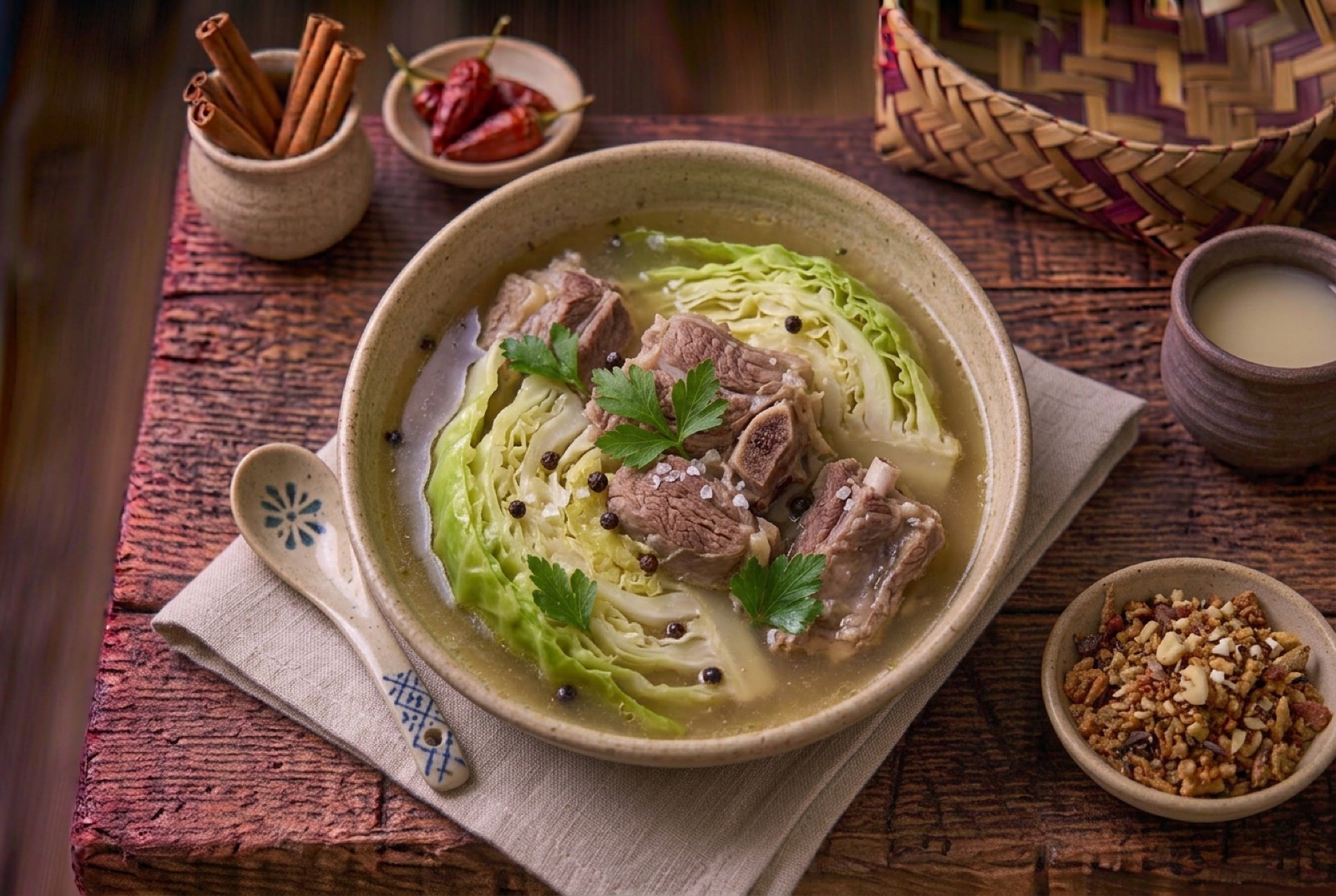
Norway has 9 more dishes in the atlas — Bergensk Fiskesuppe and Fårikål, and 7 more.
Recipe by The DishRoute Kitchen · published August 19, 2026 · updated August 19, 2026