Praetud Räim.
Fried Marinated Baltic Herring
Praetud räim marinaadis · say it: PRAH-eh-tood RAIM
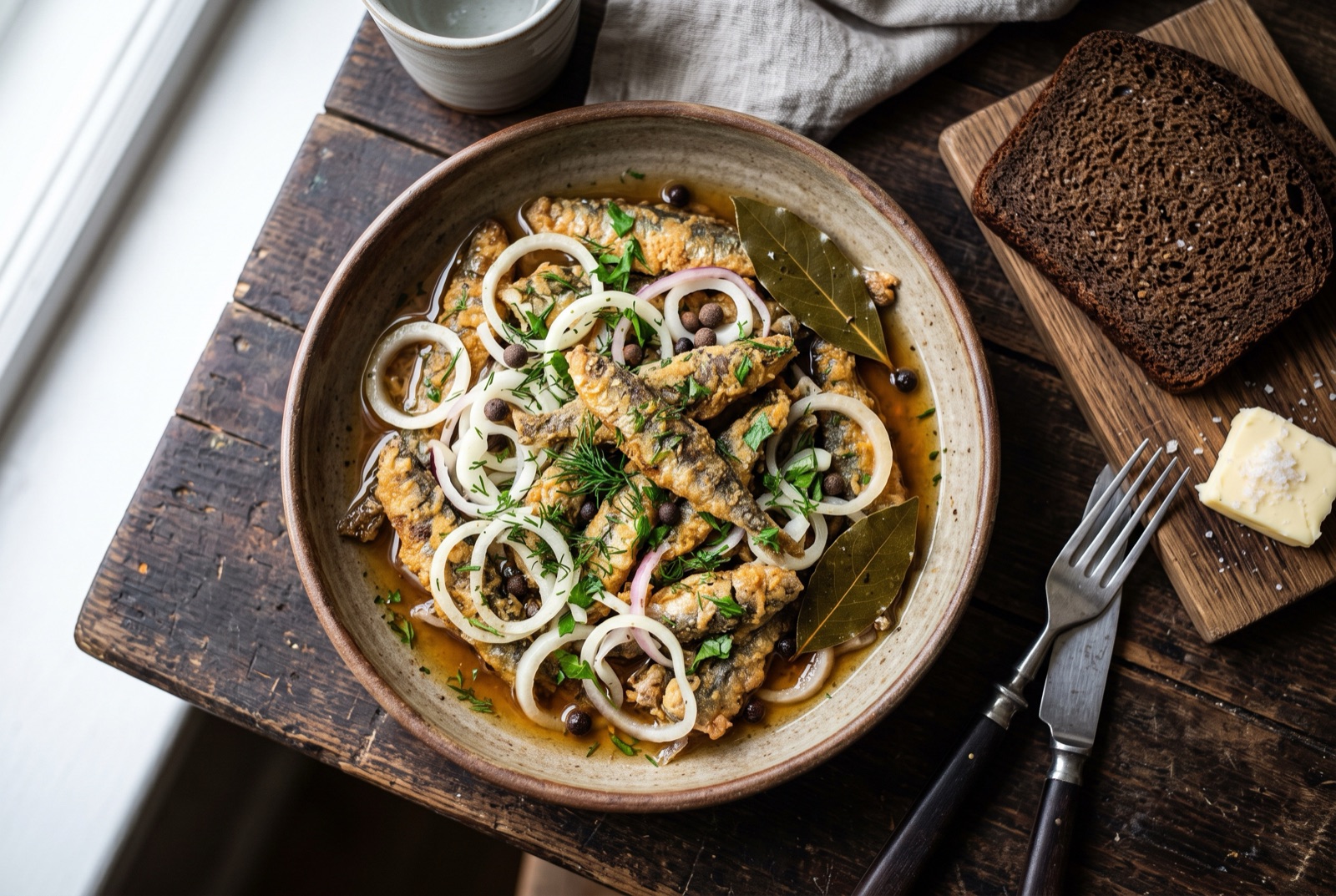
Praetud räim is fried fish that gets better after it goes cold. Small Baltic herring are butterflied, coated in rye flour and fried until the edges crackle, then packed into a dish with onion rings and covered in a hot sweet-sour vinegar marinade spiced with allspice, bay and peppercorns. Overnight in the fridge the crust softens into something silky, the vinegar tames the oiliness of the fish, and the bones that remain dissolve almost entirely. It is served cold, straight from the dish, with buttered black rye bread — an Estonian coastal staple that costs very little and keeps for the better part of a week.

- Gate
- Estonia
- Prep
- 30 min
- Cook
- 20 min
- Total time
- 12 hr 50 min incl. 12 hr rest
- Serves
- 4
- Status
- Medium
- Nutrition / serving · estimated
- Calories 390 kcal
- Protein 30 g
- Carbs 27 g
- Fat 18 g
- Fiber 2 g
- Sugar 14 g
- Sodium 820 mg
Why this recipe works.
- Butterflying the fish rather than filleting keeps the shape traditional and leaves the small pin bones to soften in the marinade.
- Rye flour, not wheat — a darker crust that holds up to overnight souring instead of going to mush.
- A hot marinade poured over warm fish, which draws the spices in far faster than a cold pour.
- Explicit about substitutes, so this works with sardines or small Atlantic herring when Baltic räim is unavailable.
Ingredients.
13 itemsFor the fish
For the marinade
Equipment
- Large heavy frying pan
- Non-reactive glass or ceramic dish with a lid
- Small saucepan
Instructions.
Butterfly the fish
Pull the head off each herring, slit the belly, and open the fish flat like a book. Run a thumb down either side of the backbone and lift it out from the tail end, leaving the two fillets joined along the back. Rinse briefly and pat completely dry.
Tip The fish should feel dry to the touch before it meets the flour, or the crust will not stick.
Flour and fry
Mix 120 g of rye flour with the salt and pepper on a plate. Press each fish into it on both sides, shaking off the excess, and fry in hot oil for 2–3 minutes per side until the coating is dark gold and the tail edges have gone crisp and curled.
Tip Fry in batches with gaps between the fish; a crowded pan steams instead of frying.
Layer with onion
Pack the hot fish into a glass or ceramic dish skin side up, layering onion rings and the sliced carrot between every layer of fish. Keep the layers loose enough for the marinade to run all the way to the bottom.
Boil the marinade
Bring the vinegar, water, sugar, allspice, bay leaves and peppercorns to a boil in a small pan, stirring until the sugar has dissolved, then simmer for 3 minutes until the kitchen smells clearly of spice rather than raw vinegar.
Pour over while warm
Pour the hot marinade with all its spices over the fish so everything is submerged, pressing the top layer down with a small plate if it floats. Let it cool to room temperature uncovered, then cover and refrigerate.
Wait overnight, then serve
Leave at least 12 hours, preferably 24. The fish is ready when the coating has softened to a silky skin, the onions are translucent and the flesh tastes sweet-sour all the way through. Serve cold with black bread and butter.
Tips from our kitchen.
- Ask the fishmonger to butterfly the fish if you can. Otherwise it is fifteen minutes of easy work: head off, slit the belly, thumb along the spine, lift the backbone out from the tail end.
- Dry the fish thoroughly on kitchen paper before flouring. Wet fish steams in the pan and the rye coating slides straight off.
- Fry in batches with space between the fish. Crowding the pan drops the temperature and gives you pale, greasy herring instead of crisp ones.
- Pour the marinade over while the fish is still warm — warm flesh absorbs the vinegar and spice noticeably faster than cold.
- Give it at least twelve hours before eating, and twenty-four if you can wait. Under-marinated herring tastes of raw vinegar rather than of sweet-sour fish.
- Use a non-reactive dish — glass or ceramic. Vinegar sitting overnight in a metal dish picks up a distinctly tinny taste.
Substitutions.
- Baltic herring (räim) → Small Atlantic herring, fresh sardines or fresh sprats
- Any small oily fish under about 20 cm works. Sardines are the easiest to find and behave almost identically in the marinade.
- Rye flour → Plain wheat flour, or half wheat and half fine cornmeal
- Lighter in colour and flavour. Cornmeal gives a crunchier crust that survives the marinade well.
- White wine vinegar → Apple cider vinegar or plain 5% spirit vinegar diluted with a little extra water
- Cider vinegar is slightly fruitier and works well. Check the strength — anything above 6% needs more water and sugar.
Variations.
- Hot fried räim
- Skip the marinade entirely and eat the fish straight from the pan with lemon, boiled potatoes and dill butter. This is the everyday Estonian way and takes twenty minutes start to finish.
- Räimesalat
- Flake the marinated fish and fold it through diced boiled potato, apple and onion with sour cream, turning the leftovers into a salad for the buffet table.
- Mustard marinade
- Whisk a tablespoon of coarse mustard and a spoonful of tomato paste into the hot marinade for a tangier, orange-tinted version common in Estonian delis.
Storage & reheating.
Keeps 5 days in the fridge, submerged in its marinade in a covered non-reactive container, and the flavour peaks around days two and three. Bring it to cool room temperature for about twenty minutes before serving — straight from the fridge, the fish tastes flat and the marinade tastes only of vinegar. Do not freeze: thawed marinated herring falls apart into shreds and the onion goes limp and slimy.
Serve with
Thick slices of black rye bread with cold salted butter. Boiled new potatoes with dill, and a spoonful of the marinated onions from the dish.
The story behind Praetud Räim.
Räim is the Baltic herring, a smaller, leaner subspecies of Atlantic herring that thrives in the brackish, low-salinity water of the Baltic Sea. It is the fish of the Estonian coast — cheap, abundant, and historically eaten so routinely that the joke about coastal families getting sick of it has a genuine basis. Because the fish are small and oily and land in large hauls, the two traditional responses were salting and this: fry the catch quickly, then preserve it in vinegar so it keeps for days without refrigeration.
The rye flour coating is the local fingerprint. Estonian kitchens had rye long before they had reliable white wheat flour, and rye gives the fish a darker, nuttier crust than wheat does, one that stands up better to sitting in acid. The marinade itself belongs to a wider northern European family of soused and marinated fish — Scandinavians, Germans and Poles all do versions — but the Estonian balance leans sweeter than the Scandinavian and lighter on the mustard seed than the German.
The fish is caught mainly in spring and autumn and shows up on Estonian tables in dozens of forms: fried fresh with a squeeze of lemon, layered into a baked casserole with potato, salted whole, or marinated like this. The island of Saaremaa and the fishing villages of the north coast are the traditional heartlands, and small-scale coastal fishing for räim still supports villages along the Gulf of Finland. Buying it outside the region is the only real obstacle for a home cook. Baltic herring rarely travels; ordinary small Atlantic herring, sprats, or even fresh sardines make an honest substitute, because the technique — bone, flour, fry, souse — is what carries the dish, not the exact species.
Questions, answered.
Do I have to remove the bones from the herring?
Remove the backbone, yes — it is thick enough to be unpleasant. The small pin bones can stay: they soften almost completely during a night in the acidic marinade and are eaten without anyone noticing. This is exactly why so many small oily fish are traditionally soused rather than simply fried.
What can I use instead of Baltic herring?
Any small oily fish of roughly the same size. Fresh sardines are the most widely available and behave almost identically; small Atlantic herring, fresh sprats or small mackerel fillets also work. The method — butterfly, flour, fry, then souse in hot spiced vinegar — is what defines the dish rather than the exact species.
How long does it need to marinate?
Twelve hours minimum, twenty-four for the best result. Below that the vinegar has only reached the surface and the fish tastes sharp and unfinished. After a full day the marinade has penetrated the flesh, the crust has softened to a silky coating and the onions have gone translucent and sweet.
Should I eat it hot or cold?
Cold, or at cool room temperature. The marinated version is a fridge dish eaten as a snack or starter with black bread. If you want hot fried herring, eat it straight from the pan with lemon and potatoes and skip the marinade entirely — both are traditional Estonian preparations of the same fish.
Why did my coating come off in the pan?
Usually because the fish was still wet when it was floured, or because the pan was not hot enough when the fish went in. Pat each fish completely dry, flour it just before frying rather than letting it sit, and wait until the oil shimmers before adding the first batch. Do not move the fish for the first two minutes so the crust can set.
You might also like.
All recipes →


Keep exploring Estonia.
Estonia has 9 more dishes in the atlas — Hapukapsasupp and Kama, and 7 more.
All Estonia recipes Rye flour recipes Onion recipes Vinegar recipes mainappetizerpescatariandairy freeRecipe by The DishRoute Kitchen · published August 20, 2026 · updated August 20, 2026