Raspeballer.
Norwegian Grated Potato Dumplings
Raspeballer / komle · say it: RAHS-peh-bahl-ler
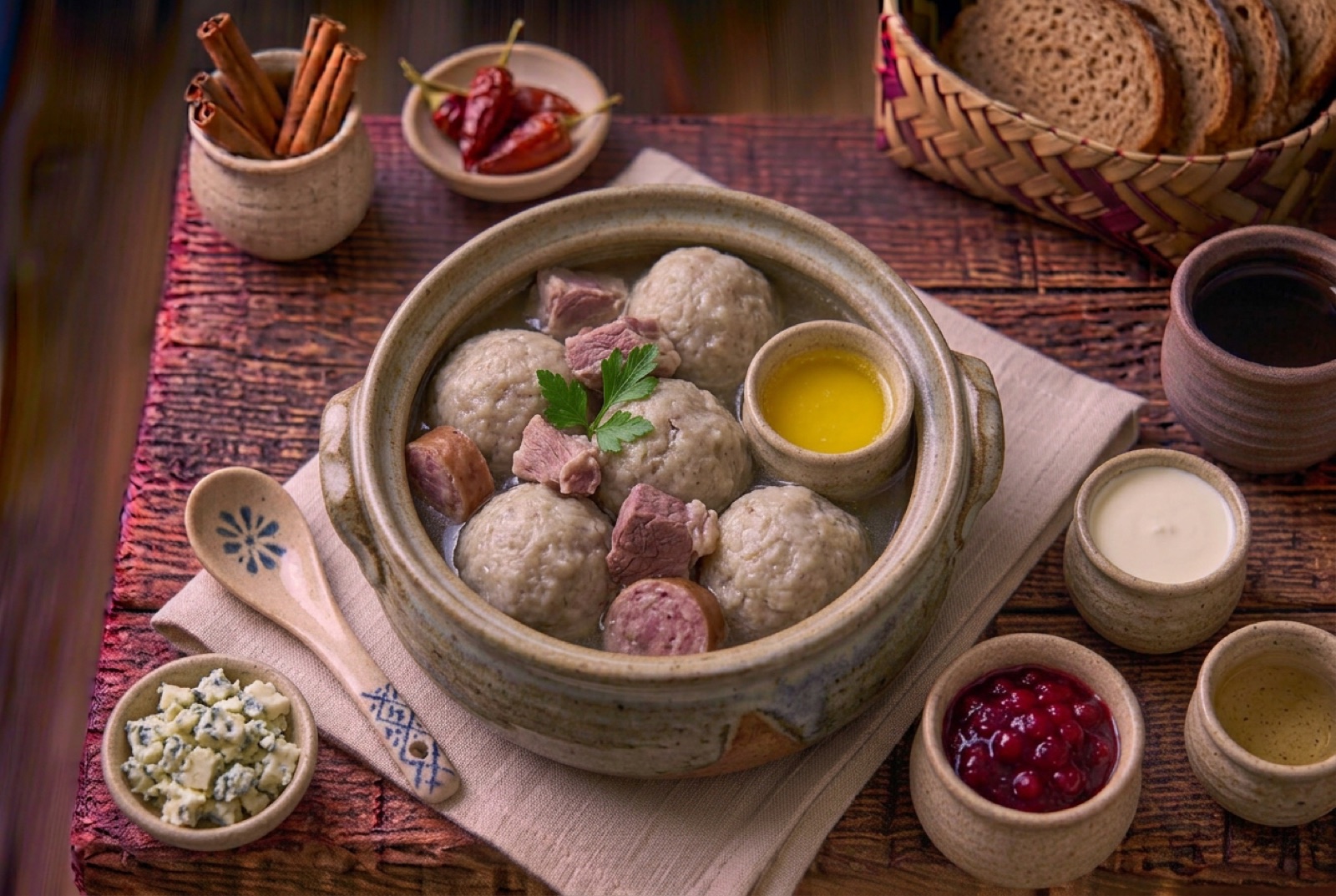
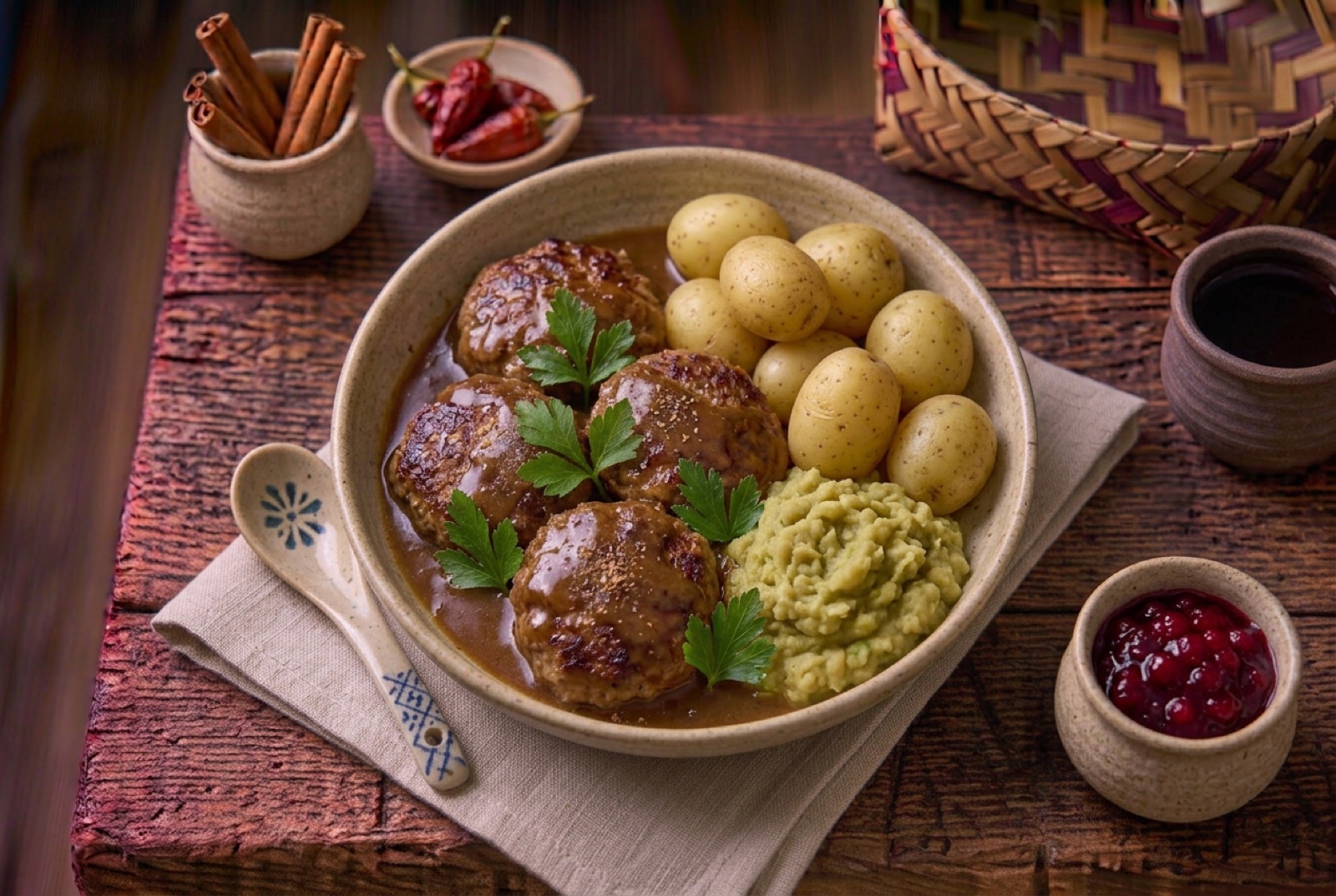
Raspeballer are heavy, pale grey-brown potato dumplings made from raw potato grated to a wet pulp, bound with mashed cooked potato and a little flour, and simmered slowly in salted meat broth until they swell and firm up. They are not light and they are not trying to be — the texture is close-grained and faintly chewy, the flavour is quiet potato and salt, and the whole thing exists as a vehicle for what surrounds it: salted cured lamb, smoked sausage, mashed swede, and melted butter poured over until it pools. On the Norwegian west coast this is Thursday dinner with such regularity that the day is often just called komletorsdag.

- Gate
- NorwayVestlandet
- Prep
- 40 min
- Cook
- 50 min
- Total time
- 1 hr 30 min
- Serves
- 4
- Status
- Medium
- Nutrition / serving · estimated
- Calories 830 kcal
- Protein 42 g
- Carbs 78 g
- Fat 40 g
- Fiber 9 g
- Sodium 1900 mg
Why this recipe works.
- Keeps the potato starch that settles out when you squeeze the raw potato — the traditional step most modern recipes drop, and the reason the dumplings hold together.
- Cooks the dumplings in salted meat broth rather than plain water, so they are seasoned all the way through instead of only on the surface.
- Tells you to test one dumpling before committing the batch, which is what every Norwegian cook actually does.
- Covers the whole Thursday plate — cured lamb, sausage, swede mash and butter — not just the dumplings in isolation.
Ingredients.
13 itemsFor the broth and the plate
For the dumplings
For the swede mash
To serve
Equipment
- Box grater
- Clean tea towel or muslin for squeezing
- Large wide pot
- Slotted spoon
Instructions.
Cook the cured meat first
Put the salted lamb in a large pot with the bay leaf, cover with cold water and bring slowly to a simmer. Cook gently for about an hour, until the meat is tender, then lift it out and keep it warm. Taste the broth: if it is aggressively salty, dilute it with water until it tastes like well-seasoned soup.
Tip This broth is the cooking liquid for the dumplings, so getting its salt level right now decides how the dumplings taste later.
Grate and squeeze the raw potato
Grate 1 kg of the raw peeled potatoes on the fine side of a box grater into a bowl. Tip the pulp into a clean tea towel and wring it out hard over a second bowl until no more liquid runs — the pulp should feel damp, not wet.
Recover the starch
Let the squeezed-out liquid stand for 5 minutes. A dense white layer of starch will settle at the bottom; pour off the brownish water carefully and scrape that starch back into the grated potato.
Tip This is the step that makes the dumplings hold together. Throwing the liquid away means adding much more flour to compensate.
Make the dough
Add the cold mashed potato, flour, salt and pepper to the bowl and work everything together with your hands until it forms a stiff, slightly sticky dough that holds a shape when squeezed. It will darken to grey as you work — that is normal.
Test one dumpling
Bring the meat broth back to a bare simmer. Shape a single dumpling about the size of a small orange and lower it in. After 10 minutes it should be holding together firmly; if it has broken up, knead another 2 tablespoons of flour into the dough and test again.
Shape and simmer the batch
With wet hands, shape 8 dumplings and lower them one at a time into the barely simmering broth. Cook uncovered for 40–45 minutes with the surface only trembling — they will sink, then rise and swell, and are done when a skewer pushed into the centre comes out clean and hot.
Tip Never let it boil hard. The dumplings will tear open and thicken the broth into paste.
Make the swede mash
While the dumplings cook, boil the swede and potato cubes in salted water for 25 minutes until a knife slides in with no resistance. Drain well, let them steam dry for 2 minutes, then mash with the butter, nutmeg and a ladle of the meat broth until thick and coarse.
Build the plate
Warm the sausage through in the broth for the last 10 minutes. Lift the dumplings out with a slotted spoon into a single layer on a warmed dish, and serve each person a dumpling, sliced cured meat, sausage and a mound of swede mash, with melted butter poured generously over everything.
Tips from our kitchen.
- Grate the raw potato on the fine side of a box grater, not in a food processor. A processor cuts rather than tears and gives a wetter, looser pulp that needs far more flour.
- Squeeze the grated potato hard in a clean cloth, but keep the liquid — let it stand five minutes, pour off the water and scrape the white starch from the bottom back into the bowl.
- Work fast once the potato is grated. Raw potato oxidises within minutes and the dough darkens from cream to grey; this is normal, but the faster you move the paler the result.
- Boil one test dumpling before shaping the rest. If it falls apart, work in another spoonful of flour; if it is rubbery and heavy, add another spoonful of mashed potato.
- Keep the pot at a bare simmer with the lid ajar. Rolling water breaks the dumplings apart and they will not come back together.
- Do not stack the finished dumplings — they weld to each other. Lift them onto a warmed dish in a single layer with a slotted spoon.
Substitutions.
- Salted cured lamb → Smoked ham hock, gammon, or salted pork belly
- Any salt-cured meat that gives a well-seasoned broth will do. Soak very salty cuts for a few hours first and taste the stock before you use it — it should season the dumplings, not overwhelm them.
- Barley flour → Plain wheat flour, or half wheat and half rye
- Barley flour is traditional in parts of Vestlandet and gives a slightly nutty, coarser dumpling. Wheat alone is completely standard elsewhere.
- Swede mash (kålrabistappe) → Mashed carrot and potato with butter and nutmeg
- Swede is the traditional partner for its mustardy edge, but the plate needs some kind of soft, sweet mash to sit against the salt.
Variations.
- Komle with a meat centre
- Press a 1 cm cube of salted lamb or pork into the middle of each dumpling before sealing it. Common in Rogaland, and it seasons the dumpling from the inside as it cooks.
- Sweet komle
- Leftover dumplings sliced thick, fried in butter until crisp at the edges, and eaten with dark syrup or sugar. Many west-coast Norwegians consider this the better meal.
- Klubb with sirup and butter
- The Trøndelag habit of serving the fresh dumplings simply with melted butter and dark syrup, no meat at all — sweet, salty and startlingly good.
Storage & reheating.
Cooked raspeballer keep three days refrigerated and are traditionally eaten as leftovers rather than fresh — slice them 1.5 cm thick and fry in plenty of butter until the cut faces are golden and crisp. They freeze well for three months: cool completely, freeze in a single layer, then bag them, and reheat from frozen in simmering water for about 15 minutes. Do not reheat them in the microwave without a splash of water; they go leathery.
Serve with
Salted cured lamb or ham, smoked sausage, swede and potato mash, melted butter, and dark syrup for anyone who wants it.
The story behind Raspeballer.
The dumpling goes by more names than almost any other Norwegian dish, and the name changes with the fjord: raspeballer in Bergen and much of Hordaland, komle in Rogaland, kumle further along the coast, klubb in Trøndelag, potetball in the north, kompe, kompa, kams, klot. Norwegians treat this the way other countries treat football rivalries, and asking which is correct in the wrong town is a reliable way to be told at length. The variations are real too — some regions work barley flour into the dough, some hide a cube of salted meat in the centre of each ball, some serve them with syrup and butter as a sweet second course.
What unites them is the potato's late arrival and total takeover. Potatoes only became a staple in Norway from the late eighteenth century onward, but they solved the country's oldest problem — reliable calories from poor, cold ground — better than any grain ever had, and within a couple of generations they had generated an entire family of dishes. Raspeballer are the most substantial of them: cheap, enormously filling, and built to be cooked in one large pot over a fire.
The Thursday tradition is the part outsiders find hardest to believe. Canteens, cafés and ferry cafeterias across Vestlandet put komle on the menu on Thursdays, and enough households follow it that the smell in a Bergen stairwell on a Thursday afternoon is genuinely identifiable. The dumplings are boiled in the salty stock left from cooking the cured meat, which seasons them from the outside in and closes the loop with Norway's preserving tradition: the meat is salted so it lasts the winter, and the water it is freshened in becomes the cooking liquid for the dumplings. Leftovers are sliced and fried in butter the next day, which many people quietly prefer to the original.
Questions, answered.
Why are they called komle in some places and raspeballer in others?
The dish has at least a dozen regional names in Norway — raspeballer, komle, kumle, klubb, potetball, kompe, kams — and which one you use signals where you are from. They refer to essentially the same dumpling, with small differences in flour, whether meat is hidden inside, and how they are served. There is no correct national name, and Norwegians enjoy arguing about it.
Why do my dumplings fall apart in the water?
Usually too much moisture and not enough binder. Squeeze the grated raw potato much harder than feels necessary, and make sure you scraped the settled starch back in from the drained liquid — that starch is a significant part of the bind. Boiling too hard also breaks them; the water should barely tremble. Test one dumpling first, and add flour a tablespoon at a time if it disintegrates.
Why does the potato mixture turn grey?
Raw grated potato oxidises on contact with air, exactly as a cut apple browns, and the mixture will shift from cream to grey-brown within minutes. It is harmless and does not affect flavour — traditional raspeballer are a dull greyish colour. Working quickly keeps them paler, and some cooks add the mashed cooked potato immediately to slow it down.
What kind of potatoes should I use?
Floury, high-starch varieties such as Maris Piper, russet, King Edward or the Norwegian Beate and Pimpernel. Waxy potatoes hold too much water and not enough starch, so the dumplings need extra flour and turn heavy and gluey. Use the same variety for both the raw grated portion and the boiled portion.
Can I cook raspeballer in plain water?
You can, but they will taste flat. The traditional method uses the salty stock left from simmering cured meat, which seasons the dumplings throughout as they cook and gives them their savoury character. If you have no cured meat, use well-salted water plus a stock cube and a bay leaf, and salt the dough slightly more generously.
You might also like.
All recipes →
Keep exploring Norway.
Norway has 9 more dishes in the atlas — Bergensk Fiskesuppe and Fårikål, and 7 more.
Recipe by The DishRoute Kitchen · published August 19, 2026 · updated August 19, 2026