Rosolje.
Estonian Beetroot, Herring and Potato Salad
Rosolje · say it: ROH-soh-lyeh
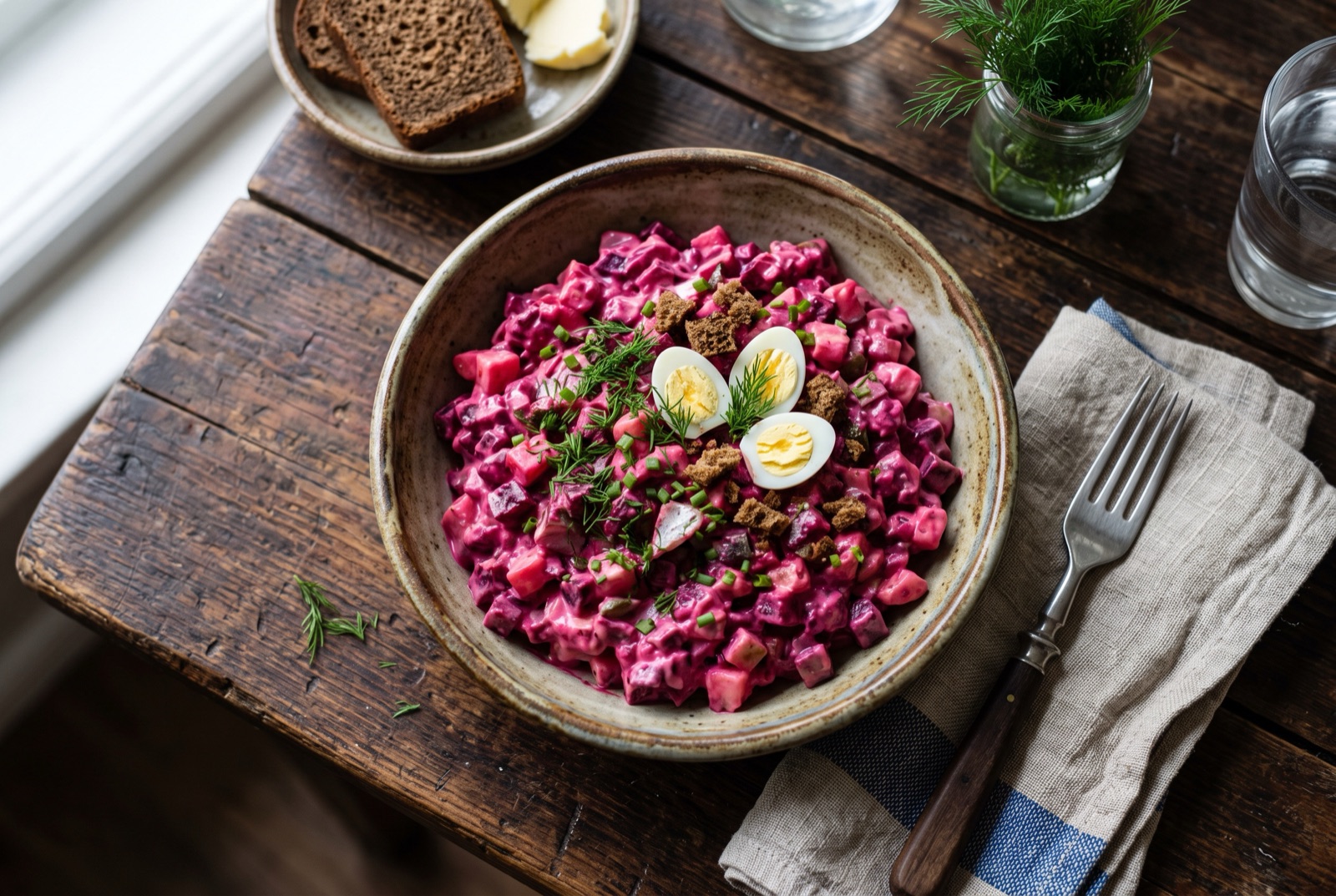
Rosolje is a cold salad of diced beetroot, boiled potato, tart apple, pickled cucumber, salted herring and hard-boiled egg, folded into a dressing of sour cream sharpened with mustard and a little of the beet liquid. Everything is cut to the same small dice, and after a few hours in the fridge the beetroot bleeds through the whole bowl and turns it a startling magenta. The taste is sweet, sour and salty at once — earthy beet, sharp cucumber, fruity apple and the salt hit of the herring — and it appears at practically every Estonian celebration, funeral, Christmas table and office buffet.

- Gate
- Estonia
- Prep
- 35 min
- Cook
- 45 min
- Total time
- 5 hr 20 min incl. 4 hr rest
- Serves
- 6
- Status
- Easy
- Nutrition / serving · estimated
- Calories 290 kcal
- Protein 15 g
- Carbs 24 g
- Fat 15 g
- Fiber 4 g
- Sugar 11 g
- Sodium 890 mg
Why this recipe works.
- Everything in a uniform small dice, which is what makes each spoonful taste of the whole salad rather than one ingredient.
- A sour cream and mustard dressing loosened with beet liquid, so the colour is deliberate rather than an accident of stirring.
- Herring soaked or rinsed first, because the salt level in cured fish varies wildly between brands.
- Made the day before by design — the resting time is what fuses the flavours rather than an inconvenience.
Ingredients.
13 itemsFor the salad
For the dressing
To finish
Equipment
- Saucepan
- Sharp knife and chopping board
- Large mixing bowl
Instructions.
Boil the vegetables whole
Simmer the beetroot in unsalted water until a skewer slides through the centre, 35–45 minutes depending on size, and boil the potatoes separately until just tender. Cool both completely, then rub the beet skins off under cold water and peel the potatoes.
Tip Cook them a day ahead if you can — fully cold vegetables dice far more cleanly.
Dice everything to match
Cut the beetroot, potato, apple, pickled cucumber and herring into an even 8 mm dice, and chop three of the eggs the same way, keeping one back for the top. Consistency matters more than precision — every spoonful should carry all five things.
Mix the dressing
Whisk the sour cream with the mustard, sugar, vinegar, a good pinch of salt and plenty of white pepper until smooth. It should taste noticeably sharper than you want the finished salad to be, since the potato and beetroot will mute it.
Fold, do not stir
Tip the diced ingredients and the onion into a large bowl, pour the dressing over and fold everything together gently with a spatula until the whole bowl has turned an even pink and the potato cubes are still intact.
Tip Stop folding the moment the colour is even; every extra turn breaks down more potato.
Chill to set the colour
Cover and refrigerate for at least 4 hours, ideally overnight. The salad deepens from pale pink to full magenta and the sharp onion mellows into the dressing during this rest.
Finish and serve cold
Taste and correct with salt, pepper or another splash of cucumber brine, then scatter the reserved chopped egg and the dill across the top. Serve straight from the fridge with black bread and butter.
Tips from our kitchen.
- Cook the beetroot whole and unpeeled, then slip the skins off under cold running water. Peeled beets bleed their colour and sweetness into the boiling water.
- Chill every component completely before dicing and mixing. Warm potato absorbs dressing unevenly and goes gluey at the edges.
- Taste the herring before it goes in. If it is fiercely salty, soak the fillets in cold milk or water for an hour, then pat them dry.
- Fold, do not stir. Aggressive mixing mashes the potato and turns the whole bowl into pink paste rather than distinct cubes.
- Hold back a chopped egg and a few dill sprigs to scatter on top just before serving, so the surface is not uniformly magenta.
- Add a spoonful of the pickled cucumber brine if the salad tastes flat. It sharpens the dressing more cleanly than extra vinegar.
Substitutions.
- Salted herring fillets → Pickled herring in vinegar, drained, or anchovy fillets chopped fine
- Pickled herring is sweeter and softer than salted; use slightly less. Anchovy is much saltier, so use about a third of the weight.
- Sour cream dressing → Half mayonnaise and half sour cream, or all mayonnaise
- Mayonnaise gives a richer, denser salad closer to the deli version. All sour cream is lighter and sharper.
- Herring (for a fish-free version) → Diced cooked beef or veal, or simply leave it out
- The beef version is genuinely traditional in Estonia. Without any protein the salad is milder but still works.
Variations.
- Beef rosolje
- Replace the herring with 200 g of cold roast or boiled beef in the same small dice. A Baltic-German inheritance and common at Estonian Christmas tables.
- Mayonnaise deli style
- Bind entirely with mayonnaise and add a little sugar. Heavier and sweeter, and the version most often sold ready-made in Estonian supermarkets.
- Layered rosolje
- Instead of folding, build the ingredients in layers in a glass dish with dressing between them, so the cut face shows distinct pink and white bands.
Storage & reheating.
Keeps 3 days refrigerated in a covered container and is at its best after the first overnight rest. The beetroot keeps releasing colour, so expect the salad to darken from pink towards deep magenta by day two. Do not freeze — potato and sour cream both break down badly, and thawed rosolje turns watery and grainy. If it weeps liquid after a day, drain off the excess and fold in an extra spoonful of sour cream rather than remixing the whole bowl.
Serve with
Black rye bread and butter, as part of a cold buffet. Alongside jellied meat, cured fish and open sandwiches at a celebration table.
The story behind Rosolje.
Rosolje belongs to the wide family of beetroot-and-herring salads found across the Baltic, Nordic and Russian world: Swedish sillsallad, Russian selyodka pod shuboi, Latvian and Lithuanian versions with slightly different ratios. The name comes from the German Rosolje or Russian rassol, both tied to brine and pickling, and the dish likely arrived in Estonia through the Baltic-German manor kitchens that shaped so much of the country's nineteenth-century cooking before spreading downward into ordinary households.
What locks it into Estonian food culture is where it sits on the table. Estonian entertaining runs on the cold buffet — a spread of open sandwiches, jellied meat, salads and cured fish laid out at once — and rosolje is the salad that anchors it. Its colour makes it the visual centre of the table, and its keeping quality makes it the sensible thing to prepare the day before, which is exactly what most people do. It shows up at Christmas alongside blood sausage and roast pork, at Midsummer, at birthdays, and in the deli cabinets of every Estonian supermarket year-round.
The arguments about it are real and unresolved. Some households insist on salted herring, others use only the pickled sort in vinegar, and a substantial minority leaves the fish out entirely and calls it rosolje anyway. Some use sour cream, some use mayonnaise, most use a mixture. A few add cooked beef or veal, a habit inherited from the same German manor kitchens. What is not negotiable is the dice — everything cut small and roughly the same size, so a single spoonful carries beet, potato, apple, cucumber and fish together. Cut it coarse and it stops being rosolje and becomes an ordinary beetroot salad.
Questions, answered.
Can I make rosolje without herring?
Yes. Many Estonian households make a fish-free version, either leaving the herring out entirely or replacing it with diced cooked beef or veal, which is a long-standing traditional variant. The salad loses some of its salty backbone, so compensate with a little extra pickled cucumber and a firmer hand with the salt in the dressing.
Should I use fresh beetroot or the pre-cooked kind?
Fresh beetroot boiled or roasted whole gives the best flavour and firmest dice. Vacuum-packed cooked beetroot works perfectly well and saves an hour, but drain it thoroughly and avoid anything packed in vinegar unless you cut the acid elsewhere in the dressing. Pickled beetroot from a jar makes the salad far too sharp.
Why did my salad turn watery?
Usually because the vegetables were still warm when they were dressed, or because the pickled cucumber and beetroot were not drained properly. Salt draws liquid out of both as the salad sits. Chill everything fully, drain hard, and if it still weeps overnight simply pour off the liquid and fold in a fresh spoonful of sour cream before serving.
How far ahead can I make it?
Make it the day before — this is not just permitted but preferred. The flavours need several hours to merge, the beetroot needs time to colour the whole bowl evenly, and the dressing softens the sharpness of the raw onion. It holds well for three days in the fridge, though it darkens as it sits.
What is the difference between rosolje and Russian vinegret?
They share ingredients but not construction. Vinegret is dressed with oil and vinegar, contains sauerkraut or peas, and is served loose and glossy. Rosolje is bound with sour cream or mayonnaise into a creamy, pale pink salad and includes apple and hard-boiled egg. Both use beetroot and potato, and both appear on Baltic tables, but they taste and look quite different.
You might also like.
All recipes →
Keep exploring Estonia.
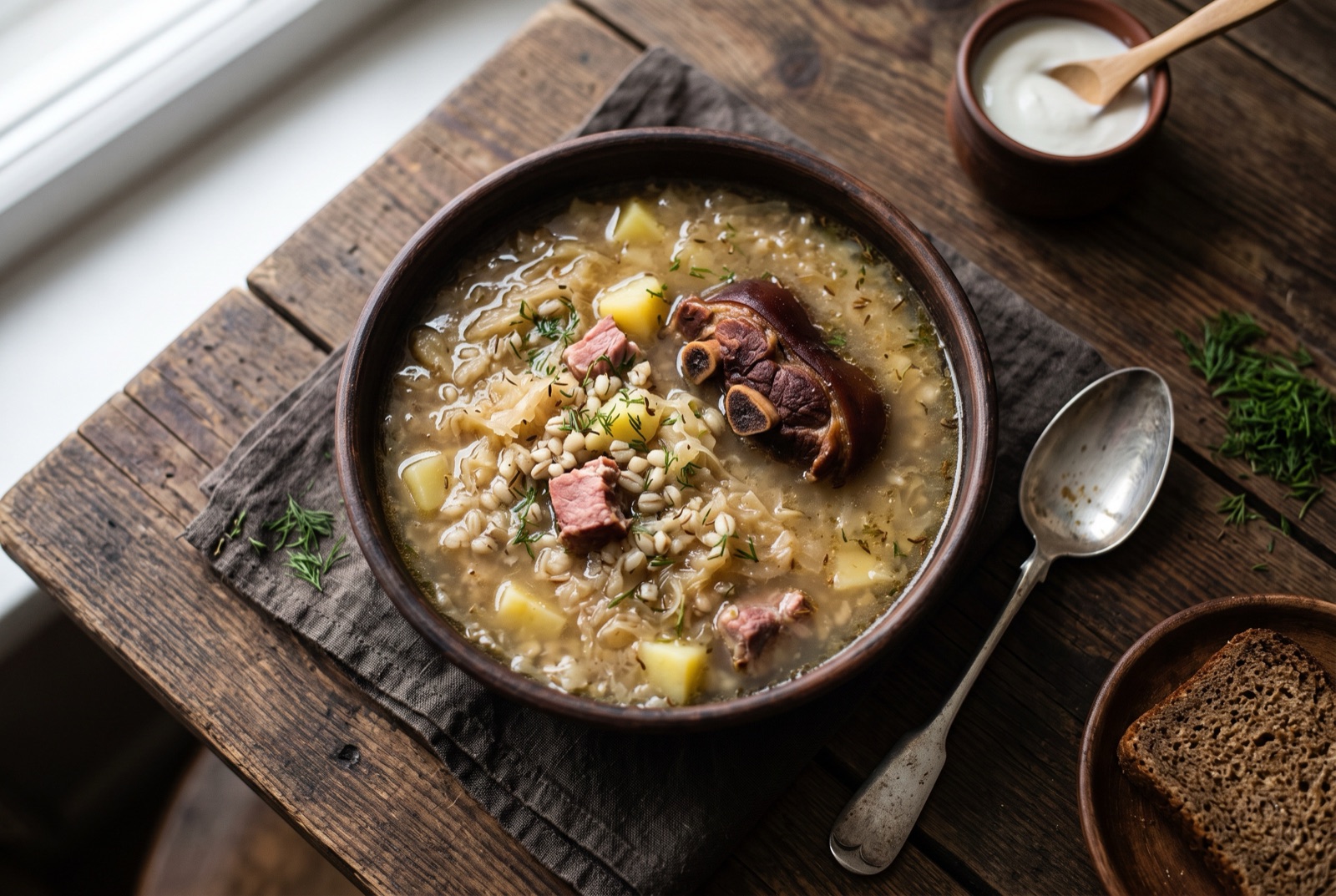
Estonia has 9 more dishes in the atlas — Hapukapsasupp and Kama, and 7 more.
Recipe by The DishRoute Kitchen · published August 20, 2026 · updated August 20, 2026