Hapukapsasupp.
Estonian Sauerkraut and Barley Soup
Hapukapsasupp · say it: HAH-poo-kap-sah-soop
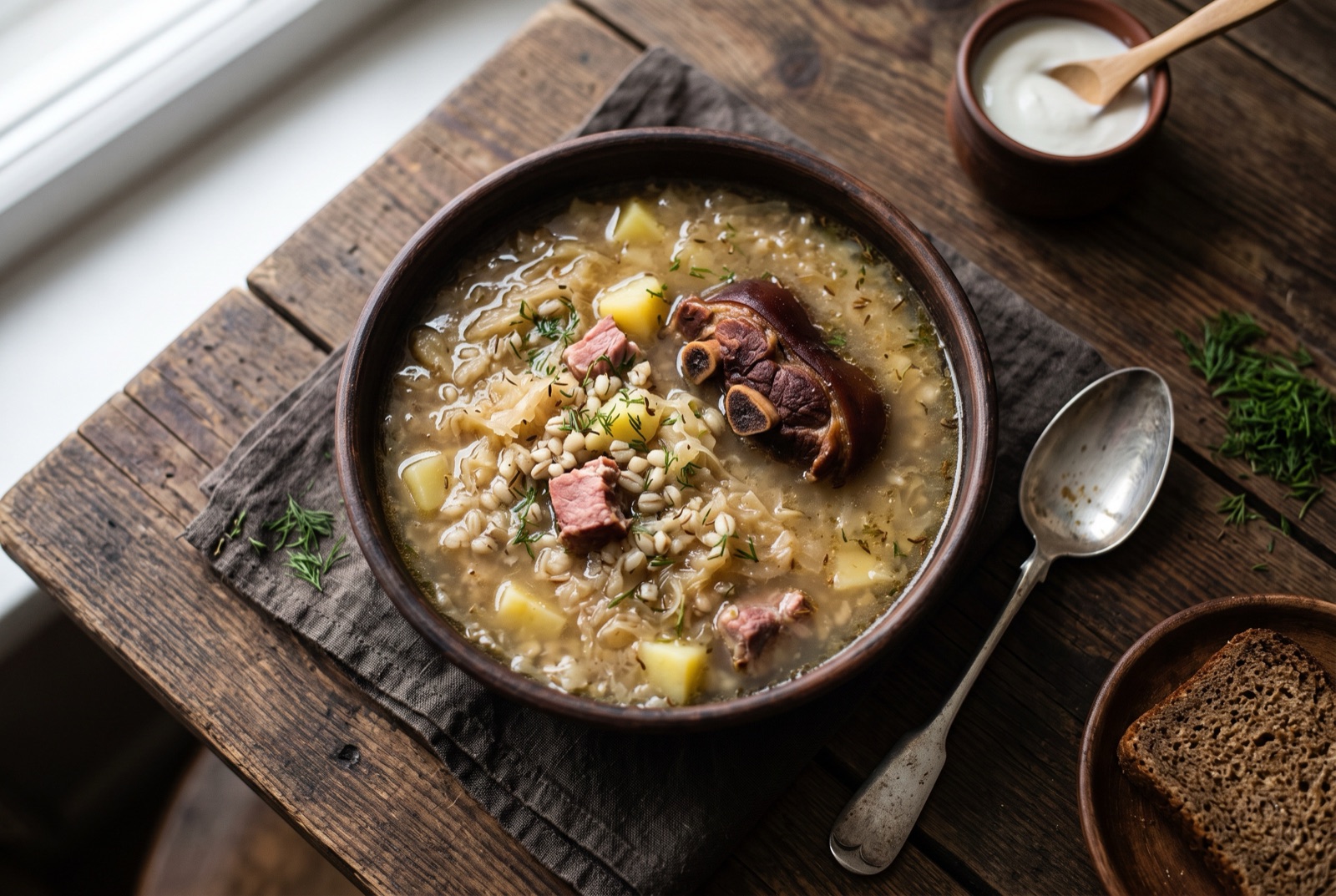
Hapukapsasupp is the everyday winter soup of Estonia: sauerkraut, pearl barley and potato simmered for an hour and a half with a smoked pork bone, until the sourness has mellowed into something round and savoury and the barley has thickened the broth to a cloudy, spoon-coating consistency. It is sour, smoky and faintly sweet from long-cooked onion and carrot, with soft strands of cabbage and grains that still hold a slight chew. Almost nothing in it costs money, and it is one of those soups where the recipe honestly asks you to make it a day ahead, because the flavour settles overnight into something better than it was on the stove.

- Gate
- Estonia
- Prep
- 15 min
- Cook
- 1 hr 40 min
- Total time
- 1 hr 55 min
- Serves
- 6
- Status
- Easy
- Nutrition / serving · estimated
- Calories 340 kcal
- Protein 19 g
- Carbs 33 g
- Fat 15 g
- Fiber 7 g
- Sodium 1100 mg
Why this recipe works.
- Ninety minutes of simmering, which is what converts sharp raw kraut into the mellow, rounded sourness the soup depends on.
- A smoked bone rather than stock cubes — it costs almost nothing and gives the broth its whole smoky backbone.
- Barley goes in early with the kraut so it thickens the broth instead of sitting in it as separate grains.
- Better on day two, and the method is written so making it ahead is the plan rather than an afterthought.
Ingredients.
13 itemsFor the broth
For the soup
To finish
Equipment
- Large heavy soup pot or Dutch oven
- Ladle
- Sharp knife
Instructions.
Start the smoky broth
Put the smoked pork, water, bay leaves and allspice in a large pot, bring slowly to a boil and skim off the grey foam that rises. Reduce to a bare simmer and cook uncovered for 40 minutes, until the broth smells clearly of smoke and the meat has begun to loosen from the bone.
Sweat the vegetables
Skim a spoonful of fat from the surface of the broth into a frying pan and cook the onion and carrot over medium heat until the onion is translucent and the carrot edges have taken a little colour, about 8 minutes. Tip them into the pot.
Add kraut and barley
Stir in the chopped sauerkraut and 120 g of pearl barley, bring back to a simmer and cook, partly covered, for 45 minutes. The kraut should lose its raw bite entirely and the broth should start to turn cloudy as the barley releases its starch.
Tip Stir occasionally — barley likes to settle and stick to the bottom of the pot.
Add the potatoes
Drop in the potato cubes and simmer for a further 25 minutes, until they are tender to a knife tip but still holding their shape. Lift out the pork, strip the meat from the bones, shred it and return it to the pot.
Balance the sourness
Stir in the sugar, then taste. The soup should be pleasantly tart with a smoky, savoury base — add salt only now, since smoked pork carries plenty of its own, and grind in black pepper generously.
Rest, then serve
Let the soup stand off the heat for at least 15 minutes before serving, or refrigerate it overnight for the fuller flavour. Ladle into bowls, add a spoonful of sour cream and a scattering of dill, and serve with black bread.
Tips from our kitchen.
- Taste your sauerkraut raw before it goes in. If it makes you wince, rinse it briefly; if it is mild and vinegary, use it as is and add a splash of the brine at the end.
- Brown the onion, carrot and a little of the pork fat before adding liquid. Skipping this step gives a noticeably thinner, flatter broth.
- Add the potatoes only in the last thirty minutes. Potatoes cooked for the full hour and a half collapse and turn the soup pasty.
- A teaspoon of sugar near the end is normal Estonian practice — it does not sweeten the soup, it just takes the edge off the acid.
- If the soup thickens too much overnight, loosen it with water rather than stock, since the seasoning is already concentrated.
- Do not add salt until the smoked bone has been simmering for an hour, because smoked pork can be salty enough on its own.
Substitutions.
- Smoked pork bone or hock → Smoked bacon rind, a smoked ham hock, or 150 g diced smoked bacon
- Any smoked pork gives the broth its depth. Without smoke the soup tastes noticeably plainer, so add a pinch of smoked paprika if you have none.
- Pearl barley → Millet or short-grain rice, added in the last 30 minutes
- Both thicken the soup similarly but cook far faster than barley, so time them with the potatoes.
- Pork (for a vegetarian version) → Dried mushrooms soaked in hot water, with their soaking liquid added to the pot
- Mushrooms supply the savoury depth the bone would have. Add a small pinch of smoked paprika for the missing smoke.
Variations.
- Tomato hapukapsasupp
- Stir a heaped spoonful of tomato paste in with the onion. Common in Soviet-era Estonian canteens, and it gives a redder, slightly sweeter broth.
- With sausage
- Drop sliced smoked sausage or kielbasa into the pot for the last fifteen minutes, turning the soup into a heavier one-pot dinner.
- Thick winter version
- Double the barley and reduce the water by a third for a soup so thick the spoon stands up — the way it is often served in rural households in January.
Storage & reheating.
Refrigerate up to 5 days; the flavour peaks on day two and holds well through day four. The barley keeps absorbing liquid, so expect it to thicken noticeably in the fridge and loosen it with water when reheating. Freezes for 3 months, though the potatoes turn slightly grainy after thawing — if you plan to freeze it, leave the potato out and add freshly boiled cubes when you reheat. Reheat gently to a bare simmer rather than a rolling boil.
Serve with
Black rye bread with cold butter, and a spoonful of sour cream stirred into each bowl. Boiled potatoes on the side if the soup is being stretched to feed more people.
The story behind Hapukapsasupp.
Sour cabbage soup exists across the whole northern and eastern half of Europe — Russian shchi, Polish kapuśniak, Ukrainian kapusniak, German Sauerkrautsuppe — and Estonia's hapukapsasupp belongs squarely to that family. What sets the Estonian version apart is the same thing that sets most Estonian dishes apart: pearl barley. Where the Slavic versions often lean on potato alone or add millet, Estonians reach for barley, which thickens the broth and gives the soup a texture closer to a thin porridge than a clear cabbage soup.
The logic behind the dish is straightforward preservation economics. Cabbage was shredded, salted and packed into barrels in autumn, where it fermented and then kept through to spring — a reliable source of vitamin C in a country with no fresh vegetables between November and April. Pork was smoked and hung. Barley and potatoes sat in the cellar. Hapukapsasupp is simply what happens when those four things go into one pot with water, and versions of it were being cooked in Estonian farmhouses long before anyone wrote them down.
It survives now as ordinary food rather than heritage food. Estonian canteens and home kitchens make it through the cold months, restaurants put it on winter menus, and it turns up in the week after Christmas as a way of using the smoked bones and leftover sauerkraut from the holiday table. Two things are worth knowing before you cook it. First, sauerkraut varies enormously — barrel-fermented Baltic kraut is sharper than the vinegar-brined jars sold in most supermarkets, so taste yours raw and adjust. Second, the long simmer is not optional. Sauerkraut cooked for twenty minutes is aggressively sour; sauerkraut cooked for ninety turns soft, sweet-edged and mellow, and that transformation is the entire soup.
Questions, answered.
Why does my sauerkraut soup taste too sour?
Almost always because it has not simmered long enough. Sauerkraut needs at least an hour of gentle cooking for the sharp acidity to break down into a mellow sourness. If it is still aggressive after that, stir in a teaspoon of sugar and a knob of butter, both of which round the acid without making the soup sweet. Rinsing the kraut before cooking prevents the problem in the first place.
Can I make this soup vegetarian?
Yes, though you need to replace the smoky depth the pork bone provides. Soak a handful of dried mushrooms in hot water and add both the mushrooms and their strained soaking liquid to the pot, then finish with a pinch of smoked paprika and a good spoonful of butter. The result is different but genuinely good rather than a compromise.
Is it really better the next day?
Yes, and this is not just folklore. Overnight the barley finishes absorbing liquid and swells, the sauerkraut continues to soften, and the smoky and sour elements distribute evenly through the broth instead of sitting in separate layers. Estonians routinely cook it a day ahead for exactly this reason.
Do I need to rinse the sauerkraut?
It depends on your kraut. Traditionally barrel-fermented sauerkraut is sharp and salty and benefits from a quick rinse and squeeze. Milder supermarket sauerkraut packed in vinegar brine can go in as it is. Taste a strand raw before deciding, and remember that a long simmer will soften whatever sourness is there.
What kind of barley should I use?
Pearl barley, which has had the bran polished off and cooks to tenderness in about an hour while releasing enough starch to thicken the broth. Pot or hulled barley also works but needs soaking overnight and a longer simmer. Do not substitute quick-cook barley flakes, which dissolve completely and turn the soup into porridge.
You might also like.
All recipes →

Keep exploring Estonia.
Estonia has 9 more dishes in the atlas — Kama and Kiluvõileib, and 7 more.
Recipe by The DishRoute Kitchen · published August 20, 2026 · updated August 20, 2026