Casamiento.
Salvadoran Rice Married with Red Beans
Casamiento · say it: kah-sah-mee-EN-toh
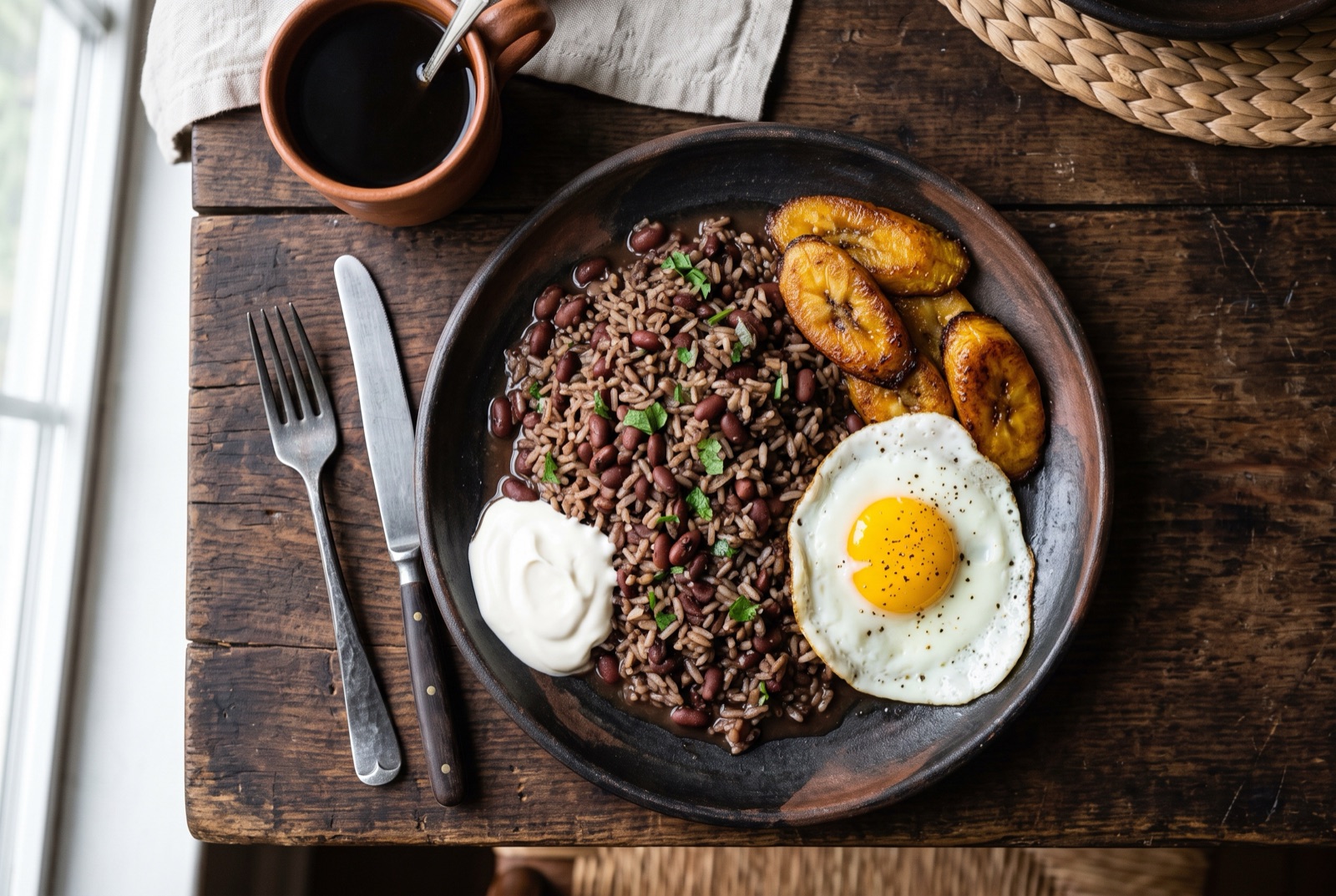
Casamiento is rice and beans cooked together until they stop being two things — the name means "marriage" and refers to exactly that. Cold, dry, day-old rice goes into a pan with soft red beans and a good ladle of their almost-black cooking liquid, and it is stirred over heat until the grains take on a purple-brown stain and the whole pan smells of fried onion and bean. The texture is loose and slightly sticky rather than fluffy, and it tastes savoury and earthy with a little sweetness from the onion. It is breakfast food first, side dish second.

- Gate
- El SalvadorNationwide
- Prep
- 10 min
- Cook
- 15 min
- Total time
- 25 min
- Serves
- 4
- Status
- Easy
- Nutrition / serving · estimated
- Calories 420 kcal
- Protein 12 g
- Carbs 70 g
- Fat 11 g
- Fiber 9 g
- Sodium 420 mg
Why this recipe works.
- Insists on day-old rice and explains why fresh rice collapses into paste in the pan.
- Uses the dark bean cooking liquid as the seasoning, which is what actually colours and flavours the grains.
- Frying the onion and pepper to real sweetness first gives a depth that stirring beans into rice never achieves.
- Works as a fifteen-minute breakfast on a weekday and scales up to feed a table without changing anything.
Ingredients.
9 itemsBase
To finish
Equipment
- Wide heavy frying pan or sauté pan
- Wooden spoon
Instructions.
Break up the rice
Tip the cold rice into a bowl and rub it between your fingers until every clump has separated into loose grains. Cold rice that goes into the pan in lumps will never colour evenly.
Fry the aromatics properly
Heat the oil in a wide pan and cook the onion, bell pepper and garlic over medium heat for 7–8 minutes, until the onion is translucent, sweet-smelling and just beginning to gold at the edges. Do not rush this — pale onion leaves the dish flat.
Reduce the bean broth
Pour in the dark bean cooking liquid and let it bubble for 2 minutes until it reduces, darkens and thickens slightly and the pan smells strongly of beans.
Marry the rice
Add the rice and stir constantly for 3–4 minutes until every grain has taken on a purple-brown stain and there is no dry white rice visible anywhere in the pan.
Tip If it looks dry before the colour is even, add another splash of bean liquid rather than water.
Fold in the beans
Add the drained beans and fold them through gently so they stay whole. Let the pan sit undisturbed for a minute so a light crust forms on the base, then scrape it up and stir it back through.
Season and serve
Taste and correct with salt and black pepper, then stir in the cilantro off the heat. Serve hot with fried plantain, a fried egg, cheese and crema for the full breakfast plate.
Tips from our kitchen.
- Cook the rice the day before and refrigerate it uncovered for an hour first — the drier the grains, the better they separate in the pan.
- Keep the bean liquid. It should be dark and slightly thick; if yours is thin and pale, simmer it down for a few minutes before using it.
- Add the bean broth first and let it reduce into the rice before you add the beans themselves, so the grains colour evenly and the beans stay whole.
- Use a wide pan and give the mixture a minute of stillness now and then — a light crust forming on the base and being scraped back in is where much of the flavour comes from.
- Do not add so much liquid that it pools. Casamiento should be moist and glossy, not wet, or it turns to a mush the moment it cools.
- Season at the end, not the start. Bean broth is already salty and reduces as you cook.
Substitutions.
- Frijoles de seda (red silk beans) → Small red beans, kidney beans or black beans
- Black beans give a much darker, almost purple casamiento and are entirely acceptable. Kidney beans hold their shape more and break down less.
- Neutral oil → Lard or bacon fat
- The traditional choice in many households and noticeably richer. It stops the dish being vegetarian, which for most Salvadoran cooks is not a consideration.
- Day-old rice → Freshly cooked rice, spread on a tray and cooled for 30 minutes
- Not as good, but workable in a hurry. Use slightly less water than usual when cooking it and let the steam escape fully.
Variations.
- Casamiento con chile
- Green bell pepper is standard, but some cooks add a chopped jalapeño with the onion for a gentle background heat.
- With bacon or chorizo
- Diced bacon or crumbled chorizo rendered before the onion, so the whole dish fries in that fat. A weekend rather than weekday version.
- Casamiento negro
- Made with black beans and their inky broth, which stains the rice a deep purple-grey. More common near the Guatemalan border.
Storage & reheating.
Casamiento keeps 4 days refrigerated and reheats better than most rice dishes — add a splash of water or bean broth and warm it in a covered pan over medium heat until steaming, breaking up clumps with a fork. It also fries well: press cold casamiento into a pan and let it form a crust on one side. Freeze in flat portions for up to 2 months. Reheat rice thoroughly and only once, and cool leftovers quickly rather than leaving them out.
Serve with
Fried ripe plantain, a fried egg, crumbled fresh cheese, thick crema and warm tortillas — the full Salvadoran breakfast plate.
The story behind Casamiento.
Rice-and-bean dishes exist across the whole Caribbean and Central American basin, and each country insists its version is distinct. Nicaraguans make gallo pinto, Costa Ricans make gallo pinto and argue about who made it first, Cubans make moros y cristianos, Jamaicans make rice and peas with coconut. Casamiento is the Salvadoran and Honduran entry, and what separates it is the bean: the frijol de seda, a small red bean whose thin skin breaks down into a silky purée and whose cooking liquid is dark, glossy and used deliberately as a seasoning rather than drained away.
The timing of the meal matters as much as the recipe. A Salvadoran breakfast plate — desayuno típico — is a fixed arrangement: casamiento, fried sweet plantain, a slab of queso duroblando, a spoonful of thick crema, a fried egg, and a stack of tortillas to push it all together. This is not a light meal and it is not meant to be; it is designed for people going out to work in fields or markets. The same casamiento reappears at lunch as a side to grilled meat, and at dinner as the base under whatever is left.
The cooking logic is thrift, and it shows in the details. The rice must be leftover, because freshly cooked rice is too wet and turns to porridge in the pan. The bean broth is treated as a resource — Salvadoran cooks routinely keep a jar of it in the fridge. And the dish scales infinitely, which is why it is the default food for large families. The one genuine variable is fat: many households fry it in lard or bacon drippings for depth, while plenty of others use plain oil, which is what keeps this version entirely plant-based without anyone regarding that as a modification.
Questions, answered.
What is the difference between casamiento and gallo pinto?
They are close cousins. Casamiento is the Salvadoran and Honduran name and is usually made with red silk beans and their broth, fried simply with onion and pepper. Nicaraguan and Costa Rican gallo pinto often includes Salsa Lizano or Worcestershire-style seasoning and more herbs, and Costa Ricans typically use black beans. The technique — frying cooked rice into cooked beans — is the same.
Why does my casamiento turn mushy?
The rice was too fresh or too wet. Rice cooked the same day still holds steam inside each grain, and stirring it in a hot pan bursts the starch and glues everything together. Use rice that has spent a night in the fridge, break the clumps up with your fingers before it goes in, and keep the added liquid to what the pan can absorb within a couple of minutes.
Can I make it with canned beans?
Yes, but the liquid in a can is thin and starchy rather than the dark broth the dish depends on. Drain and rinse the beans, then simmer them for ten minutes with a piece of onion, a garlic clove and a little salt in just enough water to cover — that gives you a serviceable broth. Use it in place of the cooking liquid.
Is casamiento vegan?
This version is, since it uses vegetable oil. Traditionally many Salvadoran households fry it in lard or bacon fat, and the breakfast plate it belongs to includes egg, cheese and cream. The rice-and-bean component itself contains no animal products unless the cook adds them.
What rice should I use?
Ordinary long-grain white rice, the everyday rice of Central America. It holds its grain shape when fried and takes the bean colour cleanly. Avoid short-grain or risotto rice, which are too starchy and clump, and avoid parboiled rice, which resists absorbing the bean broth and stays stubbornly pale.
You might also like.
All recipes →

Keep exploring El Salvador.
El Salvador has 9 more dishes in the atlas — Curtido and Empanadas de Plátano, and 7 more.
All El Salvador recipes Rice recipes Black beans recipes Onion recipes breakfastsidevegetarianvegangluten freedairy freeRecipe by The DishRoute Kitchen · published August 20, 2026 · updated August 20, 2026