Sardinhas Assadas.
Charcoal-Grilled Sardines
Sardinhas assadas · say it: sar-DEEN-yash ah-SAH-dash
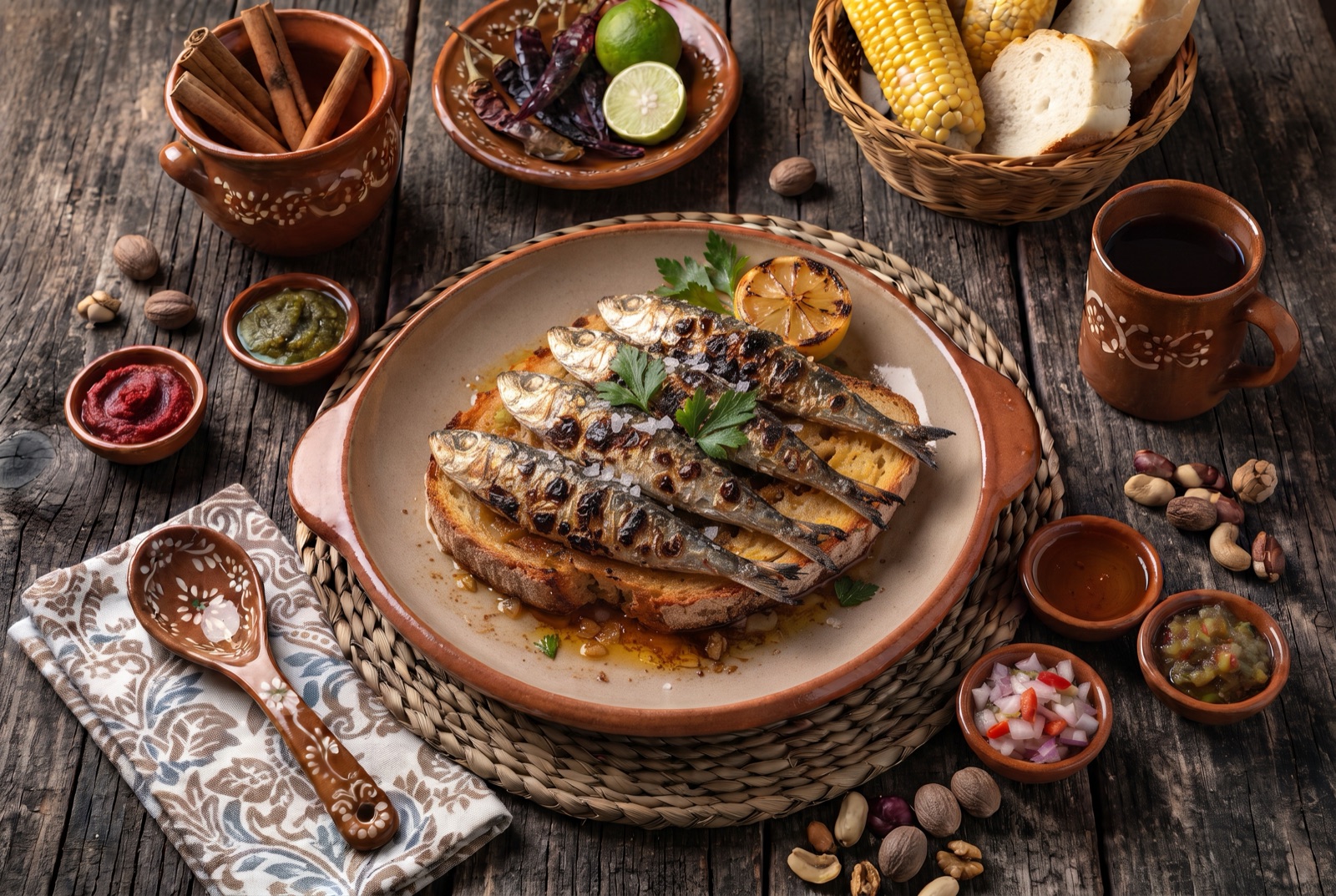
Grilled sardines are a three-ingredient dish: sardines, coarse salt, fire. The fish are salted heavily an hour ahead so the flesh firms and seasons through, the excess is brushed off, and they go straight onto a fiercely hot grill with no oil and no marinade. What you get is skin that crackles and splits, flesh that is oily and soft and deeply savory, and a smell of smoke that fills a whole street. There is nothing subtle about the flavour — sardines are rich, mineral and unmistakably fishy in the way that oily fish should be — and the bread underneath, which catches the fat and juices as they run, ends up as good as the fish. It is the most Portuguese thing you can cook and among the easiest, provided you buy the fish right and get the fire hot enough.

- Gate
- PortugalLisbon and the Atlantic coast
- Prep
- 15 min
- Cook
- 12 min
- Total time
- 1 hr 27 min incl. 1 hr rest
- Serves
- 4
- Status
- Easy
- Nutrition / serving · estimated
- Calories 520 kcal
- Protein 42 g
- Carbs 34 g
- Fat 24 g
- Fiber 5 g
- Sodium 1200 mg
Why this recipe works.
- Uses the salting method properly, with timings and a reason, instead of a vague instruction to season the fish.
- Explains why no oil, no marinade and no lemon go on before the grill — the three mistakes that make sardines stick and steam.
- Gives a workable indoor route for cooks with no charcoal, and is honest about exactly what you lose.
- Covers buying: what a fresh sardine actually looks like and when in the year it is worth cooking one.
Ingredients.
9 itemsFor the fish
For the pepper salad
To serve
Equipment
- Charcoal grill or ridged cast-iron grill pan
- Fish cage or two wide spatulas
- Large tray for salting
Instructions.
Salt the sardines
Lay the sardines in a single layer on a tray and bury them under the coarse salt, turning each one so both sides are thickly coated. Leave at room temperature for 45–60 minutes; you will see beads of moisture pull out onto the skin and the bodies stiffen slightly.
Tip This is not seasoning to taste — the salt is doing structural work, drying the skin so it crisps rather than steams.
Roast the peppers
While the fish salts, char the whole peppers over a flame or under a hot grill, turning until the skins are blackened and blistered all over. Seal them in a bowl under a plate for 10 minutes, then rub off the skins, tear the flesh into strips and dress with the garlic, olive oil, vinegar and a little salt.
Get the fire properly hot
Light the charcoal and wait until the coals are covered in grey ash and you can hold a hand 10 cm above the grate for no more than two seconds. Scrape the bars clean. Indoors, heat a ridged cast-iron pan over high heat until it is faintly smoking.
Brush off the salt
Wipe or shake the excess salt off each sardine — you want a thin residue, not a crust. Do not rinse them under the tap and do not oil them; the fish carry enough of their own fat to keep from sticking on a hot grate.
Grill hard, turn once
Lay the sardines across the bars in a single layer and grill for 3–4 minutes without touching them. When the skin has set and lifts cleanly, turn them once and give the second side another 3–4 minutes, until the skin is blistered and split and the eyes have gone opaque white.
Tip Expect flare-ups as the fat drips. Move the fish to a cooler part of the grill for a moment rather than trying to fight the flames.
Serve on bread, immediately
Slide each sardine onto a thick slice of bread so the fat and juices soak straight in, and take them to the table while the skin still crackles. Put the pepper salad, boiled potatoes and lemon wedges alongside and let people pull the fillets off the bone with their fingers.
Tips from our kitchen.
- Buy the fish whole and ungutted if you can. Portuguese cooks grill sardines with the guts in — they melt into the flesh and add a bitter savoury depth — but gutting them is entirely acceptable if that is not for you.
- Judge freshness with your eyes: bright bulging eyes, firm bodies that do not sag when held flat, tight scales and a smell of clean seawater rather than fish.
- Salt at least 45 minutes ahead and use far more salt than feels right — a thick coating, not a sprinkle. You brush most of it off, and what is left has seasoned the flesh through.
- The grill must be properly hot before the fish goes on. Sardines cooked over a lazy fire release fat slowly, stick to the bars and tear when you turn them.
- Turn once and once only, using a fish cage or two spatulas. Every extra flip costs you skin.
- Sardines are done in 3–4 minutes a side. The tell is the eye going opaque white and the dorsal fin pulling out cleanly when tugged.
Substitutions.
- Fresh sardines → Fresh mackerel fillets, or small horse mackerel (carapau)
- Both are oily enough to grill the same way. Carapau grilled with salt is a genuine Portuguese standby when sardines are out of season.
- Charcoal grill → A ridged cast-iron grill pan on high heat, or the oven grill on its top setting with the fish 10 cm from the element
- You get the char and the crisp skin but not the smoke. Open a window — the smell of sardines indoors lasts a full day.
- Broa de milho for serving → Any dense, chewy country bread cut thick
- The bread has to hold together under hot fat. Thin or fluffy bread disintegrates before you have finished the first fillet.
Variations.
- Sardinhas com salada de pimentos
- The standard partner: red and green peppers roasted until blackened, peeled, torn into strips and dressed with olive oil, garlic and vinegar. Sweet and sharp against the oily fish.
- Sardinha na broa
- The street-festival form — one sardine, one thick slice of corn bread, no plate and no cutlery. The bread is the plate and then the last mouthful.
- Sardinhas de escabeche
- Leftover grilled sardines laid in a warm marinade of olive oil, vinegar, garlic, bay and paprika and left overnight. A traditional way to stretch a big catch, eaten cold.
Storage & reheating.
Grilled sardines are at their best within minutes of coming off the fire and lose most of their appeal once cold and reheated. If you have leftovers, do not microwave them — instead make escabeche: lay the cold fish in a dish, pour over warm olive oil infused with sliced garlic, bay, paprika and a splash of vinegar, and refrigerate for up to 3 days, eating them cold with bread. Raw sardines should be cooked the day you buy them, or frozen immediately and used within a month, though frozen fish never grills as cleanly.
Serve with
Boiled new potatoes in their skins, roasted pepper salad, thick bread, and cold vinho verde or a simple white.
The story behind Sardinhas Assadas.
Sardines are seasonal, and Portugal treats that seasonality as a calendar rather than an inconvenience. The fish are lean and small in spring, and only from around June do they carry enough fat to grill well — which is exactly when the santos populares, the popular saints' festivals, take over the cities. Lisbon celebrates Santo António on the thirteenth of June, Porto celebrates São João on the twenty-fourth, and Braga and dozens of smaller towns keep São Pedro at the end of the month. For those weeks, grills appear on pavements outside houses and bars, the old neighbourhoods fill with paper garlands, and the smoke of sardines is so thick that it is genuinely part of how the city smells.
The technique is unchanged and stubbornly simple because sardines do not want help. No oil goes on before grilling — the fish is oily enough that it bastes itself, and added fat only causes flare-ups. No lemon goes on before grilling either; acid on the raw skin makes it stick. Salt, and a lot of it, does the whole job: it draws surface moisture so the skin dries and crisps instead of steaming, and it seasons the flesh right through the thin body. In coastal towns they are cooked on a simple open grill over hardwood charcoal, turned once, and served with boiled potatoes and roasted pepper salad, or with nothing at all beyond a piece of bread.
That bread is the detail outsiders miss. At a street festival the sardine is handed to you on a thick slice of broa or a hunk of white loaf, and you eat the fish off the bread, pulling the fillets away from the spine with your fingers. The bread turns golden and heavy with fat and salt and is eaten last, which is why regulars will tell you the bread is the best part. The unrenewable part of the tradition is the fish itself: Atlantic sardine stocks have been under real pressure and Portugal has run catch restrictions in recent years, so buying from a fishmonger who can tell you where the fish came from is not fussiness — it is the difference between the tradition continuing or not.
Questions, answered.
Should I gut sardines before grilling?
Traditionally no. In Portugal sardines are grilled whole with the guts intact, which keeps the fish moist and adds a distinctly bitter, savoury depth that many people consider the point. If you find that too strong, gutting them is completely fine and changes nothing about the method or timing. Either way, leave the scales and head on.
Why do my sardines stick to the grill?
Almost always because the grill was not hot enough, or because oil or lemon juice went on the fish before cooking. A very hot, clean grate lets the fish release naturally once the skin has set, usually after about two minutes. Do not try to move a sardine early: if it resists, it is not ready to turn.
How do I know when a sardine is cooked?
Three signs, all easy to read: the eye turns from clear to opaque white, the dorsal fin pulls away cleanly when you tug it, and the skin has blistered and split in places. That is around 3 to 4 minutes per side over hot coals. Sardines are small and go from perfect to dry quickly, so err on the short side.
Can I cook these indoors without a barbecue?
Yes, with a ridged cast-iron grill pan heated until it is smoking, or under an oven grill turned to maximum with the fish about ten centimetres from the element. You will get crisp, blistered skin and correctly cooked flesh; what you lose is the charcoal smoke, which is a real part of the flavour. Ventilate well, because the smell is powerful and persistent.
When is sardine season and does it matter?
It matters a great deal. Sardines are lean and thin in spring and only build up their fat through early summer, which is why the Portuguese season runs roughly from June to October and why the festivals fall in June. A winter sardine grills dry and tastes of very little. Buy them when your fishmonger says they are fat, not when a recipe tells you to.
You might also like.
All recipes →

Keep exploring Portugal.
Portugal has 9 more dishes in the atlas — Arroz de Marisco and Bacalhau à Brás, and 7 more.
Recipe by The DishRoute Kitchen · published August 19, 2026 · updated August 19, 2026