Smažený Sýr.
Czech Deep-Fried Cheese with Tartare Sauce
Smažený sýr · say it: SMAH-zhe-nee SEER
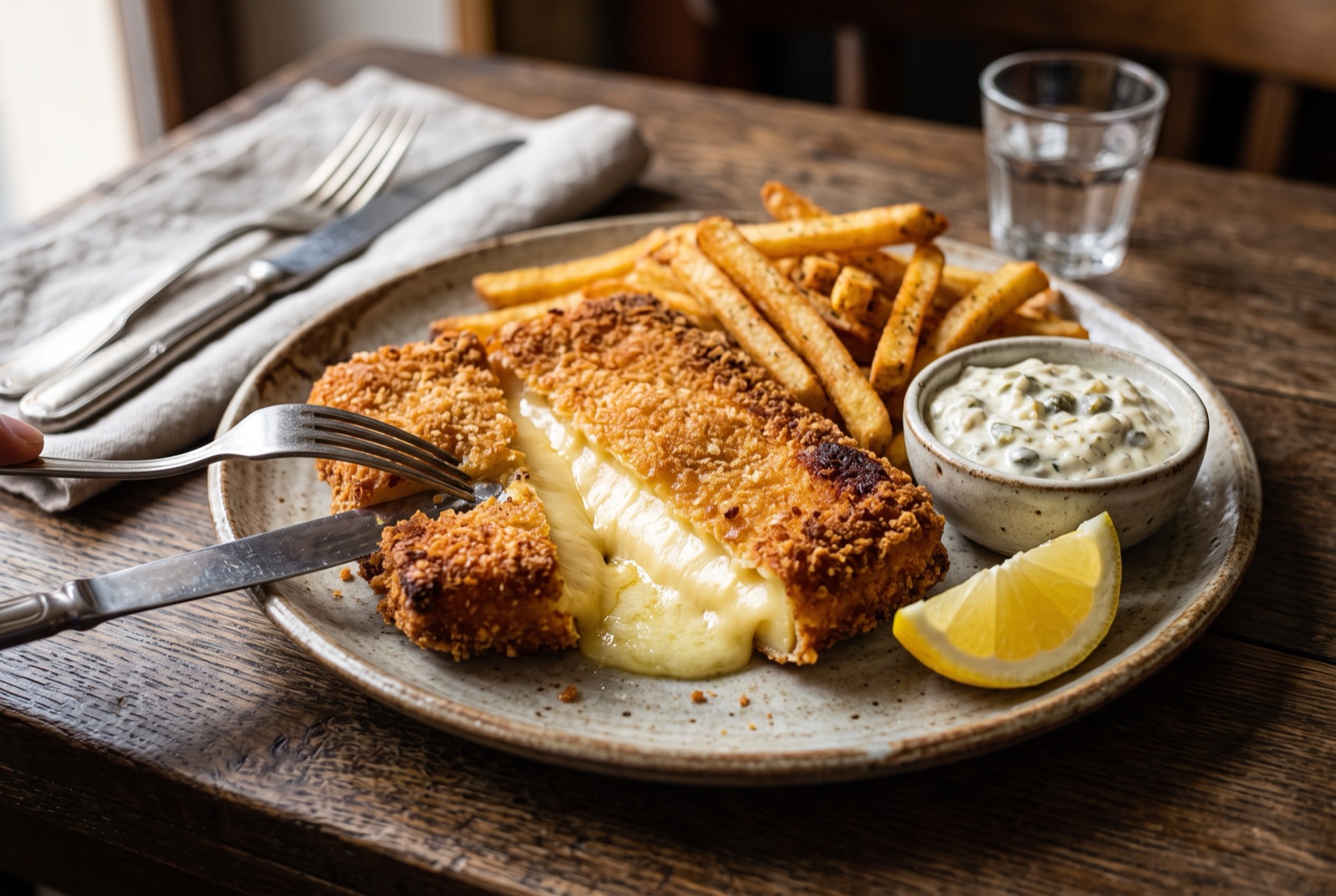
Smažený sýr is a 1.5 cm slab of mild semi-hard cheese, coated in flour, egg and breadcrumbs and deep-fried for barely three minutes, so the crust sets golden while the interior turns to liquid. It tastes exactly as straightforward as it sounds — salty, rich, faintly sweet from the cheese, with a crunch that gives way to a stretch — and it is rescued from being too much by the acid alongside: cold tartare sauce, a squeeze of lemon, sometimes a pickled gherkin. In Czech pubs it is the reliable vegetarian order, printed on the menu somewhere between the pork cutlet and the fried mushrooms, and it is also what half the country eats after midnight from a window in the wall.

- Gate
- CzechiaBohemia
- Prep
- 20 min
- Cook
- 10 min
- Total time
- 50 min incl. 20 min rest
- Serves
- 4
- Status
- Easy
- Nutrition / serving · estimated
- Calories 890 kcal
- Protein 38 g
- Carbs 62 g
- Fat 56 g
- Fiber 4 g
- Sodium 1620 mg
Why this recipe works.
- A double breadcrumb coat, which is the only reliable way to stop molten cheese escaping into the oil.
- A freezer rest between breading and frying that firms the coating and buys you crucial extra seconds in the fryer.
- A proper homemade tartare sauce recipe, sharp enough to cut the fat, rather than a jar of mayonnaise.
- Clear temperature guidance: the difference between golden crust and a pan of oily cheese soup is about 15 degrees.
Ingredients.
12 itemsFor the cheese
For the breading
For the tartare sauce
To serve
Equipment
- Deep pan or fryer
- Kitchen thermometer
- Slotted spoon
- Three shallow bowls for breading
Instructions.
Make the tartare sauce first
Stir the mayonnaise together with the chopped gherkins, onion, capers, chives and the juice of half a lemon. Season with salt and pepper, then refrigerate — it wants at least 30 minutes for the flavours to spread and it must be properly cold when it meets the hot cheese.
Cut and dry the cheese
Cut the cheese into four slabs about 1.5 cm thick and pat every surface dry with kitchen paper. A wet surface stops the flour gripping, which is the first crack in the armour.
Bread it twice
Set out flour, beaten egg and breadcrumbs in three bowls. Coat each slab in flour, then egg, then crumbs, then dip it back into the egg and crumbs a second time, pressing the coating firmly onto the four cut edges with your fingertips.
Tip The edges are where cheese escapes. Stand each slab on its side and press crumbs on deliberately.
Chill the breaded slabs
Lay the coated pieces on a tray and freeze for 20 minutes, until the surface is firm and cold to the touch. This buys the crust time to set before the interior liquefies.
Cook the fries
While the cheese chills, fry or roast the potatoes until crisp and golden, then salt them and keep them warm in a low oven. Get this out of the way now — the cheese cannot wait for anything.
Heat the oil precisely
Bring the oil to 175°C in a deep pan, checking with a thermometer rather than guessing. A cube of bread should turn golden in about 40 seconds at the right temperature.
Fry two at a time
Lower in two slabs and fry for 2–3 minutes, turning once with a slotted spoon, until the crust is an even deep gold all over and the slab feels slightly softer and heavier when nudged. Drain briefly on a rack, not on paper, so the underside stays crisp.
Serve at once
Plate each slab with the fries, a generous spoon of cold tartare sauce and a lemon wedge, and get it to the table within a minute or two while the inside is still molten. Cut in with the side of a fork and the cheese should pull into a thread.
Tips from our kitchen.
- Cut the cheese at least 1.5 cm thick. Thin slices melt through before the crust colours and there is no way to recover them.
- Bread it twice — flour, egg, crumbs, then egg and crumbs again — and pay particular attention to the four edges, which is where cheese escapes.
- Chill the breaded slabs in the freezer for 20 minutes before frying. Cold cheese buys you the seconds you need for the crust to set.
- Keep the oil at 175°C. Too cool and the coating soaks up fat before it browns; too hot and the crust burns while the middle is still solid.
- Fry no more than two pieces at a time so the oil temperature does not crash, and turn them once, gently, with a slotted spoon.
- Serve within a couple of minutes of frying. Fried cheese has a short window between molten and rubbery, and it does not reopen.
Substitutions.
- Edam → Young Gouda, mild Emmental, or halloumi for a firmer, less runny result
- You want a mild semi-hard cheese with medium moisture. Strongly aged cheeses split into oil, and very soft cheeses collapse entirely.
- Tartare sauce → Mayonnaise mixed with chopped gherkins, capers, onion and a squeeze of lemon
- That is essentially what Czech tatarka is. What matters is that it is cold and sharp against the hot cheese.
- Deep frying → Shallow frying in 2 cm of oil, turning once
- Works fine and uses much less oil, but watch the sides — they get less heat, so give them a moment leaning against the pan wall.
Variations.
- Smažák v housce
- The street version: the fried slab pushed into a soft round bun with tartare sauce and a lettuce leaf. Eaten walking, usually late.
- Ham-stuffed fried cheese
- Two thinner slices of cheese sandwiched around a slice of ham, then breaded as one piece. Common in pubs and often listed separately on the menu.
- Smažený hermelín
- Made with hermelín, the Czech camembert-style cheese, so the inside runs to cream rather than stretching. Softer, tangier and a genuine step up in flavour.
Storage & reheating.
This is a dish to eat immediately — reheated fried cheese turns tough and weeps oil, and there is no technique that fixes it. What you can prepare ahead is the breading: coated slabs keep in the freezer for up to a month, wrapped individually, and fry straight from frozen with an extra minute added. The tartare sauce keeps 3 days refrigerated and improves after a few hours as the gherkin and onion flavours spread through it.
Serve with
Fries or boiled potatoes, a bowl of cold tartare sauce, a lemon wedge and a pilsner.
The story behind Smažený Sýr.
Fried cheese belongs to the Austro-Hungarian habit of breading and frying anything that can be persuaded to hold a coating, a technique that arrived in Bohemia along with the schnitzel and never left. Czech kitchens applied it to pork, chicken, cauliflower, mushrooms and eventually to a block of Edam-style cheese, which the domestic dairy industry produced in enormous quantities and which behaves perfectly under heat: it melts smoothly without splitting into oil and curds, and it is mild enough to carry salt and crust rather than fight them.
The dish became genuinely important during the socialist decades, for a reason that is more practical than romantic. Meat supply was inconsistent, cheese was not, and a restaurant needed something on the menu that could be assembled from a block in the fridge in five minutes. Smažený sýr took that slot and kept it. It is still the answer a Czech pub gives when a vegetarian asks what they can eat, which is either charming or a national embarrassment depending on who you ask — the joke about Czech vegetarians surviving on fried cheese and fried cauliflower has been running for decades and is not entirely a joke.
Today it exists in two registers. There is the plate version, served with hranolky (fries) and a dish of tartare sauce, eaten sitting down with a beer. And there is the smažák v housce, a fried cheese sandwich sold from street windows late at night: the slab jammed into a bun with tartare and a leaf of lettuce, handed over in a paper napkin. Both are the same three ingredients. Neither pretends to be anything more sophisticated than it is, and that honesty is a large part of why Czechs are so fond of it.
Questions, answered.
Why did my cheese leak into the oil?
Either the coating had a gap or the oil was too hot. Bread the cheese twice and press crumbs firmly onto all four cut edges, which are the usual escape route. Then check your oil is at 175°C, not hotter — above about 190°C the cheese liquefies before the crust has set and pushes through the weakest point.
What cheese should I use outside Czechia?
Young Edam or Gouda are the closest matches and are widely available. Mild Emmental, low-moisture mozzarella in a block, or a firm cheese such as halloumi all fry successfully. Avoid mature cheddar and other well-aged cheeses: their fat separates under heat and you get an oily, grainy interior instead of a smooth melt.
Can I bake or air-fry it instead?
You can, and it will be edible, but it is a different dish. In an air fryer at 200°C for about 8 minutes the coating dries and colours rather than crisping in fat, and the crust is noticeably harder and less golden. Spraying the breaded slabs generously with oil first gets you closer to the fried result.
Is smažený sýr vegetarian?
Usually yes, and it is the standard vegetarian order in Czech pubs. Two things to check if it matters to you: whether the cheese was made with animal rennet, and whether the kitchen fries it in the same oil as the schnitzels and fried mushrooms, which many pubs do. At home you control both.
How do I know when it is done?
Go by colour and time rather than by poking it. Two to three minutes total at 175°C, turning once, until the crust is an even deep gold — the same shade as a well-fried schnitzel. Cutting into it to check defeats the purpose, because the cheese immediately runs out.
You might also like.
All recipes →
Keep exploring Czechia.
Czechia has 9 more dishes in the atlas — Bramborák and Hovězí Guláš, and 7 more.
Recipe by The DishRoute Kitchen · published August 20, 2026 · updated August 20, 2026