Větrník.
Czech Caramel Choux Pastry Wheel
Větrník · say it: VYET-r-nyeek
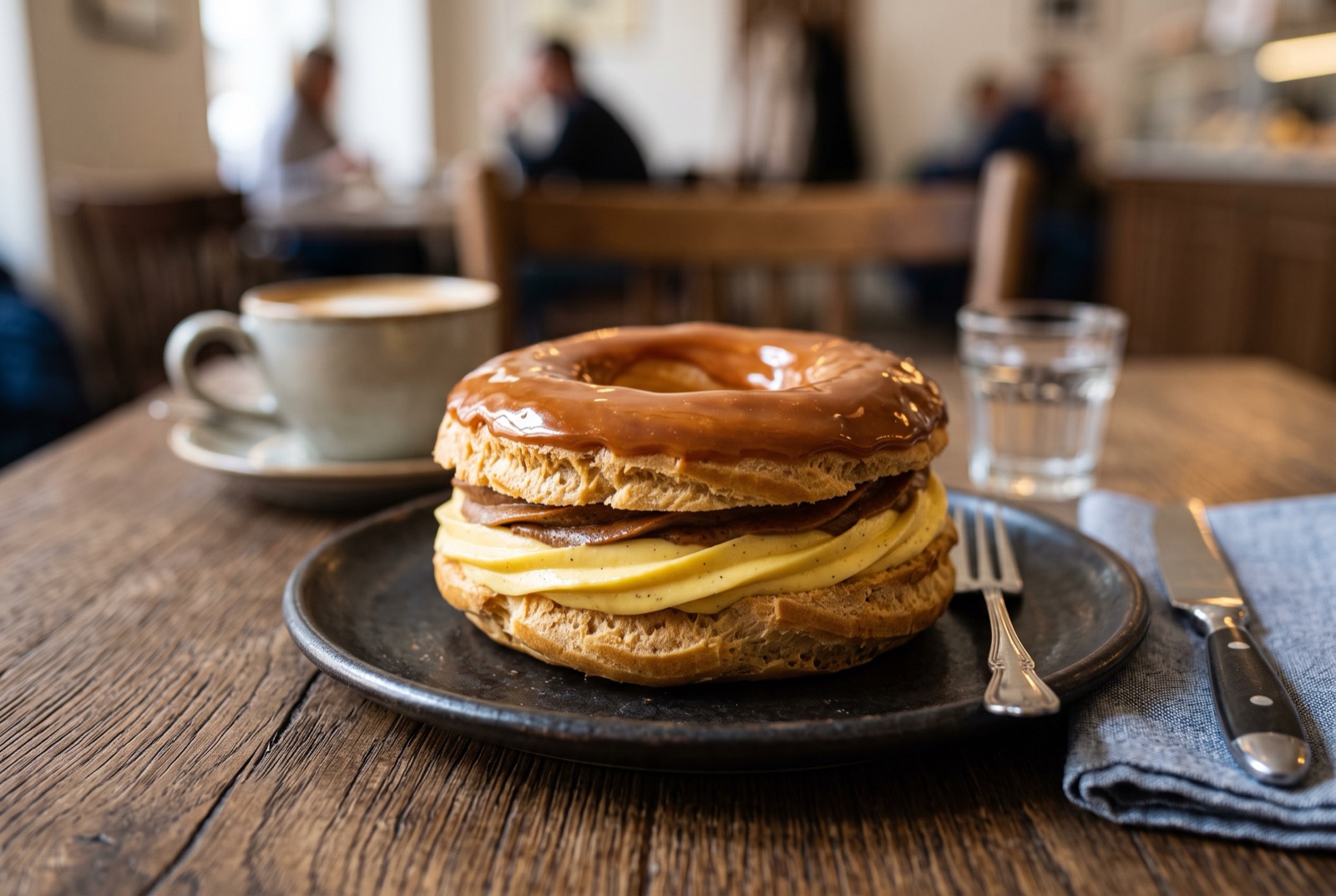
A větrník is a fist-sized ring of choux pastry, sliced through the middle, loaded with two creams and capped with a lid that has been dipped in caramel until it sets glassy. The lower cream is a vanilla custard beaten with butter until it is thick enough to stand a spoon in; the upper one is the same cream with cooked caramel folded through, which makes it darker, saltier at the edges and faintly bitter. Bite through and you get three textures in order: brittle glaze, crisp shell, then a wall of cold cream. It is unapologetically large, sold one per person, and eaten with a small fork off a paper plate at the counter.

- Gate
- CzechiaBohemia
- Prep
- 45 min
- Cook
- 40 min
- Total time
- 3 hr 25 min incl. 2 hr rest
- Serves
- 6
- Status
- Takes skill
- Nutrition / serving · estimated
- Calories 640 kcal
- Protein 9 g
- Carbs 60 g
- Fat 41 g
- Fiber 1 g
- Sugar 44 g
Why this recipe works.
- Two separate creams, vanilla below and caramel above, which is how a real cukrárna builds it — not one beige filling doing both jobs.
- One batch of cooked caramel serves both the cream and the glaze, so you make caramel once instead of twice.
- The custard is beaten into softened butter rather than the other way round, which is what stops the cream splitting into curds.
- Exact visual cues for the choux — the film on the pan base, the falling V, the point at which the rings stop collapsing.
Ingredients.
17 itemsFor the choux rings
For the vanilla cream
For the caramel (cream and glaze)
Equipment
- Piping bag with a 1.5 cm star nozzle
- Heavy saucepan with a light-coloured base (so you can read the caramel colour)
- Electric hand mixer or stand mixer
- Baking parchment and two trays
- Serrated knife
Instructions.
Cook the custard base first
Bring the milk to a bare simmer with the split vanilla pod and its seeds. Whisk the yolks, caster sugar and cornstarch to a pale paste, pour in a ladle of hot milk while whisking, then return everything to the pan. Cook over medium heat, whisking hard, until it thickens and blips slowly like lava — then keep it bubbling for a full minute so the starch cooks out.
Tip Whisk into the corners of the pan. Custard scorches where the whisk cannot reach and you will taste it.
Chill the custard flat
Scrape the custard onto a wide plate or tray, spread it thin, and press cling film directly onto the surface so no skin forms. Refrigerate for at least an hour, until fridge-cold and stiff. It must be cold before it meets the butter.
Make the choux paste
Heat the oven to 200°C. Bring the water, cubed butter, sugar and salt to a full rolling boil — the butter must be entirely melted before the liquid boils. Tip in all 150 g of the flour at once and beat with a wooden spoon over medium heat for 1–2 minutes, until the paste balls up, pulls cleanly from the sides and leaves a thin dry film on the base of the pan.
Beat in the eggs
Transfer the paste to a bowl and let it cool for five minutes, until it is warm rather than hot. Beat in the egg a little at a time, working each addition in fully before the next. Stop when the paste falls from the spatula in a slow, heavy V and the trail closes back over itself within a couple of seconds — glossy, not runny.
Tip If it goes slack you cannot take egg back out. Add the last of it a teaspoon at a time.
Pipe and bake the rings
Pipe six rings about 10 cm across onto lined trays, spacing them well apart. Bake at 200°C for 15 minutes without opening the door, then drop to 175°C and bake 20–25 minutes more, until deep golden brown and rigid — a pale ring will sag the moment it hits cool air. Pierce each one in the side, switch the oven off, and leave them inside with the door ajar for 10 minutes to dry.
Cook the caramel
Heat the granulated sugar with 3 tablespoons of water in a heavy pan over medium heat, swirling but never stirring, until it turns the colour of strong tea and smells toasted with a bitter edge. Pull it off the heat, stand back, and pour in the warm cream — it will erupt and steam. Stir in the butter and let it settle to a smooth, pourable sauce. Cool to room temperature.
Tip Read the colour against a light pan base. Amber is not far enough; smoking and acrid is too far.
Whip the two creams
Beat the softened butter for three or four minutes until pale and aerated, then add the cold custard a heaped spoonful at a time, beating between each, until you have a thick, glossy cream that holds a peak. Divide it in two. Beat 5 tablespoons of the cooled caramel into one half so it turns a light toffee brown; leave the other half plain.
Tip If it looks curdled, the temperatures were mismatched — warm the bowl briefly with your hands and keep beating and it will come back together.
Split, fill and glaze
Saw each ring in half horizontally with a serrated knife. Pipe a thick coil of vanilla cream into every base, pipe the caramel cream on top of it, and set the lid back on. Stir the icing sugar into the remaining caramel until it is thick enough to coat the back of a spoon, then spoon it over each lid and let it run just to the edge.
Set and serve
Chill the finished pastries for 30 minutes, until the glaze is firm to a light touch and the cream is cold through. Serve within a few hours, one per person, on a plate big enough to catch what escapes when the fork goes in.
Tips from our kitchen.
- Boil the water and butter properly before the flour goes in. If the butter is still melting when the liquid boils, some of the water has already gone and the paste will be too stiff.
- Hold back the last egg. Flour absorbs differently every time — add egg until the paste falls from the spatula in a slow, thick V, and stop there even if there is egg left in the bowl.
- Do not open the oven for the first twenty minutes. Choux is holding itself up on steam alone, and a draught of cold air drops the rings flat with no way back.
- Pierce each baked ring in the side and return it to the switched-off oven for ten minutes. Trapped steam is what turns a crisp shell soft an hour later.
- The custard must be properly cold and the butter properly soft before they meet. Cold butter plus cold custard gives lumps; warm custard plus soft butter gives soup.
- Take the caramel further than feels comfortable — to the colour of strong tea, when it smells toasted and slightly bitter. A pale caramel disappears completely once it is folded into cream.
Substitutions.
- Vanilla pod → 2 tsp vanilla bean paste, or 1 tbsp good vanilla extract stirred in after cooking
- Extract loses aroma in a boiling custard, so add it off the heat. Paste behaves like a pod and keeps the flecks.
- Cornstarch in the custard → Equal weight of plain flour, or 30 g custard powder
- Flour needs a full two minutes of bubbling to lose its raw taste. Custard powder is what many Czech home cooks actually use and gives a yellower, slightly softer cream.
- Piping bag with a star nozzle → A freezer bag with a 1.5 cm corner cut off
- The rings come out smooth instead of ridged, which bakes and tastes the same. The star nozzle is cosmetic.
Variations.
- Věneček
- The smaller sibling from the same case: a slimmer choux wreath filled with plain vanilla cream and glazed white with rum-scented fondant instead of caramel.
- Coffee větrník
- Dissolve a tablespoon of instant espresso into the hot caramel before it goes into the cream. Common in Moravian shops and it sharpens the bitterness usefully.
- Salted caramel version
- Whisk a generous pinch of flaky salt into the caramel sauce while it is still warm. Modern rather than traditional, but it makes the glaze far less cloying.
Storage & reheating.
Větrníky are at their best three to six hours after filling, when the glaze has set but the shell has not yet drawn moisture from the cream. They keep one day in the fridge, loosely covered, after which the choux goes soft — still good, no longer crisp. Do not freeze the finished pastry: the custard weeps on thawing and the glaze turns tacky. The components store far better than the assembly, so bake the unfilled rings up to two days ahead and keep them airtight at room temperature, refresh them for five minutes in a 160°C oven, and make the custard the day before.
Serve with
Black coffee, or the small glass of Becherovka that older customers order alongside it in the afternoon.
The story behind Větrník.
To understand the větrník you have to understand the cukrárna, the Czech pastry shop, which is less a bakery than a small municipal institution. There is one on most high streets, the lighting is usually unflattering, the chairs are usually plastic, and behind the glass sits the same lineup it has held for decades: laskonky in their meringue shells, kremrole wound with cream, punčový řez stained pink with rum, věneček under its white glaze, and the větrník, taking up more space than anything else in the case. People have a regular. The větrník is the one used to judge a shop, because there is nothing in it to hide behind — bad choux is soggy, bad cream tastes of packet pudding, and bad caramel is just brown sugar.
The pastry itself is imported technique made local. Choux came into Bohemian confectionery through the Austro-Hungarian pastry trade, which took French method and spread it across Central Europe; Czech bakers call it odpalované těsto, roughly "fired-off dough", named for the step where flour is cooked directly into boiling butter and water. The French relatives are obvious once you look — the same ring shape carries a Paris-Brest — but where the French fill with praline, the Czech version commits entirely to caramel, in both the cream and the glaze. The name means windmill or weather vane, from vítr, wind. Nothing about the pastry turns, and the connection is presumably to the round, spoked look of a piped ring rather than to anything documented.
Industrial větrníky are everywhere, sold in supermarket chill cabinets with margarine cream and a glaze that tastes of caramel flavouring rather than cooked sugar, and they are the reason some visitors leave the country unimpressed. A homemade one is a genuine afternoon of work — choux, custard, caramel, assembly — and it is a completely different object: the shell still crisp, the caramel actually bitter, the cream cold and heavy. This is the version worth the afternoon.
Questions, answered.
Why did my choux rings collapse after baking?
Almost always because they came out too early or the oven was opened too soon. Choux inflates on steam and only holds that shape once the walls have dried and browned enough to be rigid, which means baking to a deep golden colour rather than pale blond. If a ring feels light and hollow but sounds soft when tapped, it needs longer. Keep the oven door shut for the first twenty minutes.
My caramel seized into a solid lump when I added the cream. Can I save it?
Yes. Sugar seizes when cold liquid hits hot caramel and part of it crystallises back into a mass. Put the pan back on low heat and stir patiently — the lumps dissolve into the cream over two or three minutes. Warming the cream before adding it prevents this in the first place, and adding it slowly, off the heat and at arm's length, prevents the more dangerous problem of it spitting at you.
What is the difference between a větrník and a věneček?
They are both choux rings from the same Czech pastry-shop lineup, but a věneček is smaller and slimmer, filled only with vanilla cream, and glazed with white fondant usually flavoured with rum. A větrník is bigger, carries two creams — vanilla and caramel — and is finished with a caramel glaze. If you see a fat brown one in the case, that is the větrník.
Can I use shop-bought custard or instant pudding for the filling?
You can, and plenty of Czech households do, but it changes the pastry. Instant pudding sets soft and slightly gelatinous, so the cream slumps out of the sides when you cut into it. If you go that route, make the pudding with less milk than the packet says and still beat it into softened butter, which gives it enough body to hold the lid up.
Can I make větrníky ahead for a party?
Bake the choux rings up to two days early and store them airtight at room temperature, never in the fridge, where they go leathery. Make the custard the day before and keep it covered with film touching the surface. Whip it with butter, fill and glaze on the day, ideally three to four hours before serving so the glaze sets firm while the shell is still crisp.
You might also like.
All recipes →
Keep exploring Czechia.
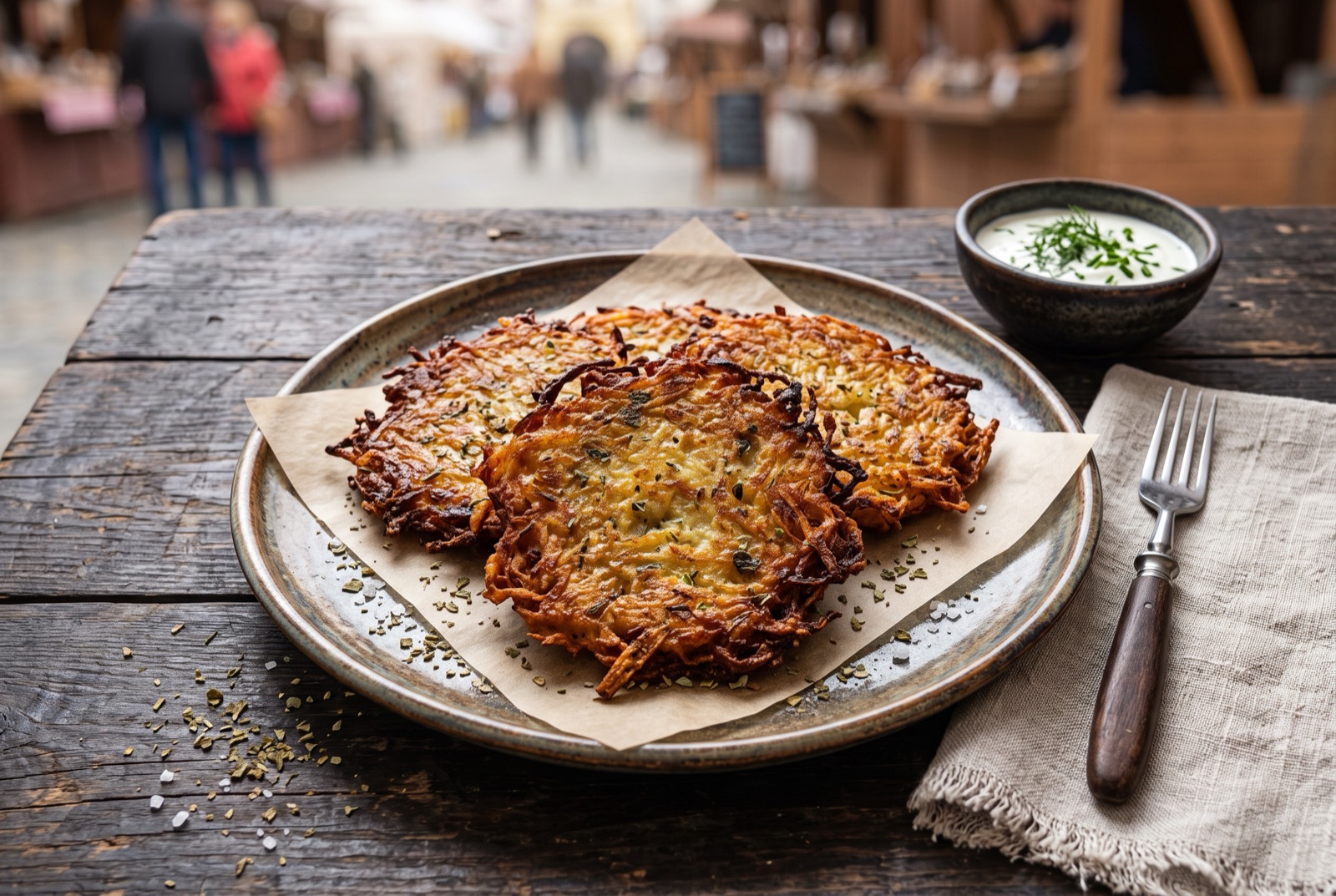
Czechia has 9 more dishes in the atlas — Bramborák and Hovězí Guláš, and 7 more.
Recipe by The DishRoute Kitchen · published August 20, 2026 · updated August 20, 2026