Trdelník.
Sugar-Crusted Czech Chimney Cake
Trdelník · say it: TR-dell-neek
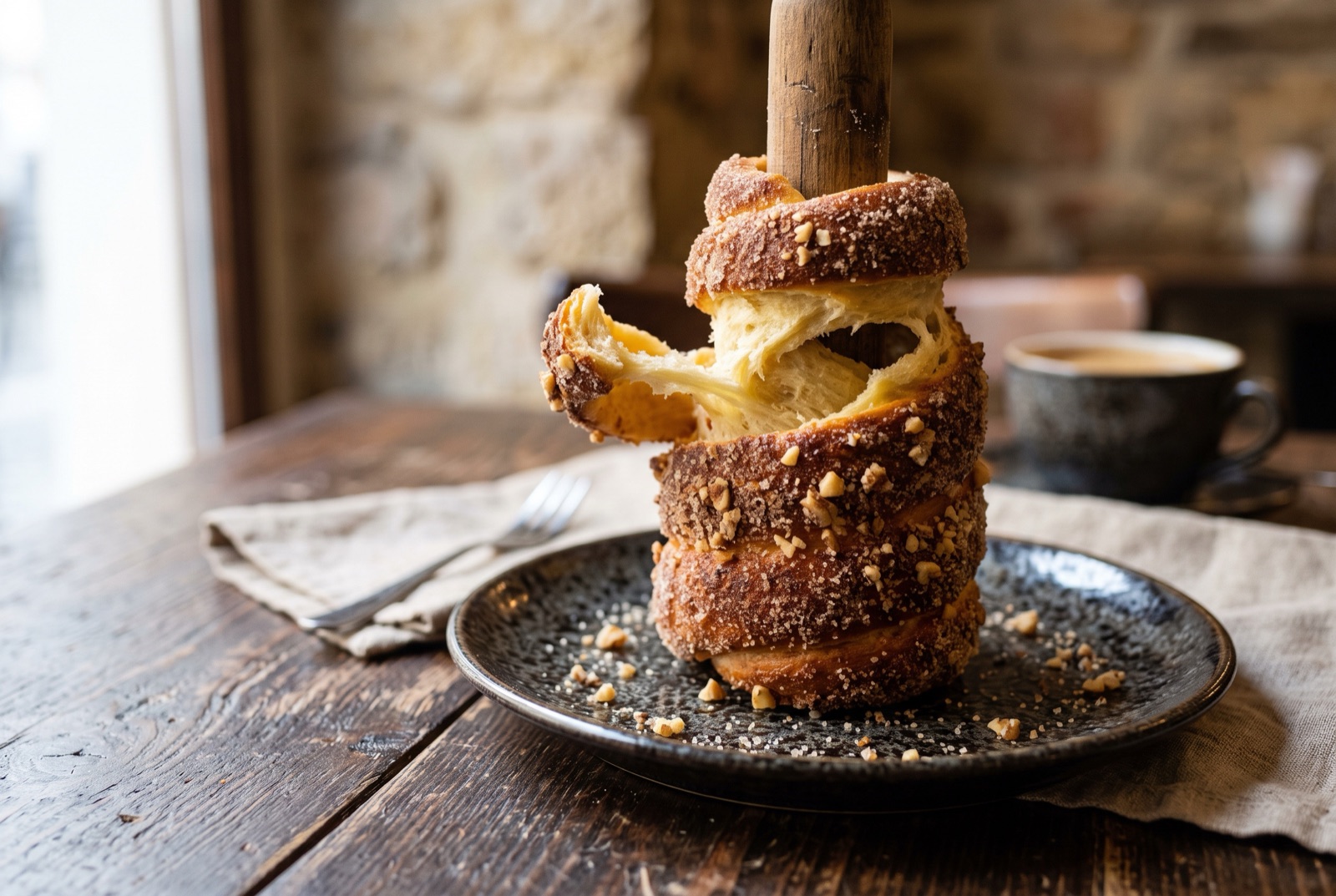
Trdelník is a rope of sweet yeast dough wrapped around a thick wooden or metal roller, brushed with butter, rolled in sugar and chopped walnuts, and turned over heat until the outside caramelises into a crackling shell. Pull it off the spit and you get a hollow tube that unwinds into a single warm spiral — soft and bready inside, crisp and sweet where the sugar has melted and set. It tastes of butter, cinnamon and toasted nuts, and it is best eaten within about four minutes of coming off the fire. The home version below uses a hot oven and a foil-wrapped roller, and gets remarkably close.

- Gate
- CzechiaPrague
- Prep
- 30 min
- Cook
- 25 min
- Total time
- 2 hr 40 min incl. 1 hr 45 min rest
- Serves
- 4
- Status
- Medium
- Nutrition / serving · estimated
- Calories 720 kcal
- Protein 15 g
- Carbs 102 g
- Fat 29 g
- Fiber 4 g
- Sugar 48 g
- Sodium 320 mg
Why this recipe works.
- A home method using foil-wrapped rolling pins in a very hot oven, rather than assuming you own a rotating spit.
- The dough is enriched with butter, egg and milk so it stays tender instead of drying out at high heat.
- Sugar goes on before baking so it actually caramelises into a shell, not after, when it just sits there as loose grains.
- Says plainly what the pastry is and is not, instead of repeating the origin story printed on Prague tourist stalls.
Ingredients.
12 itemsFor the dough
For the coating
Equipment
- 4 rolling pins or metal tubes about 5 cm across
- Heavy-duty foil
- Deep roasting tin
- Pastry brush
Instructions.
Mix and knead the dough
Whisk the yeast into the lukewarm milk with a spoonful of the caster sugar and leave for 10 minutes until foamy. Mix into the flour with the remaining caster sugar, one egg, the salt and the lemon zest, then knead for 8 minutes, working in the softened butter a piece at a time, until the dough is smooth, glossy and only slightly tacky.
Let it rise
Cover the bowl and leave in a warm place for about 75 minutes, until doubled and domed. Enriched dough rises more slowly than plain bread dough, so judge it by size rather than by the clock.
Prepare the rollers
Wrap each rolling pin or tube in two layers of heavy foil and brush the foil generously with melted butter. Mix the granulated sugar, chopped walnuts and cinnamon together in a wide shallow tray.
Roll and wind
Divide the dough into four and roll each piece into a rope about 90 cm long and 1.5 cm thick. Wind each rope around a prepared roller in a tight spiral, each turn just touching the last without overlapping, and press the two ends gently onto the foil to anchor them.
Tip If the rope tears while rolling, let the dough relax for two minutes and try again — it is fighting you, not broken.
Coat before the second rise
Brush each wound roller all over with beaten egg, then roll it firmly in the sugar and walnut mixture, pressing so the coating sticks in a thick, even layer. Rest the rollers across a deep roasting tin so the tubes hang clear of the base and leave for 30 minutes.
Bake and turn
Bake at 200°C for 20–25 minutes, turning each roller a quarter turn every 5 minutes and brushing with melted butter at each turn. They are ready when the sugar has melted into a glassy amber shell and the exposed dough between the coils is deep golden.
Slide them off hot
Take the rollers out and immediately twist each tube gently off the foil while the caramel is still soft — thirty seconds too long and it sets like glue. Stand the tubes upright on a rack for two minutes so the shell firms.
Tip Use a cloth. The sugar is hotter than it looks and sticks to skin.
Eat while it crackles
Serve straight away, pulling the tube apart along its spiral rather than cutting it. The shell should crack audibly and the crumb underneath should still be steaming.
Tips from our kitchen.
- Roll the dough into a long rope about 1.5 cm thick and wind it so each turn just touches the last. Gaps make the tube fall apart; overlaps make it doughy where they meet.
- Wrap your rollers in foil and oil them well. Dough sticks to bare wood and you will destroy the tube trying to get it off.
- The dough needs a second short rise on the roller before it goes into the oven, or the tube comes out dense and tight.
- Use granulated sugar rather than caster for the coating. The larger crystals melt into a proper crackling shell instead of dissolving away.
- Turn the rollers every five minutes so the tubes brown evenly. This is the part a rotating spit does for you and the part you have to do by hand.
- Slide each tube off the roller while it is still hot. Left to cool on the roller, the caramelised sugar glues it in place permanently.
Substitutions.
- Walnuts → Chopped almonds, hazelnuts, or a plain cinnamon-sugar coating with no nuts
- Walnut is the classic Czech choice, but the coating is the flexible part of this recipe.
- Wooden rollers → Foil-wrapped rolling pins, thick cannoli tubes, or cylinders made from several layers of heavy foil
- Anything about 5 cm across, oven-safe and non-stick once oiled will work. Uniform diameter matters more than material.
- Milk in the dough → Plant milk plus an extra teaspoon of oil
- Works well; the crumb is slightly less rich but the caramel shell is unaffected.
Variations.
- Kürtőskalács
- The Hungarian and Székely relative, and probably the ancestor: the same spit method, usually plainer dough and a coating of just sugar, cinnamon or ground nuts.
- The tourist cone
- The Prague stall version, filled with soft-serve ice cream and chocolate spread. Not traditional in any sense, and it goes soggy fast — but it is what most visitors mean by trdelník.
- Savoury spit bread
- Coat the dough with coarse salt, caraway and grated cheese instead of sugar. A pub-snack idea rather than a heritage recipe, and very good with beer.
Storage & reheating.
Trdelník is a same-hour pastry. Within two hours the caramel shell softens as it absorbs moisture from the crumb, and by the next day it is a dense sweet bread. If you must keep it, store it loosely covered at room temperature and refresh it in a 180°C oven for 4 minutes, which restores some crispness but not all. Do not refrigerate, which dries the crumb and softens the crust at the same time. The unbaked dough can be refrigerated overnight after the first rise and rolled cold.
Serve with
Nothing inside it and a black coffee alongside — the pastry is the point, and anything wet in the middle ruins the crust.
The story behind Trdelník.
Trdelník needs an honest introduction, because it has become the most contested pastry in Prague. Walk through the Old Town and you will pass a dozen stalls selling it as "traditional Czech pastry", often filled with ice cream and Nutella. Czechs will tell you, with varying degrees of patience, that this is a recent tourist phenomenon rather than something their grandmothers made, and they are broadly right: the ice-cream-filled version dates from the 2010s and the stall boom is younger still.
The pastry itself is genuinely old, but not specifically Czech. Spit cakes of this kind exist across Central Europe and the Carpathian basin — the Hungarian and Székely kürtőskalács is the best documented and probably the direct ancestor, and versions appear in Slovakia, Romania, Austria and Germany. The Czech connection runs through Skalice, a town now in Slovakia, and the name trdlo refers to the wooden roller itself, a word that doubles as a mild insult for a fool. Where exactly it originated is not settled, and the confident origin stories printed on Prague stall signs should be read as marketing rather than history.
None of which makes it bad. A trdelník baked properly, eaten hot, with nothing inside it, is an excellent piece of baking: yeasted dough with enough butter and egg to stay tender, a shell of sugar taken just to caramel, and walnuts that toast in the last minutes over the heat. The problem with the Old Town version is not the pastry but the queue, the price and the ice cream, which turns a crisp hot tube into a soggy cone within a minute. Make it at home and you get the thing itself, which is what this recipe is for.
Questions, answered.
Is trdelník actually a traditional Czech pastry?
Only partly. Spit cakes of this type are old across Central Europe and the Carpathian region, with the Hungarian and Székely kürtőskalács the best documented and likely ancestor, and versions exist in Slovakia, Romania and Austria. The Czech link runs through the town of Skalice, now in Slovakia. The Prague street version filled with ice cream is a tourist product of the last decade or so, and Czechs generally do not regard it as their national pastry.
Can I make it without a spit or rotisserie?
Yes. Wrap several rolling pins or thick metal tubes in oiled foil, wind the dough around them, and rest them across the edges of a deep roasting tin so the tubes hang in the air. Bake at 200°C and turn each roller by a quarter every five minutes. You lose the smoky note from charcoal but the caramelised sugar shell comes out very close.
Why is my trdelník doughy in the middle?
Usually the dough rope was too thick or the turns overlapped. Roll to about 1.5 cm and wind so each coil just touches the one before, without stacking. It can also mean the oven was too hot, so the sugar caramelised and the outside browned before the inside had time to bake through — drop the temperature by 20°C and add a few minutes.
How do I stop the sugar burning?
Sugar goes from caramel to bitter fast at high heat. Keep the oven at 200°C rather than higher, turn the rollers regularly so no side sits facing the element for long, and pull the tubes as soon as the shell is a deep amber. If your oven has a fierce top element, move the tin to a lower shelf for the last five minutes.
Can I fill it like the ones sold in Prague?
You can, and the hollow tube is a natural cup. Be aware of the trade-off: ice cream or a soft spread starts softening the caramel shell within a minute, and the texture contrast that makes the pastry worth eating disappears. If you want to fill it, do it at the table and eat immediately.
You might also like.
All recipes →
Keep exploring Czechia.
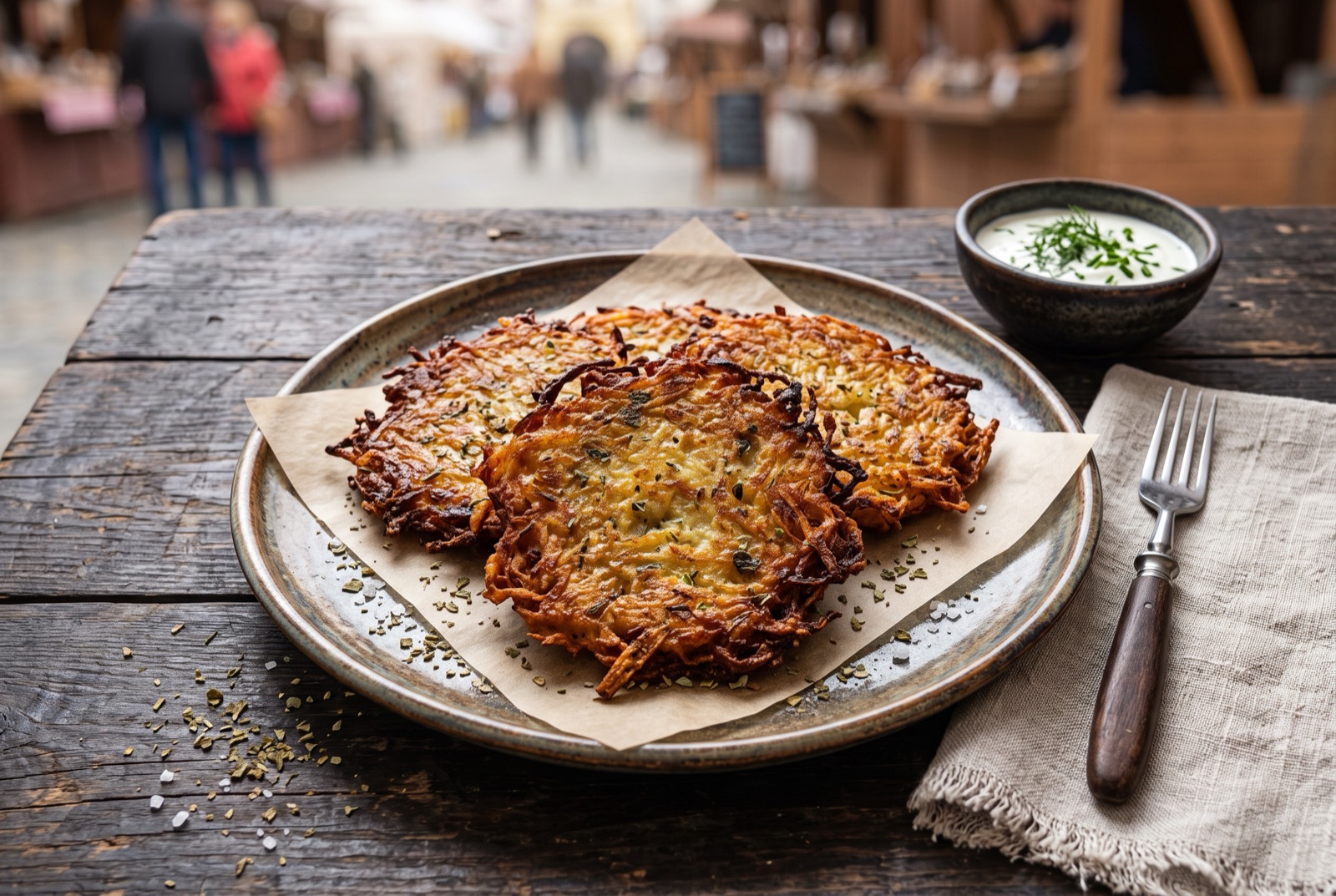
Czechia has 9 more dishes in the atlas — Bramborák and Hovězí Guláš, and 7 more.
Recipe by The DishRoute Kitchen · published August 20, 2026 · updated August 20, 2026