Tufahije.
Bosnian Walnut-Stuffed Poached Apples
Tufahije · say it: too-fah-HEE-yeh
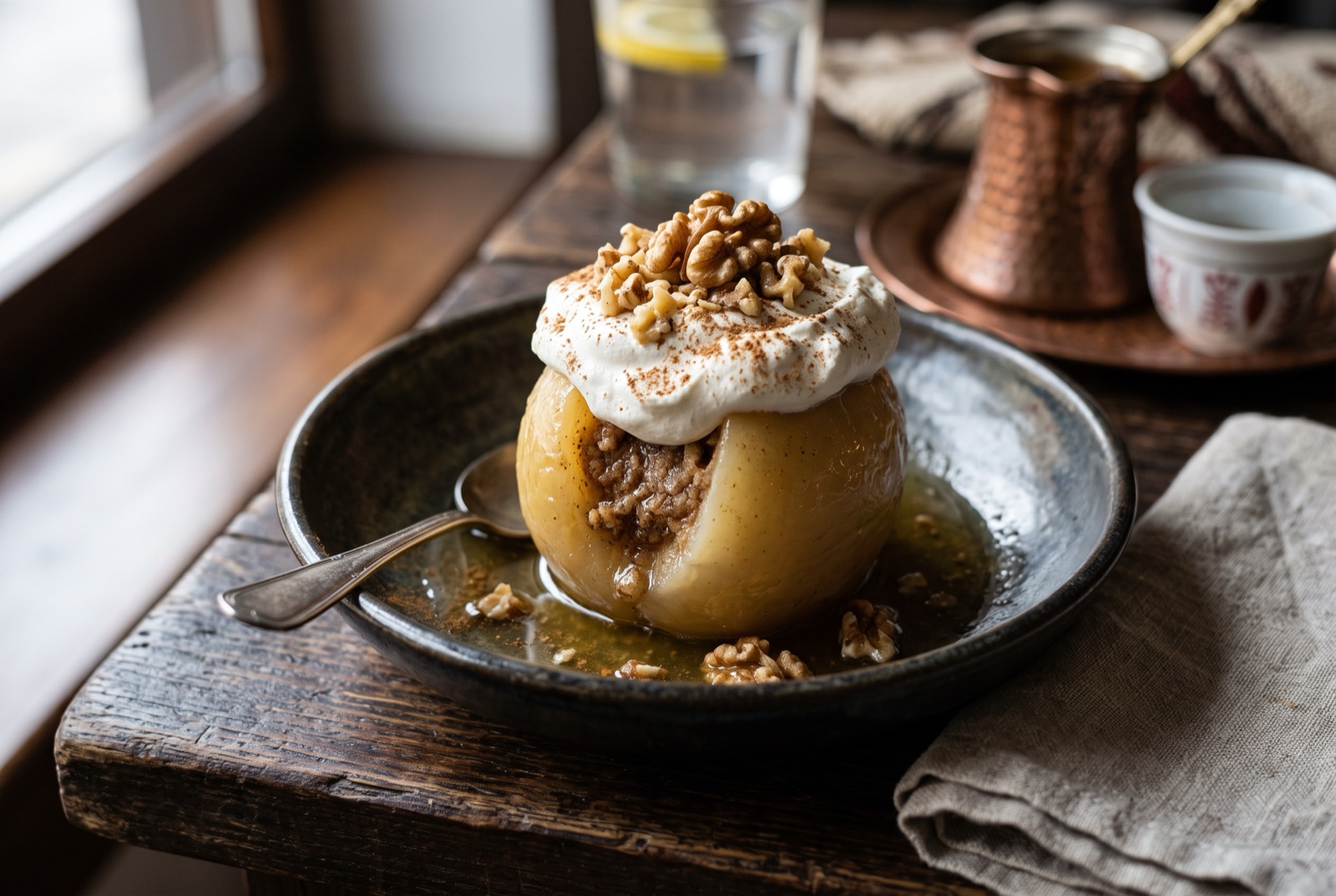
Tufahije are whole apples poached slowly in a light lemon syrup until they turn glassy and yielding but still hold their shape, then cored, filled with ground walnuts beaten with sugar and a little cream, and chilled in the syrup they cooked in. Served in a stemmed glass with a swirl of whipped cream and a walnut half on top, they are one of the few Balkan desserts that manage to be rich without being heavy — the apple stays tart and juicy, the filling is dense and cool, and the syrup soaking through carries a clear note of lemon. It is a made-in-advance dessert that improves with a night in the fridge, which is exactly why it appears at every kind of Bosnian celebration and on the sweet table at iftar.

- Gate
- Bosnia and HerzegovinaSarajevo
- Prep
- 30 min
- Cook
- 25 min
- Total time
- 4 hr 55 min incl. 4 hr rest
- Serves
- 4
- Status
- Easy
- Nutrition / serving · estimated
- Calories 610 kcal
- Protein 6 g
- Carbs 72 g
- Fat 34 g
- Fiber 5 g
- Sugar 63 g
Why this recipe works.
- A poaching window described by feel and appearance, so the apples come out translucent and whole instead of collapsing.
- Lemon in the syrup from the start, which keeps the flesh pale and stops the whole thing tasting cloying.
- Filling made with freshly ground walnuts bound with syrup, not the dry sugar-and-nut-dust version.
- Made a day ahead by design — the overnight soak is what turns good apples into tufahije.
Ingredients.
11 itemsFor the apples
For the syrup
For the filling
To serve
Equipment
- Wide pot deep enough to submerge the apples
- Teaspoon or melon baller
- Food processor or nut grinder
- Serving glasses
Instructions.
Prepare the apples and syrup
Peel 4 of apples thinly, leaving them whole and unpeeled at the stem, and drop them into water with a squeeze of lemon to stop them browning. In a wide pot, bring the water, sugar, lemon juice, lemon peel and cinnamon stick to a simmer and stir until the sugar has dissolved completely.
Poach until glassy
Lower the apples into the syrup, cover them with a small plate to keep them submerged and poach at the barest simmer for 12–20 minutes depending on size. They are ready when the flesh looks translucent rather than chalky white and a skewer meets light resistance at the centre.
Tip Test from 12 minutes on. The gap between perfectly poached and collapsed is about four minutes.
Cool in the syrup
Take the pot off the heat and let the apples cool in their syrup until you can hold one comfortably in your hand. This finishes the cooking gently and lets them start absorbing the lemon syrup.
Hollow them out
Slice a small lid off the top of each apple and scoop out the core and surrounding flesh with a teaspoon, working in small circles until only about 1 cm of flesh remains at the base and around the sides. Set the lids aside.
Make the walnut filling
Grind the walnuts to a coarse, slightly oily meal — not a paste — and beat them with the icing sugar, 3 tablespoons of cream and the rum or vanilla until the mixture holds together when squeezed. Pack it firmly into each hollowed apple, mounding it above the rim, and set the lids back on at an angle.
Chill in syrup
Stand the filled apples in a dish, spoon the cooled syrup around and over them, cover and refrigerate for at least 4 hours or overnight, spooning syrup over once or twice if you are passing.
Serve in glasses
Whip the cold cream with the tablespoon of icing sugar to soft peaks. Set each apple in a stemmed glass, spoon over several tablespoons of syrup, top with whipped cream and a walnut half, and serve cold with coffee.
Tips from our kitchen.
- Choose firm, tart apples of even size — Granny Smith, Braeburn or Boskoop. Soft eating apples turn to mush in the syrup.
- Peel them thinly and drop them straight into water with lemon juice so they do not brown while you work.
- Poach at the barest simmer with a plate on top to keep them submerged; a rolling boil splits the skin-side flesh.
- Start testing at 12 minutes. The apple is ready when a skewer slides in with light resistance and the flesh looks glassy rather than opaque white.
- Hollow them only once cool enough to handle — a hot poached apple tears under a spoon.
- Chill in the syrup at least 4 hours, ideally overnight; the flavour is noticeably flatter if you serve them the same afternoon.
Substitutions.
- Walnuts → Ground almonds or hazelnuts
- Both work and both taste good, but walnuts are what makes it tufahije in Bosnia — their slight bitterness is the counterweight to the syrup. Hazelnuts are the closer of the two.
- Whipped cream → Thick sour cream, or nothing at all
- The cream is a later addition rather than an ancient part of the dish, so leaving it off is entirely legitimate and makes the dessert lighter and dairy-free.
- Rum in the filling → A teaspoon of vanilla extract, or a pinch of cinnamon
- Many Bosnian households do not cook with alcohol, so the vanilla or cinnamon version is at least as common as the rum one.
Variations.
- With custard
- A spoon of thick vanilla custard hidden under the whipped cream, which turns the dessert into something closer to a trifle in an apple shell.
- Quince tufahije
- Made with quince instead of apple, poached far longer until deep pink and fragrant. A late-autumn version that is worth the extra hour.
- Baked tufahije
- Apples stuffed first, then baked in the syrup rather than poached, giving a softer, more caramelised result and a thicker sauce.
Storage & reheating.
Keep them in their syrup in a covered container in the fridge for up to 4 days — day two is arguably better than day one. Add the whipped cream only at the moment of serving, since it weeps and collapses into the syrup within an hour. They do not freeze: the apple flesh breaks down into a watery mush on thawing and the walnut filling turns grainy. If you want to prepare further ahead, poach the apples and keep them in syrup, then hollow and fill on the day.
Serve with
Small cups of Bosnian coffee, and a glass of cold water, which is how they are served in Sarajevo confectioners.
The story behind Tufahije.
The name comes from the Arabic tuffāḥ, apple, arriving in Bosnian through Ottoman Turkish — a straightforward marker of where the dish came from. It belongs to the family of Ottoman fruit desserts in which whole fruit is cooked in syrup and stuffed with nuts, cousins of the Turkish elma tatlısı and of stuffed quinces and figs made across the eastern Mediterranean. Bosnia adapted it in a specific direction: less sugar than its Turkish relatives, a firm insistence on walnuts rather than pistachios or almonds, and the whipped cream on top, which is a Central European addition that shows how thoroughly this country sits on the seam between two culinary worlds.
Sarajevo is the city most associated with it, where old confectioners serve tufahije in tall glasses alongside coffee, and where the standard is judged on whether the apple has stayed whole. That is the difficult part of the whole recipe. Under-poach and the apple is crunchy and refuses the syrup; over-poach by five minutes and it collapses when you try to hollow it, which is why cooks test constantly with a skewer from the moment the fruit starts to look translucent at the edges.
The walnut filling is unfussy: ground walnuts, sugar, sometimes a spoon of the poaching syrup or a little cream to bind, occasionally a splash of rum in households where that is acceptable and vanilla or cinnamon in those where it is not. What matters more than the additions is grinding the walnuts freshly and coarsely — pre-ground nut meal has usually lost its oil and tastes dusty, while walnuts ground too fine turn into paste. The apples then sit in their syrup for several hours or overnight, absorbing sweetness and lemon while staying pleasantly firm. They are served cold, in glass, with the syrup spooned over, and they are eaten with a small spoon rather than cut with a knife.
Questions, answered.
Which apples hold up best for poaching?
Firm, tart varieties with dense flesh — Granny Smith, Braeburn, Boskoop or any cooking apple that is not a Bramley. Bramleys and other very floury apples are bred to collapse into sauce, which is the opposite of what you want. Choose fruit of similar size so they finish poaching at the same time.
My apples fell apart while I was hollowing them. What went wrong?
They were poached a few minutes too long, or hollowed while still hot. The flesh should feel yielding but springy when pressed, and a skewer should meet a little resistance rather than sliding straight through. Let the apples cool in the syrup until you can hold one comfortably before you go near them with a spoon.
Can I make tufahije ahead of time?
They are designed for it. Poach, hollow and fill the apples, then leave them in the syrup in the fridge overnight so they absorb sweetness and lemon all the way through. Add the whipped cream just before serving. Made and eaten on the same afternoon they taste noticeably less developed.
How do I hollow the apple without cutting through the bottom?
Cut a lid off the top and work downward with a teaspoon or a melon baller, scraping in small circles and stopping when about a centimetre of flesh remains at the base. Check by pressing the outside of the bottom with a thumb — if it flexes, stop immediately. An apple corer is risky here because it goes straight through.
Is the syrup meant to be thick like a sauce?
No. Tufahije syrup stays thin and light, closer to a sweet lemony liquid than a caramel, so it can soak into the apple rather than coat it. If it reduces too far while poaching it will set into a sticky glaze in the fridge — add a splash of water and warm it briefly to loosen it before pouring it back over.
You might also like.
All recipes →
Bosnia and Herzegovina2 hr 55 min
Hurmašice
Bosnian Semolina Cookies in Lemon Syrup
Bosnia and Herzegovina1 hr 45 min
Begova Čorba
Bosnian Bey's Chicken and Okra Soup
Bosnia and Herzegovina2 hr 5 min
Burek
Bosnian Coiled Filo Pie with Minced Beef
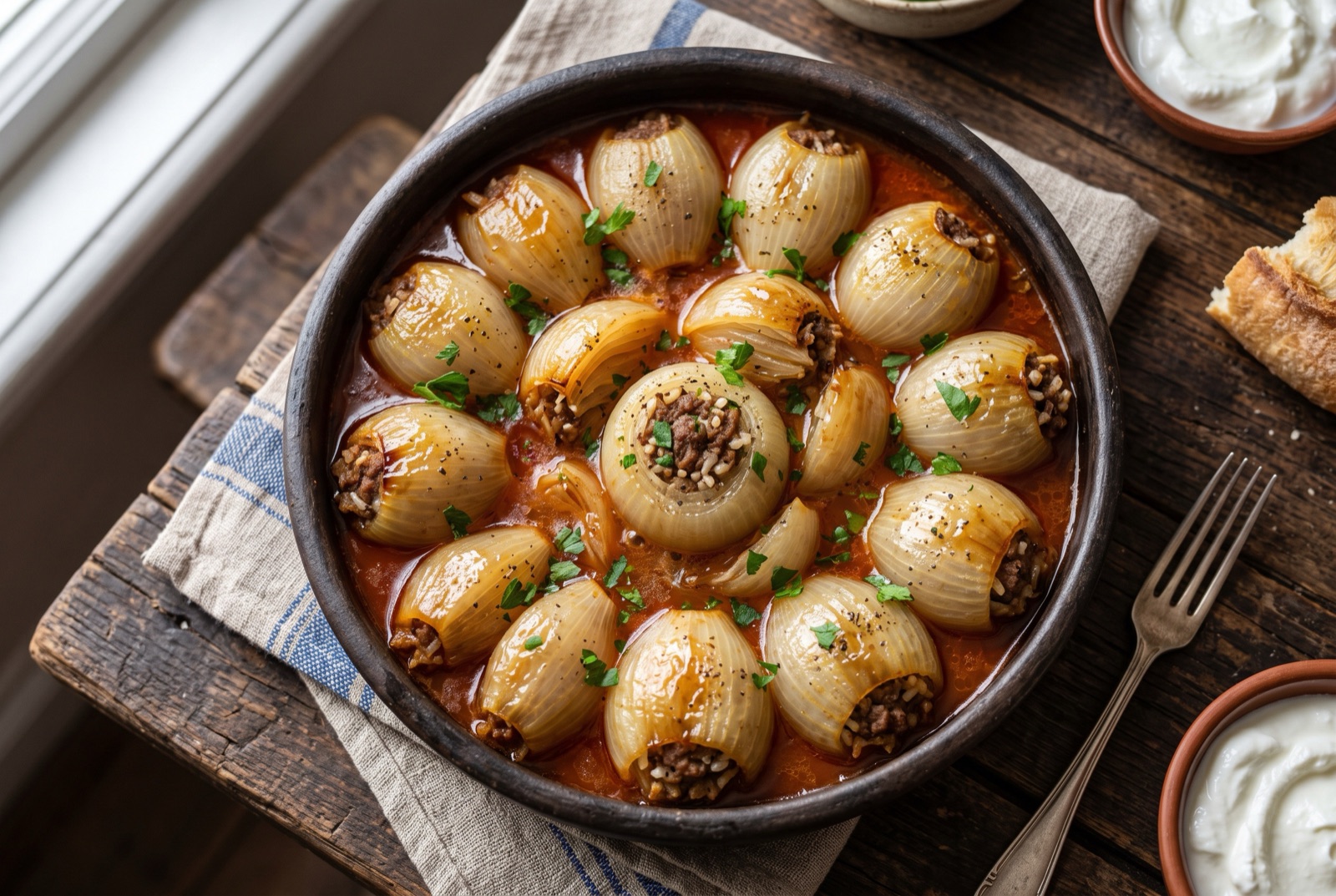
Bosnia and Herzegovina2 hr 15 min
Sogan-Dolma
Sarajevo Stuffed Onions in Tomato Broth
Keep exploring Bosnia and Herzegovina.
Bosnia and Herzegovina has 9 more dishes in the atlas — Begova Čorba and Bosanski Lonac, and 7 more.
All Bosnia and Herzegovina recipes Apple recipes Walnuts recipes Lemon recipes dessertvegetariangluten freeRecipe by The DishRoute Kitchen · published August 20, 2026 · updated August 20, 2026