Empanadas Salteñas.
Baked Argentine Beef Turnovers
Empanadas salteñas · say it: em-pah-NAH-dahs sahl-TEH-nyahs
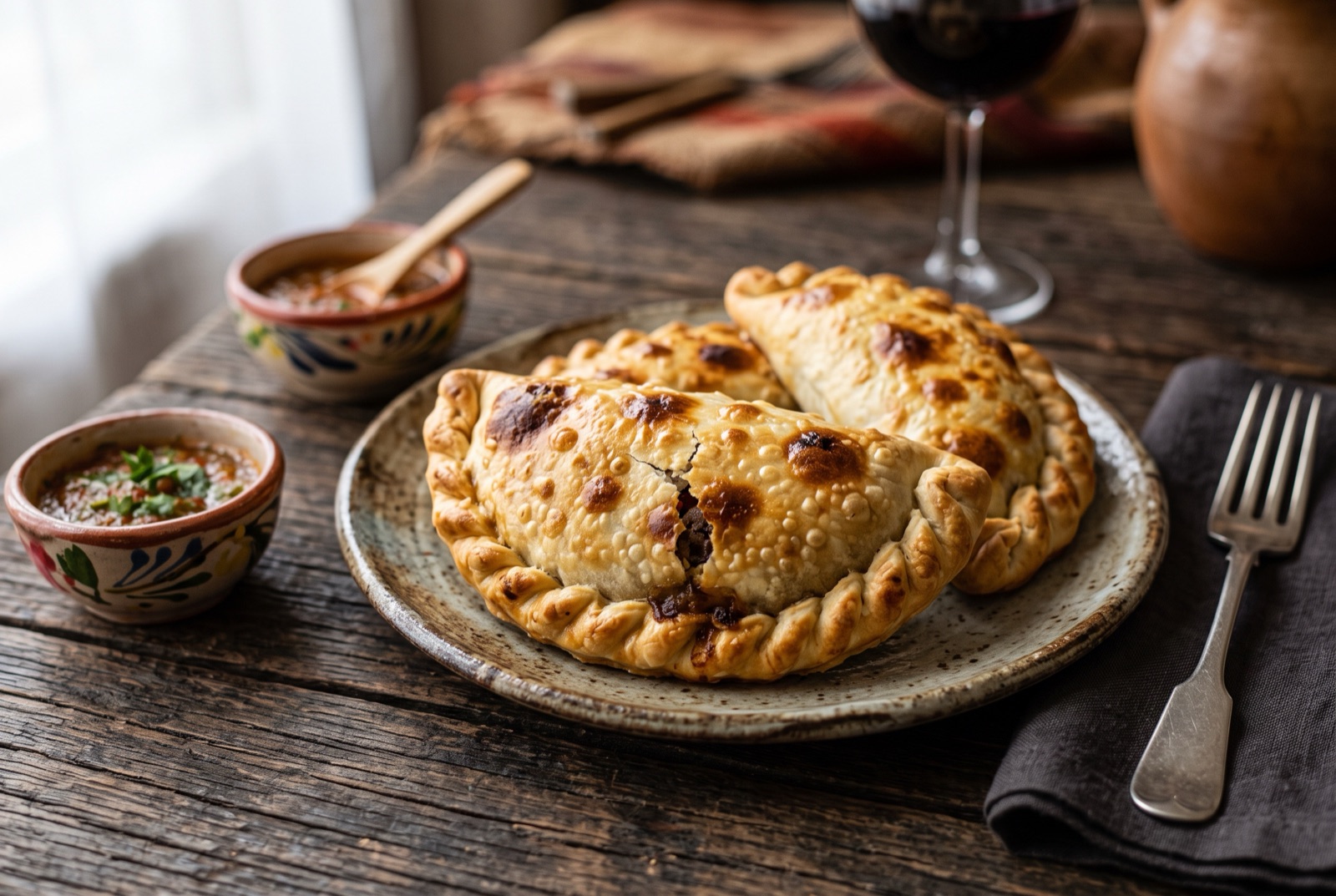
An empanada salteña is a small wheat-pastry turnover filled with beef that has been cut with a knife rather than minced, cooked briefly with a large amount of onion, cumin, sweet paprika and scallion, then chilled solid before it is wrapped. The filling is deliberately juicy — as the empanada bakes the set fat melts again and the inside turns to a loose, savory braise, which is why you eat these leaning forward. Diced potato, a wedge of hard-boiled egg and a green olive go in with the meat. They are small enough that three make a starter and six make dinner, and they are meant to be eaten hot enough to burn your mouth slightly.

- Gate
- ArgentinaSalta
- Prep
- 50 min
- Cook
- 25 min
- Total time
- 5 hr 15 min incl. 4 hr rest
- Serves
- 4
- Status
- Medium
- Nutrition / serving · estimated
- Calories 640 kcal
- Protein 30 g
- Carbs 58 g
- Fat 32 g
- Fiber 4 g
- Sodium 890 mg
Why this recipe works.
- Knife-cut beef instead of mince, so the filling has texture rather than turning to paste.
- The overnight chill is built into the method, which is the difference between juicy and leaking.
- Explains the repulgue fold step by step, including the fallback fork seal if your hands refuse to cooperate.
- Honest about the mud oven: what its floor heat gives you and how to fake most of it at home.
Ingredients.
16 itemsFor the dough
For the filling
To fill and finish
Equipment
- Heavy pan for the filling
- Rolling pin
- 12 cm round cutter or bowl
- Baking tray or pizza stone
Instructions.
Cook the onions down
Melt the cooking fat in a wide pan over medium heat and add 700 g of chopped onion with a good pinch of salt. Cook for 15–18 minutes, stirring often, until the onion has collapsed to about a third of its volume, turned glassy and smells sweet rather than sharp. Do not let it brown.
Add the beef and spices
Raise the heat, add the diced beef and stir for 3–4 minutes only, until the outside has lost its raw red colour but the centre is still pink. Stir in the cumin, paprika and chile, season firmly with salt and pepper, and take the pan off the heat — the meat finishes cooking inside the empanada.
Tip The mixture should look wet and loose in the pan. That liquid is what makes the empanada juicy once it sets.
Boil the potato and chill the filling
Boil the diced potato in salted water for 6–7 minutes, until a knife tip meets slight resistance, then drain well and fold it into the meat with the sliced scallions. Spread the filling in a shallow dish, cool it, then refrigerate for at least 4 hours or overnight until the fat has set firm on top.
Make the dough
Rub the fat into the flour and salt with your fingertips until it looks like coarse sand, then add the warm water and bring it together into a shaggy mass. Knead for 4–5 minutes until smooth and elastic, wrap and rest for 30 minutes at room temperature so it rolls without springing back.
Cut and fill the discs
Roll the dough 2–3 mm thick and cut twelve 12 cm rounds. Put two tablespoons of cold filling slightly off-centre on each, add a quarter of hard-boiled egg and half an olive, and keep a clean 1.5 cm border all the way round.
Seal with the repulgue
Fold each disc over into a half-moon and press the edges together firmly. Starting at one corner, fold a small piece of the rim over onto itself and press, then repeat along the curve so you build a rope of overlapping folds. If the folds fight you, press the edge flat with a fork instead — it seals just as well.
Tip Wet fingers make the pastry slippery. Keep hands dry and the rim free of filling and the seal holds.
Bake hot
Heat the oven to its maximum, at least 220°C, with a heavy tray inside. Brush the tops with beaten egg, slide the empanadas onto the hot tray and bake for 12–15 minutes, until the pastry is deep gold, freckled with darker blisters and firm underneath when you lift one.
Rest briefly and serve
Let them sit 5 minutes off the tray so the filling stops sloshing, then serve straight away while the shell is still crisp. Eat them hand-held, bitten from a corner, with a napkin — the juice inside is the point.
Tips from our kitchen.
- Cut the beef into 5 mm dice with a sharp knife. A food processor bruises it into paste and the filling loses all its bite.
- Weigh the onion — you want roughly 700 g for 500 g of meat. It looks absurd raw and cooks down to exactly the right amount of juice.
- The filling must be refrigerator-cold and firm before you fill anything. Warm filling melts the fat into the dough and the empanadas split.
- Bake as hot as your oven goes, on a preheated tray or stone, so the bases set before the filling has time to soak through.
- Leave a clean 1.5 cm border of dry pastry around the filling; any grease on the rim stops the seal from holding.
- Brush with beaten egg only on top, never over the crimp, or the folds glue shut unevenly and tear.
Substitutions.
- Beef fat (grasa de pella) for the dough → Cold unsalted butter, or half butter and half lard
- Beef fat gives the flakiest, most traditional shell and a faint savory note. Butter is easier to buy and works well; the pastry is slightly softer and browns faster.
- Ají molido (Argentine crushed red chile) → Sweet paprika plus a small pinch of chile flakes
- Ají molido is mild and fruity rather than hot. Do not reach for cayenne — these empanadas are seasoned, not spicy.
- Homemade dough → Frozen tapas para empanadas (empanada discs), the criollas type for baking
- Latin grocers and many supermarkets stock them. Use the discs marked for baking rather than frying; they are thinner and less greasy.
Variations.
- Tucumana
- No potato, matambre or another cut boiled and diced instead of raw beef, and often fried in beef fat rather than baked. Juicier and richer, and the province will tell you it is the original.
- Empanadas de humita
- A meatless northern filling of grated fresh corn cooked with onion and milk into a thick, creamy paste, sometimes with cheese. Served alongside meat empanadas rather than instead of them.
- Empanadas de carne cortada a cuchillo con pasas
- The Catamarca and Riojana habit of adding raisins to the beef filling for a sweet-savory edge. Divisive elsewhere in the country, standard at home.
Storage & reheating.
Baked empanadas keep 3 days refrigerated; reheat at 180°C for 8–10 minutes so the shell crisps again, never in the microwave, which turns the pastry to leather. They freeze best raw and unbaked: freeze on a tray until solid, bag them, and bake straight from frozen at 200°C, adding about 6 minutes. The filling on its own keeps 3 days refrigerated and freezes for 2 months.
Serve with
Ají or chimichurri for dipping, a bowl of salsa criolla, and a glass of young Malbec or Torrontés.
The story behind Empanadas Salteñas.
The empanada arrived in South America from Spain, which had it from a longer Mediterranean and Middle Eastern line of stuffed pastries, and every country in the region then took it somewhere different. Chile stuffs its pino version with beef, onion, raisin and egg and bakes it flat and wide; Bolivia has the saltena, a soupy baked pasty with its own separate history; Colombia and Venezuela fry theirs in corn dough. Arguing about which nation owns the empanada is a losing exercise — it belongs to all of them, and the interesting differences are provincial rather than national.
Inside Argentina alone the variations are strict and taken seriously. Salta and Jujuy cut the beef by hand, add potato, and bake in a horno de barro, a domed mud oven whose floor heat gives the base its blistered spots. Tucumán refuses potato and traditionally uses matambre, boiled and diced, often fried rather than baked. Mendoza leans on olives, Santiago del Estero on a heavier hand with cumin, and Catamarca sweetens the filling. The competitive national empanada festival held in Famaillá exists precisely because these differences are worth fighting about.
Two details separate a good salteña from a dry one. The first is the ratio: nearly as much onion as meat, cooked down until sweet, which supplies the juice. The second is the chill — the filling goes into the fridge overnight so the fat sets hard and can be handled without soaking the dough, then liquefies in the oven. The crimp, the repulgue, is the third thing, and it is both a seal and a signature; in some provinces the number and shape of the folds once told you what filling was inside.
Questions, answered.
Why did my empanadas burst open in the oven?
Almost always one of three things: the filling was still warm when you assembled them, the rim of the dough had grease or filling on it and could not seal, or they were overfilled. Chill the filling until it is firm, keep a clean dry border of 1.5 cm, and use about two tablespoons of filling per disc.
Can I make the filling in advance?
You should. The filling is meant to rest at least 4 hours and ideally overnight in the refrigerator so the rendered fat sets and the spices settle into the meat. It keeps 3 days chilled or 2 months frozen, so making a double batch and freezing half is standard practice.
What cut of beef is best for empanadas?
A cut with some fat and connective tissue that stays tender when diced small — chuck, blade or brisket flat all work. Very lean cuts such as top round go dry and grainy inside the pastry. Buy it in a piece and dice it yourself rather than using ready-ground beef.
Should empanadas be baked or fried?
Both are traditional in Argentina and the answer is provincial rather than universal. Salta bakes, historically in a wood-fired mud oven; Tucumán commonly fries in beef fat. Baked empanadas are lighter and easier to make in quantity, fried ones are richer and blister into bubbles on the surface.
Do I really need a mud oven?
No, but it is worth knowing what you are missing. A horno de barro holds fierce floor heat that sets the base instantly and leaves scorched blisters on the pastry. At home a domestic oven at maximum temperature with a preheated steel tray or pizza stone gets you most of the way there.
You might also like.
All recipes →
Keep exploring Argentina.
Argentina has 9 more dishes in the atlas — Alfajores de Maicena and Asado, and 7 more.
Recipe by The DishRoute Kitchen · published August 20, 2026 · updated August 20, 2026