Locro.
Argentine Hominy, Squash and Meat Stew
Locro criollo · say it: LOH-kroh
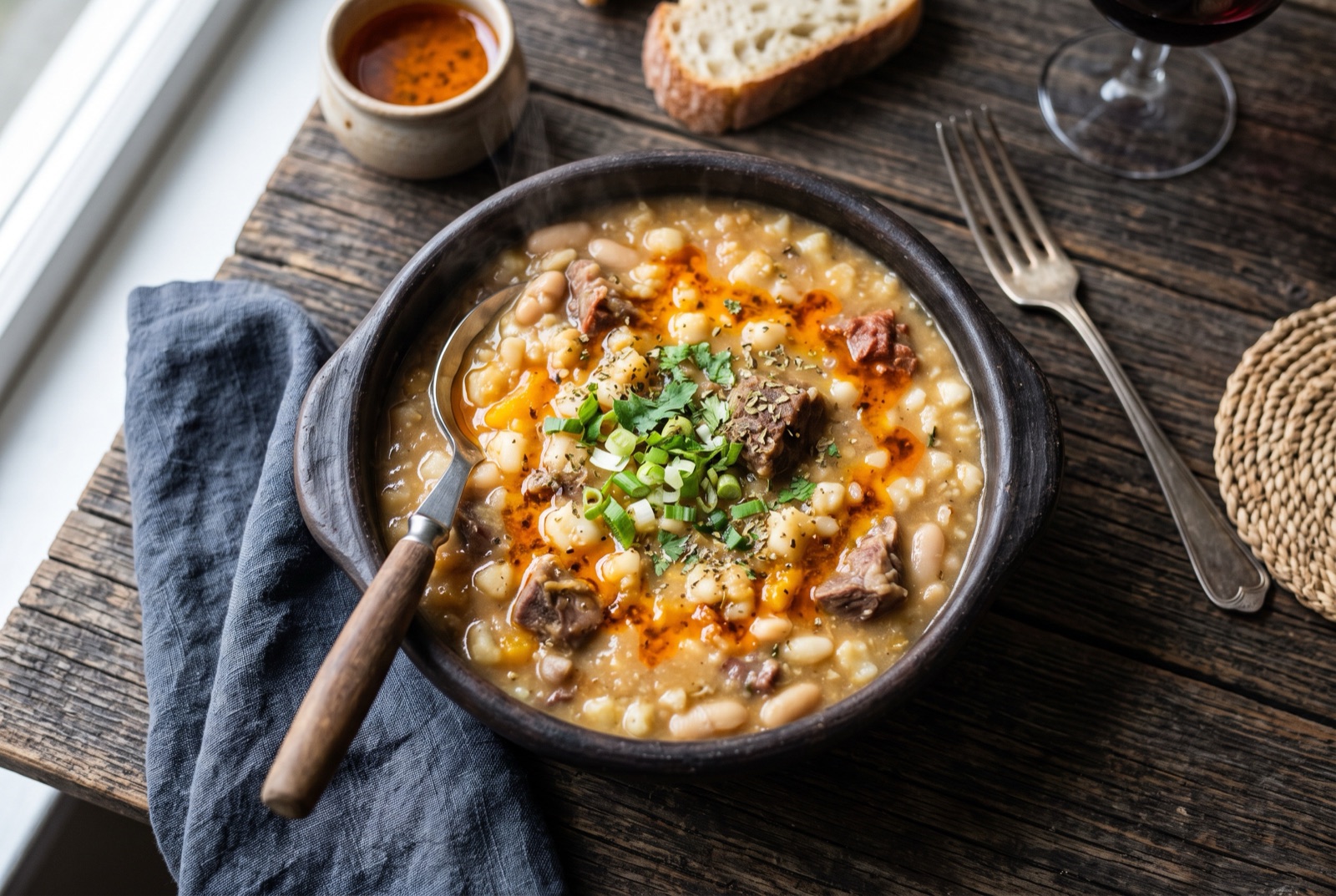
Locro is a thick winter stew built on white hominy corn, dried beans and squash, cooked for three hours with beef shank, pork belly and chorizo until the squash disintegrates and thickens everything into something closer to a porridge than a soup. It tastes deep and starchy-sweet rather than spiced, and it is finished at the table with a spoonful of hot red oil made from scallions, paprika and chile — that final drizzle is what stops it being heavy. One pot feeds a crowd, it is better on the second day, and in Argentina it is eaten on two specific dates in the middle of winter.

- Gate
- ArgentinaNorthwest
- Prep
- 30 min
- Cook
- 3 hr 30 min
- Total time
- 16 hr incl. 12 hr rest
- Serves
- 8
- Status
- Medium
- Nutrition / serving · estimated
- Calories 640 kcal
- Protein 36 g
- Carbs 54 g
- Fat 31 g
- Fiber 11 g
- Sodium 980 mg
Why this recipe works.
- Soaking and timing set out clearly, so the corn, beans and squash all finish together.
- The paprika-scallion oil is made properly and served separately, the way it is eaten.
- Uses cuts a normal butcher stocks instead of hard-to-find pig trotters and skin.
- Explains the thickening — squash, not flour — so you know what you are waiting for.
Ingredients.
18 itemsSoaked the night before
The pot
For the paprika oil
Equipment
- Large heavy stockpot
- Flat wooden spoon
- Small frying pan for the oil
Instructions.
Soak overnight
Put the hominy and the beans in two separate bowls, cover each with plenty of cold water and leave them 10–12 hours. The corn kernels will swell to nearly double and lose their chalky look; drain both and discard the soaking water.
Start the corn and meats
Tip the drained hominy into a large pot with the beef shank, pork belly and tripe if using, add the water and bring to a simmer. Skim the grey foam off the surface for the first ten minutes, then add the bay leaves and cook uncovered for 1 hour.
Add the beans and aromatics
Stir in the drained beans, the chopped onion, garlic, cumin and the tablespoon of paprika. Simmer another hour, topping up with hot water if the level drops below the solids, until the beans are tender enough to crush against the side of the pot.
Tip Hold the salt until this point. Salted water keeps bean skins tough.
Add the squash and chorizo
Add both the chunked and grated squash along with the sliced chorizo, season with salt, and cook for a final 45–60 minutes. The grated squash should vanish into the liquid while the chunks stay just intact, and the surface should turn a warm orange.
Thicken and check
Stir the bottom of the pot firmly with a flat spoon every ten minutes now, breaking up the meat into shreds as it falls apart. The locro is ready when a spoon pushed upright into it leans over slowly instead of dropping, and the corn is soft with a faint chew left.
Fry the paprika oil
While the pot finishes, warm the oil in a small pan over low heat, add the scallions and cook 2 minutes until limp and fragrant. Pull the pan off the heat, stir in the paprika and chile flakes, and let them steep in the residual heat until the oil turns deep red — do not let the paprika sizzle or it goes bitter.
Serve with the oil on top
Ladle the locro into deep bowls and spoon a tablespoon of the red oil over each, letting it spread across the surface without stirring it in. Season at the table and eat it hot enough to steam.
Tips from our kitchen.
- Soak the hominy and beans in separate bowls overnight. The corn takes far longer to cook and needs a head start in the pot.
- Do not salt until the beans have softened. Salt early and the skins stay tough no matter how long you simmer.
- Cut half the squash into large chunks and grate or finely dice the rest — the small pieces melt and thicken, the large ones stay visible.
- Stir along the bottom every 20 minutes with a flat wooden spoon. Locro catches and scorches easily once it thickens.
- Add the chorizo in the last hour only. Any earlier and it gives up all its fat and turns to grey crumbs.
- Make it a day ahead if you can. It thickens further overnight and the flavours settle; loosen with hot water when reheating.
Substitutions.
- White hominy (maíz blanco pisado / mote) → Tinned hominy, drained, added in the last hour; or pearl barley for a different but workable texture
- Dried hominy from a Latin grocer gives the correct bite and starch. Tinned is already cooked, so it needs no soaking and only heating through. Barley thickens the stew more aggressively.
- Dried white beans → Butter beans, cannellini or a tin of each added late
- The bean is not the star here. Any large white bean works; tinned beans should go in during the last 30 minutes so they do not disintegrate.
- Pork belly and beef shank → Smoked pork hock plus beef brisket, or chicken thighs for a lighter pot
- You want one cut that provides collagen and one that provides fat. Lean meat alone makes a thin, disappointing locro.
Variations.
- Locro vegetariano
- Built on hominy, beans, squash, sweet potato and corn with a strong paprika oil and no meat. Genuinely eaten in Argentina at public locros, not a modern invention, and it needs extra fat to taste finished.
- Locro santiagueño
- The Santiago del Estero style, heavier on the corn and cooked with tripe and pork skin for a stickier, more gelatinous body. Traditionally the thickest version of the three main regional takes.
- Locro con mondongo
- Tripe cut into ribbons and simmered from the start alongside the meats. Adds body and a distinct texture; leave it out if it is not to your taste and nobody will call the stew wrong.
Storage & reheating.
Locro keeps 4 days refrigerated and genuinely improves after one night. It sets almost solid when cold, so reheat gently with a cup of hot water or stock stirred in, over low heat, scraping the base constantly. It freezes very well for 3 months in portions; freeze without the paprika oil and make that fresh, since it tastes flat once frozen and thawed.
Serve with
Nothing but the paprika oil, bread on the side, and a strong red wine — locro is a one-bowl meal.
The story behind Locro.
Locro predates Argentina by a long way. Its base — corn, squash, beans and potato cooked in one pot — is Andean, and versions of it are eaten from Ecuador down through Peru and Bolivia into northern Chile and Argentina, with the name coming from Quechua. What the Spanish added was livestock: beef, pork and the fat that comes with them, which turned a vegetable-and-grain stew into the meat-heavy version made in Salta, Tucumán and Santiago del Estero today. Along the way each region kept its own emphasis, and the Peruvian and Ecuadorian dishes carrying the same name are now quite different from the Argentine one.
In Argentina the stew became attached to two national dates, 25 May and 9 July, both of which fall in winter in the southern hemisphere. Political parties, unions, schools and neighbourhood clubs cook it in enormous pots and sell portions by the bowl, and for many city-dwellers those two days are the only times of year they eat it. That is unusual for a national dish: locro is less a daily food than a calendar event, and its association with public celebration is as much a part of it as the ingredients.
The cooking itself is patient and largely unattended. Hominy and beans soak overnight, then everything simmers together long enough for three separate things to happen: the corn softens and splits, the squash falls apart and thickens the pot, and the collagen in the shank and pork skin dissolves into the liquid. The stew is done when a spoon stood upright in it leans slowly rather than falling. Nothing in it is spicy — the heat arrives only at the end, in the fried paprika oil that people ladle over their own bowls, called quiquirimichi in some northern provinces and simply salsa de grasa colorada elsewhere.
Questions, answered.
What is hominy and where do I find it?
Hominy is dried corn treated with an alkaline solution so the hulls slip off and the kernels swell, sold as maíz blanco pisado, mote or pozole corn. Latin American grocers and many large supermarkets carry it dried or tinned. Dried needs an overnight soak and around three hours of simmering; tinned is already cooked.
Why is my locro thin instead of thick?
The squash is the thickener, and it has to break down completely. Grate or finely dice at least half of it so it dissolves into the liquid, keep the pot at a real simmer rather than a bare one for the last hour, and leave the lid off so liquid reduces. A correctly thickened locro holds the mark of a spoon for a moment.
Is locro spicy?
The stew itself is not — it is seasoned with cumin, paprika and bay leaf and tastes sweet and savoury rather than hot. The heat comes from the fried oil spooned over each bowl at the table, so everyone controls their own. Make that oil as mild or as fierce as you like.
Can I make locro in a pressure cooker?
Yes, and it saves about two hours. Cook the soaked hominy, beans and meats under pressure for 40 minutes, release, then add the squash and simmer uncovered for another 30 minutes so it breaks down and thickens the pot. Adding the squash under pressure turns it to water rather than to body.
When do Argentines actually eat locro?
Mainly on the two winter national holidays, 25 May and 9 July, when clubs, unions and neighbourhood organisations cook it in bulk and sell it by the bowl. It is also common in the northwest provinces through the cold months, but in Buenos Aires it is strongly tied to those dates.
You might also like.
All recipes →
Keep exploring Argentina.
Argentina has 9 more dishes in the atlas — Alfajores de Maicena and Asado, and 7 more.
Recipe by The DishRoute Kitchen · published August 20, 2026 · updated August 20, 2026