Bantan.
Mongolian Flour Crumb Soup
Бантан · say it: BAHN-tahn
Bantan is a thin, savoury porridge of a soup: mutton broth into which flour, dampened and rubbed between the palms into loose crumbs, is scattered so it cooks into small soft pellets rather than a paste. The texture sits somewhere between soup and thin congee, the flavour is broth and wheat and salt, and it is deliberately gentle. This is what a Mongolian household gives someone who is ill, a small child, or an adult who overdid the vodka. It also takes fifteen minutes if the broth already exists, which is part of why it endures.
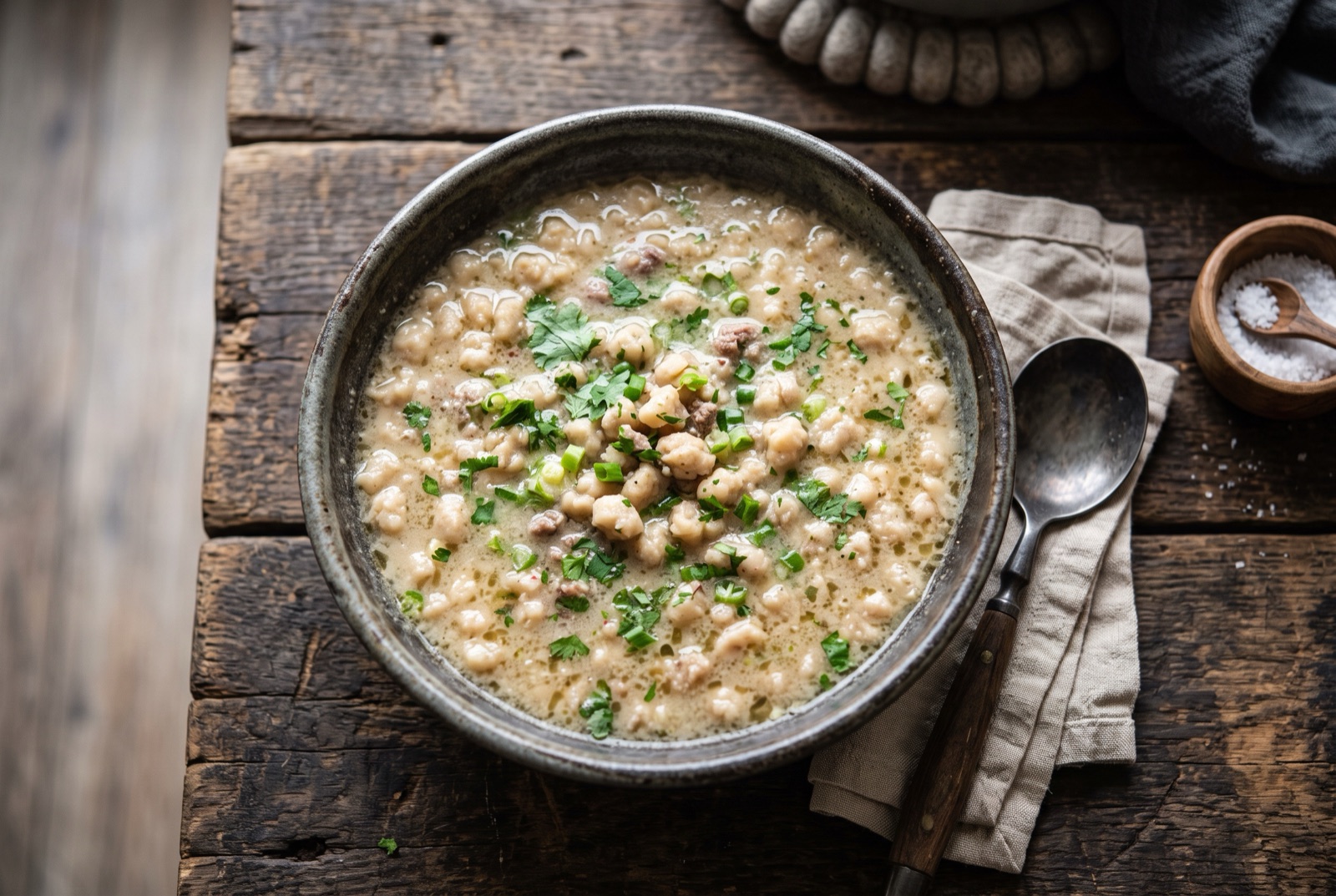

- Gate
- Mongolia
- Prep
- 10 min
- Cook
- 20 min
- Total time
- 30 min
- Serves
- 4
- Status
- Easy
- Nutrition / serving · estimated
- Calories 320 kcal
- Protein 18 g
- Carbs 30 g
- Fat 14 g
- Fiber 2 g
- Sodium 1100 mg
Why this recipe works.
- The rubbing technique explained properly, which is the difference between crumb soup and glue.
- Two thicknesses given — thin for someone ill, thicker for a real meal.
- Works with leftover broth, so it is a genuine fifteen-minute dish.
- Includes the optional beaten egg finish that most Mongolian households actually use.
Ingredients.
10 itemsEquipment
- Saucepan
- Wide shallow bowl for rubbing the flour
- Whisk or wooden spoon
Instructions.
Rub the flour into crumbs
Put the flour in a wide bowl and sprinkle over the cold water a teaspoon at a time, rubbing the flour between flat palms after each addition. Stop when it forms loose, irregular crumbs the size of small peas with no dry powder and no sticky lumps left.
Tip If a crumb squashes into paste between your fingers you have added too much water — work in another spoonful of dry flour.
Fry the meat and onion
Melt the fat in a saucepan over medium heat, add the onion and cook until soft and translucent, then add the minced mutton if using and fry, breaking it up, until it has lost all pink and started to brown at the edges.
Bring the broth up
Pour in the broth, add the salt and pepper and bring to a gentle simmer. Taste it now — the crumbs will mute the seasoning, so it should already taste well salted rather than merely acceptable.
Scatter in the crumbs
Stirring the simmering broth continuously with one hand, sift the flour crumbs in through the fingers of the other so they fall separately across the whole surface. Keep stirring for a full minute after the last of them goes in.
Tip Dumping them in one place is how a bantan turns into one large dumpling.
Simmer until the crumbs soften
Cook at a low simmer for 8 minutes, stirring every so often to stop the base catching, until the crumbs are soft all the way through with no chalky centre and the soup has thickened to a loose, cloudy porridge.
Finish and serve
If using the egg, pour it in slowly in a thin stream while stirring so it sets into fine threads. Correct the salt, scatter the scallion greens over and serve very hot, thinned with a little extra broth if it has stiffened.
Tips from our kitchen.
- Add the water to the flour in tiny amounts. Too much at once gives dough, and dough gives lumps.
- Rub with your palms flat, not your fingertips — you want to break clumps apart, not press them together.
- Sift the crumbs through your fingers as you scatter them into the pot so they land separately rather than as a clump.
- Stir constantly for the first minute after adding the crumbs. That is when they are most likely to weld together.
- Season at the end. The crumbs absorb salt as they cook, so a broth that tasted right beforehand will taste flat afterwards.
- If it thickens too much on standing, thin it with hot broth rather than water so the flavour holds.
Substitutions.
- Mutton broth → Beef or chicken stock, or plain salted water
- A good broth makes the soup; a weak one leaves it tasting of nothing but flour. If you only have water, add a spoonful of butter or fat for body.
- Minced mutton → Any minced meat, or leave it out entirely
- The version given to someone ill is usually made without meat at all — just broth, crumbs and salt.
- Plain wheat flour → Barley flour, or half wheat and half barley
- Barley flour is used in some households and gives an earthier, slightly nuttier soup with a greyer colour.
Variations.
- Egg bantan
- A beaten egg streamed in at the end while stirring, giving fine threads through the soup and noticeably more body.
- Milk bantan
- Made with milk in place of some of the broth for a mild, faintly sweet version often given to small children.
- Thick meat bantan
- Twice the crumbs and a generous amount of minced mutton fried in first, producing a spoon-standing porridge eaten as a full meal.
Storage & reheating.
Bantan keeps 2 days refrigerated but thickens dramatically as it cools — expect to need a good splash of hot broth when reheating, plus a fresh pinch of salt. Reheat gently while stirring, since the flour crumbs catch and scorch on a hot base. It does not freeze acceptably: thawed crumbs turn grainy and the texture separates into watery liquid with sediment underneath.
Serve with
Nothing, usually. If it is a meal rather than medicine, a piece of boortsog or flat bread on the side.
The story behind Bantan.
Bantan belongs to the same practical tradition as the rest of Mongolian home cooking — flour, meat, water — but its role is medicinal rather than nutritional in the ordinary sense. It is convalescent food, and the reputation is national. Ask about hangovers in Mongolia and bantan comes up quickly, alongside the same claim made for broths in a dozen other cultures: salt, warmth, fat and easily digestible starch, which is a reasonable description of what a depleted body wants.
The technique is the interesting part. Adding raw flour to hot liquid gives lumps, because the outside of any clump gelatinises instantly and seals the dry flour inside. The Mongolian answer is to wet the flour first — very lightly, a spoonful of water at a time — and rub it between the palms until it forms irregular crumbs the size of small peas. Each crumb is already hydrated through, so it cooks evenly and stays a discrete soft pellet in the finished soup instead of dissolving into wallpaper paste. It is the same principle behind Central European rubbed dough and Italian pasta grattata, arrived at independently in a kitchen that had the same problem.
How thick bantan should be is a matter of household preference and purpose. For someone ill it is made thin, barely more than cloudy broth with a few crumbs suspended in it. As everyday food it goes thicker and often has an egg beaten in at the end for body. Minced meat may be added, or not. What stays constant is that it is unspiced beyond salt, always served very hot, and always made in one pot with no fuss whatsoever.
Questions, answered.
How do I stop the flour going lumpy?
Wet the flour before it meets the hot liquid. Sprinkle water over it a teaspoon at a time and rub it between flat palms until it forms separate pea-sized crumbs, then scatter those into the pot while stirring. Raw dry flour tipped into hot broth always lumps, because the outside gelatinises and seals the dry centre in.
How thick should bantan be?
It depends what it is for. Made for someone who is ill it should be barely thicker than broth, with crumbs suspended in it. As a proper meal it is much thicker, close to a loose porridge that mounds slightly on the spoon. Adjust by using more or fewer crumbs, not by boiling it down.
Can I make bantan without meat?
Yes, and the convalescent version often is. Use a good broth if you have one, or salted water with a spoonful of butter for body. Without any fat or broth behind it the soup tastes distinctly of raw flour, so at minimum add fat and season it firmly.
Why is it considered a hangover cure?
It delivers salt, warm liquid, fat and easily digested starch in a form that is very easy on an unhappy stomach, which is the same reasoning behind broths in many other countries. Mongolians make it for hangovers, for illness and for small children for exactly those reasons.
Can I use stock cubes?
You can, and it will work, but salt the soup carefully afterwards because stock cubes are already salty and the flour crumbs absorb a surprising amount. Homemade mutton or beef broth gives a noticeably rounder result, since there is almost nothing else in the pot to hide behind.
You might also like.
All recipes →
Keep exploring Mongolia.
Mongolia has 9 more dishes in the atlas — Aaruul and Boortsog, and 7 more.
Recipe by The DishRoute Kitchen · published August 20, 2026 · updated August 20, 2026