Buuz.
Mongolian Steamed Mutton Dumplings
Бууз · say it: BOATS
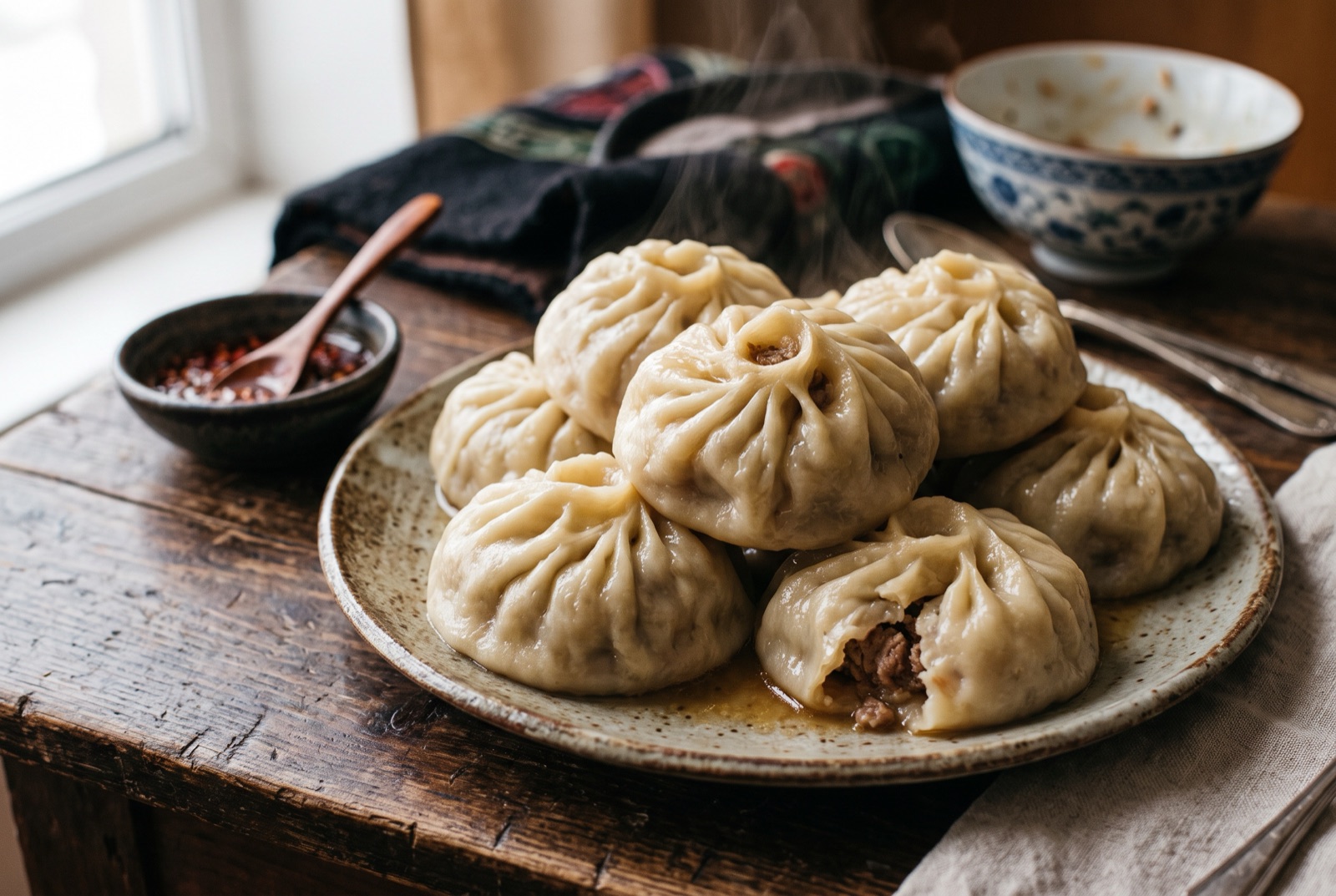
Buuz are steamed mutton dumplings the size of a small plum, pleated shut so that the fat rendering out of the filling has nowhere to go and turns into a mouthful of hot broth. The filling is deliberately plain — mutton, plenty of onion, garlic, salt, a splash of water — because the point is the meat itself and the sweetness the onion draws out of it. The wrapper is unleavened flour and water, rolled thin at the rim and left slightly thicker at the centre so it can carry the weight. You eat them with your fingers, bite a small hole first, drink the juice, then finish the rest.

- Gate
- Mongolia
- Prep
- 1 hr
- Cook
- 20 min
- Total time
- 1 hr 50 min incl. 30 min rest
- Serves
- 4
- Status
- Medium
- Nutrition / serving · estimated
- Calories 540 kcal
- Protein 26 g
- Carbs 48 g
- Fat 28 g
- Fiber 3 g
- Sodium 890 mg
Why this recipe works.
- A wrapper method that stays thin at the edge and sturdy at the base, so nothing splits in the steamer.
- Explains how to get real broth inside — cold fat, chopped meat, and a little water worked into the filling.
- Honest about mutton: how to buy it, how to trim it, and what changes if you use lamb instead.
- Freezer instructions built in, because buuz are made in big batches or not at all.
Ingredients.
11 itemsFor the dough
For the filling
For steaming
Equipment
- Steamer with a flat tray
- Rolling pin (a short thin one is easiest)
- Heavy knife for chopping the meat
Instructions.
Mix and rest the dough
Stir the salt into the flour, pour in the warm water and work it into a stiff, slightly rough dough. Knead 5 minutes until it stops sticking to your hands, then cover and rest 30 minutes — it should go from resistant to soft enough to dent with a fingertip.
Chop and season the filling
Chop 500 g of mutton into pieces the size of rice grains with a heavy knife, then chop the cold fat separately and fold both together with the onion, garlic, salt and pepper. Do not grind it — the texture should still look like meat, not paste.
Tip Freeze the meat for 20 minutes before chopping. Firm meat cuts cleanly instead of dragging under the blade.
Work in the water
Beat the cold water into the filling a spoonful at a time, stirring in one direction, until the mixture turns tacky and slumps slowly off the spoon. Chill it while you roll the wrappers so the fat stays hard.
Roll the wrappers
Divide the dough into 24 pieces, roll each into a ball, then flatten and roll to a 9 cm round — press harder at the edge so the rim is thin and the centre stays a little thick. Keep the finished rounds under a cloth.
Fill and pleat
Put a heaped tablespoon of filling in the centre of a wrapper, then pinch small pleats around the rim with one hand while turning the dumpling with the other, gathering them into a closed purse at the top. Press the last pleat firmly against the first so no gap remains.
Tip Hold the dumpling in your cupped palm rather than on the board — gravity keeps the filling down and the rim clean.
Steam
Brush the steamer tray with oil and set the buuz on it a finger apart. Steam over rapidly boiling water for 18 to 20 minutes, until the wrappers turn glossy and slightly translucent and feel taut and heavy when lifted.
Rest and serve
Let them stand off the heat for 2 minutes so the broth settles, then lift them off with a spatula rather than pulling. Serve hot, and warn anyone eating their first one to bite a small hole and drink before taking a full mouthful.
Tips from our kitchen.
- Chop the meat with a knife rather than grinding it to paste — mince turns dense and pasty once steamed, while hand-chopped mutton keeps its texture.
- Keep the fat cold right up to the moment you fill. Warm fat smears into the meat and renders out into the steamer instead of collecting inside the dumpling.
- Roll each wrapper so the rim is noticeably thinner than the middle; the pleats stack up at the top and a thick rim there becomes a doughy knot.
- Oil the steamer tray, not the dumplings. An unoiled tray glues the bases on and tears them open when you lift them.
- Leave a finger of space between dumplings — they swell as they steam and stuck-together buuz rip when separated.
- If the filling looks dry after mixing, add cold water a spoon at a time until it slumps slowly off the spoon. That water becomes the broth.
Substitutions.
- Mutton → Lamb shoulder, or beef chuck with extra fat
- Lamb is milder and more widely sold; beef needs about 20 percent added fat or the filling steams dry. Neither tastes quite as strong as real mutton, which is the point of the dish for Mongolians.
- Mutton tail fat → Lamb fat trimmings, or cold butter grated in
- Tail fat is the traditional and best option. Butter is not authentic but does the same mechanical job of melting into liquid inside the wrapper.
- Homemade wrappers → Thick round dumpling wrappers from an Asian grocer
- Buy the thickest available and let them warm to room temperature first. Thin gyoza skins tear under the weight of this filling.
Variations.
- Khuushuur filling
- The same meat mixture, flattened into a half-moon of dough and shallow-fried instead of steamed — the festival version of the identical filling.
- Bansh
- Miniature buuz, roughly thumb-sized, boiled instead of steamed and often dropped straight into milk tea or a clear broth.
- Cabbage and potato buuz
- A meat-light version made in lean seasons, stretching a small amount of mutton with finely chopped cabbage and grated potato.
Storage & reheating.
Steamed buuz keep 3 days refrigerated and reheat best by steaming again for 5 minutes — a microwave turns the wrapper leathery. Uncooked buuz freeze extremely well: arrange them apart on a floured tray, freeze solid, then bag them. Steam from frozen without thawing, adding 4 to 5 minutes to the cooking time. Do not thaw first, or the wrappers slump and stick to the tray.
Serve with
Suutei tsai (salted milk tea), a sharp cabbage-and-carrot pickle, and a small dish of chili sauce for those who want it.
The story behind Buuz.
Buuz belong to the dumpling family that spread across Inner Asia with the movement of people between Tibet, Mongolia and northern China — the same lineage as Tibetan momo and Chinese baozi, adapted to a kitchen where mutton and flour were the two things a household could reliably count on. What Mongolia did with the form is specific: the filling stays unspiced, the meat is chopped rather than pounded to paste, and a good share of tail fat goes in on purpose, because fat is the flavour and the calorie the steppe winter demands.
The dumpling is inseparable from Tsagaan Sar, the lunar new year. In the weeks before, families make buuz by the hundred and freeze them outdoors, which in a Mongolian winter means simply setting the trays outside the door. When guests arrive during the holiday they are steamed in batches without pause, and a household is quietly judged on how many it can offer and how well they are pleated. Counting is not a joke — households routinely make one to two thousand, and the tally is a matter of pride.
The pleating itself carries meaning. Different closures are recognised across the country: a gathered purse, a rope-like twist along one side, a simple pinched seam for everyday cooking. What is agreed on is that the seal must be complete. A buuz that leaks in the steamer loses its broth, and the cook will hear about it. Outside the new year they are ordinary food too — sold at roadside guanz canteens across the country, eaten by the plate with salted milk tea and a bowl of shredded cabbage pickle on the side.
Questions, answered.
Why did my dumplings leak in the steamer?
Almost always an incomplete seal or a wrapper that was too thin at the pleat. Press each fold firmly against the last one and check there is no pinhole at the top before steaming. Overfilling causes it too — the filling should sit below the rim, not bulge against it.
How do I get broth inside the dumpling?
The broth is rendered fat plus the water you mix into the filling. Use meat with real fat content, keep everything cold while you work, and beat two or three tablespoons of cold water into the mixture until it turns sticky. Both liquefy in the steamer and are trapped by the sealed wrapper.
Can I make buuz ahead of time?
Yes, and it is the normal way. Shape them, freeze them on a tray until hard, then store in bags for up to three months. Steam them straight from frozen with a few extra minutes. Shaped but unfrozen buuz should be steamed within an hour or the wrapper goes damp and sticky.
What is the difference between buuz and khuushuur?
The filling is essentially the same seasoned mutton. Buuz are gathered into a small round parcel and steamed, eaten year-round and especially at the lunar new year. Khuushuur are flattened into a half-moon and shallow-fried until blistered, most associated with the summer Naadam festival.
Do I need a bamboo steamer?
No. Any steamer with a flat perforated tray works, including a metal insert in a pot or a plate set on a trivet above simmering water. What matters is oiling the surface, spacing the dumplings apart, and keeping the lid on so the steam stays constant.
You might also like.
All recipes →


Keep exploring Mongolia.
Mongolia has 9 more dishes in the atlas — Aaruul and Bantan, and 7 more.
Recipe by The DishRoute Kitchen · published August 20, 2026 · updated August 20, 2026