Guriltai Shul.
Mongolian Mutton Noodle Soup
Гурилтай шөл · say it: GOO-rill-tie SHOOL
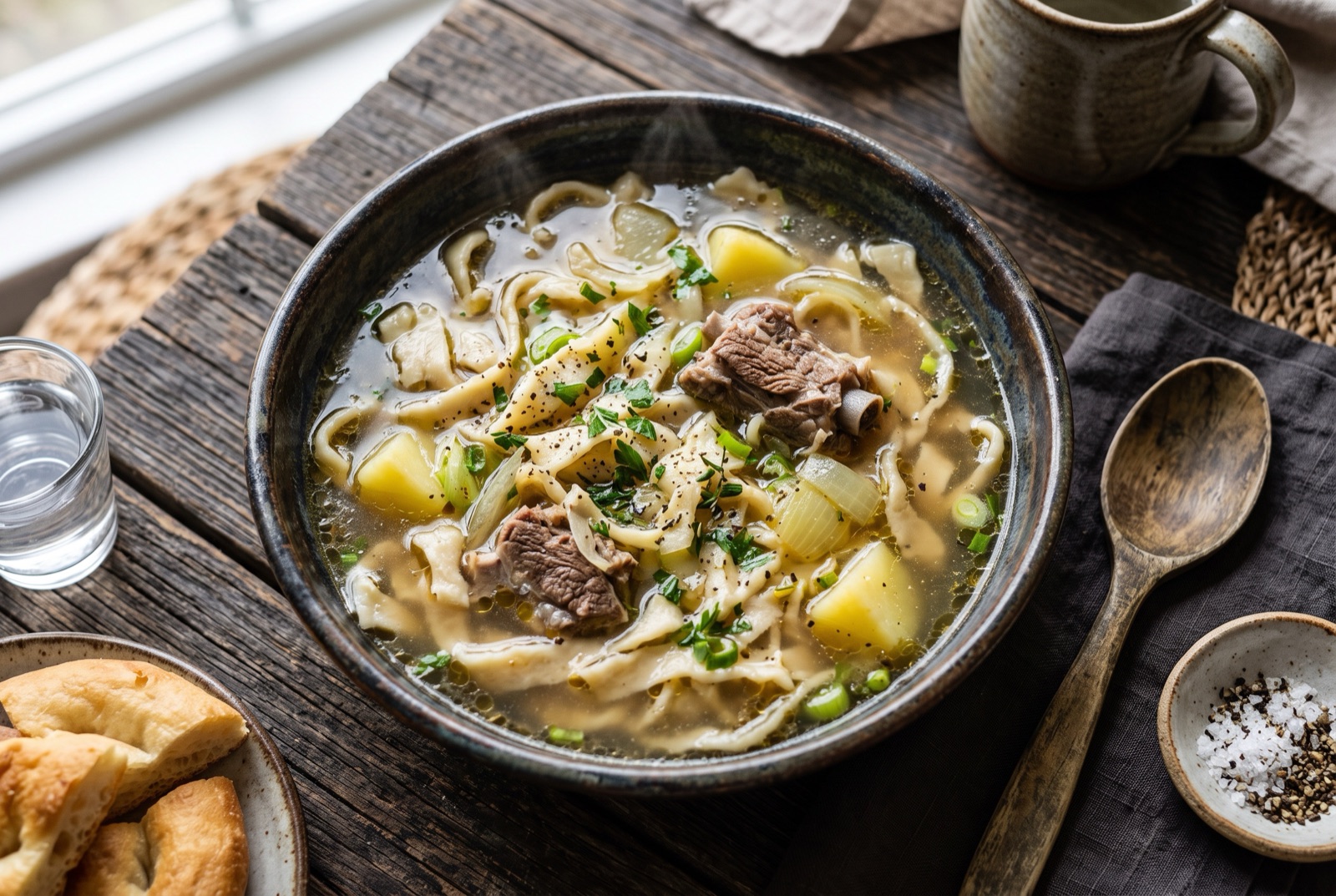
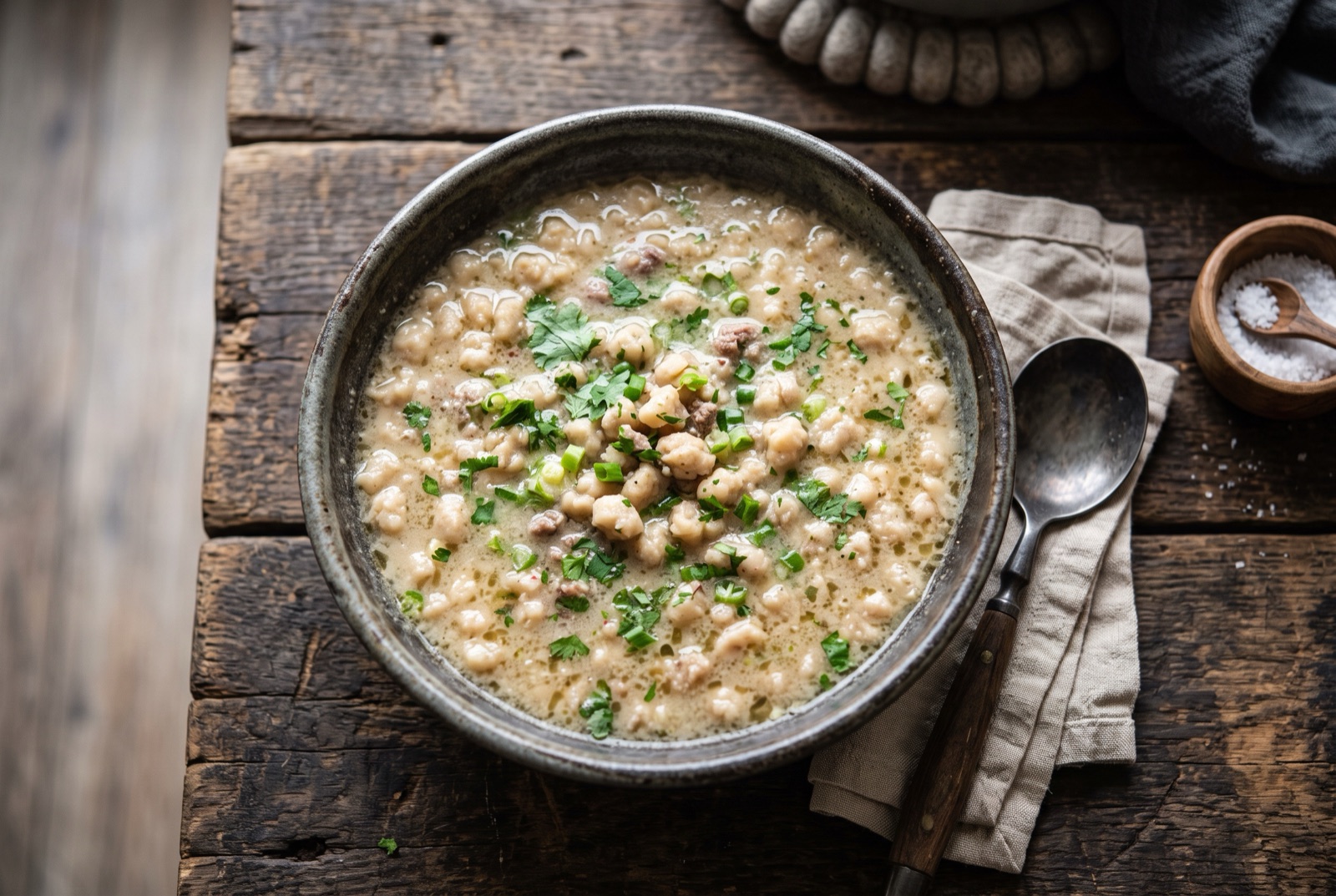
Guriltai shul is mutton soup with noodles in it, and that plainness is the point. Bone-in mutton is simmered until the broth turns cloudy-rich, then onion, potato and carrot go in, and finally strips of hand-rolled dough are dropped straight into the pot so their starch thickens the liquid slightly. Salt is the main seasoning; pepper and a few wild-onion tops if you have them. What you taste is mutton, softened by the sweetness of long-cooked onion and the starch off the noodles. It is lunch across most of Mongolia, most days.

- Gate
- Mongolia
- Prep
- 25 min
- Cook
- 1 hr 35 min
- Total time
- 2 hr 20 min incl. 20 min rest
- Serves
- 4
- Status
- Easy
- Nutrition / serving · estimated
- Calories 480 kcal
- Protein 32 g
- Carbs 52 g
- Fat 15 g
- Fiber 5 g
- Sodium 1050 mg
Why this recipe works.
- Builds a genuinely clear, deep broth by starting the mutton in cold water and skimming properly.
- Noodles torn straight into the pot, so their starch thickens the soup the way it should.
- Timings that keep the potato intact instead of dissolving into the broth.
- One pot, cheap cuts, and better on the second day.
Ingredients.
12 itemsFor the broth
For the noodles
For the soup
To finish
Equipment
- Large stockpot
- Skimmer or wide spoon
- Rolling pin
Instructions.
Start the broth cold
Put 700 g of mutton in a stockpot, cover with the cold water and bring slowly to a simmer over medium heat. Skim the grey foam off the surface as it gathers for the first 10 minutes, until only clear liquid and a bright film of fat remain.
Tip Do not stir while the foam is forming — it breaks up and disperses back into the broth.
Simmer the meat
Add the halved onion, the bay leaf and 2 teaspoons of salt, then cook at a bare tremble for 75 minutes, until the meat pulls off the bone with no resistance and the broth has turned distinctly meaty rather than watery.
Make the noodle dough
While the broth cooks, mix the flour, salt and water into a firm dough and knead 4 minutes until smooth. Cover and rest for 20 minutes so it rolls out without fighting you.
Roll and cut the noodles
Roll the dough to about 2 mm thick, dust it with flour and cut or tear it into irregular strips roughly 1 cm wide and a finger long. Leave them spread out on the board rather than heaped.
Add the vegetables
Fish out the halved onion and bay leaf. Add the sliced onion, potato and carrot to the pot and simmer 12 minutes, until the potato is tender at the edge but still holds firm when pressed with a spoon.
Cook the noodles in the broth
Drop the noodle strips into the simmering soup a handful at a time, stirring gently so they do not clump, and cook 6 minutes until they float and are tender with no floury centre. The broth will thicken slightly as their starch releases.
Season and serve
Add the pepper, then taste and correct the salt — this is a large pot and it will need more than you expect. Ladle into bowls with meat and vegetables in each and scatter the scallion greens over the top.
Tips from our kitchen.
- Start the meat in cold water, not boiling. Cold water draws out the proteins that you can then skim, which is what keeps the broth clear rather than muddy.
- Skim the grey foam for the first 10 minutes and stop there. Skimming later removes fat you actually want.
- Keep the pot at a bare tremble, never a rolling boil — hard boiling emulsifies the fat and turns the broth cloudy and greasy.
- Roll the noodle dough properly thin, about 2 mm. Thick dough strips stay stodgy in the middle no matter how long they cook.
- Add the noodles last and only to the portion you will eat now; left in the pot overnight they swell and drink the broth.
- Taste the broth before salting and expect to need more than you think — a large volume of water needs real seasoning.
Substitutions.
- Bone-in mutton → Lamb neck, beef shank, or goat
- Bones matter more than the animal. A boneless cut gives a thin broth — if that is all you have, add a couple of soup bones for the simmer.
- Hand-made noodles → Fresh wheat noodles, or torn strips of lasagne sheet
- Cook them in the broth rather than separately so the starch goes where it belongs. Dried noodles work but need their own timing.
- Wild onion tops → Scallion greens or chives
- The wild alliums used in the countryside are not exportable. Scallion greens get you the fresh sharp note, if not the exact flavour.
Variations.
- Bansh shul
- The same broth with tiny boiled dumplings instead of noodle strips — a slightly richer, more festive version of the same bowl.
- Winter version with dried meat
- Built on borts, air-dried shredded meat, which gives a darker and more concentrated broth but needs longer soaking and simmering.
- Turnip and barley
- Countryside cooks sometimes swap some potato for turnip and add a handful of barley, giving a thicker, more porridge-like soup.
Storage & reheating.
The broth and meat keep 4 days refrigerated and improve overnight as the flavours settle. Store the noodles separately if you can — left in the soup they keep absorbing liquid and go soft and bloated. The broth freezes well for 3 months without noodles or potato; freeze it plain and add fresh noodles and potato when you reheat, since both turn grainy after thawing.
Serve with
Flat bread or boortsog for dipping, and salted milk tea afterwards rather than alongside.
The story behind Guriltai Shul.
Gurilt means noodle or dough piece, shul means soup — the name simply describes the bowl. There is no secret to it and no regional argument about it, which is unusual for a national dish and tells you something about its role. This is not celebration food or restaurant food; it is what gets made when someone needs feeding and there is meat, flour and a pot. A herder's midday meal, a canteen lunch, the thing a Mongolian mother makes when you come in cold.
The noodle is worth attention. Rather than being cut into neat strands, the dough is often rolled thin and torn or sliced into irregular strips straight over the pot, which means they cook unevenly and give the soup a mix of thin, soft edges and thicker chewy centres. That variation is desirable. The starch that comes off them thickens the broth just enough to give it body without anyone adding flour or cream, which is a genuinely elegant solution in a kitchen with a short ingredient list.
The vegetables are again the storage roots that survive a Mongolian winter — potato, carrot, onion, turnip — and their proportions shift with the season and what the household has. In summer, when milk is abundant and meat less so, the soup gets thinner and the noodle share rises. In autumn after slaughtering, it gets thick with meat. In the countryside, wild alliums such as taana are gathered and dropped in fresh, and cooks who grew up eating that will tell you the shop-bought version is missing something, which it is.
Mongolians almost never make it fiery or heavily spiced. If you are used to seasoning a soup with five things, the discipline here is to add salt, taste, and stop.
Questions, answered.
Why is my broth cloudy?
Either you started the meat in hot water, or the pot boiled hard. Cold-water starts let you skim off the proteins that cloud a broth, and a gentle tremble keeps the fat from emulsifying into the liquid. Once a broth has gone cloudy from hard boiling you cannot clear it, though it still tastes fine.
Can I use store-bought noodles?
Yes. Fresh wheat noodles are the closest match and should be cooked in the broth itself so their starch thickens it. If you only have dried noodles, cook them in the soup as well but check the packet timing, and expect to add a little extra water since they absorb more.
How long should the mutton simmer?
About 75 to 90 minutes for bone-in mutton, until the meat comes away from the bone easily and the broth tastes of meat rather than water. Lamb needs closer to 60 minutes. Rushing this stage is the main reason a homemade version tastes thin.
Is it supposed to be this plain?
Yes. Mongolian soups are seasoned with salt, sometimes pepper, and whatever alliums are around, and the flavour is meant to come from the meat and the long simmer. If it tastes flat, the answer is usually more salt or a longer simmer, not more spices.
Can I make it ahead for the week?
Make the broth, meat and vegetables ahead and keep them together, but boil the noodles fresh in a ladleful of broth each time you serve. Noodles left standing in soup swell, go soft and soak up so much liquid that the whole pot turns into a thick stew by day two.
You might also like.
All recipes →
Keep exploring Mongolia.
Mongolia has 9 more dishes in the atlas — Aaruul and Bantan, and 7 more.
Recipe by The DishRoute Kitchen · published August 20, 2026 · updated August 20, 2026