Khorkhog.
Mongolian Hot-Stone Mutton
Хорхог · say it: HOR-hog
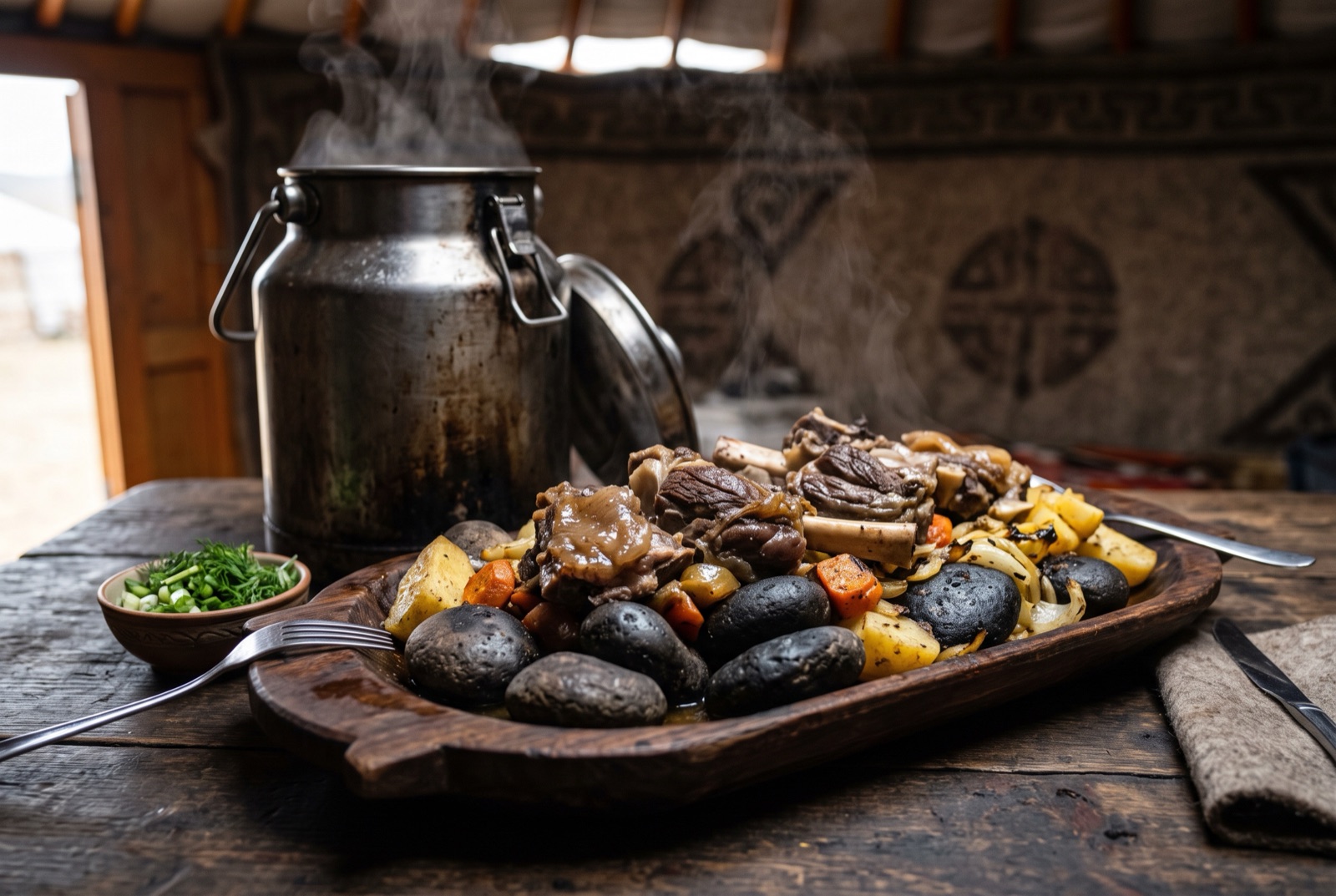
Khorkhog is mutton cooked by rocks. Smooth river stones are heated in a fire until they glow dull red, then packed between pieces of bone-in mutton and a little water inside a metal milk churn that is sealed and set over the flames. The stones cook the meat from within while the churn steams it from without, and after an hour and a half the result is dark, tender, faintly smoky mutton with a concentrated broth at the bottom. It is celebration food — made outdoors, for a group, and the hot stones are passed around and held in the hands afterwards.

- Gate
- Mongolia
- Prep
- 30 min
- Cook
- 1 hr 40 min
- Total time
- 2 hr 25 min incl. 15 min rest
- Serves
- 6
- Status
- Takes skill
- Nutrition / serving · estimated
- Calories 680 kcal
- Protein 52 g
- Carbs 22 g
- Fat 42 g
- Fiber 3 g
- Sodium 850 mg
Why this recipe works.
- An honest home adaptation that keeps the stones and the sealed-pot method rather than quietly turning into a stew.
- Specific about which stones are safe to heat and which will crack or explode.
- Layering order that puts fat and water where they need to be for a proper broth.
- Includes the outdoor version, so you can do it properly if you have a fire and a churn.
Ingredients.
9 itemsEquipment
- Heavy cast-iron Dutch oven with a tight lid
- Oven or fire for heating stones
- Long metal tongs
- Heatproof gloves
Instructions.
Heat the stones
Arrange the dry stones on a baking tray and heat at 250°C for 45 minutes, or bury them in a wood fire for the same time until they are grey-hot and the surface looks chalky. Handle them only with long tongs and heatproof gloves.
Tip Any stone that hisses, sweats or shows a hairline crack should be discarded immediately, not used.
Season the meat
Rub the salt and pepper over the mutton pieces, working it into the cut surfaces and around the bones. Have the onions, garlic and any vegetables cut and within reach — the layering has to happen fast once the stones come out.
Layer the pot
Put a hot stone in the bottom of the Dutch oven, then build alternating layers of mutton, onion, garlic and a stone every second layer, finishing with meat on top. Tuck the potatoes and carrots into the gaps if using.
Tip Work quickly and confidently. Stones lose usable heat within a couple of minutes out of the oven.
Seal and set over heat
Pour the water down the side of the pot — it will hiss hard against the stones — clamp the lid on and weight it if it does not sit tight. Set over medium-low heat on the stovetop, or on a bed of embers if you are outdoors.
Cook undisturbed
Cook for 90 minutes without lifting the lid, keeping the heat low enough that you hear a steady quiet simmer rather than a rolling boil. If the pot goes silent, raise the heat slightly.
Check the meat
Open the pot and test a piece with a fork — the meat should slide off the bone with no pull and the broth at the bottom should be dark and glossy. If it still clings, reseal and give it another 20 minutes.
Rest, serve and pass the stones
Let the pot stand covered off the heat for 15 minutes so the juices settle back into the meat. Lift the mutton onto a platter, spoon the broth over, then fish out the stones with tongs and pass them round for everyone to hold.
Tips from our kitchen.
- Use only smooth, dense, water-worn river stones about the size of an egg. Porous, layered or damp stones can crack violently when heated — never use sandstone, slate, or anything picked up from a riverbed and used wet.
- Scrub and thoroughly dry the stones a day ahead. Trapped moisture is the main cause of a stone splitting.
- Cut the mutton into large bone-in pieces. Small boneless cubes overcook against the stones and the broth loses the body the bones give it.
- Add only a cup of water. This is steaming, not boiling — the meat releases plenty of its own liquid, and too much water washes out the flavour.
- Keep the lid weighted or clamped. Steam escaping means slower cooking and dry meat, and the pressure is part of how the dish works.
- Do not open the pot to check before an hour has passed. Every opening resets the internal temperature and the stones lose their stored heat fast.
Substitutions.
- River stones → Food-safe cooking stones, or omit and cook the same layers as a covered braise
- Without stones you lose the sear and the mineral note, and you have made a good mutton braise rather than khorkhog. If you cannot source safe stones, this is the honest compromise.
- Mutton on the bone → Bone-in goat, or lamb shoulder and neck
- Goat is entirely traditional. Lamb cooks faster — start checking at 60 minutes. Boneless meat works but gives a thinner broth.
- Metal milk churn over a fire → Heavy cast-iron Dutch oven on the stovetop
- The churn is the traditional vessel and gives more even heat from all sides. A Dutch oven with a heavy lid is the closest kitchen equivalent.
Variations.
- Boodog
- The whole-animal version, in which a goat or marmot is cooked from inside its own sealed carcass with hot stones and the skin singed over the fire.
- Khorkhog with vegetables
- Potatoes, carrots and onion layered above the meat, cooked in the same steam — a modern addition that stretches the dish for a bigger group.
- Pressure-cooker khorkhog
- City kitchens sometimes use a pressure cooker with a few stones in the base, cutting the time to around 45 minutes at the cost of some depth.
Storage & reheating.
The meat keeps 3 days refrigerated, submerged in its broth so it does not dry out, and reheats gently in a covered pan. The fat sets solid on top when chilled and should be left there as a seal until you reheat. Khorkhog freezes well for up to 2 months in its broth. Never reheat with the stones in the pot — they hold heat unevenly and can scorch the meat where they touch it.
Serve with
Nothing complicated — flat bread or boiled potatoes to mop the broth, raw onion, and vodka or salted milk tea.
The story behind Khorkhog.
Khorkhog is a herder's solution to cooking a whole animal without an oven, and it survives today mostly as a festive, communal dish rather than a daily one. The traditional occasion is a gathering out in the countryside: a sheep or goat is slaughtered, butchered into large bone-in pieces, and the stones — always smooth, water-worn river stones, never porous ones that could crack or shatter — are heated in an open fire while the meat is prepared. Everything then goes into a metal container, historically a milk churn, that can be sealed and set directly over the fire.
The stones do more than add heat. They contact the meat directly, searing where they touch and giving khorkhog its characteristic mineral, faintly smoky edge that no oven produces. At the end of the meal the blackened, greasy stones are fished out and handed around the group to hold — hot enough to hurt slightly, and widely believed to be good for you. Whatever you make of the health claim, the ritual is real and it is the moment everyone remembers.
A related dish, boodog, goes further: the animal — usually a goat or a marmot — is cooked from the inside with hot stones packed into its own emptied carcass, which is sealed and the outside blowtorched or singed. Both are outdoor, group, occasion cooking, tied to summer, guests and celebration rather than the everyday pot on the ger stove.
A home cook cannot honestly reproduce a churn over an open fire in a kitchen. What follows is an adaptation using a heavy lidded pot and stones heated in the oven, which gets you the layering, the stone contact and the concentrated broth. It will not carry the wood smoke of an open fire, and it is worth saying so plainly rather than pretending otherwise.
Questions, answered.
Which stones are safe to use?
Smooth, dense, rounded river stones roughly egg-sized, scrubbed and completely dried for at least a day beforehand. Avoid porous or layered rock such as sandstone, shale, slate or limestone, and avoid any stone that is damp inside, because trapped water turns to steam and can crack the stone forcefully when heated.
Can I make khorkhog without stones?
You can cook the same ingredients as a sealed braise and it will be very good mutton, but it is not khorkhog. The stones sear the meat where they touch it and add a mineral, smoky character that nothing else in the pot provides. If safe stones are not available, make the braise and know what you are missing.
How long does it take and how do I know it is done?
About 90 minutes for mutton, 60 to 75 for lamb. It is done when the meat pulls away from the bone with no resistance and the connective tissue has gone soft and slightly sticky rather than rubbery. If it still clings to the bone, seal the pot and give it another 20 minutes.
Why is my broth thin and pale?
Too much water. Khorkhog uses only about a cup, because the meat releases a great deal of its own liquid as it cooks. If you have already added too much, take the lid off at the end and reduce hard for a few minutes until the broth darkens and coats a spoon.
Do people really hold the hot stones afterwards?
Yes. Once the meat is served the blackened stones are pulled out and passed from hand to hand around the group, hot enough to be uncomfortable. It is a customary part of the meal and widely said to be good for health and circulation, and it is the part guests remember most.
You might also like.
All recipes →
Keep exploring Mongolia.
Mongolia has 9 more dishes in the atlas — Aaruul and Bantan, and 7 more.
Recipe by The DishRoute Kitchen · published August 20, 2026 · updated August 20, 2026