Barmbrack.
Irish Tea-Soaked Fruit Loaf
Báirín breac · say it: BAW-reen BRACK
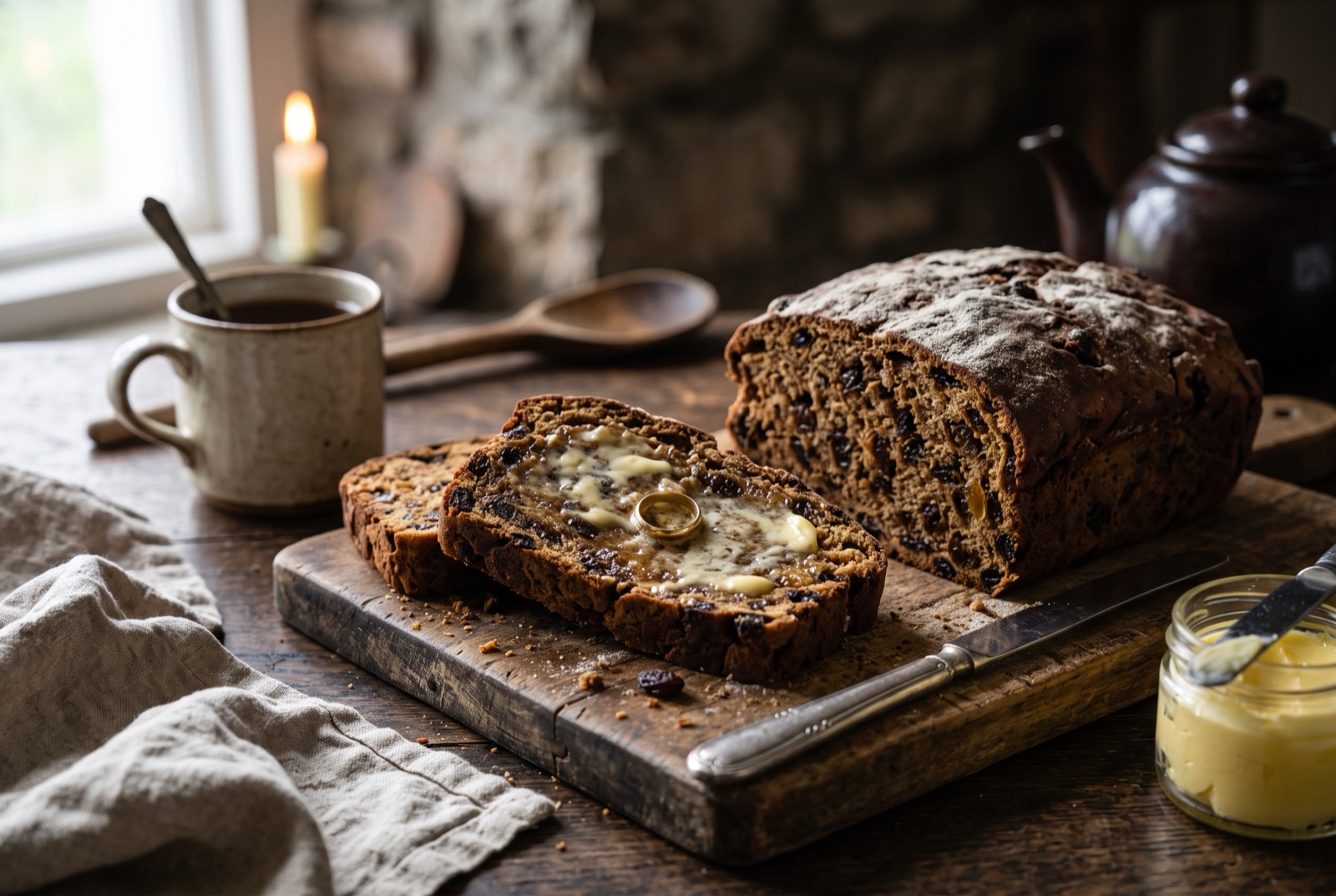
Barmbrack is a fruit loaf built on tea rather than butter. Raisins, sultanas and mixed peel are left overnight in a bowl of strong black tea until they swell and go plump and glossy, and the next morning that fruit and every drop of the tea it drank goes into a batter of flour, brown sugar, egg and mixed spice. The result is dense, dark and barely sweet, closer to a malt loaf than a cake, with a tannic edge from the tea that stops the dried fruit becoming cloying. It is not eaten as a dessert so much as with a cup of tea in the afternoon, cut in thick slices and spread with cold salted butter. At Halloween a ring goes into the batter and whoever finds it is said to be married within the year.

- Gate
- Ireland
- Prep
- 20 min
- Cook
- 1 hr 15 min
- Total time
- 13 hr 35 min incl. 12 hr rest
- Serves
- 10
- Status
- Medium
- Nutrition / serving · estimated
- Calories 320 kcal
- Protein 5 g
- Carbs 72 g
- Fat 1 g
- Fiber 4 g
- Sugar 46 g
Why this recipe works.
- Soaks the fruit a full twelve hours and uses the leftover tea in the batter, so nothing tannic or flavourful is thrown away.
- Keeps the sugar deliberately low — brack is a tea bread, and most recipes push it towards cake.
- Bakes low and slow with a foil tent, which stops the exposed raisins burning before the centre is set.
- Handles the Halloween charms safely, wrapped and added in a way that will not crack a tooth by surprise.
Ingredients.
11 itemsTo soak
For the batter
To finish
Equipment
- 900 g loaf tin
- Large mixing bowl
- Baking parchment
- Skewer
Instructions.
Steep the fruit overnight
Put the dried fruit and brown sugar in a large bowl, pour the hot tea over them and stir until the sugar dissolves. Cover and leave at room temperature overnight, or at least 4 hours, until the fruit is visibly swollen and most of the liquid has been drunk.
Tip Give it a stir before bed if you remember; the fruit on top soaks unevenly otherwise.
Prepare the tin and oven
Heat the oven to 170°C and line a 900 g loaf tin with baking parchment, leaving an overhang on the long sides so you can lift the finished loaf out. This is a sticky batter and it will not release from a bare tin.
Mix the batter
Stir the beaten egg and orange zest into the soaked fruit and any remaining tea, then sift in the flour, baking powder, mixed spice, cinnamon and salt. Fold with a spatula only until no dry flour remains — the batter will look thick, dark and lumpy with fruit, which is correct.
Tip Do not beat it smooth. Developing the gluten here makes the loaf tough and rubbery.
Add the charms, if using
For a Halloween brack, wrap a ring and any other charms individually in small squares of baking parchment and push them into the batter from the top, spaced apart, then smooth the surface over them so they are fully hidden.
Bake low and tent it
Scrape the batter into the tin and level the top. Bake for 40 minutes, then lay a sheet of foil loosely over the loaf and bake for a further 30 to 35 minutes, until a skewer pushed into the dead centre comes out clean with no wet batter clinging to it.
Glaze, cool and rest
Brush the hot loaf with warmed honey if you want a shine, then cool in the tin for 15 minutes before lifting it out onto a rack. Wrap it once fully cold and leave it a day if you can — the crumb firms and the flavour deepens noticeably.
Tips from our kitchen.
- Use genuinely strong tea — three bags in 300 ml, brewed five minutes. Weak tea leaves the loaf tasting only of raisins.
- Soak the fruit overnight, or a minimum of four hours. Under-soaked fruit steals moisture from the batter and the crumb comes out dry.
- Do not beat the batter once the flour is in. Stir until it is just combined; overworked brack is tough and rubbery.
- Tent the tin with foil after 40 minutes. The raisins at the surface scorch and turn bitter long before the middle is cooked.
- Test with a skewer into the centre, not the edge — this loaf is dense and the middle finishes last by a wide margin.
- Wrap it and leave it a day before cutting if you can. The flavour deepens and it slices far more cleanly than when fresh.
Substitutions.
- Strong black tea → Cold black tea plus 50 ml of Irish whiskey, or apple juice for a caffeine-free loaf
- Whiskey brack is a common festive version. Apple juice makes a sweeter, softer loaf with less of the tannic backbone.
- Mixed dried fruit → Any combination of raisins, sultanas, currants, chopped dates, dried cranberries or chopped apricots
- Keep the total weight the same. Larger fruit like apricots should be chopped to raisin size so it distributes evenly.
- Mixed spice → 1 tsp cinnamon plus ¼ tsp each of nutmeg, ginger and allspice
- Mixed spice is a British and Irish blend that is hard to find elsewhere; this approximates it closely.
Variations.
- Yeasted barmbrack
- The older version: an enriched yeast dough with fruit, proved twice and baked into a round. Lighter and more bread-like, and closer to what the name originally meant.
- Whiskey and marmalade brack
- Replace 50 ml of the tea with whiskey and stir 2 tbsp of coarse-cut marmalade into the batter for a sharper, more aromatic loaf.
- Brack bread and butter pudding
- Use stale slices, buttered and layered in a dish, covered with a custard of 3 eggs, 300 ml milk and 100 ml cream, then baked at 170°C for 35 minutes.
Storage & reheating.
Wrapped in foil or kept in a tin, barmbrack keeps well for 5 days and is better on days two and three than on the day it is baked. Do not refrigerate it, which dries the crumb quickly. It freezes for 3 months whole or sliced; thaw wrapped at room temperature, and frozen slices toast straight from the freezer. Once it has gone properly stale it makes an outstanding bread and butter pudding.
Serve with
Cut in thick slices with cold salted butter, and a strong cup of tea — brack is not served with cream or icing.
The story behind Barmbrack.
The name comes from the Irish báirín breac, speckled loaf, and it describes exactly what the fruit does to the crumb. The original barmbrack was a yeasted bread — barm is the froth from fermenting ale, once used as leavening — and the yeasted version is still baked and still sold, particularly by older bakeries. The tea brack in this recipe is the later, simpler descendant: raised with baking powder, requiring no proving, and made possible by soaking the fruit so long that it supplies both the liquid and the flavour. Both are called barmbrack, and the tea version is what most Irish households bake.
Its real home is Halloween. Samhain, the Gaelic festival marking the end of harvest, was traditionally a night when the boundary between worlds thinned and the future could be read, and barmbrack became one of the tools for reading it. Charms were baked into the loaf and your slice told your fortune for the coming year: a ring meant marriage, a coin meant wealth, a piece of cloth meant poverty, a thimble or button meant you would stay single, and a pea meant no marriage that year either. Shop-bought bracks in Ireland still come with a toy ring wrapped in paper inside, which is one of the more durable survivals of a pre-Christian festival into supermarket packaging.
Because it keeps, travels and improves for a day or two, brack also became the loaf kept in a tin for visitors — the thing produced with tea when someone called in. That habit is fading less slowly than most, and buttered brack remains one of the most reliable things offered in an Irish kitchen in the afternoon.
Questions, answered.
Why is a ring baked into barmbrack?
It is a Halloween fortune-telling custom rooted in Samhain, the Gaelic harvest festival. Charms were baked into the loaf and your slice predicted your year: a ring for marriage, a coin for wealth, a rag for poverty, a thimble or button for staying single, a pea for no marriage. Commercially baked Irish bracks still include a wrapped toy ring every autumn.
Is it safe to bake charms into the loaf?
Only with care. Wrap each charm tightly in baking parchment before pushing it into the batter, use metal or food-safe items rather than plastic that may melt, and tell everyone at the table that the loaf contains them before anyone bites into a slice. Do not serve a charmed brack to small children — it is a genuine choking hazard.
Why did my barmbrack turn out dry?
Usually under-soaked fruit or over-baking. Dried fruit that has not absorbed enough liquid will pull moisture out of the batter as it bakes, so soak it a full twelve hours and add every bit of the remaining tea to the mixture. Beyond that, this is a dense loaf that browns before it is cooked, so tent it with foil and go by a skewer in the centre rather than by colour.
What is the difference between barmbrack and tea brack?
Barmbrack originally meant a yeasted, enriched fruit bread — barm being the froth from fermenting ale used as leavening. Tea brack is the modern version, raised with baking powder and made with fruit soaked in tea instead. Both are widely called barmbrack in Ireland today; the tea version is quicker and far more common at home.
Can I make barmbrack without soaking the fruit overnight?
You can shorten it, but not skip it. Pour boiling tea over the fruit and leave it a minimum of four hours, or cover it and warm it gently in a pan for ten minutes then leave it to cool completely, which speeds absorption considerably. The fruit should be visibly swollen and soft before it meets the flour, or the finished loaf will be dry.
You might also like.
All recipes →
Keep exploring Ireland.
Ireland has 9 more dishes in the atlas — Bacon and Cabbage and Beef and Guinness Stew, and 7 more.
Recipe by The DishRoute Kitchen · published August 19, 2026 · updated August 19, 2026