Irish Soda Bread.
Buttermilk Quick Bread
Arán sóide
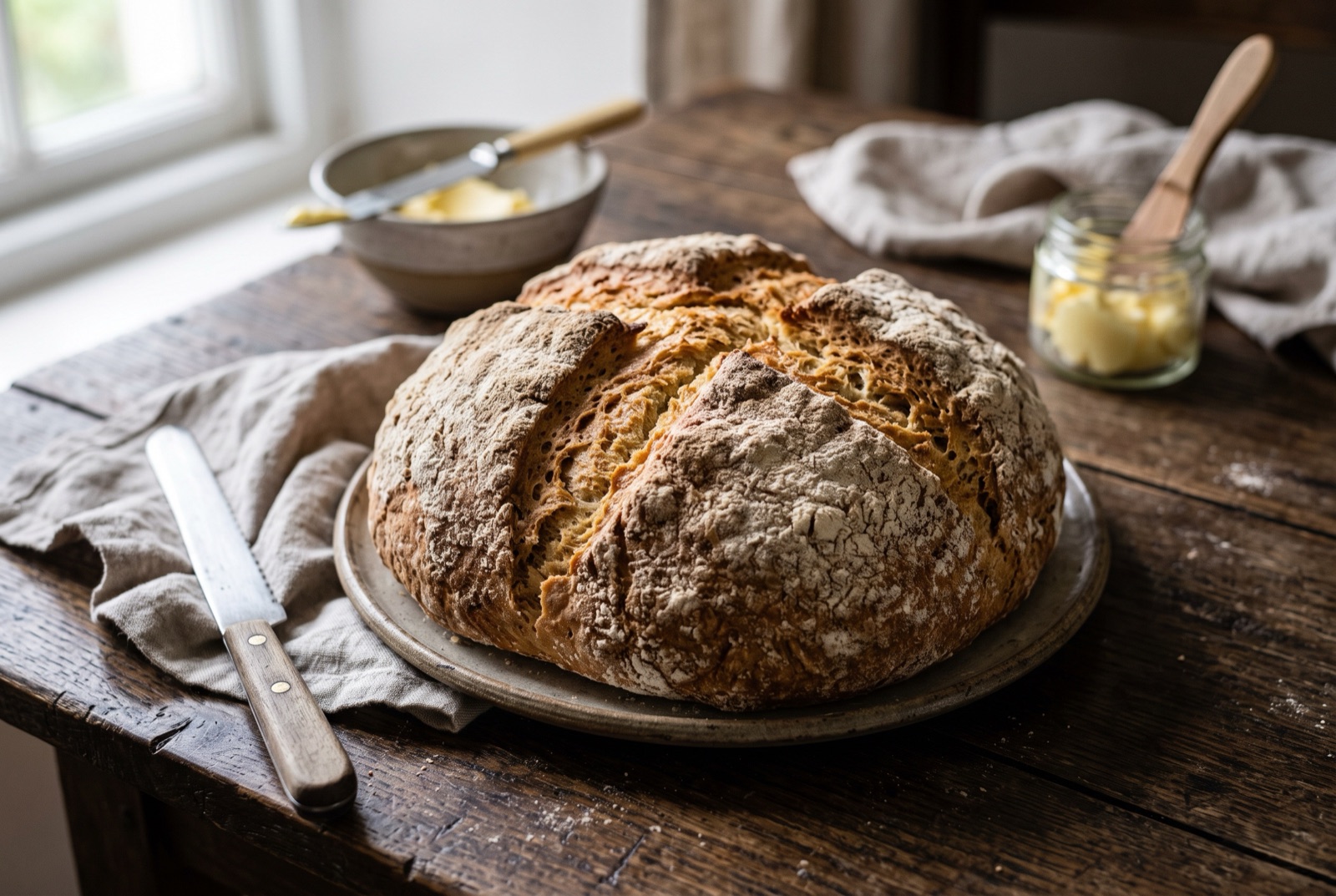
Soda bread is the fastest real bread there is. Flour, buttermilk, bicarbonate of soda and salt are stirred together for barely a minute, shaped by hand, slashed with a cross and baked — no yeast, no kneading, no rising time, and the loaf is on the table forty-five minutes after you decide to make it. The acid in the buttermilk reacts with the soda immediately and produces the carbon dioxide that lifts it, which is why speed matters more than skill here. The crumb is close, moist and slightly cakey, the crust is thick and floury, and the flavour is faintly tangy and wheaty. Eaten warm with cold salted butter it needs nothing else at all.

- Gate
- Ireland
- Prep
- 10 min
- Cook
- 45 min
- Total time
- 1 hr 15 min incl. 20 min rest
- Serves
- 8
- Status
- Easy
- Nutrition / serving · estimated
- Calories 250 kcal
- Protein 9 g
- Carbs 48 g
- Fat 2 g
- Fiber 5 g
- Sodium 520 mg
Why this recipe works.
- Gives weights and a single mixing window, because soda bread fails from over-handling far more often than from bad ingredients.
- Uses a mix of wholemeal and white flour for the brown loaf most Irish kitchens actually bake.
- Explains the hollow-tap test and the internal temperature, so you are not guessing at doneness.
- Keeps it plain and puts the fruited spotted dog where it belongs, in the variations.
Ingredients.
7 itemsEquipment
- Large mixing bowl
- Baking tray
- Sharp knife or dough scriber
- Wire cooling rack
Instructions.
Heat the oven first
Heat the oven to 220°C and dust a baking tray with flour. Do this before you touch the buttermilk — the raising reaction begins the moment it meets the soda, and a loaf waiting for a cold oven loses its lift.
Combine the dry ingredients
Tip both flours, the sieved bicarbonate of soda and the salt into a wide bowl and mix them through with your fingers for 20 seconds. Sieving the soda matters: a lump of it left whole tastes bitter and soapy in the finished bread.
Bring the dough together fast
Pour in almost all the buttermilk at once and stir in wide circles with one open hand for about 30 seconds, until there is no dry flour left. Add the last of the buttermilk only if the dough is still stiff — it should be soft, shaggy and tacky.
Tip Stop the instant it comes together. Every extra stir costs you rise.
Shape and cut the cross
Turn the dough onto a floured surface, pat it lightly into a round about 18 cm across and 5 cm tall, and lift it onto the tray. Cut a cross right across the top, about 2 cm deep, and scatter with oats if using.
Bake hot, then lower the heat
Bake at 220°C for 15 minutes, then reduce to 200°C and bake for a further 25 to 30 minutes, until the loaf is deep golden brown and the four quarters have pulled visibly apart along the cross.
Test and cool
Turn the loaf over and knock the base — it should sound hollow, and a thermometer in the centre should read at least 96°C. Cool on a wire rack for 20 minutes before cutting, wrapped in a tea towel if you prefer a softer crust.
Tip Cutting it straight from the oven compresses the moist crumb into a doughy line under the knife.
Tips from our kitchen.
- Real buttermilk gives the best rise and flavour. If you use the milk-and-lemon substitute, let it stand ten minutes until it visibly curdles.
- Mix with one hand held open like a claw, in wide circles, for no more than 30 seconds. Soda bread dough is stirred, never kneaded.
- The dough should be soft and slightly sticky. A firm, tidy dough bakes into a heavy, dry loaf every time.
- Cut the cross deep — a good 2 cm into a loaf that is about 5 cm tall — or the centre stays raw while the crust sets.
- Get the oven fully up to temperature before the buttermilk touches the soda. The reaction starts instantly and waiting dough is wasted lift.
- Cool on a wire rack under a clean tea towel if you want a softer crust; leave it bare for a crisp, floury one.
Substitutions.
- Buttermilk → Whole milk with 1 tbsp lemon juice or white vinegar per 250 ml, left to curdle for 10 minutes
- Also works with thin natural yogurt or kefir loosened with a little water. Plain milk alone will not work — the soda needs acid.
- Wholemeal flour → All plain white flour
- Makes the classic white soda loaf: lighter, paler and softer. Reduce the buttermilk by about 30 ml, as white flour absorbs less.
- Bicarbonate of soda → Baking powder, 3 tsp in place of 1 tsp soda
- A workable emergency measure, but the loaf loses the characteristic tang and rises slightly less confidently.
Variations.
- Spotted dog
- The Irish fruited version: add 100 g raisins or sultanas, 2 tbsp sugar and a beaten egg to the dough. A teatime loaf rather than a table bread.
- Ulster soda farls
- Roll the dough to 2 cm thick, cut into four triangles and cook on a dry griddle over medium-low heat for 8 to 10 minutes a side, until each face is speckled brown.
- Treacle and oat brown bread
- Swap 50 g of the flour for rolled oats and add a tablespoon of black treacle. Darker, denser and a natural partner for smoked salmon.
Storage & reheating.
Soda bread is at its best on the day it is baked and noticeably drier by the second. Keep it wrapped in a clean tea towel rather than plastic, which softens the crust to sogginess, and use day-two bread for toast, which it takes to very well. It freezes well for 3 months whole or in slices; thaw wrapped at room temperature. Stale soda bread also makes excellent breadcrumbs and a good base for a bread-and-butter pudding.
Serve with
Cold salted butter first, then seafood chowder, a boiled egg, or smoked salmon with lemon.
The story behind Irish Soda Bread.
Soda bread exists because of a chemical shortcut and a set of hard local facts. Bicarbonate of soda became widely available in Ireland in the 1830s, arriving in a country with very few household ovens, a wheat crop too soft and low in gluten to make good yeast bread, and no tradition of village bakeries in the rural west. Buttermilk, however, was everywhere as a by-product of butter-making, and it is acidic. Put the two together and you get lift without yeast, in a dough that can be baked in a covered pot buried in the embers of a turf fire — a bastible or Dutch oven. A country with no ovens got its daily bread that way.
The cross cut into the top is often explained as blessing the loaf or letting the devil out, and those stories are told sincerely across Ireland. The practical function is not in dispute either: a deep cross opens the dense dough so heat reaches the middle before the crust hardens, and it lets the baker tear the finished loaf into four quarters, called farls. In Ulster the same dough is not made into a round at all but rolled flat, cut into four triangles and cooked on a griddle, which is the soda farl that anchors an Ulster fry.
One honest correction is worth making. The loaf sold worldwide as Irish soda bread — sweetened, studded with raisins, sometimes glazed and enriched with egg and butter — is not what most Irish households mean by soda bread. Traditional soda bread has four ingredients. The fruited version does exist in Ireland and has affectionate names, spotted dog and railway cake among them, but it is a treat rather than the daily loaf, and the very sweet American St Patrick's Day version has drifted a good distance from either. The plain loaf below is the one that goes with soup, chowder, smoked salmon and boiled eggs.
Questions, answered.
Why is my soda bread dense and heavy?
Almost always over-mixing or a delay. Once buttermilk meets bicarbonate of soda the gas is produced immediately, so any kneading knocks it out and any waiting lets it escape. Mix for under a minute, shape quickly with floury hands, and get the loaf into a fully preheated oven. A dough that is too dry will also bake heavy — it should feel soft and slightly tacky.
Can I make soda bread without buttermilk?
Yes, but you need acid of some kind. Stir a tablespoon of lemon juice or white vinegar into 250 ml of whole milk and leave it ten minutes until it thickens and curdles, or use thin natural yogurt or kefir. Plain milk on its own will not react with the bicarbonate of soda, and the loaf will come out flat and taste soapy.
Why do you cut a cross in the top?
Practically, it lets heat penetrate a dense, unyeasted dough so the centre bakes through before the crust sets hard, and it lets you tear the cooled loaf into four quarters, or farls. Culturally, the cross is widely said to bless the bread or let the devil out, and plenty of Irish bakers will tell you both reasons in the same breath.
Is traditional Irish soda bread sweet, with raisins?
No. The everyday Irish loaf is flour, buttermilk, bicarbonate of soda and salt — savoury and plain, made for soup and butter. The fruited, sweetened version does exist in Ireland under names like spotted dog or railway cake, but it is a teatime cake rather than table bread, and the heavily sweetened loaves sold abroad around St Patrick's Day have drifted further still.
How do I know when it is baked through?
Turn the loaf over and knock the base with a knuckle: it should sound clearly hollow, like a drum rather than a thud. If you have a thermometer, the centre should read 96 to 98°C. A loaf that looks brown after 30 minutes can still be raw inside, so use the tap or the thermometer rather than colour alone.
You might also like.
All recipes →
Keep exploring Ireland.
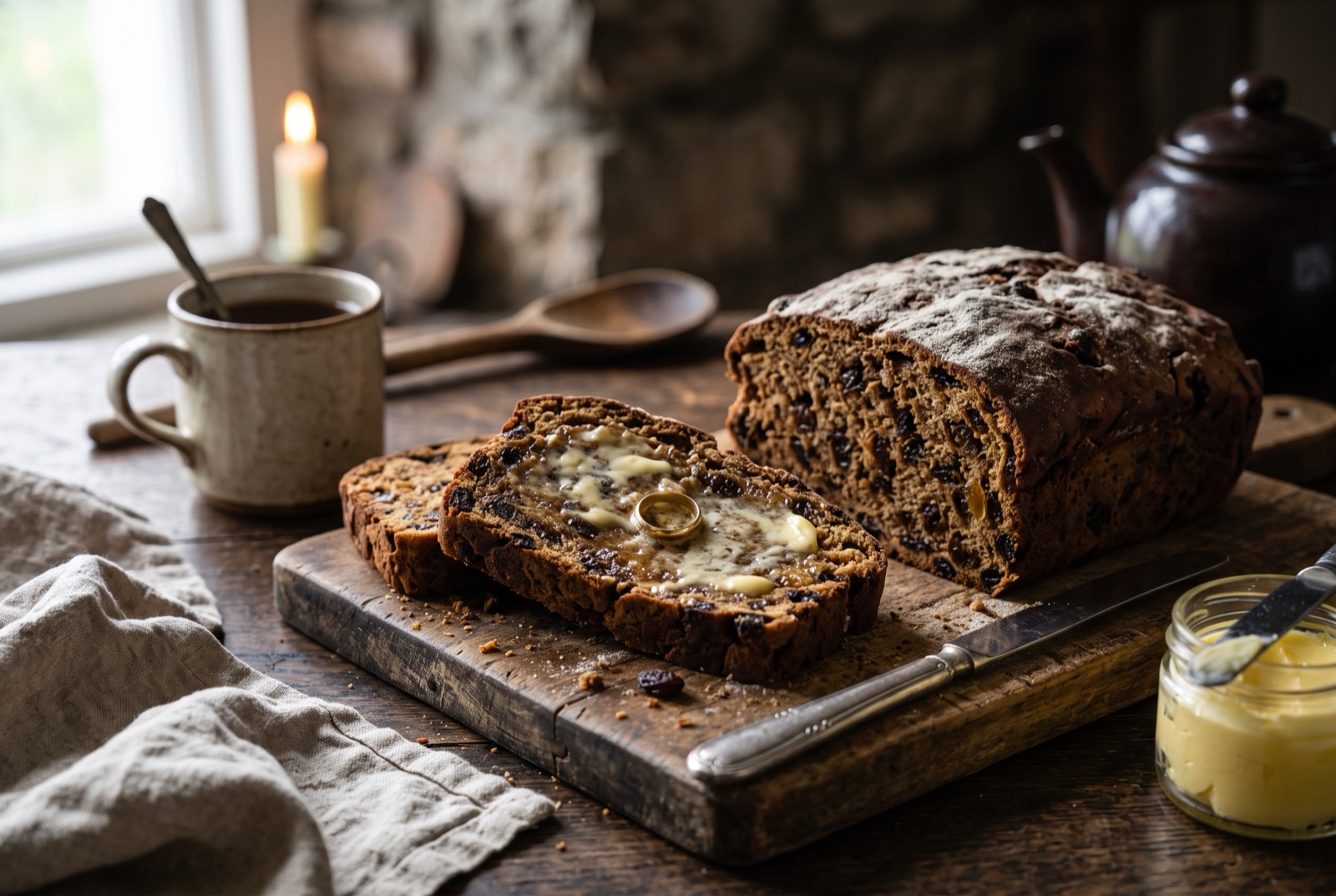
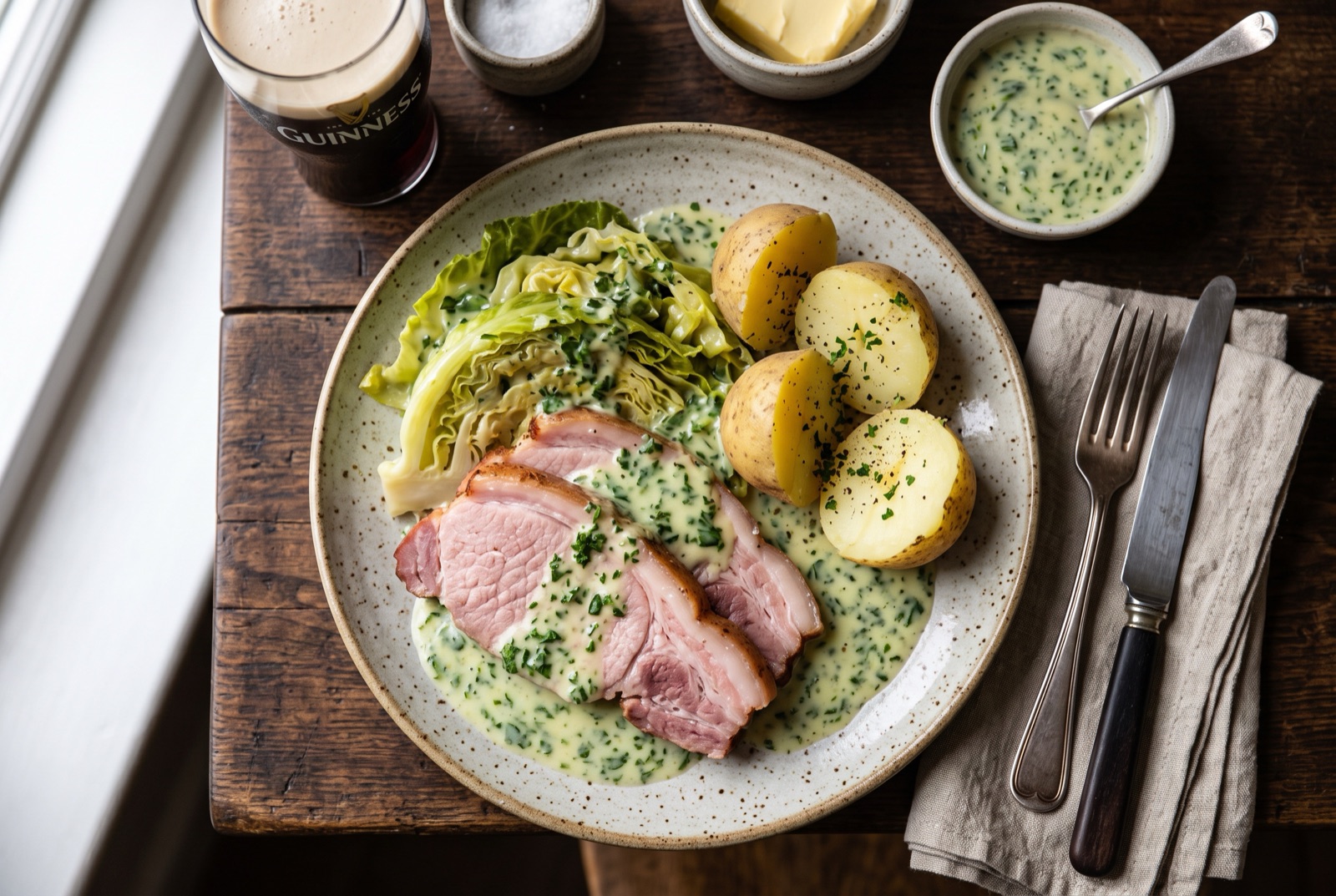
Ireland has 9 more dishes in the atlas — Bacon and Cabbage and Barmbrack, and 7 more.
Recipe by The DishRoute Kitchen · published August 19, 2026 · updated August 19, 2026