Churchkhela.
Georgian Grape Must and Walnut Candy
ჩურჩხელა · say it: choorch-KHEH-lah
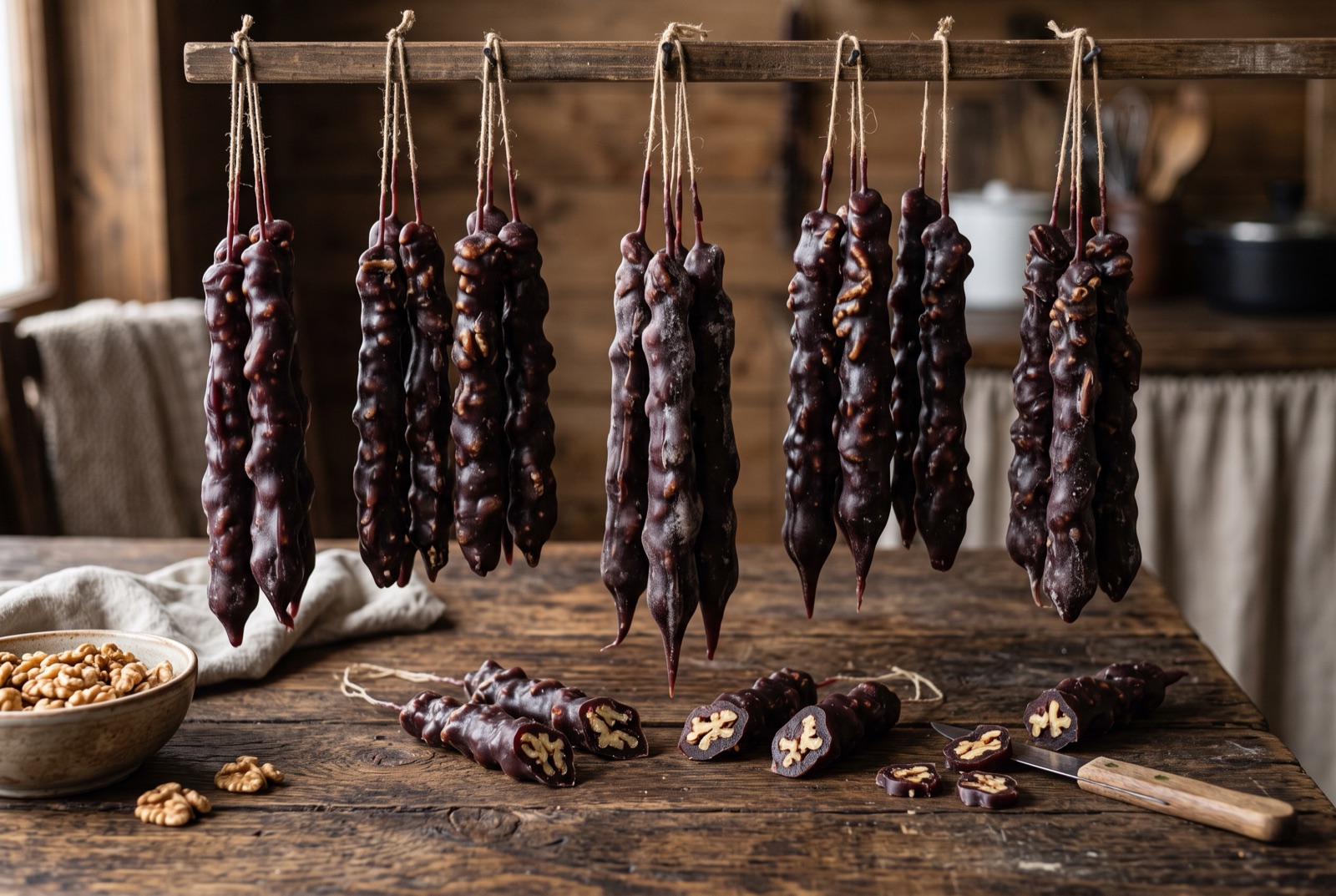
Churchkhela is a candle-shaped sweet made of nothing but grape juice, flour and walnuts. Shelled walnut halves are threaded onto a long string, then dipped repeatedly into tatara — grape must thickened with flour into a warm, glossy pudding — with drying time between each coat until the string is thickly sheathed. Hung in a dry room for two to three weeks, the coating firms into something chewy and leathery, faintly tannic, sweet in a fruity rather than sugary way, with the walnuts inside staying crisp. It is Georgia's oldest travel food, it contains no added sugar at all, and it is sold in every colour from amber to near-black at every roadside stall in the country.

- Gate
- GeorgiaKakheti
- Prep
- 40 min
- Cook
- 1 hr
- Total time
- 25 hr 40 min incl. 24 hr rest
- Serves
- 8
- Status
- Medium
- Nutrition / serving · estimated
- Calories 340 kcal
- Protein 6 g
- Carbs 42 g
- Fat 18 g
- Fiber 3 g
- Sugar 28 g
Why this recipe works.
- Built around dark grape juice reduced at home, so it works outside a wine region in October.
- The flour-to-must ratio is set for a coating that clings in thin layers instead of sliding off the string.
- Every dipping and drying interval is specified, which is the entire difference between chewy and gluey.
- No added sugar, no gelatine, no dairy — the sweetness comes entirely from the grapes.
Ingredients.
7 itemsFor the strings
For the tatara coating
Equipment
- Heavy saucepan
- Long trussing needle or thick darning needle
- Strong cotton kitchen string
- A pole or rail to hang from
Instructions.
Thread the walnuts
Tie a knot at one end of each string and thread 400 g of walnut halves on with a long needle, pushing them snug against each other. Stop 4–5 cm from the knotted end and leave a long loop at the top for hanging.
Tip Thread through the flat side of each half — pushing through the curve splits them.
Reduce the juice
Bring the grape juice to a boil in a wide heavy pan and simmer briskly for 35–45 minutes, skimming any scum, until it has reduced by half and turned syrupy enough to coat a spoon thinly. Let it cool to lukewarm before the next step.
Whisk in the flour off the heat
Ladle out about 400 ml of the cooled must and whisk the flour into it until completely smooth with no lumps at all. Pour this back into the pan, whisking hard, and add the lemon juice, salt and cinnamon if using.
Tip Flour must always meet cool liquid. Tipped into hot must, it seizes instantly into lumps you cannot whisk out.
Cook the tatara to coating thickness
Set the pan back over low heat and cook 10–15 minutes, stirring constantly with a wooden spoon, until the mixture thickens to a glossy pudding. It is ready when a finger drawn across the coated back of the spoon leaves a line that stays clean and does not run closed.
Tip Keep stirring right into the corners of the pan — the flour catches and scorches in seconds.
Dip the first coat
With the tatara still warm and pourable, lower a walnut string into the pan, submerge it fully, then lift it out steadily and let the excess drip back. Hang it immediately from a rail with paper or a tray underneath. Repeat with all the strings.
Build up the layers
Leave the strings hanging 1–2 hours until the surface is tacky but no longer wet, then dip again. Repeat 3 or 4 times in total, reheating the tatara gently if it stiffens, until the coating is an even sheath about 1 cm thick with the walnuts only faintly bumped through it.
Hang to dry for weeks
Hang the finished strings in a dry, airy, unheated room out of direct sun for 2 to 3 weeks. They are done when the surface is matte and dry to the touch and the string is firm but still yields when squeezed. Slice into rounds with a serrated knife to serve.
Tips from our kitchen.
- Use walnut halves that are as intact as possible. Broken pieces slip on the string and leave gaps the coating cannot bridge.
- Leave a 4–5 cm gap of bare string at the bottom and tie a knot below the last walnut so the nuts cannot slide off during dipping.
- Whisk the flour into cold must before heating, never into hot. Flour hitting hot liquid seizes into lumps that will not disperse.
- The tatara is ready when it coats a spoon thickly and a finger drawn through the coating leaves a clean line that does not close.
- Dip fast and hang immediately, letting the excess drip back into the pan. Holding the string in the pan makes the layer too thick and it will slide off as it cools.
- Hang somewhere dry and airy, out of the sun, at cool room temperature. A damp kitchen will grow mould on the surface before the coating sets.
Substitutions.
- Fresh grape must → 2 litres of unsweetened dark grape juice, reduced by half
- The realistic home option. Choose 100% juice with no added sugar. It lacks the tannin of real must, so add a tablespoon of lemon juice to stop it tasting flatly sweet.
- Plain wheat flour → Fine cornmeal or corn flour
- Used in parts of western Georgia and it makes the sweet gluten-free. The coating sets slightly firmer and matte rather than glossy.
- Walnuts → Hazelnuts, or alternating walnut and hazelnut
- Common in the Black Sea provinces and in Turkish versions. Hazelnuts are rounder and thread less securely, so push them on firmly.
Variations.
- Tatara or pelamushi
- The thickened must on its own, poured into shallow dishes and chilled into a set pudding, then eaten cold with walnuts. The same base, no drying, ready the same day.
- White churchkhela
- Made with juice from white grape varieties, giving a pale amber string with a lighter, more floral taste. Common in Imereti and western Georgia.
- Sujukh and sharots
- The Armenian and Turkish relatives, made almost identically and often with hazelnuts or mixed nuts. Which came first is a long-running argument nobody wins.
Storage & reheating.
Properly dried churchkhela keeps 3 to 4 months hung in a cool, dry, airy place, and Georgian households traditionally store it in a wooden box layered with walnut leaves. Do not refrigerate it — the humidity makes the surface sticky and can bring on mould. A fine white bloom of natural fruit sugar on the outside after a few weeks is normal and desirable; fuzzy or coloured spots are mould and mean it dried somewhere too damp. Slice it with a serrated knife into 1 cm rounds to serve.
Serve with
Sliced into rounds on a wooden board with cheese and a glass of red wine, the way it appears at the end of a Georgian meal.
The story behind Churchkhela.
Churchkhela is a by-product of winemaking, which is why it belongs to autumn. When the grapes are pressed in September and October, the fresh must left over is boiled down and thickened, and the walnut harvest lands at the same moment. Georgian households make dozens of strings at once and hang them from beams to dry, and by the time the cold sets in they have a shelf-stable sweet that keeps for months. That combination — sugar, fat, protein, no refrigeration — made it soldier and traveller food long before it was a market souvenir, and it is often described as the original energy bar without much exaggeration.
Georgia has among the strongest claims to the longest continuous winemaking tradition anywhere, with grapes fermented in buried clay qvevri for thousands of years, and churchkhela sits inside that tradition rather than beside it. The colour of a string tells you the grape: Kakhetian saperavi gives deep purple-black, western Georgian white varieties give amber and tan. Neighbouring cultures make close relatives — sharots or sujukh in Armenia, cevizli sucuk in Turkey, and versions across the Caucasus and northern Iran — and arguments about who made it first are perennial and unresolvable. What is clear is that Georgia holds a protected designation of origin for its own churchkhela, and that every producing culture considers theirs the reference version.
The home cook's honest problem is fresh grape must. Outside a wine region in autumn you will not find it, and the workable substitute is unsweetened dark grape juice reduced hard, which gets you a good result while lacking the tannin and complexity of real pressings. The other honest problem is time: the drying is not a suggestion. Two weeks minimum in a dry, airy, unheated room is what turns a sticky wet coating into the chewy, matte, faintly dusty surface of proper churchkhela. Rush it and you have sweet gluey nuts on a string. Nothing about the process is difficult — it is simply slow, and it cannot be hurried in an oven.
Questions, answered.
What is grape must and what can I use instead?
Must is freshly pressed grape juice with skins and seeds, the starting point of wine, and it is only available where grapes are being pressed. The practical substitute is two litres of 100% unsweetened dark grape juice reduced by half, which concentrates the sugar similarly. Add a tablespoon of lemon juice, since bottled juice lacks the tannic edge of real must.
How long does churchkhela really need to dry?
Two weeks minimum, three is better, hung in a dry airy room away from direct sun. It is ready when the surface is matte and dry to the touch, the string feels firm rather than tacky, and it gives slightly when squeezed. Drying cannot be shortened with an oven or a dehydrator without making the coating brittle and separating it from the nuts.
Why is my coating sliding off the walnuts?
Either the tatara was too thin or the previous layer was still wet when you dipped again. The mixture must be thick enough to hold a clean line when a finger is drawn across a coated spoon, and each layer needs an hour or two of hanging before the next. Building four or five thin layers works; two thick ones will slump.
Is there any added sugar in churchkhela?
None at all in the traditional recipe. All the sweetness comes from concentrated grape sugars in the must, which is why the flavour is fruity and slightly tannic rather than flatly sweet. Some commercial versions do add sugar or use fruit juice concentrates, but there is no need for it at home.
Can I make a smaller batch or a faster version?
Yes to both. The recipe halves cleanly, and if you do not want to wait weeks, pour the finished tatara into shallow dishes, scatter with walnuts and chill it into pelamushi, a set grape pudding eaten within a few days. That is a genuine Georgian dish in its own right, not a shortcut invented for impatient cooks.
You might also like.
All recipes →

Keep exploring Georgia.
Georgia has 9 more dishes in the atlas — Adjarian Khachapuri and Badrijani Nigvzit, and 7 more.
Recipe by The DishRoute Kitchen · published August 20, 2026 · updated August 20, 2026