Lobio.
Georgian Spiced Kidney Bean Stew
ლობიო · say it: LOH-bee-oh
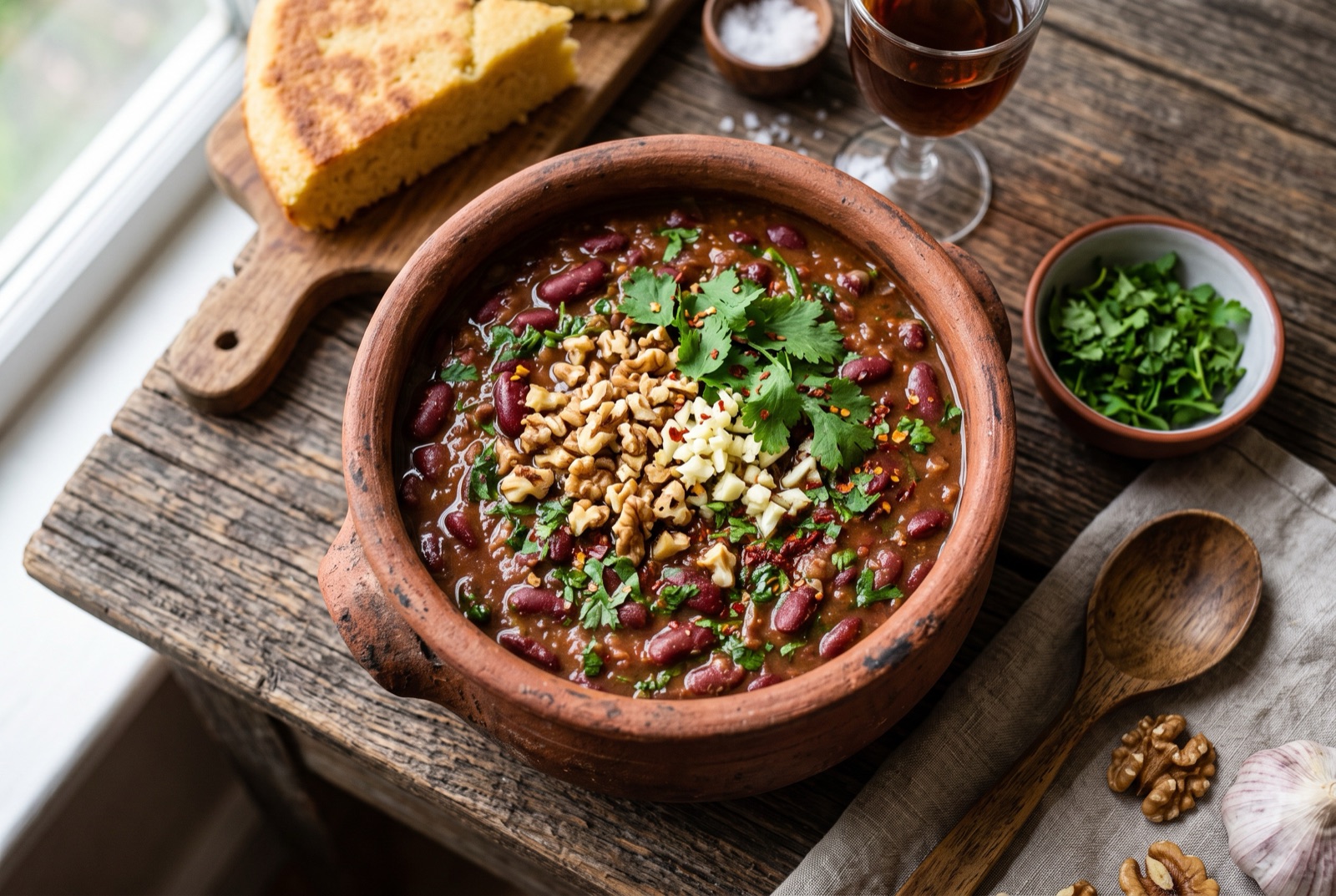
Lobio is the everyday Georgian bean pot: dried red kidney beans cooked until they are collapsing, seasoned with fried onion, ground coriander and blue fenugreek, and then partly mashed against the side of the pot so the starch thickens whatever liquid is left. Ground walnuts and crushed raw garlic go in at the end, along with a bunch of coriander leaf, which is what stops it tasting like any other bean stew. The texture is deliberately uneven — some beans whole, some smashed to a rough purée — and the flavour is earthy, garlicky and slightly sour from a splash of vinegar. It is vegan without trying, cheap, and eaten with cornbread and pickles as a meal in its own right.

- Gate
- GeorgiaRacha and Imereti
- Prep
- 20 min
- Cook
- 1 hr 45 min
- Total time
- 10 hr 5 min incl. 8 hr rest
- Serves
- 4
- Status
- Easy
- Nutrition / serving · estimated
- Calories 430 kcal
- Protein 19 g
- Carbs 51 g
- Fat 17 g
- Fiber 16 g
- Sodium 620 mg
Why this recipe works.
- Beans are cooked from dried with the aromatics already in the pot, so the flavour goes into the bean rather than sitting around it.
- Half-mashing is used as a thickening technique, which means no flour and no need to reduce the liquid to nothing.
- Walnuts, garlic and vinegar all go in at the end, where they still taste of themselves.
- Naturally vegan and gluten-free without any substitution or apology.
Ingredients.
15 itemsFor the beans
For the seasoning
To finish
Equipment
- Heavy pot or clay crock
- Wooden spoon
- Frying pan
Instructions.
Soak, then boil hard
Soak the beans in plenty of cold water for at least 8 hours, then drain and rinse. Cover them with fresh water by 5 cm, bring to a full rolling boil and hold it there for 10 minutes, skimming the grey foam. This step is not optional with red kidney beans.
Simmer until collapsing
Lower the heat, add the bay leaves and halved onion, and simmer partly covered for 60–80 minutes until a bean squashes to paste between your fingers with no chalky centre. Top up with boiling water if they threaten to catch. Do not salt yet.
Tip Undercooked lobio is the most common failure — go 10 minutes past when you think they are done.
Fry the onions properly
Meanwhile, cook the chopped onions in the oil over medium-low heat for 15 minutes until soft, sweet and lightly golden at the edges. Stir in the coriander seed, blue fenugreek, marigold and chilli and fry 60 seconds more, until the pan smells toasted and floral rather than dusty.
Combine and season
Fish out the bay and onion halves from the beans, then scrape the spiced onions into the pot with about 300 ml of the bean liquid. Now salt generously and simmer together for 10 minutes so the beans take up the seasoning.
Mash for body
Press roughly half the beans against the side of the pot with a wooden spoon and stir the purée back through. The stew should turn thick and slightly creamy with plenty of whole beans still visible, and a spoon dragged through should leave a trail that closes slowly.
Tip If it stiffens too far, splash in more bean liquid — it will keep thickening off the heat.
Finish raw
Off the heat, stir in the ground walnuts, crushed garlic, vinegar and most of the coriander. Taste and correct with salt, pepper and a little more vinegar until the stew is savoury with a faint sour lift at the back.
Rest and serve in the pot
Cover and leave 10 minutes so the garlic spreads through. Serve straight from the pot, scattered with the remaining coriander and the pomegranate seeds if using, with cornbread and pickles alongside.
Tips from our kitchen.
- Soak the beans overnight in plenty of cold water. Unsoaked kidney beans cook unevenly and some stay stubbornly chalky in the middle.
- Boil kidney beans hard for the first ten minutes and discard nothing but the foam — raw and undercooked red kidney beans contain a toxin that this hard boil destroys.
- Salt only once the beans are fully tender. Salted early, their skins toughen and the cooking time doubles.
- Mash roughly half the beans against the side of the pot with a wooden spoon. A blender turns the whole thing into hummus and kills the texture.
- Keep more bean liquid back than you think you need — lobio thickens dramatically as it sits and will be stiff within ten minutes of leaving the heat.
- Add the vinegar in small amounts and taste between each. It should read as a savoury lift, not as sourness you can name.
Substitutions.
- Dried red kidney beans → 3 × 400 g tins of kidney beans, drained and rinsed
- Cuts the cooking to 25 minutes but gives a thinner, less flavourful liquor. Simmer them in 400 ml of vegetable stock with the aromatics to make up for it.
- Blue fenugreek (utskho suneli) → 1 tsp khmeli suneli blend, or half the quantity of ordinary ground fenugreek
- Ordinary fenugreek is much more bitter than the blue kind, so never swap it measure for measure.
- Walnuts → Omit entirely
- Plenty of Georgian households make lobio without them, especially in the east. The stew loses richness but stays completely recognisable, and it becomes nut-free.
Variations.
- Lobio with pomegranate
- Finished with a handful of pomegranate seeds and their juice instead of vinegar, which gives a sweeter, brighter sourness and a much better looking pot.
- Lobiani
- The same bean filling, mashed smooth, sealed inside a round of dough and baked flat like khachapuri. Sold by the slice all over Georgia and the classic road-trip food.
- Mingrelian lobio
- A spoonful of ajika chilli paste and a second head of garlic stirred through. Considerably hotter, and the western Georgian house style.
Storage & reheating.
Lobio keeps 4 days refrigerated and is better on day two once the garlic has spread through it. It thickens to a paste when cold — reheat over low heat with a good splash of water, stirring, until it loosens back to a spoonable stew, and check the seasoning, because chilled beans mute salt badly. It freezes well for 3 months, ideally without the fresh coriander, which you can add on reheating. Make a double batch and freeze half; the filling doubles as lobiani stuffing.
Serve with
Mchadi cornbread for scooping, pickled vegetables, sliced raw onion, and a pot of tkemali plum sauce on the side.
The story behind Lobio.
Beans arrived in Georgia from the Americas and settled in fast, largely because they solved a calendar problem. The Orthodox fasting year removes meat, dairy and eggs from the table for something close to two hundred days when observed strictly, and lobio became one of the anchors of that cooking — filling, protein-heavy, and improved rather than compromised by the walnut-and-herb seasoning that Georgian cooks were already using everywhere else.
It is also tavern food. In Tbilisi, a lobiani house serves lobio in small clay pots called ketsi or in individual crocks, straight from the coals, with a wedge of mchadi — dense unleavened cornbread cooked on a griddle — and a plate of pickled vegetables. The cornbread is not a side but a tool: mchadi is crumbly and dry on purpose, so it soaks up the bean liquor. Pickled jonjoli buds, green tomatoes or cabbage cut the starch. That trio, lobio and mchadi and pickles, is one of the cheapest full meals in the country and one that Georgians eat by choice rather than economy.
Regional versions run in every direction. Racha, high in the northwest, is proud of its own bean variety and cooks lobio thick and plain. Mingrelia loads it with chilli and ajika. Some households finish it with pomegranate seeds, some with a handful of dried marigold, some with a whole extra head of garlic. There is a version made with fresh green beans rather than dried, a cold version pressed and sliced, and lobiani, where the same filling is baked inside bread. All of them are called lobio, which simply means beans, and none of them is the definitive one. The version below is the pot version: red kidney beans, walnuts, coriander and garlic, cooked long and mashed rough.
Questions, answered.
Do I have to soak and hard-boil the kidney beans?
Yes to the hard boil, which is a safety matter — raw and undercooked red kidney beans contain phytohaemagglutinin, and ten minutes at a full rolling boil destroys it. Soaking is not strictly required but gives far more even cooking and cuts an hour off the time. Never cook dried kidney beans in a slow cooker without boiling them hard first.
My lobio is watery. How do I thicken it?
Mash more of the beans. Press a ladleful against the side of the pot with a wooden spoon and stir the purée back through, then simmer uncovered for five minutes. Bean starch is the only thickener the dish needs, and it will continue to set as the pot cools, so stop while it still looks slightly loose.
What is mchadi and can I serve something else?
Mchadi is a dense unleavened Georgian cornbread, just cornmeal, water and salt, cooked on a dry griddle until a crust forms. It is dry and crumbly on purpose so it absorbs the bean liquor. Any plain cornbread, polenta wedges or even crusty white bread will do the same job, though fluffy sweetened American cornbread fights the dish.
Is lobio meant to be eaten hot or cold?
Hot, straight from the pot, is the standard. There is also a genuinely traditional cold version where the mashed beans are pressed into a dish, chilled until firm and sliced, usually served with raw onion and walnut. Both are correct; the hot pot is the everyday tavern version.
Can I make lobio in a pressure cooker?
Yes. Boil the soaked beans hard on the stovetop for ten minutes first, then pressure cook for about 15 minutes with the aromatics. Finish the mashing, walnuts, garlic and herbs on the stove as written, since none of that benefits from pressure and the garlic would lose its edge entirely.
You might also like.
All recipes →

Keep exploring Georgia.
Georgia has 9 more dishes in the atlas — Adjarian Khachapuri and Badrijani Nigvzit, and 7 more.
All Georgia recipes Onion recipes Walnuts recipes Garlic recipes sidemainveganvegetariangluten freedairy freeRecipe by The DishRoute Kitchen · published August 20, 2026 · updated August 20, 2026