Satsivi.
Georgian Turkey in Cold Walnut Sauce
საცივი · say it: sah-TSEE-vee
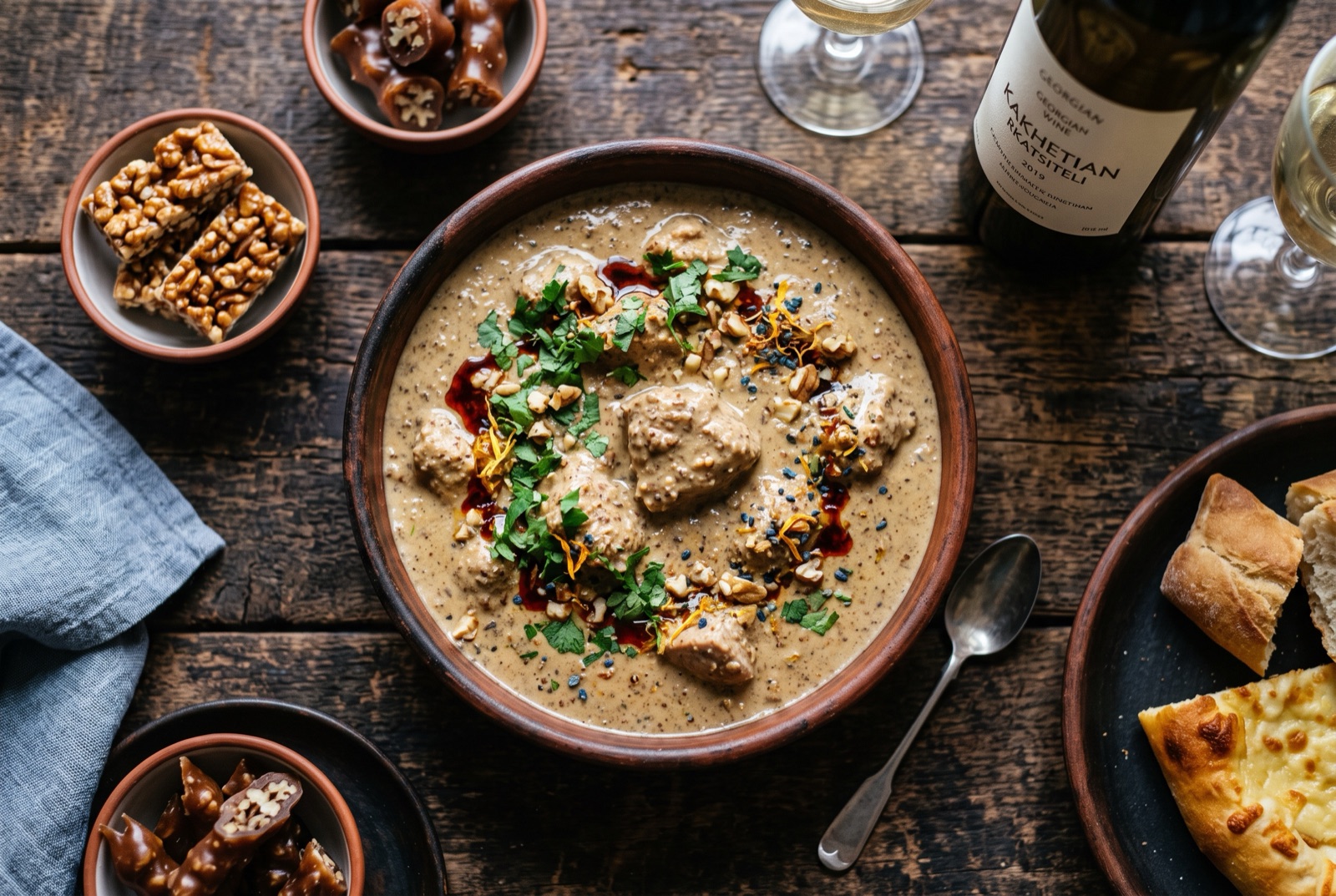
Satsivi is poached poultry served cold under a walnut sauce so thick it sets around the meat like a savoury custard. The name comes from the Georgian word for cold, and that is not a detail — the sauce is deliberately chilled until it stiffens, and eating it warm is considered simply wrong. The flavour is dense and unusual to anyone meeting it for the first time: sweet walnut fat, sharp raw garlic, the faint hay-and-flower note of blue fenugreek, dried marigold for colour and resin, all sharpened at the end with a little wine vinegar. Turkey is traditional, chicken is the everyday version. Both are torn into pieces, coated, and left overnight so the sauce and the meat stop being two things.

- Gate
- GeorgiaKartli and Imereti
- Prep
- 40 min
- Cook
- 1 hr 30 min
- Total time
- 14 hr 10 min incl. 12 hr rest
- Serves
- 6
- Status
- Takes skill
- Nutrition / serving · estimated
- Calories 690 kcal
- Protein 44 g
- Carbs 12 g
- Fat 52 g
- Fiber 5 g
Why this recipe works.
- The poaching broth becomes the sauce liquid, so nothing is wasted and the walnut base tastes of the bird.
- Grinding and temperature are spelled out at the two points where satsivi actually fails — grit and splitting.
- Spice quantities are set for cooks buying blue fenugreek for the first time, with an honest substitution if only ordinary fenugreek is available.
- Made entirely a day ahead, which is the traditional method rather than a shortcut.
Ingredients.
18 itemsFor the poached bird
For the walnut sauce
To finish
Equipment
- Large pot for poaching
- Food processor or nut grinder
- Fine sieve
- Wide serving dish
Instructions.
Poach the bird
Put the turkey in a pot with the halved onion, bay, celery and salt, cover with cold water by 3 cm and bring slowly to a bare simmer. Skim the grey foam off in the first ten minutes, then cook 70–80 minutes until the meat pulls easily from the bone.
Tip Never let it boil. A hard poach makes stringy meat and a cloudy broth you need clear.
Strain and separate
Lift the bird out and let it cool until you can handle it. Strain the broth through a fine sieve, skim the fat from the surface into a small bowl and keep it, and measure out 800 ml of clear broth for the sauce.
Grind the walnuts properly
Pulse 500 g of walnuts in short bursts until they form a damp, clumping paste that glistens with released oil. Scrape the bowl down twice. Loosen the paste with 200 ml of the warm broth and blend again until smooth enough that it feels only faintly sandy between your fingers.
Tip Stop the moment the walnuts look wet and clumped — grinding past that point heats the oil and dulls the flavour.
Soften the onions
Melt the butter or reserved poultry fat in a wide pan over low heat and cook the finely chopped onions for 12–15 minutes, stirring, until they are completely soft and translucent but with no colour at all. Stir in the flour, if using, and cook one more minute.
Build the sauce below a simmer
Pour in the remaining broth, then whisk in the walnut paste, coriander, blue fenugreek, marigold and the cinnamon and cloves if using. Cook 15–20 minutes on the lowest heat, stirring often, until the sauce thickens to the consistency of pouring cream and amber oil beads at the surface.
Tip If bubbles ever break the surface, pull the pan off the heat immediately and whisk in a splash of cold broth.
Finish with garlic and vinegar
Take the pan off the heat and stir in the pounded garlic and the vinegar. Taste and correct with salt — the sauce should be sharp and garlicky against the walnut richness, not sweet or bland, and it will taste slightly stronger than you want once chilled.
Coat the meat and chill overnight
Tear the turkey off the bone into large pieces, discarding skin and bones, and arrange them in a wide dish. Pour the warm sauce over so every piece is buried, cool to room temperature, then refrigerate at least 8 hours and preferably overnight.
Serve cool, not cold
Take the dish out 20 minutes before eating so the sauce loosens slightly. Scatter with pomegranate seeds and spoon over any walnut oil that has separated at the edges. Serve with bread and the rest of the cold table.
Tips from our kitchen.
- Grind the walnuts in short pulses until they clump and glisten with their own oil, then push them through further with a splash of broth. Long continuous blending heats them and turns the sauce muddy.
- Use fresh walnuts. Old ones taste bitter and rancid, and in a sauce this concentrated there is nothing to hide behind — taste one before you commit half a kilo.
- Keep the sauce below a simmer once the walnuts go in. If it bubbles, the oil separates and the texture never recovers.
- Add the garlic and vinegar off the heat at the end. Cooked garlic loses the sharpness that keeps this rich sauce from being cloying.
- Thin the sauce slightly more than you think it needs — it thickens noticeably as it cools and again overnight in the fridge.
- Take it out of the fridge 20 minutes before serving. Fridge-cold satsivi tastes flat and the sauce is stiff enough to hold a fork upright.
Substitutions.
- Turkey → A whole chicken, about 1.6 kg
- The common everyday version and much easier to poach evenly. Reduce the poaching time to around 50 minutes and the sauce quantities stay the same.
- Blue fenugreek (utskho suneli) → Half the quantity of ordinary ground fenugreek plus a pinch of dried marjoram
- Blue fenugreek is milder and floral; standard fenugreek is much more bitter, so using it measure for measure will overwhelm the sauce.
- Dried marigold petals (imeretian saffron) → ¼ tsp turmeric
- Turmeric matches the colour but not the resinous aroma. It is a colour fix rather than a flavour one, and satsivi without either is still perfectly good.
Variations.
- Kartli-style with cinnamon and cloves
- Eastern Georgian cooks add a pinch of ground cinnamon and clove to the sauce, giving a faintly sweet, almost mulled edge. Western Georgians consider this an eccentricity.
- Bazhe
- The same walnut sauce made without poultry broth, thinned with water and vinegar, served as a cold dipping sauce for fish, chicken or vegetables. Faster and useful on its own.
- Satsivi with fish
- Poached sturgeon or trout under the same sauce — a fasting-season dish, since the Orthodox calendar bans meat but not always fish.
Storage & reheating.
Satsivi is designed to be made ahead and keeps 4 days refrigerated in a covered dish. It is never reheated — it is served cold or at cool room temperature, and warming it splits the walnut sauce. If the sauce has stiffened too much after a few days, stir in a spoonful of cold broth or water rather than heating it. Freezing is not recommended: the emulsion breaks on thawing and leaves a grainy, oily mess even if the flavour survives.
Serve with
Torn white bread or gomi cornmeal porridge, alongside other cold supra dishes and a glass of dry amber wine.
The story behind Satsivi.
Satsivi belongs to the New Year table, and in most Georgian households it is not optional. It is made on the 30th or 31st of December because it has to sit overnight, and it appears alongside the other cold dishes — pkhali, badrijani, jonjoli pickles — that anchor a supra table for the whole evening while hot food comes and goes above them. A family's satsivi is judged on the texture of the sauce and the balance of its garlic, and opinions on both are inherited rather than argued.
The sauce is the dish. Walnuts are ground until they weep oil, then let down with the strained poaching broth until the mixture is the consistency of thin porridge, and warmed gently with garlic and the two spices that define Georgian cooking: utskho suneli, blue fenugreek, milder and more floral than the Indian kind, and dried marigold petals sold as imeretian saffron, which give satsivi its yellow cast. Cooks who own good walnuts skim the amber oil that separates on the surface and spoon it back over the finished plate as a mark of quality. Cinnamon and cloves appear in eastern versions and are left out further west, and neither side has conceded.
The technique demands patience in exactly two places. The walnuts must be ground far finer than feels reasonable — a coarse grind gives a gritty sauce no amount of resting will fix — and the sauce must never boil once the walnuts are in, because heat splits the emulsion and leaves oil floating on a grainy base. Get those right and everything else is assembly. The reward for making it the day before is real: overnight, the garlic softens, the fenugreek spreads through the sauce, and the whole thing goes from a strange nutty gravy to something coherent that Georgians will eat cold, out of the fridge, for the first week of January.
Questions, answered.
Why is satsivi served cold?
The name literally comes from the Georgian word for cold, and the sauce is built to set as it chills — the walnut fat firms up and holds the meat in a thick coating. Served warm it is loose and greasy, and warming it after chilling makes the oil separate out. Take it from the fridge about 20 minutes before eating so it is cool rather than ice cold.
My walnut sauce turned grainy and oily. What happened?
Either the walnuts were ground too coarsely or the sauce got too hot. Once ground walnuts are in the pan the mixture must stay below a simmer, because boiling drives the oil out of the emulsion. Grind the nuts until they are a paste that clumps around the blade, and if the sauce does split, whisk in a few tablespoons of cold broth off the heat to pull it back.
Can I make satsivi without blue fenugreek?
Yes, though it will taste less specifically Georgian. Blue fenugreek is the signature note, and the best substitute is half the amount of ordinary fenugreek — never an equal measure, since the common kind is far more bitter. Georgian and Eastern European grocers stock it cheaply, and it keeps for a year in a sealed jar.
How far ahead should I make it?
A full day ahead is standard and genuinely better. Overnight in the fridge the garlic mellows, the spices spread evenly through the sauce and the meat absorbs flavour instead of sitting in it. Made and eaten the same afternoon, satsivi tastes like poultry with nut sauce rather than one dish.
Is satsivi very garlicky?
Yes, distinctly so, and it is meant to be. The raw garlic added at the end cuts through a sauce that is otherwise very rich in walnut fat. Five or six cloves is a moderate Georgian amount; if your table is cautious, drop to three, but do not cook the garlic into the sauce to soften it or the balance disappears.
You might also like.
All recipes →
Keep exploring Georgia.
Georgia has 9 more dishes in the atlas — Adjarian Khachapuri and Badrijani Nigvzit, and 7 more.
Recipe by The DishRoute Kitchen · published August 20, 2026 · updated August 20, 2026