Tres Leches Tico.
Three-Milk Soaked Cake
Torta tres leches · say it: trehs LEH-chess
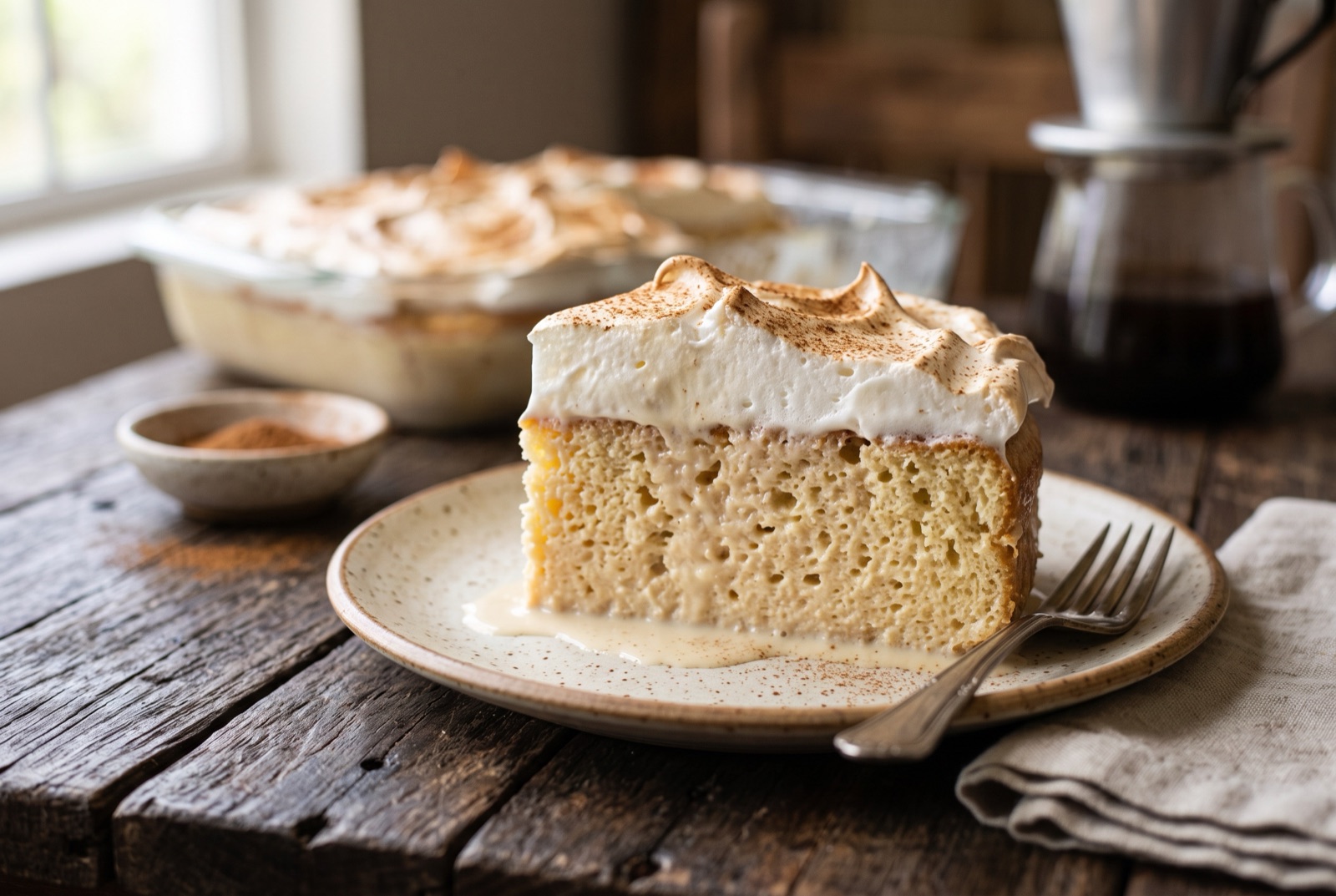
Tres leches is a cake designed to be saturated. The sponge itself is deliberately lean — whipped eggs, sugar and flour with almost no fat — because a rich, buttery crumb repels liquid while a dry one drinks it. Once baked and cooled, it is pricked all over and flooded with a mixture of evaporated milk, condensed milk and cream, then left overnight so the soak reaches the bottom. What you cut the next day is not soggy but dense and cool, somewhere between cake and set custard, sweet enough that a small square is enough. Costa Ricans top it with soft meringue rather than the whipped cream common further north, which adds a marshmallowy layer and cuts through the sweetness underneath.

- Gate
- Costa RicaCentral Valley
- Prep
- 35 min
- Cook
- 30 min
- Total time
- 9 hr 5 min incl. 8 hr rest
- Serves
- 12
- Status
- Medium
- Nutrition / serving · estimated
- Calories 420 kcal
- Protein 10 g
- Carbs 56 g
- Fat 17 g
- Sugar 44 g
Why this recipe works.
- A genuinely lean sponge with whipped whites, which is the only reliable way to make a cake absorb this much liquid.
- The soak is poured in three stages rather than all at once, so it reaches the base instead of pooling on top.
- Gives both traditional finishes — Costa Rican meringue and whipped cream — with an honest note on which is which.
- Made the day before by design, so it is a dessert you finish rather than start when guests arrive.
Ingredients.
13 itemsFor the sponge
For the soak
For the meringue
Equipment
- 23 x 33 cm baking tin
- Electric whisk or stand mixer
- Thin skewer
- Large mixing bowls
Instructions.
Whip the whites
Beat the 5 egg whites with the pinch of salt until they hold soft peaks that curl over when you lift the whisk. Add half the sugar a spoonful at a time and beat until the mixture is glossy but still slumps slightly.
Beat the yolks and combine
In a second bowl, beat the yolks with the remaining sugar for 3 minutes until pale and thick enough to leave a ribbon on the surface. Beat in the milk and vanilla, then fold this into the whites in three additions with a light hand.
Fold in the flour and bake
Sift the flour and baking powder over the batter in two goes and fold just until no dry streaks remain. Pour into an ungreased 23 x 33 cm tin and bake at 175C for 28 to 30 minutes, until the top springs back and a skewer comes out clean.
Tip Do not grease the tin sides — the sponge climbs them as it rises.
Cool completely, then prick
Leave the cake in its tin until it is fully cold, at least an hour. Then pierce it all over at 2 cm intervals with a thin skewer, pushing right down to the base of the tin each time.
Pour the soak in stages
Whisk the evaporated milk, condensed milk and double cream together. Pour a third over the cake, wait 5 minutes for it to disappear, then repeat twice more until all of it has been absorbed and only a thin film sits on the surface.
Tip If liquid still pools after the third pour, wait — it will sink in as it chills.
Chill overnight
Cover the tin and refrigerate for at least 6 hours, ideally overnight, so the milk travels evenly through the crumb and the cake sets to a firm, custardy texture.
Make the meringue
Whip the 3 egg whites to soft peaks, then add the sugar a spoonful at a time, beating until the meringue is thick, glossy and holds a peak that flops gently at the tip.
Top and serve
Spread the meringue over the cold cake in thick swoops, dust generously with cinnamon, and cut into squares straight from the tin. Serve cold, with coffee.
Tips from our kitchen.
- Do not grease the tin sides. The sponge needs to grip the walls as it rises, and it is served from the tin anyway.
- Whip the whites to soft peaks that curl over, not stiff dry ones — over-whipped whites tear the batter as you fold and the cake bakes short.
- Let the sponge cool completely before soaking. Warm cake goes gluey rather than absorbent.
- Prick it with a thin skewer, not a fork, and go all the way to the base of the tin. Shallow holes leave a dry bottom layer.
- Add the milk mixture in three pours, waiting a few minutes each time. Poured all at once it floods over the sides and never sinks in.
- Chill at least 6 hours, ideally overnight. This is not an optional resting time — it is when the cake becomes tres leches.
Substitutions.
- Evaporated milk → Whole milk simmered down by about half, cooled
- It works but tastes fresher and less caramelised than tinned evaporated milk, which has a distinctive cooked-milk note the cake relies on.
- Meringue topping → Whipped double cream with a spoon of icing sugar
- Faster, no raw egg concerns, and the standard finish in many countries. Meringue is the more traditional Costa Rican choice and is noticeably lighter on the tongue.
- Plain flour sponge → A gluten-free plain flour blend with 1/4 tsp xanthan gum
- Works well here because the sponge is aerated by eggs rather than gluten development. Fold gently and expect a slightly closer crumb.
Variations.
- Tres leches con merengue
- The Costa Rican bakery standard: a thick layer of soft meringue spread in swooping peaks, sometimes lightly browned, with cinnamon dusted over.
- Tres leches de café
- A tablespoon of strong coffee added to the milk soak, which cuts the sweetness sharply and suits people who find the original too rich.
- Cuatro leches
- A fourth milk added to the soak — usually cajeta or dulce de leche thinned with cream — giving a caramel note through the whole cake.
Storage & reheating.
Keeps 4 days refrigerated, covered, and the texture holds well for the first three. Meringue topping weeps slightly after day two, so spread it on the day you plan to serve if you can. Do not freeze a soaked tres leches — the liquid separates from the crumb on thawing and leaves a wet base under a dry cake. The unsoaked sponge, however, freezes for a month.
Serve with
Strong black coffee, and a dusting of ground cinnamon over each slice.
The story behind Tres Leches Tico.
Tres leches is claimed by half of Latin America and no single origin story survives inspection. Nicaragua makes the loudest claim and has the strongest oral tradition behind it; Mexico, Cuba and Costa Rica all treat it as their own. What is clear is that the cake could not have existed before canned milk, and canned evaporated and condensed milk spread across Latin America from the late nineteenth century onwards. It is also a matter of record that condensed milk manufacturers printed soaked-cake recipes on their labels through the twentieth century as a way to sell tins, and that this is how many households first met the dish. That does not settle who invented it, but it explains why nearly identical cakes appeared in many countries within the same few decades.
What it means locally is easier to describe. In Costa Rica tres leches is birthday cake, celebration cake, and the standard dessert on the tray at a family gathering. Bakeries sell it by the slice in disposable cups because it is too wet to hand over on a napkin. It sits alongside a small canon of Tico sweets — arroz con leche, cajeta, tamal asado, queque seco — and is the most extravagant of them by some distance.
The technical argument in Costa Rica is about the topping. Meringue, whipped soft and spread thick, is the older and more traditional finish and is what most bakeries in San José still use. Whipped cream is more common in Mexican-influenced versions and in modern cafés. Some households do both, meringue over the cake and cream piped on top. A dusting of cinnamon is standard; a glacé cherry in the middle is a bakery flourish nobody defends but everybody recognises. Whichever way you finish it, the fundamentals do not change: dry sponge, generous soak, overnight rest, served cold.
Questions, answered.
Why is my tres leches soggy at the bottom and dry on top?
The soak was poured too quickly, so it ran down the sides and collected at the base instead of being absorbed evenly. Prick the cooled sponge all the way through to the bottom of the tin with a thin skewer, then add the milk mixture in three separate pours with a few minutes between each so the crumb has time to draw it in. A long chill also lets the liquid redistribute upwards.
Which three milks are in tres leches?
Evaporated milk, sweetened condensed milk and a fresh dairy — usually double cream, sometimes whole milk or a mixture of the two. Condensed milk provides the sweetness, evaporated milk gives the characteristic cooked-milk flavour, and the cream adds richness and body. Some recipes count the cream in the topping as the third milk, which is why you will see slightly different combinations.
How long should the cake soak before serving?
At least six hours refrigerated, and overnight is better. The soak needs time to travel from the holes into the surrounding crumb; cut too early and you get wet channels running through dry cake. Twelve to twenty-four hours gives the most even texture. Beyond about three days the sponge starts to break down and the base turns pasty.
Is the meringue topping made with raw egg?
A simple whipped meringue is, which is worth knowing if you are serving young children, pregnant people or anyone immunocompromised. The safer routes are a Swiss meringue, where the whites and sugar are warmed over simmering water to 70C before whipping, or an Italian meringue made with hot sugar syrup. Whipped cream avoids the question entirely and is a completely acceptable finish.
Where does tres leches come from?
Nobody can prove it. Nicaragua, Mexico, Cuba and Costa Rica all claim it, and the cake clearly could not predate canned evaporated and condensed milk, which spread through Latin America from the late nineteenth century. Recipes for milk-soaked cakes printed on condensed milk tins helped popularise it widely in the twentieth century. The honest answer is that it is a shared regional dessert without a single verifiable inventor.
You might also like.
All recipes →

Keep exploring Costa Rica.
Costa Rica has 9 more dishes in the atlas — Agua Dulce and Casado, and 7 more.
Recipe by The DishRoute Kitchen · published August 20, 2026 · updated August 20, 2026