Flan Cubano.
Condensed Milk Caramel Custard
Flan cubano · say it: flahn koo-BAH-noh
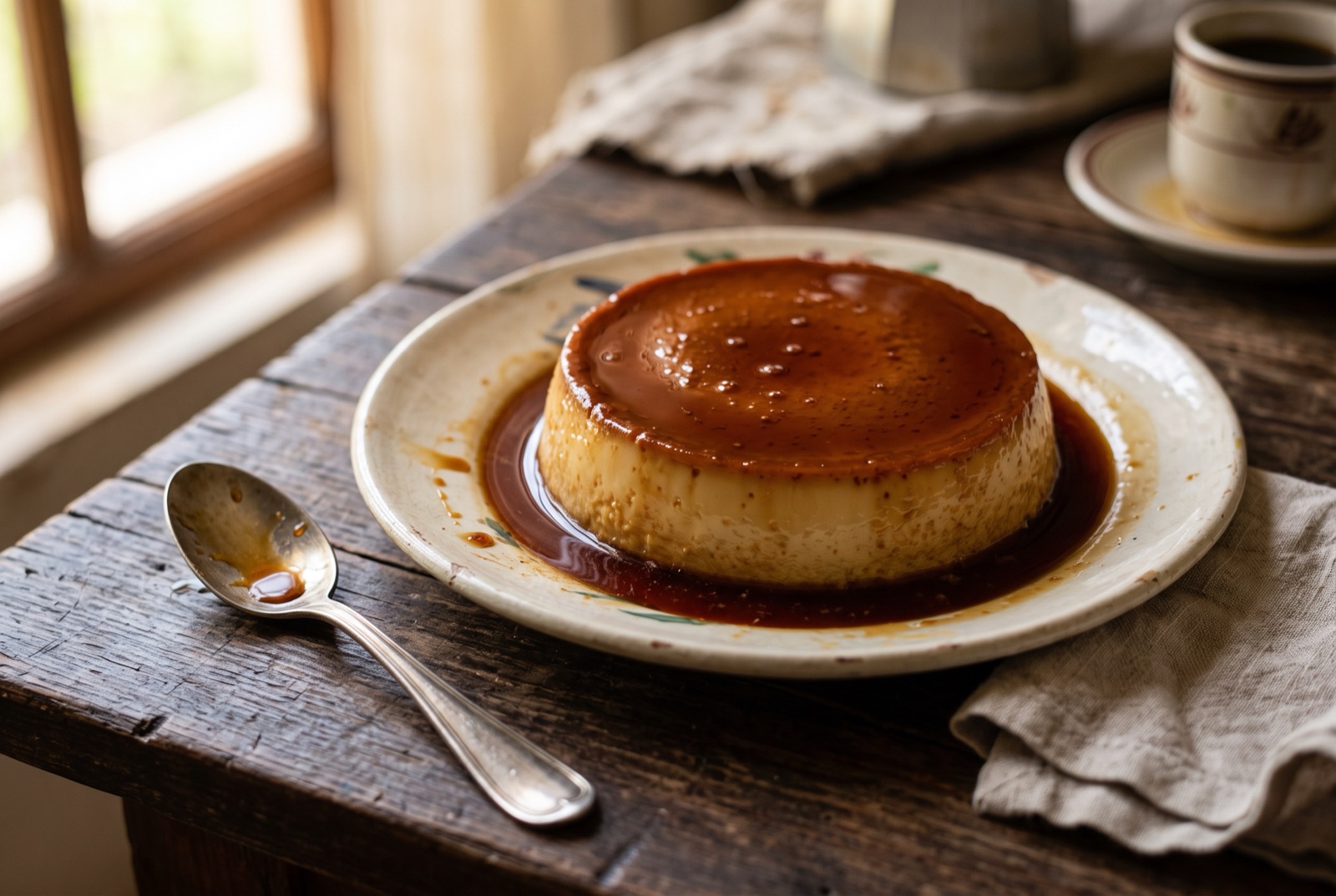
Flan cubano is a baked caramel custard built on tinned milk rather than fresh cream, which makes it noticeably denser, sweeter and smoother than a Spanish flan or a French crème caramel. Condensed milk supplies the sugar and the body, evaporated milk thins it just enough to set softly, and the whole thing bakes slowly in a water bath over a layer of dark caramel that liquefies as it chills and floods the plate when you turn it out. It takes twenty minutes of work and then a long, unavoidable wait — flan turned out warm collapses. Make it the day before, and take the caramel darker than feels safe, because that bitterness is what stops the whole thing being cloying.

- Gate
- CubaNationwide
- Prep
- 25 min
- Cook
- 1 hr
- Total time
- 9 hr 25 min incl. 8 hr rest
- Serves
- 8
- Status
- Medium
- Nutrition / serving · estimated
- Calories 380 kcal
- Protein 10 g
- Carbs 58 g
- Fat 12 g
- Sugar 56 g
- Sodium 160 mg
Why this recipe works.
- Caramel taken to a proper dark amber, which is what keeps a condensed-milk flan from tasting like sweetened milk.
- Blended, then strained, so the finished custard has no threads of cooked egg and a genuinely smooth surface.
- A water bath and a low oven with a clear doneness test, rather than a fixed time that depends on your dish.
- Straightforward about the overnight chill: this dessert cannot be rushed and the recipe is planned around that.
Ingredients.
8 itemsFor the caramel
For the custard
Equipment
- 20 cm round cake tin or flanera
- Deep roasting tin for the water bath
- Heavy small saucepan
- Blender or large whisk
- Fine sieve
Instructions.
Make the caramel
Heat the sugar and water in a small heavy pan over medium heat without stirring, swirling the pan occasionally, until the syrup turns a deep amber the colour of strong tea and just begins to smell faintly bitter, about 8 to 10 minutes.
Tip Judge by colour and smell, not by the clock. Pale caramel makes a flan that tastes only sweet.
Line the mould
Pour the caramel straight into the cake tin and tilt it quickly so the base is evenly coated before it sets, which takes under a minute. Set the tin aside; the caramel will harden into a solid sheet, and that is correct.
Mix the custard
Heat the oven to 160°C. Blend the condensed milk, evaporated milk, whole eggs, yolks, vanilla and salt on low speed for 20 seconds, or whisk gently by hand, just until smooth. Stop as soon as it is combined — beating in air ruins the texture.
Strain and pour
Pour the custard through a fine sieve directly into the caramel-lined tin, which catches any threads of egg. Skim off any foam that collects on the surface with a spoon so the finished top is smooth.
Bake in a water bath
Set the tin inside a deep roasting tin and pour hot water around it until it reaches halfway up the sides. Bake for 55 to 65 minutes, until the flan is set at the edges and the centre still wobbles as a single mass, like a set jelly, when you nudge the tin.
Tip If the surface starts to colour or crack, cover loosely with foil for the rest of the baking time.
Cool and chill overnight
Lift the tin out of the water, cool to room temperature on a rack, then cover and refrigerate for at least 6 hours and preferably overnight. The caramel dissolves into liquid sauce during this time.
Turn out
Run a thin knife around the edge, set a rimmed serving plate over the tin and invert both together in one confident movement. Lift the tin away and let the dark caramel run down over the custard and pool around the base before slicing.
Tips from our kitchen.
- Take the caramel to a deep amber the colour of strong tea. Pale caramel is just sugar and leaves the flan flat and sickly.
- Pour the caramel into the mould immediately and tilt fast — it sets hard within about thirty seconds.
- Blend the custard on low or whisk gently. Whipping air into it gives a bubbly, spongy set instead of a dense one.
- Strain the mixture through a sieve before it goes into the mould to catch any chalazae and stray cooked egg.
- The water bath should reach halfway up the mould and the oven should stay at 160°C; hotter and the custard curdles into holes.
- Chill at least 6 hours and ideally overnight. Turning out a warm flan is the single most common way to lose it.
Substitutions.
- Evaporated milk → Whole milk
- Works, but gives a lighter, less rich set. Evaporated milk carries more concentrated milk solids, which is part of the Cuban texture.
- Whole eggs and yolks as listed → 6 whole eggs
- Simpler, and the flan still sets. The extra yolks in the main recipe are what make it silkier and less rubbery.
- Oven water bath → A flanera or lidded tin steamed on the hob over low heat for about 50 minutes
- This is how it is often made in Cuba when the oven is unavailable, and the result is essentially the same.
Variations.
- Flan de queso
- Blend 150 g of cream cheese into the custard for a much denser, cheesecake-adjacent flan. Enormously popular in Cuban-American bakeries.
- Flan de coco
- Replace the evaporated milk with coconut milk and add 40 g of desiccated coconut, which settles into a layer near the top as it bakes.
- Coffee flan
- Dissolve 2 tablespoons of strong espresso into the milk before blending; the bitterness plays against the caramel and cuts the sweetness considerably.
Storage & reheating.
Keeps 4 days refrigerated, covered, and is best on days one and two after the overnight chill. Store it in the mould rather than turned out, because once unmoulded the caramel sauce runs off and the surface dries. It does not freeze — the custard weeps and turns grainy when thawed. If a hard layer of caramel remains stuck in the bottom of the mould after turning out, add a spoonful of hot water, swirl, and pour the loosened syrup over the flan.
Serve with
A small strong cafecito, and nothing else — the flan is sweet enough to stand alone.
The story behind Flan Cubano.
Custard set over caramel is Roman in ancestry and Spanish in its modern form, and it arrived in the Caribbean with colonisation as flan, one of the few desserts that took hold everywhere Spain went. What made the Cuban version diverge was refrigeration, or rather the lack of it. Condensed and evaporated milk in tins keep indefinitely without cold storage, which mattered enormously on a hot island with unreliable electricity, and they were widely available through American trade well before the revolution. Cuban cooks did not use them as substitutes for fresh dairy; they built a different, richer dessert around them and kept it.
The result is a flan that a Spanish grandmother would find heavy and that Cubans consider correct. Where a Spanish flan is delicate and wobbles, a Cuban one is close-textured and slices cleanly, and its sweetness is higher across the board. Similar tinned-milk flans are made across Latin America — the Mexican flan napolitano adds cream cheese for an even denser result, the Puerto Rican version often uses coconut milk — and each country will tell you its own is the standard.
On the island flan is the default finish to a big meal, alongside arroz con leche and the pairing of guava paste with white cheese. It shows up at Nochebuena after the roast pork, at birthdays, and in every Cuban restaurant abroad, usually made in a metal mould with a lid called a flanera that can be steamed on the hob when an oven is unavailable — a genuinely useful piece of equipment in a country where cooking gas has often been more reliable than electricity. A cake tin in a roasting pan of water does the same job.
Questions, answered.
What makes Cuban flan different from Spanish flan?
Cuban flan is made with condensed and evaporated milk rather than fresh milk and cream, which makes it denser, sweeter and smoother, and it slices cleanly instead of wobbling. Spanish flan is lighter and more delicate. The tinned-milk approach became standard in Cuba partly because those products keep without refrigeration on a hot island.
Why did my flan come out full of holes?
The oven was too hot, or the custard was over-whipped. Small holes and a spongy texture mean the eggs cooked too fast and set around trapped steam. Bake at 160°C in a water bath that reaches halfway up the mould, and mix the custard gently rather than blending it at high speed, which incorporates air.
How long does flan need to chill before turning it out?
At least six hours, and overnight is better. The custard needs to be completely cold and firm before it will hold its shape, and the caramel needs that time to dissolve into a pourable sauce. A flan turned out warm will slump or break, and there is no way to recover it once it does.
My caramel seized into a hard lump. What happened?
Sugar crystallised, usually because the pan was stirred while the sugar was melting or a stray crystal fell in from the side. Once it starts to melt, swirl the pan rather than stirring, and brush the sides down with a wet pastry brush. A seized caramel can sometimes be rescued by continuing to heat it gently until the lumps remelt.
Can I make flan without an oven?
Yes. Cuban cooks often use a flanera, a metal mould with a clamping lid, set in a pot of simmering water and steamed on the hob for around 50 minutes. Any tin covered tightly with foil in a covered pot of water works the same way. Keep the water at a bare simmer, because a hard boil overcooks the custard at the edges.
You might also like.
All recipes →
Keep exploring Cuba.
Cuba has 9 more dishes in the atlas — Cuban Arroz con Pollo and Lechon Asado, and 7 more.
Recipe by The DishRoute Kitchen · published August 20, 2026 · updated August 20, 2026