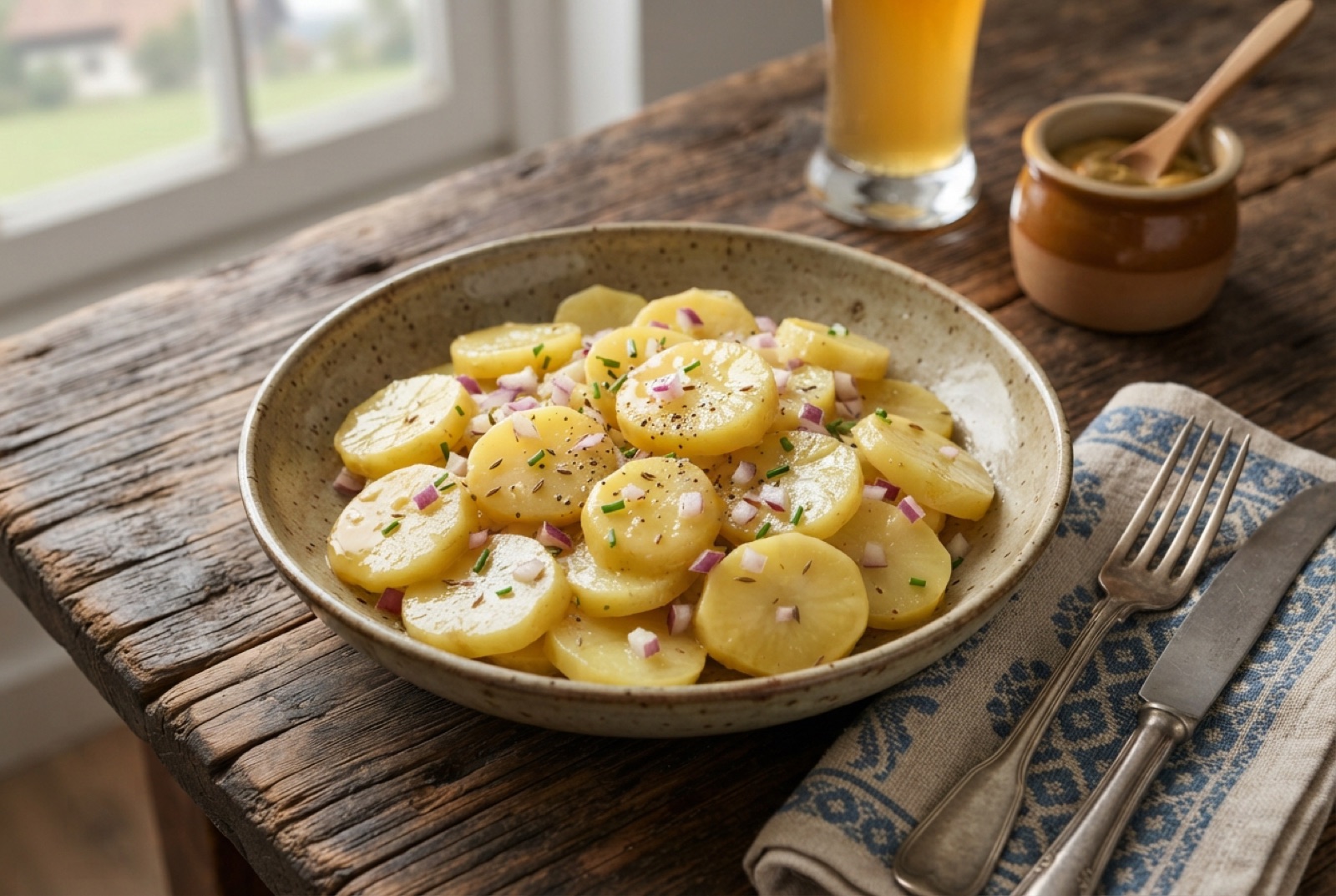
Schwäbischer Kartoffelsalat.
Warm German Potato Salad
Schwäbischer Kartoffelsalat · say it: SHVAY-bish-er kar-TOF-fel-zah-laht
Southern German potato salad contains no mayonnaise. Waxy potatoes are boiled in their skins, peeled and sliced while still too hot to hold comfortably, then drenched in hot beef broth mixed with vinegar, mustard and onion. The warm slices drink the liquid, release enough starch to bind it, and turn slippery and glossy — Swabians call the correct texture schlotzig, and it is the entire test of the dish. The flavour is sharply sour and savoury rather than rich, which is why it partners so well with fried and breaded things. It needs twenty minutes of resting before serving, and it is better at room temperature than cold.

- Gate
- GermanySwabia
- Prep
- 15 min
- Cook
- 25 min
- Total time
- 1 hr incl. 20 min rest
- Serves
- 4
- Status
- Easy
- Nutrition / serving · estimated
- Calories 300 kcal
- Protein 5 g
- Carbs 40 g
- Fat 14 g
- Fiber 4 g
- Sugar 3 g
- Sodium 720 mg
Why this recipe works.
- Broth-and-vinegar dressing applied to hot potatoes, which is what produces the glossy schlotzig texture rather than a watery bowl.
- The onion is warmed in the broth instead of going in raw, so it seasons the salad without leaving a harsh aftertaste.
- Oil is added at the very end, after the potatoes have absorbed the broth — the order matters more than the amounts.
- Twenty minutes of resting written in as a step, because served immediately it is simply potatoes in liquid.
Ingredients.
10 itemsFor the salad
For the dressing
To finish
Equipment
- Large pot
- Sharp knife
- Large mixing bowl
- Small saucepan
Instructions.
Boil the potatoes in their skins
Put 1 kg of potatoes into cold salted water, bring to the boil and cook for 20 to 25 minutes, until a knife tip slides into the centre with slight resistance. Undercooked is better than overcooked here — they continue softening as they sit in the hot dressing.
Warm the dressing
While the potatoes cook, bring the stock to a boil in a small pan with the diced onion, then take it off the heat and whisk in the vinegar, mustard, salt, pepper and sugar. Keep it hot. Warming the onion in the broth takes the raw bite out of it.
Peel and slice hot
Drain the potatoes and peel them as soon as you can bear to hold them, using a folded tea towel and a small knife — the skins slip off easily while hot. Slice them straight into a wide bowl, about 4 mm thick.
Tip Work fast. Every minute the potatoes cool is starch you lose, and the starch is what binds the salad.
Pour over the hot dressing
Pour the hot broth dressing over the warm slices and fold gently with a rubber spatula until every slice is coated. The bowl will look far too wet at this stage; that is correct and it will not stay that way.
Rest 20 minutes
Cover the bowl and leave it for 20 minutes at room temperature, folding once halfway. The potatoes absorb almost all the liquid and the salad turns glossy and slightly creamy as their starch thickens what is left.
Finish with oil and serve
Now fold in the oil and taste for salt and vinegar — it should taste noticeably sour, since it mellows as it stands. Scatter over the chives and serve warm or at room temperature, never chilled.
Tips from our kitchen.
- Use waxy potatoes only — Charlotte, Nicola, Anya or any variety sold as salad potatoes. Floury baking potatoes disintegrate the moment they meet hot broth.
- Boil them whole in their skins. Peeled and cut potatoes take on water and the salad turns bland and soggy.
- Peel and slice them while they are almost too hot to handle, holding each one in a folded tea towel. This is uncomfortable and it is not negotiable.
- Slice about 4 mm thick. Thin slices break up into mash and thick ones never absorb the dressing all the way through.
- Add the oil last, once the broth has been absorbed. Oil poured in early coats the slices and blocks them from taking up any liquid.
- Serve warm or at room temperature. Refrigeration firms the starch and the salad turns stodgy and dull; take it out an hour before eating if it has been chilled.
Substitutions.
- Beef broth → Vegetable broth
- Makes the salad vegetarian and is common in Swabian households anyway. Season it a little more assertively, since vegetable broth tastes thinner under the vinegar.
- White wine vinegar → Apple cider vinegar, or a mild red wine vinegar
- Cider vinegar gives a fruitier, softer sourness. Avoid balsamic, which colours the salad grey-brown and is far too sweet.
- Neutral sunflower oil → A mild olive oil, or half oil and half rendered bacon fat
- Traditional Swabian recipes use neutral oil so nothing distracts from the vinegar. Bacon fat pushes it towards the more rustic version served in inns.
Variations.
- With bacon and Speck
- Fry diced smoked bacon until crisp and stir it in with its fat instead of some of the oil. Standard in Bavarian and Franconian versions and excellent with sausages.
- With cucumber
- Thin slices of fresh cucumber folded in just before serving, salted separately first. Lightens the salad noticeably and is a common summer variation across the southwest.
- Northern German potato salad
- The other side of the argument: cold potatoes bound with mayonnaise, with diced pickle, apple, onion and hard-boiled egg. Different dish, same name, endless family disagreements.
Storage & reheating.
The salad keeps 2 days refrigerated but its texture is best on the day it is made. Bring it fully back to room temperature before serving, or warm it briefly in a low oven, and loosen it with a splash of hot broth since the potatoes keep absorbing liquid as they sit. Do not freeze it — potatoes turn mealy and the dressing separates on thawing. If you need to prepare ahead, boil the potatoes the same morning and leave them whole and unpeeled until an hour before you dress them.
Serve with
Schnitzel, fried sausages or Maultaschen — anything breaded or fried that benefits from something sour beside it.
The story behind Schwäbischer Kartoffelsalat.
The line between northern and southern German potato salad is real and people take sides. North of roughly the Main river the salad is bound with mayonnaise, often with apple, pickle and hard-boiled egg, and it is served cold. South of it the salad is dressed with hot stock, vinegar and oil, served warm or at room temperature, and mayonnaise is regarded as an intruder. Swabia makes the most codified southern version, to the point where the way the potatoes are sliced and the temperature of the broth are matters of some seriousness in a region not otherwise known for culinary drama.
The technique explains the tradition. Hot potatoes have loose, receptive starch; they absorb liquid and give some starch back to it, so the dressing thickens without any emulsifier at all. Cold potatoes do neither, which is why a salad assembled from yesterday's leftovers stays watery no matter how long it sits. This is also why the broth must be hot and the potatoes must be sliced immediately after peeling rather than cooled first. Everything about the method exists to exploit a twenty-minute window.
Where it appears is as fixed as how it is made. Schwäbischer Kartoffelsalat is the standard partner to Maultaschen, to Saitenwürstle, and above all to Schnitzel, where its acidity does the job a lemon does elsewhere. It travels to every Swabian picnic and every buffet table, it survives a warm afternoon better than a mayonnaise salad, and it is one of the few German side dishes that people will happily eat as a meal on its own with a slice of bread.
Questions, answered.
Which potatoes should I use for German potato salad?
Waxy, low-starch varieties sold as salad or boiling potatoes — Charlotte, Nicola, Anya, Ratte or similar. They hold their shape when sliced and soaked in hot broth. Floury varieties like Russets or Maris Piper collapse into a rough mash, which is a different and much less pleasant dish.
Why is my potato salad watery instead of creamy?
Almost always because the potatoes were cold when they were dressed. The binding comes from starch released by warm potato slices absorbing hot liquid; cold slices sit in the dressing without taking any of it up. Adding the oil too early causes the same problem by sealing the surfaces. Peel, slice and dress while the potatoes are still steaming.
Can I make this potato salad vegetarian?
Yes — use a good vegetable broth in place of the beef broth and everything else stays the same. Because vegetable broth has less body, season it more firmly and consider a teaspoon of extra mustard, which adds savouriness as well as sharpness.
Should German potato salad be served warm or cold?
The southern version is served warm or at room temperature, never straight from the fridge, because cold firms the starch and makes it stodgy. The northern mayonnaise version is the one served cold. If you have refrigerated a southern salad, take it out at least an hour before eating and stir through a little warm broth.
How far ahead can I make it?
It is at its best 30 minutes to 3 hours after dressing, which makes it an ideal dish to make in the morning for lunch. Beyond a day, the potatoes absorb all the liquid and the salad turns dry and dense, though a splash of hot broth stirred through revives it reasonably well.
You might also like.
All recipes →
Keep exploring Germany.
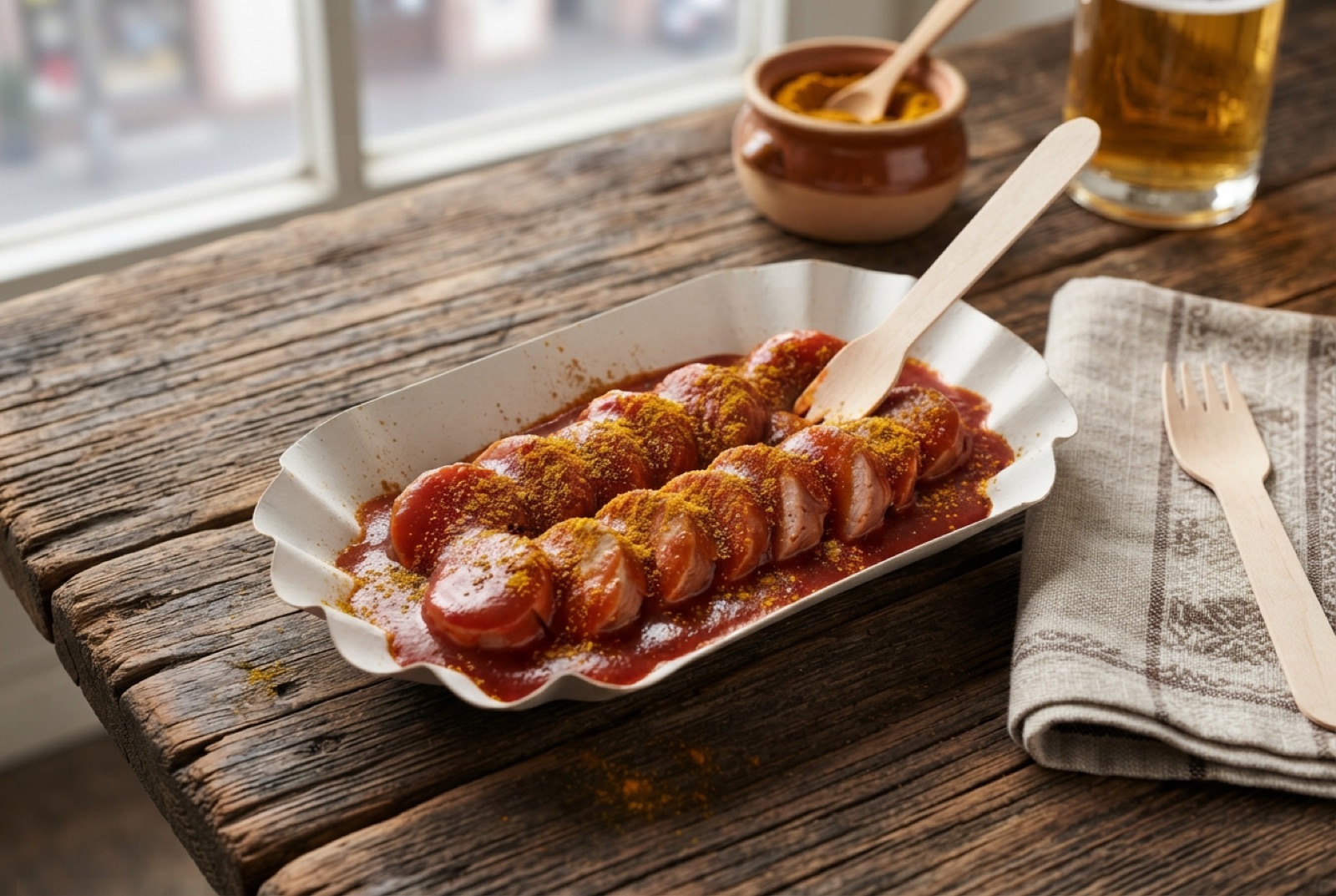
Germany has 9 more dishes in the atlas — Currywurst and Handkäse mit Musik, and 7 more.
Recipe by The DishRoute Kitchen · published August 19, 2026 · updated August 19, 2026