Käsespätzle.
Swabian Cheese Noodles with Fried Onions
Käsespätzle · say it: KAY-zeh-SHPETS-leh
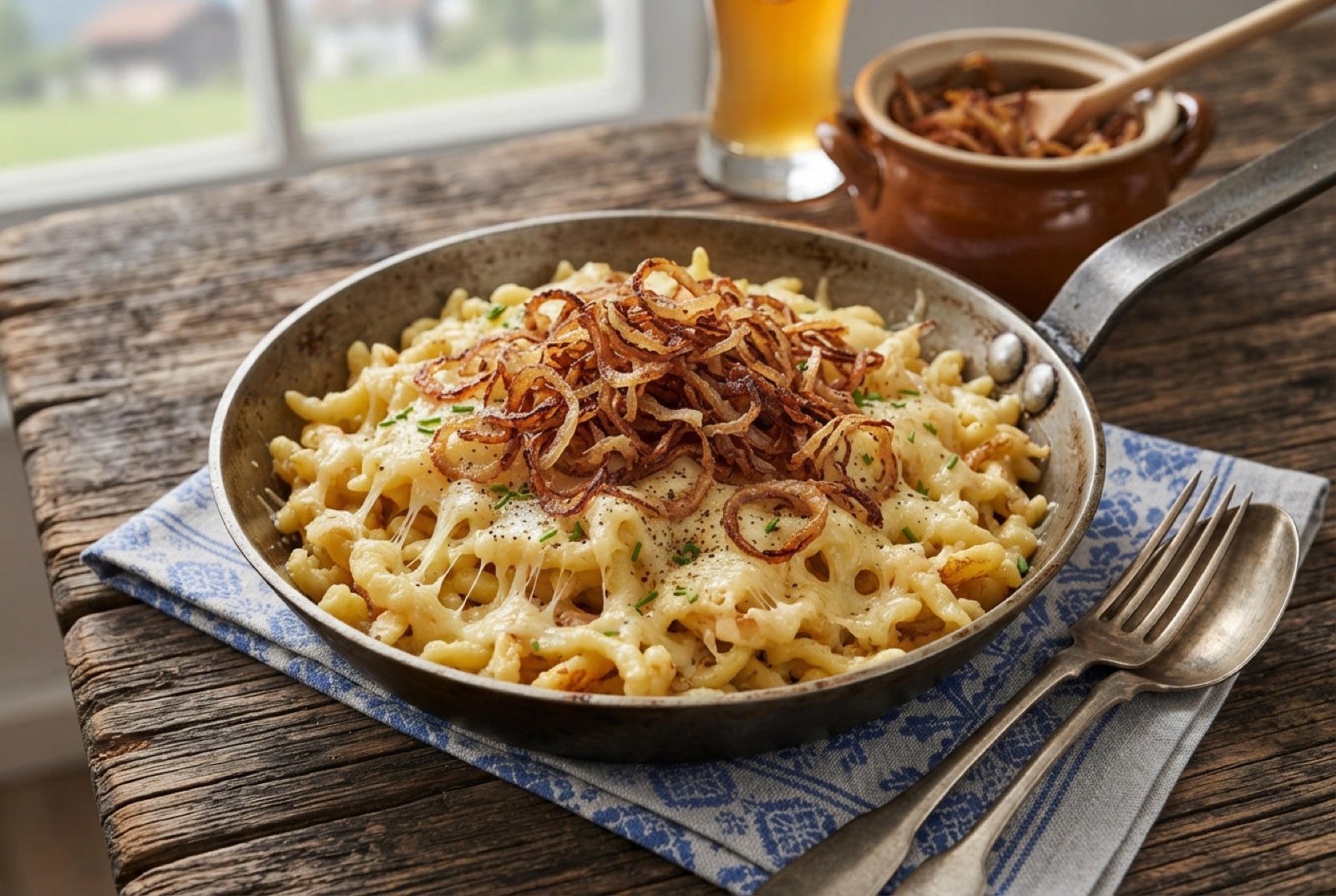
Käsespätzle is what happens when a batter of flour, eggs and a little liquid gets scraped into boiling water, drained, and layered while steaming with sharp mountain cheese that melts into ropes. On top goes a heap of onions fried slowly until they are brown and almost sweet. The noodles themselves are irregular and slightly chewy with soft ragged edges, nothing like factory pasta, and they take about ninety seconds to cook. Swabians and Allgäuers both claim it, both make it constantly, and it is the rare German classic that is vegetarian by default and finished in half an hour from a standing start.

- Gate
- GermanySwabia and the Allgäu
- Prep
- 20 min
- Cook
- 25 min
- Total time
- 45 min
- Serves
- 4
- Status
- Easy
- Nutrition / serving · estimated
- Calories 720 kcal
- Protein 31 g
- Carbs 79 g
- Fat 32 g
- Fiber 4 g
- Sugar 7 g
- Sodium 890 mg
Why this recipe works.
- Batter ratio tested for the scraping method — thick enough to hold on the board, loose enough to fall in ribbons.
- Onions fried the full 20 minutes rather than rushed, which is what separates this from noodles with cheese on top.
- Layering technique that keeps the cheese stringy instead of sliding into a greasy pool.
- No special equipment needed: a wooden board and a knife do the job a Spätzle press does.
Ingredients.
11 itemsFor the Spätzle
For the onions
To layer
To finish
Equipment
- Large pot
- Wooden board and knife, or a Spätzle press
- Slotted spoon or spider
- Wide frying pan
Instructions.
Fry the onions slowly
Melt half the butter with the oil in a wide pan and cook the sliced onions over medium-low heat for about 20 minutes, stirring often, until they collapse, turn deep brown and smell sweet rather than sharp. Set them aside — do not rush this, they are half the dish.
Tip If they start to catch before they soften, add a spoonful of water and lower the heat. Burnt onions taste acrid and there is no fixing them.
Beat the batter
Whisk the flour, salt and nutmeg in a bowl, add the eggs and milk, and beat hard with a wooden spoon for 3 minutes until the batter is glossy, blistered with bubbles and falls off the spoon in a long ribbon. Rest it for 10 minutes.
Scrape the Spätzle
Bring a large pot of well-salted water to a rolling boil. Spread a few spoonfuls of batter thinly on a wet wooden board and shave narrow strips off the edge into the water with a wet knife, or press the batter through a Spätzle press. Work in batches so the pot never gets crowded.
Cook and lift
The Spätzle sink, then bob to the surface within about a minute. Give them 30 seconds more once they float, then lift them out with a slotted spoon into a warmed bowl. Do not rinse them — the surface starch helps the cheese cling.
Layer with cheese
Working while everything is still steaming, put a layer of hot Spätzle in a warm serving dish, scatter over a third of the grated cheese and a grind of pepper, and repeat twice more. Cover for 2 minutes and let the residual heat do the melting.
Tip Give the dish a gentle shake rather than stirring. Stirring drags the melted cheese into a single lump.
Finish and serve
Melt the remaining butter, pour it over the top, then pile on the fried onions and scatter with chives. Serve immediately, while the cheese still pulls into strings when you lift a forkful, with a sharp green salad on the side.
Tips from our kitchen.
- Beat the batter hard for a full three minutes until it blisters and pulls away from the spoon in strands. Under-beaten batter makes dense, doughy Spätzle instead of light ones.
- Rest the batter 10 minutes before scraping. It hydrates and thickens slightly, which makes it far easier to handle on the board.
- Keep a mug of cold water beside the pot and dip the knife in it before each scrape, so the batter releases cleanly instead of dragging.
- Fish the noodles out about 30 seconds after they float. Left in the water they swell and lose their bite.
- Layer the cheese while the noodles are still steaming hot — residual heat is what melts it. Cheese added after the noodles cool needs the oven, and the oven dries them.
- Use two cheeses if you can: a sharp one for flavour and a softer melting one for the strings. One cheese alone rarely does both jobs well.
Substitutions.
- Bergkäse or Emmentaler → Gruyère, aged Comté, or a mix of mature Cheddar and Emmentaler
- You want an alpine-style hard cheese that melts smoothly. Avoid pre-grated bagged cheese, which is dusted with starch and melts into a grainy paste.
- Fresh Spätzle from batter → 500 g of shop-bought fresh Spätzle
- German supermarkets and delis sell them chilled. Boil for two minutes and continue from the layering step — the result is decent, just softer and more uniform.
- Milk in the batter → Sparkling mineral water
- A common Swabian trick. The bubbles lighten the noodles slightly; the flavour is marginally less rich but the texture is arguably better.
Variations.
- Allgäuer Kässpatzen
- The Bavarian alpine version: sharper cheese, often two or three kinds including a pungent one, and a heavier hand with black pepper. Same dish, more assertive.
- Krautspätzle
- Sauerkraut fried in butter and tossed through the noodles alongside or instead of the cheese. Sour, cheap and the more common weekday version in Swabian homes.
- Baked Käsespätzle
- Layer everything into a buttered dish and bake at 200°C for 15 minutes until the top browns. Better for a crowd, though you trade some of the stringy melt for a crust.
Storage & reheating.
Käsespätzle keeps 2 days refrigerated but changes character: the cheese sets and it becomes a firm cake rather than loose noodles. Reheat in a buttered pan over medium heat until the underside crisps, which is a genuinely good second life. It does not microwave well — the cheese separates into oil and rubber. Plain cooked Spätzle without cheese keep 3 days tossed in a little oil, or freeze for 2 months, and are the better thing to store if you know you will have leftovers.
Serve with
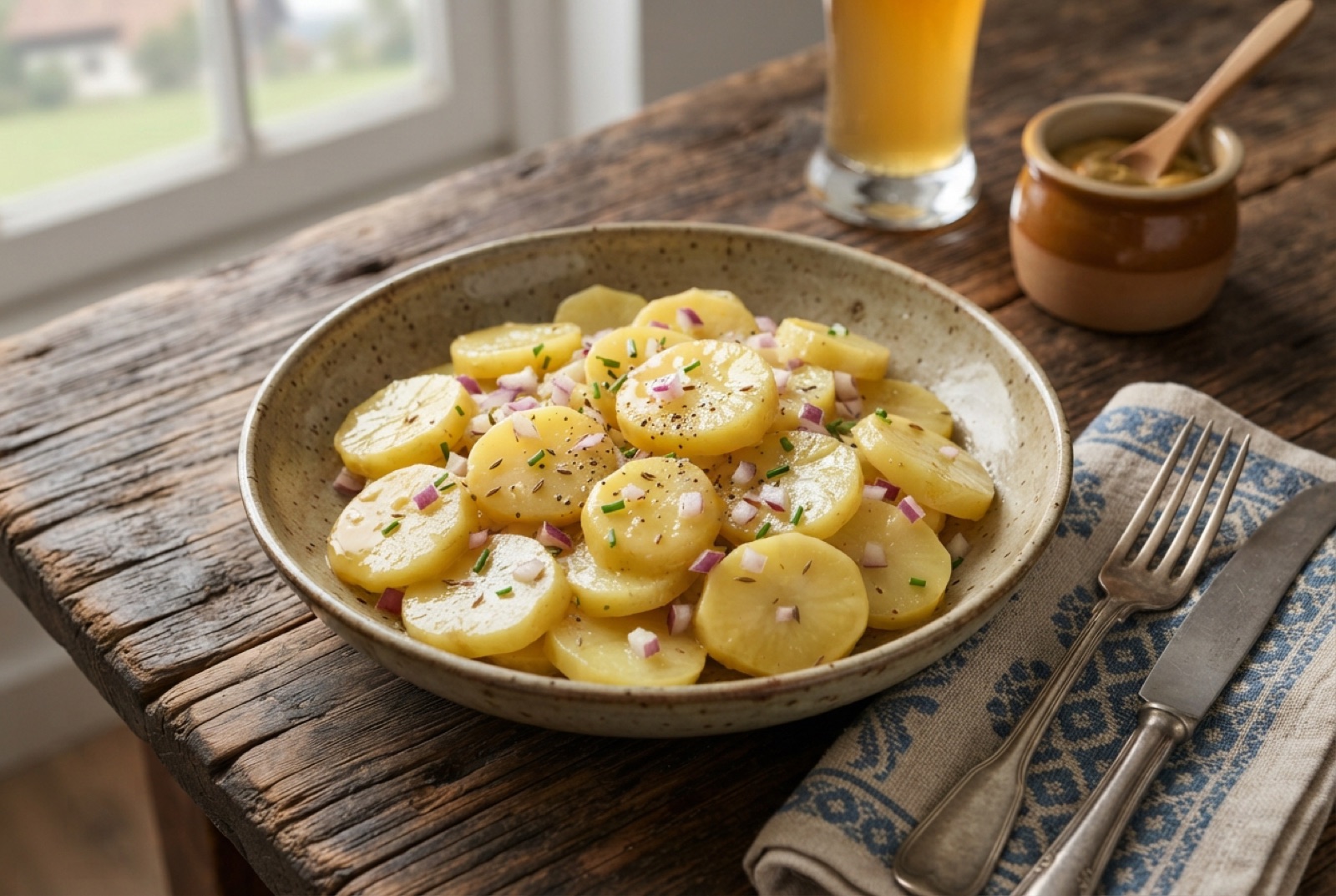
A sharp green salad with vinegar dressing, or Swabian potato salad, to cut the richness.
The story behind Käsespätzle.
Spätzle are the everyday noodle of Baden-Württemberg and the surrounding southwest, and the region takes them seriously enough that Swabian Spätzle carry protected geographical indication status in the EU. The name is usually explained as a diminutive of Spatz, sparrow, describing the small irregular shape. What matters more is the method: the batter is soft enough to be scraped, pressed or dropped rather than rolled and cut, which makes Spätzle the fastest fresh noodle in European cooking and puts them within reach of a cook with no equipment beyond a board and a knife.
The cheese version is mountain food. In the Allgäu, the alpine dairy region on the Bavarian side of the border, hard cheeses like Bergkäse and Emmentaler are the local currency, and layering them into hot noodles is the obvious use for the odds and ends. Swabian versions often use a milder cheese and more of it; Allgäu versions tend to be sharper and are frequently sold as Allgäuer Kässpatzen, which is essentially the same dish under a different dialect name. Neither side concedes. Across the border in Austria the equivalent is Käsespätzle too, in Switzerland it edges towards Chäsknöpfli, and the whole alpine arc makes some version of noodles plus melted cheese plus browned onion.
The onions are not a garnish. They are the reason the dish is not simply heavy: fried long and slow until they collapse and brown, they cut through the cheese with sweetness and a little bitterness at the edges. Skimping on them is the most common mistake made outside the region. The classic accompaniment is a green salad or a sharp potato salad, and in Swabia the meal is often eaten with a fork alone — the noodles are soft enough that a knife has nothing to do.
Questions, answered.
Do I need a Spätzle press or maker?
No. The traditional method is a wet wooden board and a knife or scraper: spread a thin layer of batter on the board and shave strips off the edge straight into the boiling water. A press or a colander with wide holes is faster and gives more uniform noodles, but board-scraped Spätzle are the ones with the ragged edges Swabians actually want.
Why are my Spätzle dense and heavy?
The batter was almost certainly not beaten enough. It needs to be worked hard until air is incorporated and it comes off the spoon in long elastic strands, which takes several minutes by hand. Too much flour also does it — the batter should be thick like a slow pancake batter, not a dough.
What cheese is best for Käsespätzle?
An alpine-style hard cheese with real flavour and good melting behaviour: Bergkäse, Emmentaler, Gruyère or aged Comté. Many cooks combine a mature cheese for taste with a younger, softer one for the strings. Avoid anything pre-grated, since the anti-caking starch makes the melt grainy.
Can I make Käsespätzle ahead for a party?
Cook and drain the Spätzle up to a day ahead, toss them in a little oil and refrigerate. On the day, reheat them in butter in a pan until hot right through, then layer with the cheese and add the fried onions, which can also be made ahead and re-crisped in a dry pan. Assembling early and holding it warm turns the cheese greasy.
Is Käsespätzle vegetarian?
The dish as written is, with one caveat: many traditional alpine hard cheeses are made with animal rennet. If that matters, check the label or choose a cheese explicitly made with microbial rennet, since plenty of Emmentaler and Cheddar-style cheeses now are.
You might also like.
All recipes →
Keep exploring Germany.
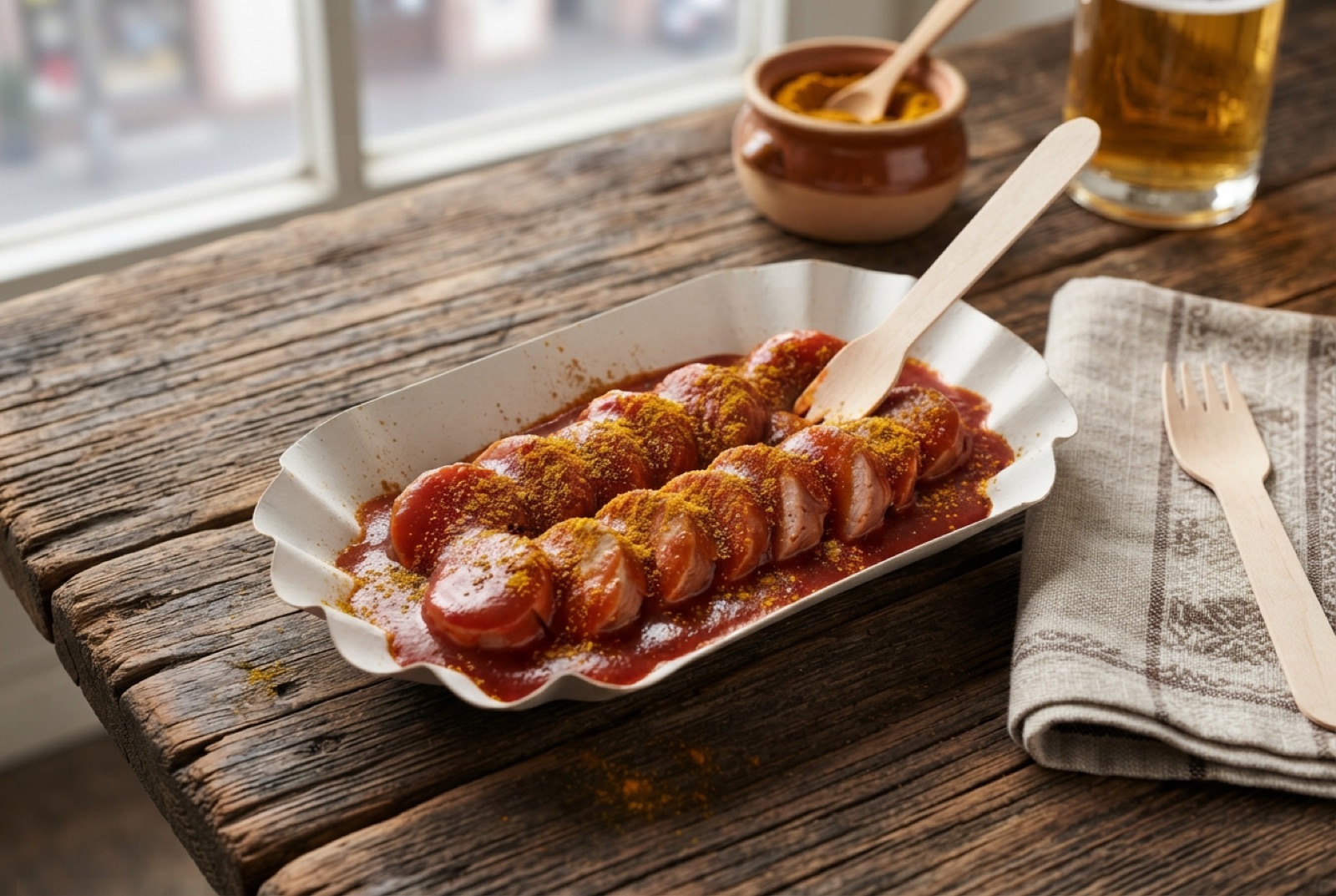
Germany has 9 more dishes in the atlas — Currywurst and Handkäse mit Musik, and 7 more.
Recipe by The DishRoute Kitchen · published August 19, 2026 · updated August 19, 2026