Rúgbrauð.
Icelandic Steamed Dark Rye Bread
Rúgbrauð · say it: ROOG-broyth
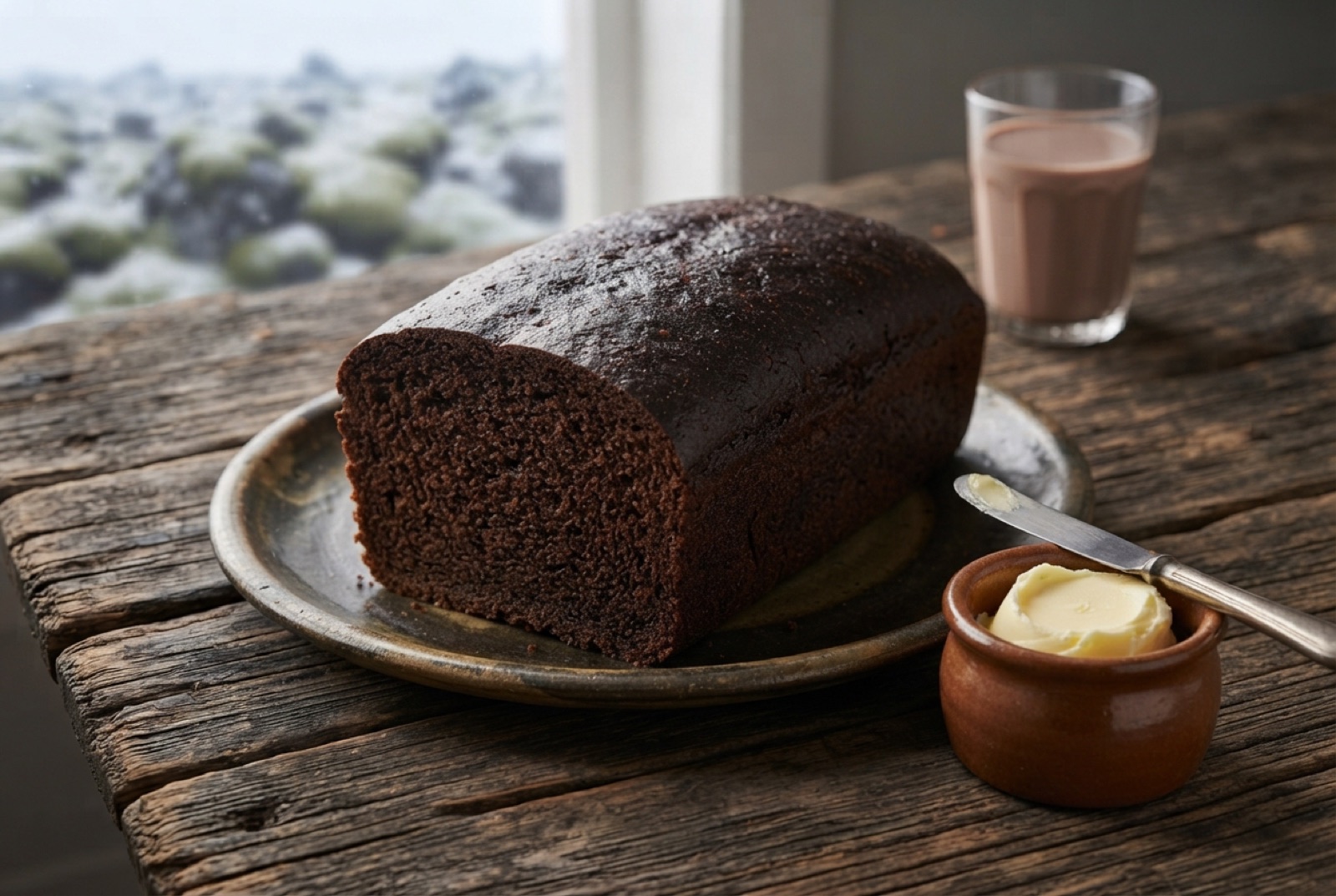
Rúgbrauð is a dense, moist, nearly cakelike rye bread with no crust worth speaking of, sweetened with dark syrup and cooked so slowly that the sugars caramelise the crumb to deep brown. It is not baked in the usual sense: the batter goes into a tightly sealed tin and is held at around 100°C for ten to twelve hours, so it steams rather than bakes, and no dry heat ever touches it. There is no yeast and no kneading — you stir a thick batter in one bowl and then wait. The taste is malty and sweet against sour rye, and it is eaten in thin slices under an unreasonable amount of cold butter, with smoked lamb, pickled herring or plokkfiskur on top.

- Gate
- IcelandNorth Iceland and Mývatn
- Prep
- 15 min
- Cook
- 12 hr
- Total time
- 20 hr 15 min incl. 8 hr rest
- Serves
- 12
- Status
- Medium
- Nutrition / serving · estimated
- Calories 245 kcal
- Protein 6 g
- Carbs 51 g
- Fat 2 g
- Fiber 6 g
- Sugar 18 g
Why this recipe works.
- Reproduces the geothermal method honestly with a sealed tin and wet heat, instead of pretending a normal bake gives the same crumb.
- One bowl, no yeast, no kneading and no proving — the only skill required is sealing the tin properly.
- Gives both routes: a very low oven overnight, or a covered water bath on the hob for anyone without oven space.
- Explains the overnight rest, which is what makes the loaf sliceable instead of sticky and crumbling.
Ingredients.
10 itemsDry
Wet
To serve
Equipment
- 1 kg loaf tin with a lid, or a tin plus heavy foil
- Large mixing bowl
- Deep roasting tray or a lidded stockpot for the water bath
Instructions.
Prepare the tin
Butter a 1 kg loaf tin heavily, right into the corners, and line the base with baking paper. This batter is sticky enough to weld itself to bare metal, and a loaf that will not release tears apart when you try.
Mix the dry ingredients
Whisk 400 g of rye flour with the plain flour, brown sugar, baking powder, bicarbonate of soda and salt in a large bowl until evenly combined with no pale streaks of raising agent left.
Make the batter
Pour in the buttermilk and syrup and stir with a spatula for about a minute, until you have a thick, glossy, dark batter that falls off the spatula in slow ribbons. It should be considerably wetter than a bread dough and slightly stiffer than a cake batter.
Tip Work reasonably quickly once the buttermilk meets the raising agents — the reaction starts immediately.
Seal the tin
Scrape the batter into the tin, filling it no more than two-thirds, and smooth the top. Cover with a double layer of foil crimped tightly under the rim, then clamp the lid on or weigh the foil down with a small ovenproof plate.
Cook low and slow
Heat the oven to 100°C. Stand the sealed tin in a deep tray, pour in 3 cm of boiling water, and cook for 10–12 hours. Alternatively set the tin in a stockpot with water reaching halfway up the sides, cover, and hold it at a bare simmer for the same time, topping up with boiling water every couple of hours.
Check it is done
Unseal carefully — the steam is fierce. A skewer pushed into the centre should come out clean and the crumb should look uniformly dark brown to near-black, with a slightly tacky, springy surface. If it is still wet in the middle, reseal and give it another hour.
Cool and rest
Cool in the tin for 20 minutes, then turn out onto a rack and cool completely. Wrap the cold loaf in a clean cloth and leave it overnight before cutting — this is what turns a sticky mass into a sliceable bread.
Slice and serve
Cut thin slices about 5 mm thick with a long serrated knife and spread each one thickly with cold salted butter. Serve with smoked lamb, pickled herring or a bowl of plokkfiskur.
Tips from our kitchen.
- Seal the tin obsessively. A double layer of foil crimped hard under the rim, plus a lid or a weight on top, keeps the steam in — a leaky tin gives you a dry, cracked loaf.
- Grease the tin heavily and line the base with baking paper; this batter sticks like glue and a stuck loaf tears apart on the way out.
- Fill the tin only two-thirds full. The loaf rises modestly but it does rise, and batter forced against the seal makes a mess.
- If you use the water-bath method, check the water level every couple of hours and top up with boiling water so the pot never runs dry.
- Do not slice it warm. Rúgbrauð needs to cool completely and rest wrapped overnight before it firms up enough to cut thinly.
- Slice much thinner than you think — 5 mm is right. This bread is rich and sweet and is meant to carry butter, not to be a sandwich base.
Substitutions.
- Dark syrup → Molasses, black treacle, golden syrup or dark honey
- Molasses gives the deepest colour and a slightly bitter edge; golden syrup makes a lighter, sweeter loaf. Icelandic recipes usually use a dark baking syrup that sits between the two.
- Buttermilk → Plain milk soured with 1 tbsp lemon juice, or thin plain yogurt let down with water
- The acid reacts with the raising agent, so some sourness is needed. Straight milk alone gives a heavier, flatter loaf.
- Loaf tin → A clean 1-litre milk carton, or a lidded stainless pudding basin
- The milk carton is the traditional Icelandic vessel for the geothermal version — folded shut and buried. In an oven, use it standing in a deep tray and cover the whole tray with foil.
Variations.
- Hverabrauð (hot-spring bread)
- The buried original: sealed batter left in geothermally heated ground for 24 hours. Only attempt this where locals do it and with permission — hot ground can scald badly and thin crust can give way.
- Seeded rúgbrauð
- A handful of caraway or fennel seeds stirred into the batter. Not traditional in Iceland but common in mainland Nordic rye breads, and it cuts the sweetness.
- Flatkaka
- The other Icelandic rye bread: an unleavened rye flatbread cooked on a dry hot plate until it scorches in patches. Faster, chewier, and the traditional partner for smoked lamb.
Storage & reheating.
Wrapped in a cloth then in a bag, rúgbrauð keeps a full week at room temperature and only gets moister and denser. Do not refrigerate — it goes hard and stale far faster than it does on the counter. It freezes exceptionally well: slice first, freeze in a bag, and take out slices as needed, since they thaw in about ten minutes. Slightly stale slices are excellent lightly toasted, though Icelanders would consider toasting it unusual.
Serve with
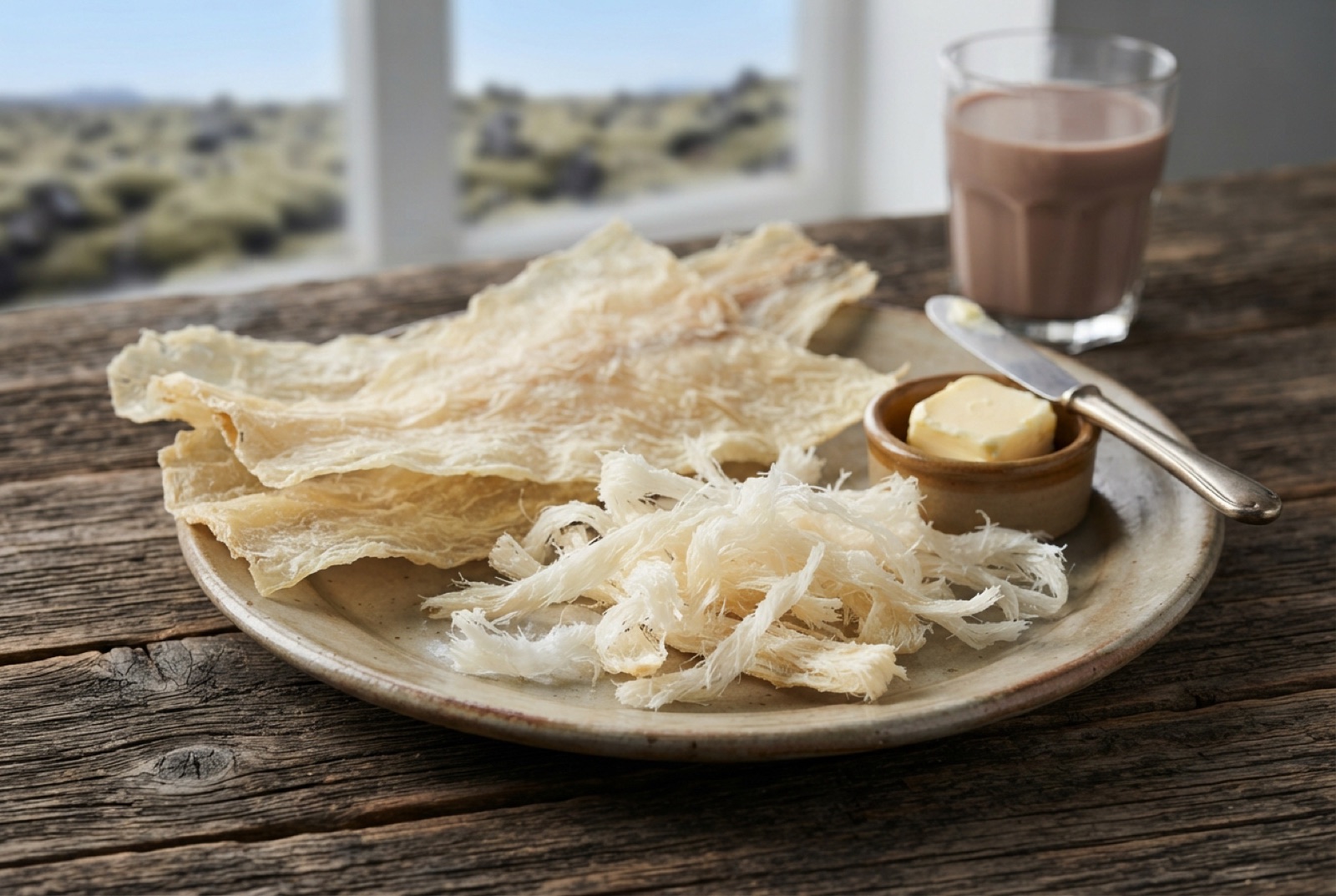
Cold salted butter, smoked lamb or pickled herring, and alongside plokkfiskur or harðfiskur.
The story behind Rúgbrauð.
Iceland had no grain to speak of. Barley was grown briefly after the settlement, then the climate cooled and cereal farming effectively stopped for centuries, which meant flour was imported, expensive, and treated as a luxury rather than a staple. Rye was the affordable import, and the bread made from it was sweetened with syrup and stretched as far as it would go. That scarcity explains why Icelandic bread culture is so small and so specific compared to the rest of Northern Europe: two or three breads, all of them made to go with fish and meat rather than to be eaten alone.
The geothermal method is not a tourist stunt, though it is now performed for tourists as well. In areas where hot ground sits close to the surface — around Lake Mývatn in the north, at Laugarvatn in the south — the soil holds a steady near-boiling temperature all day, every day, at no cost. Bakers seal the batter into a pot or a milk carton, bury it in a marked spot in the hot sand, and dig it up twenty-four hours later. Because the loaf is sealed and the heat never rises much above boiling point, nothing burns and nothing dries: the bread cooks in its own steam. Some bakeries at Mývatn have been doing this commercially for decades, and the loaf is sold as hverabrauð, hot-spring bread. Where the ground is hot enough, it is simply the most efficient oven anyone has.
A home kitchen can copy the physics if not the geology. Held in a sealed tin in a very low oven, or standing in a covered pot of simmering water, the batter cooks under exactly the same conditions — wet heat, no air, hours of it — and comes out with the same black crumb and sticky sweetness. What you lose is the faint sulphurous note that some people swear the geothermal loaves carry and others insist is imagination. What you gain is a loaf you can make anywhere, without digging a hole in ground that can scald you.
Questions, answered.
Why is Icelandic rye bread cooked at such a low temperature?
Because it is steamed rather than baked. Sealed in a tin at around 100°C for ten to twelve hours, the batter never dries out or forms a crust, and the long, slow heat caramelises the sugars until the crumb turns almost black. This mimics geothermal ground, which holds a steady near-boiling temperature and cannot go higher.
Is geothermal bread really buried in the ground?
Yes. In geothermal areas such as Lake Mývatn and Laugarvatn, bakers seal the batter in a pot or milk carton, bury it in hot sand at a marked spot, and dig it out 24 hours later. It is a genuine working method, used commercially, not a display for visitors — though visitors are often invited to watch the digging.
Can I bake rúgbrauð in a normal oven in less time?
You can bake a rye loaf faster at 150–180°C, but it will not be rúgbrauð. Higher heat forms a crust, dries the crumb and stops short of the deep caramelisation that makes this bread sweet and near-black. If you are short of time, the covered water-bath method on the hob takes about the same hours but needs no oven.
Why is my rye bread sticky and impossible to slice?
Almost always because it was cut too soon. The loaf needs to cool completely and then rest wrapped for at least eight hours, ideally overnight, for the starches to set. If it is still gummy the next day, it was underdone — the tin probably leaked steam, so seal it more tightly next time and add an hour.
Does rúgbrauð contain yeast?
No. It is raised with baking powder or bicarbonate of soda reacting with buttermilk, which is why there is no kneading, proving or shaping. That also makes it much faster to prepare than a sourdough rye, even though the cooking itself takes all night.
You might also like.
All recipes →
Keep exploring Iceland.
Iceland has 9 more dishes in the atlas — Fiskibollur and Hangikjöt, and 7 more.
Recipe by The DishRoute Kitchen · published August 19, 2026 · updated August 19, 2026