Matbucha.
Slow-Cooked Tomato and Roasted Pepper Salad
מטבוחה · Matbucha · say it: maht-BOO-khah
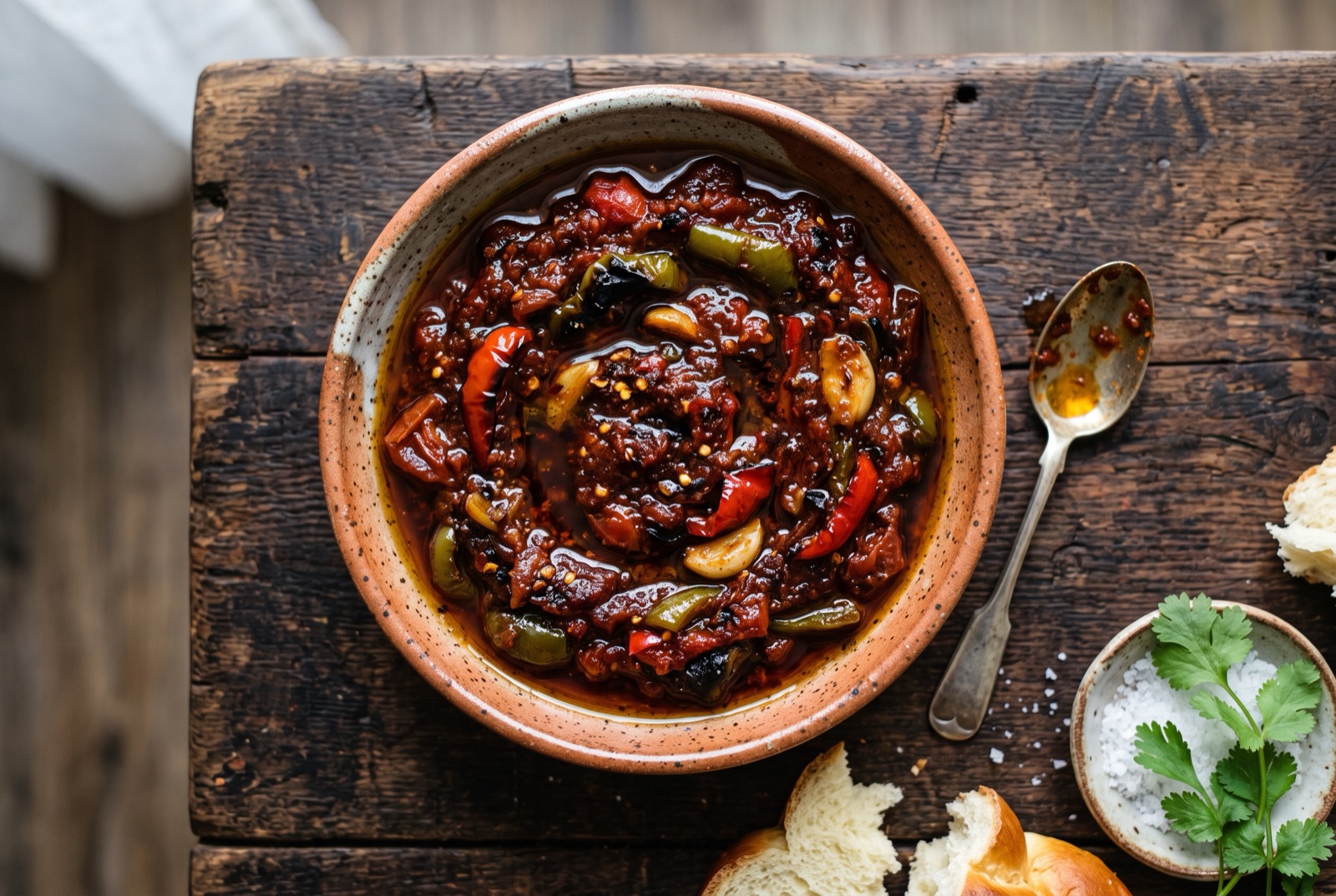
Matbucha is a cooked salad that behaves like a dip: red peppers blistered over flame and peeled, tomatoes skinned and crushed, then the two reduced together in olive oil with sliced garlic, sweet paprika and enough chilli to leave a warm edge. It is finished not by a clock but by a look — the mixture stops sloshing, holds a ridge when you drag a spoon through it, and a rim of red-stained oil separates around the pan. The taste is deep and sweet-sour rather than fresh, closer to a very slow tomato jam than to salsa. It is served cold or at room temperature, scooped with bread, and it improves for three days in the fridge.

- Gate
- IsraelMoroccan and Algerian kitchens, now nationwide
- Prep
- 30 min
- Cook
- 1 hr 45 min
- Total time
- 2 hr 15 min
- Serves
- 6
- Status
- Easy
- Nutrition / serving · estimated
- Calories 210 kcal
- Protein 3 g
- Carbs 15 g
- Fat 16 g
- Fiber 4 g
- Sugar 10 g
- Sodium 490 mg
Why this recipe works.
- Peppers are blistered and peeled first, so the finished salad is silky rather than threaded with tough transparent skins.
- A clear finishing test — the oil separating and the spoon leaving a ridge — instead of a cooking time that depends on how watery your tomatoes were.
- Paprika goes in late and off the direct heat, which keeps it sweet and red instead of scorched and bitter.
- Honest about its North African origin rather than presenting it as an Israeli invention.
Ingredients.
11 itemsFor the peppers
For the base
To season
Equipment
- Wide, heavy sauté pan or shallow casserole
- Grill, gas flame or grill pan for the peppers
- Bowl with a plate to cover it
- Sharp paring knife
Instructions.
Blister and peel the peppers
Set the whole peppers directly over a gas flame or under a hot grill, turning every few minutes until the skins are blackened in broad patches and the flesh has slumped. Drop them into a bowl, cover with a plate and leave 10 minutes, then rub the skins off, pull out the seeds and tear the flesh into rough strips.
Tip Do not rinse the peeled peppers under the tap. You will wash away the smoke you just spent fifteen minutes building.
Skin the tomatoes
Score a shallow cross in the base of each tomato and lower them into boiling water for 30 seconds, then straight into cold water. The skins will peel back from the cross. Halve them, squeeze out the watery seed pockets and crush the flesh roughly with your hands.
Tip Squeezing out the seed jelly removes a surprising amount of liquid and shortens the reduction by a good twenty minutes.
Start the tomatoes on their own
Warm the olive oil in a wide pan over medium heat and tip in the crushed tomatoes with the split chilli. Cook uncovered for about 30 minutes, stirring now and then, until the volume has dropped by roughly a third and the mixture no longer looks like chopped tomato but like a loose sauce.
Add the peppers and garlic
Stir in the torn pepper strips and the sliced garlic. Turn the heat down to its lowest steady setting and continue cooking uncovered for 45 minutes, stirring every 8–10 minutes and scraping the base so nothing catches. The colour will move from bright red towards brick.
Tip If it starts sticking before the water is gone, the heat is too high. Matbucha should barely blip, not spit.
Season and cook to the oil break
Stir in the paprika, cumin, salt and sugar if the tomatoes need it. Keep cooking for another 20–30 minutes until a spoon dragged across the base leaves a channel that stays open and a rim of red-stained oil pools around the edge of the pan. That separation is the finish line.
Tip Add the paprika now rather than earlier. Half an hour of direct heat turns it dusty and bitter.
Cool, then taste again
Fish out the chilli, pour over the last two tablespoons of olive oil and let the pan cool to room temperature before you judge the seasoning — cold matbucha tastes considerably less salty than hot. Serve at room temperature in a shallow dish with bread for scooping.
Tips from our kitchen.
- Blister the peppers until the skin is black in patches, then shut them in a bowl under a plate for ten minutes — the trapped steam lifts the skin off in sheets.
- Peel the tomatoes. Score a cross in the base, thirty seconds in boiling water, into cold water, and the skins slip. Left in, they roll into papery tubes in the finished salad.
- Use a wide pan, not a saucepan. Evaporation is the entire method and a narrow pot will still be watery after two hours.
- Do not salt heavily at the start. The volume drops by well over half, and seasoning judged at the beginning ends up brutal at the end.
- Stop when the oil pools red at the edges and a spoon dragged across the base leaves a channel that does not fill in. That is the traditional doneness signal.
- Make it a day early. Cold matbucha eaten the next day tastes rounder and less sharp than matbucha eaten straight from the pan.
Substitutions.
- Fresh red peppers → Two jars of roasted red peppers, drained well and chopped
- Saves the charring and peeling entirely. Add them halfway through the tomato reduction, since they need no further softening, and cut the salt because jarred peppers are already seasoned.
- Fresh ripe tomatoes → 1.2 kg tinned whole plum tomatoes, drained of their juice and crushed by hand
- The right call for nine months of the year. Drain properly or you will add half an hour of reduction to get back to where you started.
- Fresh hot chilli → 1 tsp harissa stirred in with the paprika
- Harissa brings caraway and garlic as well as heat, which pushes the salad towards its Tunisian cousins. Pleasant, but a different dish by a small margin.
Variations.
- Taktouka
- The Moroccan sibling: same peppers and tomatoes, but cumin and chopped coriander lead instead of paprika, and it is usually cooked a little less far so it stays looser.
- Matbucha with eggs
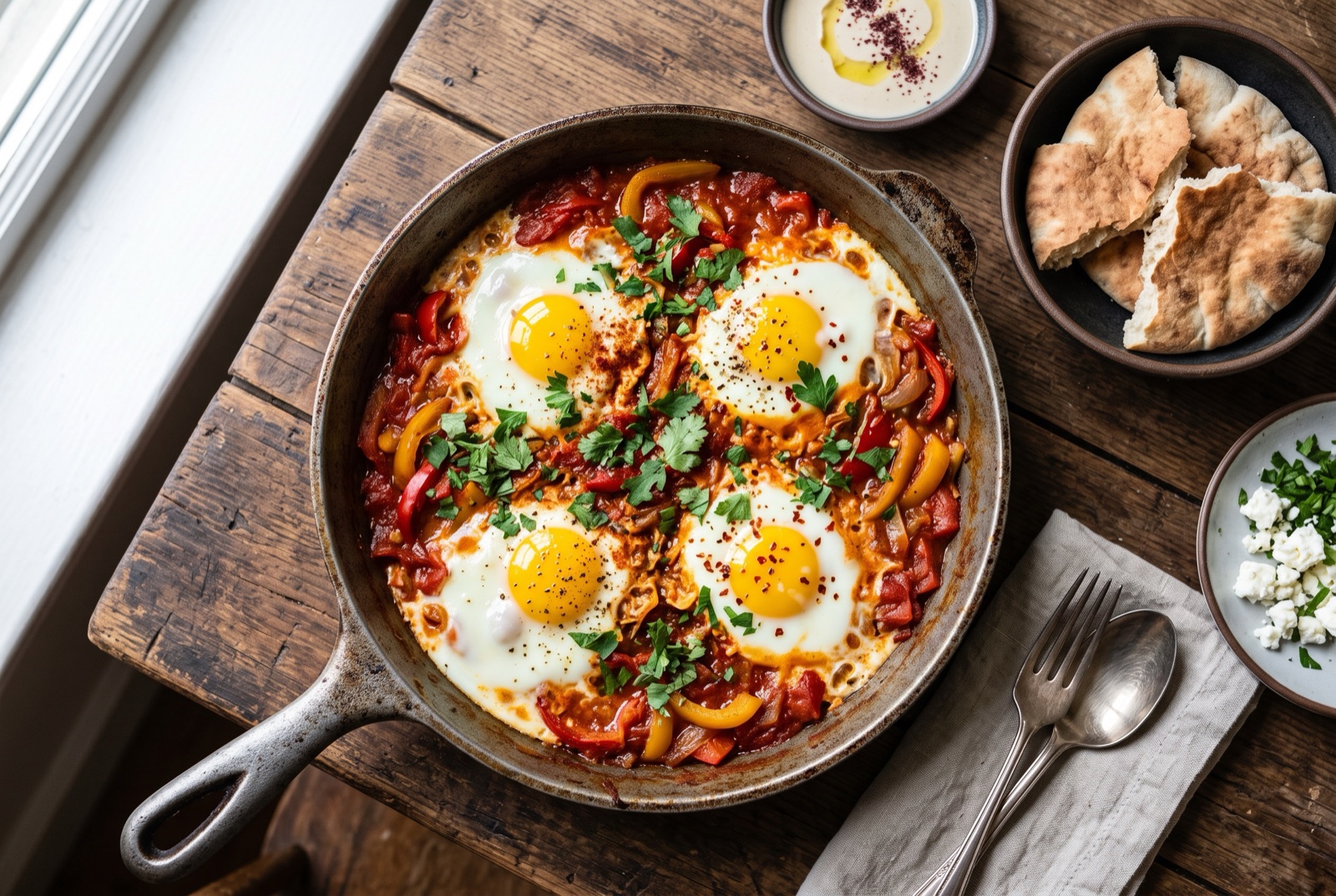
- Spread the finished salad in a small pan, make wells and bake eggs into it. Effectively a shortcut breakfast built on yesterday's leftovers.
- Green matbucha
- Made entirely with long green peppers and a heavier hand with the chilli. Sharper, hotter and noticeably less sweet than the red version.
Storage & reheating.
Matbucha is a keeper by design. Cool it completely, press it into a jar, pour a thin film of olive oil over the surface and refrigerate for up to 5 days — the flavour deepens for the first two. It freezes well for 3 months in small tubs; thaw in the fridge and stir hard to bring the separated oil back in. Always take it out of the fridge twenty minutes before serving, because fridge-cold olive oil goes cloudy and dulls the taste. Do not serve it hot from the pan; it is meant to be cool or at room temperature.
Serve with
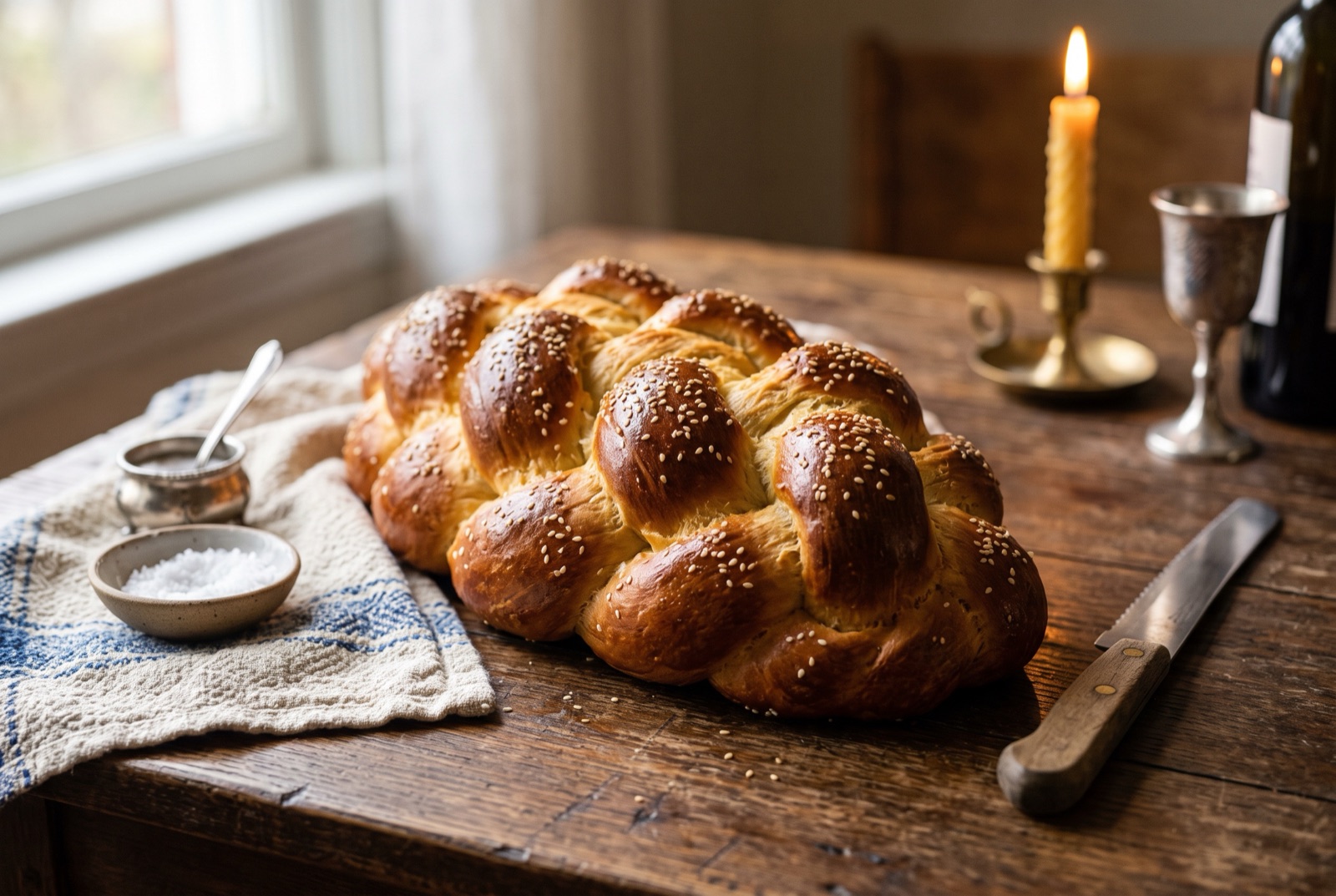
Warm pita or challah for scooping, a bowl of olives, and the rest of a salatim spread alongside grilled meat or fish.
The story behind Matbucha.
Matbucha is Maghrebi. The name is Arabic — matbukha simply means cooked — and the dish belongs to the Moroccan and Algerian repertoire of cooked pepper-and-tomato salads eaten across North Africa long before any of it reached Israel. Its closest relative is Moroccan taktouka, which is more or less the same technique with cumin and coriander leading instead of paprika, and it sits in a broad family that runs from Tunisian slata mechouia, where the peppers are grilled and chopped rather than stewed, through to the various cooked salads of the wider Levant. None of these belongs to one nation, and matbucha is fairly described as a North African dish that Moroccan Jewish immigrants brought with them in the 1950s and 1960s, not as an invention of the country it is now most associated with.
What did happen in Israel is that matbucha stopped being a household dish and became a fixture of a national eating format. Restaurants and grill houses put out salatim — a spread of small plates that lands on the table before anyone orders — and matbucha anchors it, because it is cheap, it keeps, and its dark sweetness balances the raw, lemony salads sitting next to it. Ask what the free salads are anywhere in the country and matbucha is nearly always among the first three named.
The technique is where the argument lives. Some cooks roast both peppers and tomatoes before they hit the pan; others peel the tomatoes raw and let the pot do everything. Some pass the finished salad through nothing at all, leaving it coarse and shreddy; others chop it fine enough to spread. Almost everyone agrees on the two things that cannot be shortcut: the pepper skins have to come off, because they curl into leathery slivers that never soften, and the cooking has to run long enough for the water to leave and the oil to come back out. A quick matbucha is just a wet pan of vegetables.
Questions, answered.
Is matbucha Israeli or Moroccan?
North African in origin. The name is Arabic for cooked, and cooked pepper-and-tomato salads of this kind have been made in Morocco and Algeria for a very long time. It reached Israel with Moroccan and Algerian Jewish immigrants in the mid-twentieth century and became a standard part of the free salad spread served in restaurants there. Describing it as a Maghrebi dish widely eaten in Israel is accurate; calling it an Israeli original is not.
Why is my matbucha watery?
It has not cooked long enough, or the pan was too narrow for the liquid to evaporate. The salad is finished only when the water has gone and the olive oil separates back out, forming a red rim around the edge of the pan. If the mixture still slides loosely off a tipped spoon, keep cooking uncovered over low heat, stirring every few minutes so the base does not catch.
Do I have to peel the peppers and tomatoes?
Yes, both. Pepper skin does not break down with cooking — it separates and rolls into tough, transparent slivers that ruin the texture. Tomato skins do the same on a smaller scale, curling into papery scraps. Blistering the peppers under a grill and steaming them in a covered bowl makes them easy to peel, and tomatoes skin in seconds after a brief dip in boiling water.
How spicy should matbucha be?
Warm rather than fiery in most versions. The chilli is there to stop the long-cooked tomato from tasting purely sweet, not to dominate. Moroccan families vary widely on this, and plenty make a distinctly hot version. Start with one chilli for this quantity, taste at the end when the flavours have concentrated, and add more heat then if you want it.
What is the difference between matbucha and shakshuka sauce?
Cooking time and how it is eaten. Shakshuka sauce is cooked down for twenty minutes or so and stays a sauce, with eggs poached into it and served hot from the pan. Matbucha is reduced for two hours until the oil separates and it becomes a thick spreadable salad, eaten cold or at room temperature with bread. Leftover matbucha can be used as a shakshuka base, but sauce made in twenty minutes is not matbucha.
You might also like.
All recipes →
Keep exploring Israel.
Israel has 9 more dishes in the atlas — Challah and Cholent, and 7 more.
All Israel recipes Tomato recipes Bell pepper recipes Garlic recipes appetizersidevegetarianvegangluten freedairy freeRecipe by The DishRoute Kitchen · published August 20, 2026 · updated August 20, 2026