Jianbing Guozi.
Tianjin Savoury Breakfast Crepe
煎饼果子 · Jiānbing guǒzi · say it: jyen-BING gwor-dzuh
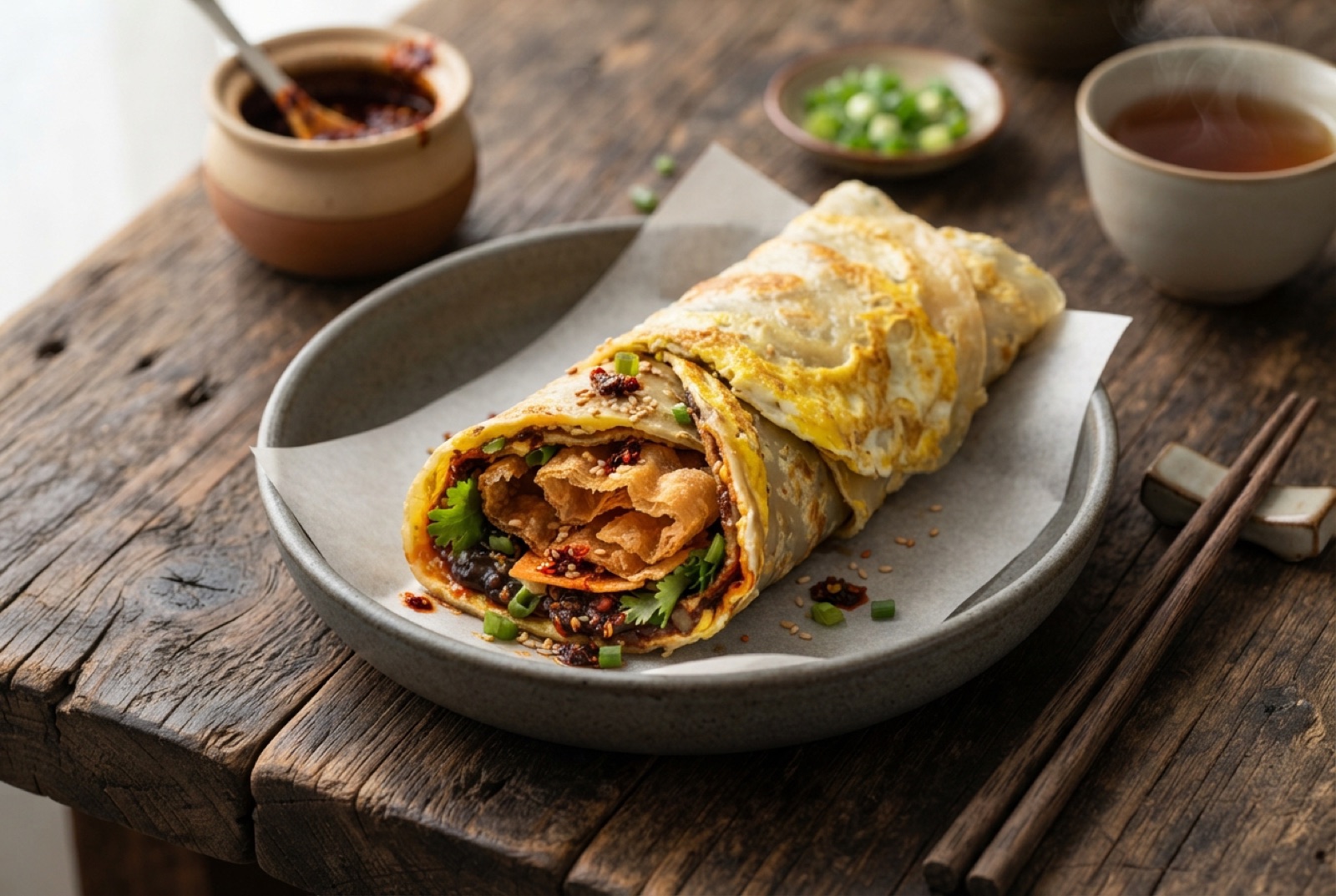
Jianbing is a griddle crepe eaten in the street on the way to work, made in about ninety seconds and constructed in layers. A thin batter of mung bean and wheat flour is spread across a hot flat plate, an egg is cracked straight onto it and smeared over the surface, then scallion, coriander and sesame go on before the whole sheet is flipped. The cooked side gets brushed with sweet fermented bean sauce and chilli paste, a large piece of fried cracker or crisp dough goes in the middle, and the crepe is folded into a rectangle and cut in half. The result is soft, savoury and slightly sweet with a loud crunch running through the centre — the textural contrast is the entire point of the dish.

- Gate
- ChinaTianjin and Shandong
- Prep
- 20 min
- Cook
- 20 min
- Total time
- 1 hr 10 min incl. 30 min rest
- Serves
- 4
- Status
- Medium
- Nutrition / serving · estimated
- Calories 430 kcal
- Protein 15 g
- Carbs 52 g
- Fat 17 g
- Fiber 4 g
- Sugar 7 g
- Sodium 920 mg
Why this recipe works.
- Keeps the mung bean flour, which is what gives jianbing its faint sweetness and tender, non-rubbery texture.
- Uses fried wonton wrappers as the crisp layer, which is the most reliable home substitute for baocui.
- Gives a clear flip signal so the crepe does not tear halfway across the pan.
- Every filling is available in a supermarket or a small Chinese grocery, with an honest swap for the sweet bean sauce.
Ingredients.
16 itemsFor the batter
For the crunch
To assemble
Equipment
- Large flat non-stick pan or crepe pan (26–30 cm)
- Ladle with a flat back or a crepe spreader
- Small saucepan for frying the crackers
- Wide spatula
Instructions.
Mix and rest the batter
Whisk the mung bean flour, plain flour, millet flour, five-spice and salt with the cold water until completely smooth, then leave it to rest for 30 minutes. It should pour off a ladle in a steady ribbon; whisk in a splash more water if it drags.
Tip Strain the batter through a sieve if any lumps survive — a lump tears the crepe as you spread it.
Fry the crisp layer
Heat the frying oil to 180°C in a small pan and fry the wonton wrappers one or two at a time for about 30 seconds each, until they blister, curl and turn pale gold. Lift onto kitchen paper and leave uncovered so they stay crackling.
Tip They keep frying for a few seconds after they leave the oil — pull them out just before the colour you want.
Spread the crepe
Wipe a large flat pan with a little oil and set it over medium heat. Pour in a quarter of the batter and immediately spread it outward from the centre in a spiral with the back of the ladle, until you have a thin circle reaching the edges of the pan.
Tip Work fast and lightly. Pressing hard drags the batter into ridges instead of a sheet.
Add the egg
As soon as the surface sets and dulls, crack an egg onto the middle of the crepe and spread it over the whole surface with the back of a spoon. Scatter over a quarter of the scallions, coriander and sesame seeds and press them in lightly so they stick.
Flip and sauce
When the edges lift away from the pan on their own and the underside is set and lightly speckled — about 60–90 seconds — flip the crepe in one movement. Brush the cooked side with a tablespoon of sweet bean sauce, a little chilli sauce and a few drops of sesame oil.
Fill, fold and cut
Lay two fried wonton wrappers across the middle, fold the two sides in over them, then fold the top and bottom to make a rectangle. Press down for a few seconds, lift onto a board and cut in half — you should hear the crunch under the knife. Eat immediately and repeat with the rest.
Tips from our kitchen.
- Rest the batter for at least 30 minutes. Mung bean flour hydrates slowly, and unrested batter spreads badly and tears at the edges.
- The batter should be about the consistency of single cream — thin enough to pour off a ladle in a smooth stream, not to plop.
- A flat non-stick pan of 26–30 cm is the right tool at home. Spread the batter with the back of a ladle in a spiral from the centre outward, working while the pan is only moderately hot.
- Crack the egg on within 20 seconds of the batter setting. Wait too long and the surface dries and the egg slides around instead of gripping.
- Flip only when the edges lift by themselves and the top has lost its wet shine — a wet crepe folds and sticks to itself.
- Fry the crackers before you start on the crepes and keep them uncovered. Covered, they steam and go soft within minutes.
Substitutions.
- Sweet bean sauce (tianmianjiang) → Hoisin sauce thinned with a teaspoon of water, or a mix of hoisin and a little dark miso
- Hoisin is sweeter and more perfumed than tianmianjiang, which is saltier and more purely fermented, so thin it and use slightly less than the recipe says.
- Baocui (crisp fried cracker) → Fried wonton wrappers, a length of shop-bought youtiao, or even prawn crackers at a pinch
- Anything large, flat and genuinely crunchy works. Chinese supermarkets sell packaged baocui sheets in the frozen or snack aisle.
- Mung bean flour → All-purpose flour with 2 tbsp chickpea flour
- A common compromise outside China. The crepe is a shade less tender and loses the faint sweetness, but the dish still works.
- Fermented chilli sauce → Chilli bean sauce (doubanjiang), or chilli crisp for a different but excellent heat
- Leave it out entirely for a mild jianbing — many vendors ask whether you want it at all.
Variations.
- Jianbing with youtiao
- A whole fried dough stick folded into the crepe instead of the flat cracker. Chewier and more substantial, and the older of the two guozi options.
- Shandong-style jianbing
- Thinner, drier and often made from millet or sorghum batter, sometimes dried into stiff sheets that are rehydrated and rolled around scallion and fermented bean paste.
- Diaspora jianbing
- Cart versions abroad add fried chicken, lettuce, pork floss or cheese. Tianjin regards this as heresy; it is also what most people outside China have actually eaten.
Storage & reheating.
Jianbing is made to be eaten within a minute of folding and does not keep: the crisp layer softens and the crepe goes leathery in the fridge. What you can store is the batter, which holds 2 days refrigerated (whisk it again before use, as the mung bean flour settles hard at the bottom), and the fried crackers, which stay crisp for 3 days in an open container or a paper bag. Never seal them in plastic.
Serve with
Hot unsweetened soy milk, or a cup of strong tea — jianbing is a breakfast eaten standing up.
The story behind Jianbing Guozi.
Jianbing belongs to the northern wheat belt, and its lineage is usually traced to Shandong, where thin griddled bing have been made for centuries on a flat iron or stone plate. The specific version the rest of China copies, though, is Tianjin's jianbing guozi, and the port city treats it as civic property. Tianjin cooks are protective enough that local trade bodies have published their own standard for what deserves the name, ruling out the lettuce, sausage and ham that stalls elsewhere pile in. The orthodox specification is narrow: mung bean batter, egg, sweet bean sauce, fermented chilli sauce, scallion, coriander, and guozi — either a length of youtiao, the fried dough stick, or baocui, a large flat cracker fried until it shatters.
The cooking equipment explains the shape. Vendors work on a round cast-iron griddle heated from below, ladle the batter into the centre, and sweep it outward with a T-shaped wooden scraper called a bapian in one smooth rotation, producing a circle far thinner than any pan-poured crepe. The egg is broken onto the surface and pushed around with the same tool. Everything after that happens in sequence at speed, and by the time you have handed over the money the crepe is folded, cut and in a bag.
Jianbing has spread far past its region, becoming standard breakfast-cart food in Beijing, Shanghai and every Chinese city with an office district, and one of the first Chinese street foods to open carts in New York and London. That travel brought variations Tianjin disapproves of: crispy fried chicken, lettuce, pork floss, cheese, and jianbing built on wheat batter alone because mung bean flour is harder to source. Home versions in Chinese kitchens are less common than you might think — jianbing is bought, not made — which makes it worth learning, because a good flat pan gets you most of the way there.
Questions, answered.
What is jianbing made of?
The batter is traditionally mung bean flour with some wheat flour and water, sometimes with millet flour added, spread thin on a hot griddle. On top go an egg, scallion, coriander and sesame seeds, and the folded crepe is spread with sweet fermented bean sauce and chilli sauce and wrapped around a crisp fried cracker or a stick of fried dough.
Can I make jianbing without a Chinese griddle?
Yes. A flat non-stick frying pan of 26–30 centimetres with low sides is the practical home substitute, or a crepe pan if you have one. Spread the batter with the back of a ladle in a spiral rather than swirling the pan, since jianbing batter is thicker than French crepe batter and will not run on its own.
Why does my crepe tear when I flip it?
Either it is too thin, or it went over too early. The crepe is ready to turn when the edges lift away from the pan by themselves and the surface has lost its wet gloss, usually 60–90 seconds. Use a wide spatula or two, and lift from the edge that has released first rather than trying to slide underneath the middle.
What is baocui and what can I use instead?
Baocui is a large, thin sheet of dough deep-fried until it puffs and shatters, tucked inside the crepe to give jianbing its crunch. Outside China, deep-fried wonton wrappers are the closest and easiest stand-in, or you can use a piece of youtiao (Chinese fried dough stick) sold frozen in Chinese supermarkets.
Is jianbing vegetarian?
The classic version is, if you count eggs: batter, egg, vegetables and fermented sauces, with no meat. Watch the sauces, since some commercial chilli pastes contain dried shrimp, and street versions abroad often add sausage, ham or fried chicken, which are additions rather than part of the traditional Tianjin recipe.
You might also like.
All recipes →

Keep exploring China.
China has 9 more dishes in the atlas — Char Siu and Cong You Bing, and 7 more.
All China recipes Eggs recipes Flour recipes Scallions recipes breakfaststreet foodvegetariandairy freeRecipe by The DishRoute Kitchen · published August 19, 2026 · updated August 19, 2026