Xiaolongbao.
Shanghai Soup Dumplings
小笼包 · Xiǎolóngbāo · say it: shyao-long-BAO
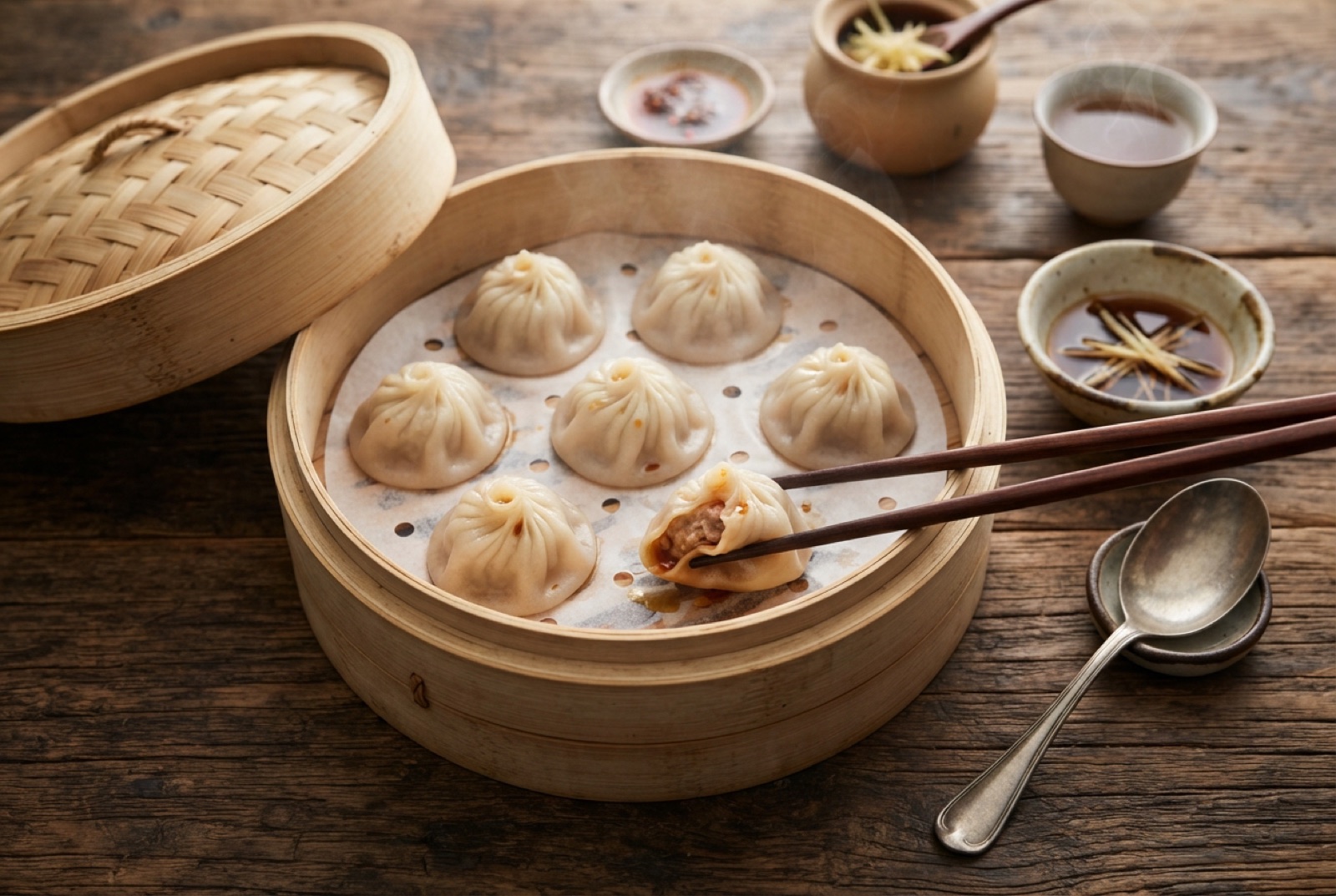
Xiaolongbao are pleated pork dumplings, steamed in small bamboo baskets, whose trick is entirely structural: pork jelly — stock set firm with gelatin — is folded into the raw filling, and when the basket hits the steam that jelly melts back into soup trapped inside the wrapper. Bite carelessly and you scald your mouth; bite properly, nibbling a hole and drinking first, and you get sweet-savory pork broth followed by a tender meatball and a wrapper thin enough to see the filling through. The flavor is gentle rather than punchy, the Jiangnan register: Shaoxing wine, ginger, a little sugar, a lot of pork. This is the hardest recipe on this site to make perfectly and one of the most satisfying to make adequately.

- Gate
- ChinaJiangnan (Shanghai & Wuxi)
- Prep
- 1 hr 15 min
- Cook
- 1 hr
- Total time
- 6 hr 15 min incl. 4 hr rest
- Serves
- 4
- Status
- Takes skill
- Nutrition / serving · estimated
- Calories 430 kcal
- Protein 24 g
- Carbs 42 g
- Fat 18 g
- Fiber 2 g
- Sodium 890 mg
Why this recipe works.
- Uses powdered gelatin plus good stock for the aspic, so you get real soup without simmering pork skin for four hours — with the traditional method explained if you want it.
- The filling is mixed with stock in stages until it turns sticky and glossy, which is what keeps the meatball juicy instead of dense.
- Realistic about the wrapper: it tells you how thin, how wide, and what dough that is too dry or too wet actually feels like in your hands.
- Includes the eating technique, because a soup dumpling served without it is just a hot dumpling and a burned tongue.
Ingredients.
18 itemsFor the aspic
For the dough
For the filling
To serve
Equipment
- Bamboo or metal steamer, 2 tiers if possible
- Rolling pin (a short dumpling pin is easiest)
- Small shallow tray for setting the aspic
- Bench scraper
Instructions.
Set the aspic
Warm the stock with the ginger slices and halved scallions until it steams, then take it off the heat, fish out the aromatics and whisk in the gelatin until no grains remain. Pour into a shallow tray and refrigerate for at least 4 hours, until it wobbles like a firm jelly and holds a clean edge when cut.
Tip Test with a fingertip: it should feel springy, not tacky. A soft set will leak out of the dumplings during filling.
Mix and rest the dough
Stir the salt into 300 g of flour, add the warm water in a steady stream while mixing with chopsticks, then knead 8–10 minutes until the dough is smooth, firm and no longer sticks to your palm. Wrap and rest 30 minutes so the gluten relaxes and the dough rolls without springing back.
Beat the filling
Combine the pork, ginger, minced scallion whites, soy sauce, Shaoxing wine, sugar, sesame oil and white pepper, then stir hard in one direction while adding the cold water a splash at a time. Keep going for 3–4 minutes until the mixture turns pale, sticky and glossy and clings to the spoon in one mass.
Tip Stirring in one direction is not superstition — it aligns the meat proteins so the filling holds water instead of weeping it into the soup.
Fold in the jelly
Chop the set aspic into 5 mm dice and fold it through the cold filling with a light hand, keeping the cubes intact. Cover and refrigerate for 30 minutes; the filling should be firm enough to scoop into neat balls.
Roll the wrappers
Divide the dough into 32 pieces, roll each into a ball, then flatten and roll into 8 cm rounds that are thin at the rim and slightly thicker in the middle. Keep the finished rounds under a damp cloth and dust lightly so they do not weld together.
Pleat and seal
Place a heaped teaspoon of filling in the center of a wrapper, then lift the edge and pleat around the circle, pinching each fold onto the last and rotating as you go. Finish by twisting the gathered top into a small knot and pinching it shut — there must be no gap, or the soup will escape.
Tip Aim for a filling ball that sits below the rim. Overfilling is the single most common reason a first batch bursts.
Steam in batches
Line the steamer, arrange the dumplings 2 cm apart, and steam over a lively boil for 8 minutes, until the wrappers turn translucent and slack and you can see the filling shifting inside when you tilt the basket. Do not lift the lid before 7 minutes.
Serve at once, with the technique
Bring the basket straight to the table with a saucer of black vinegar and slivered ginger. Lift each dumpling by the topknot onto a spoon, nick the side to release steam, drink the broth, then dip and eat — and warn anyone at the table who has not done this before.
Tips from our kitchen.
- Keep the aspic and the mixed filling refrigerator-cold right up to the moment you fill. Warm jelly starts softening and the filling smears instead of scooping.
- Roll the wrappers thin at the edges and leave the center slightly thicker — the base carries the weight of soup and meat, and a uniformly thin skin blows out at the bottom.
- Work with six wrappers at a time and keep the rest under a damp cloth. Dumpling dough skins over within minutes and dry edges refuse to seal.
- Line the steamer with cabbage leaves, parchment rounds or carrot slices. Dough sticks to bare bamboo and metal, and a stuck dumpling always tears at the seam.
- Steam over water at a lively but not violent boil, and do not open the lid early. A blast of cold air makes the skins wrinkle and toughen.
- Practice ten dumplings before judging yourself. The pleating hand learns fast, and the ugly first batch tastes exactly like the pretty last one.
Substitutions.
- Powdered gelatin aspic → 400 g pork skin simmered 3 hours with the same aromatics, then strained and chilled
- The traditional route, and the flavor is rounder and more unctuous. Ask a butcher for skin or use trotters. Both versions set firm enough to dice.
- Shaoxing rice wine → Dry sherry
- The closest common substitute in aroma and dryness. Avoid "cooking wine" with added salt, and do not use mirin — its sweetness pushes the filling in the wrong direction.
- Ground pork with 20–30% fat → Lean ground pork plus 60 g finely chopped pork fat or unsmoked bacon fat
- Lean pork alone gives a dry, crumbly meatball. Fat is what makes the filling read as tender against all that broth.
Variations.
- Wuxi style
- Noticeably sweeter — roughly double the sugar and add a spoonful of dark soy for color. A genuine regional style, not a mistake, and divisive among Shanghainese eaters.
- Crab and pork (xiefen xiaolongbao)
- The autumn luxury version: fold 100 g of picked crab meat and a little crab roe into the pork filling. Traditionally made when hairy crabs are in season around the Yangtze delta.
- Chicken soup dumplings
- Swap ground chicken thigh for pork and set the aspic from a rich chicken stock. Lighter, and the usual solution for tables that do not eat pork.
Storage & reheating.
Freeze uncooked dumplings on a tray until solid, then bag them — they keep 2 months and steam straight from frozen with 4 extra minutes. Cooked xiaolongbao do not keep: once the soup is reabsorbed into the meat and skin, resteaming gives you a stodgy dumpling with no broth. Filling and aspic can both be made a day ahead and refrigerated, which turns assembly day into a 45-minute job.
Serve with
Zhenjiang black vinegar with finely slivered young ginger, and a pot of jasmine or green tea to cut the richness.
The story behind Xiaolongbao.
Xiaolongbao belong to Jiangnan, the water-town belt around Shanghai, and the town that claims them loudest is Nanxiang, now swallowed by Shanghai's suburbs — Nanxiang xiaolongbao is the name you see on shop signs across the city. The name simply means "small basket buns": long is the little bamboo steamer they cook and arrive in, stacked in towers over the pot. They are not the same thing as the fluffy, yeasted baozi sold at breakfast stalls; the dough here is unleavened and rolled thin, closer to a dumpling skin than a bun, though the naming still confuses people who expect bread.
The soup inside is not poured in, and there is no secret injection. Cooks simmer pork skin — collagen-rich and cheap — into a stock that sets to a firm jelly when cold, dice it, and work it through the meat filling. Steam does the rest. In Wuxi, an hour up the rail line, the same dumpling is made distinctly sweeter, enough that Shanghainese and Wuxi eaters argue about it; further afield the whole idea has been scaled up into tang bao, soup buns the size of a fist eaten through a straw, which locals regard as more spectacle than dinner.
Eating them has its own choreography, learned by anyone who has burned their tongue once. The dumpling is lifted by the topknot with chopsticks — carefully, because a torn skin leaks the entire point onto the basket — set on a spoon, nicked at the side to release steam, drained of its broth, then dipped in slivered ginger and Zhenjiang black vinegar and eaten in one or two bites. The vinegar is not optional in Shanghai; its sharpness cuts the fat and resets the palate between dumplings. Counting pleats is a common obsession among reviewers, with eighteen quoted as the standard, but experienced dumpling makers treat that number as a benchmark rather than a rule: what matters is that the top seals completely and the dough there stays thin enough to eat.
Questions, answered.
How does the soup get inside the dumpling?
It is not injected or poured in. A gelatin-rich stock is chilled until it sets into a firm jelly, diced, and mixed into the raw meat filling. During steaming the jelly melts back into liquid, which the sealed wrapper traps as soup around the cooked meatball.
Why did my dumplings leak in the steamer?
Three usual causes: the seal at the top was not fully closed, the dough at the base was rolled too thin to hold the weight, or the dumpling stuck to the steamer and tore when it expanded. Seal by pinching firmly to a topknot, keep the center of the wrapper slightly thicker, and always line the basket.
How do you eat a soup dumpling without burning your mouth?
Lift it gently by the pleated top with chopsticks and set it on a soup spoon. Nick the side of the wrapper to let steam escape, sip the broth from the spoon, then dip the dumpling in black vinegar with ginger and eat it. Give a fresh basket a minute before starting — the soup inside is hotter than it looks.
Can I use shop-bought dumpling wrappers?
They work in an emergency but the result is a different dumpling. Commercial gyoza and wonton wrappers are cut thin and even, so they cannot take the weight of soup at the base and often burst; they are also stamped small. If you use them, choose the thickest round ones, fill lightly, and expect a few losses.
What is the difference between xiaolongbao and baozi?
Baozi are made with a leavened, yeasted dough and steam up soft, thick and bready. Xiaolongbao use an unleavened dough rolled thin, so the skin is delicate and translucent, and they carry soup inside from melted aspic. Both are steamed in baskets, which is where the name confusion comes from.
You might also like.
All recipes →
Keep exploring China.
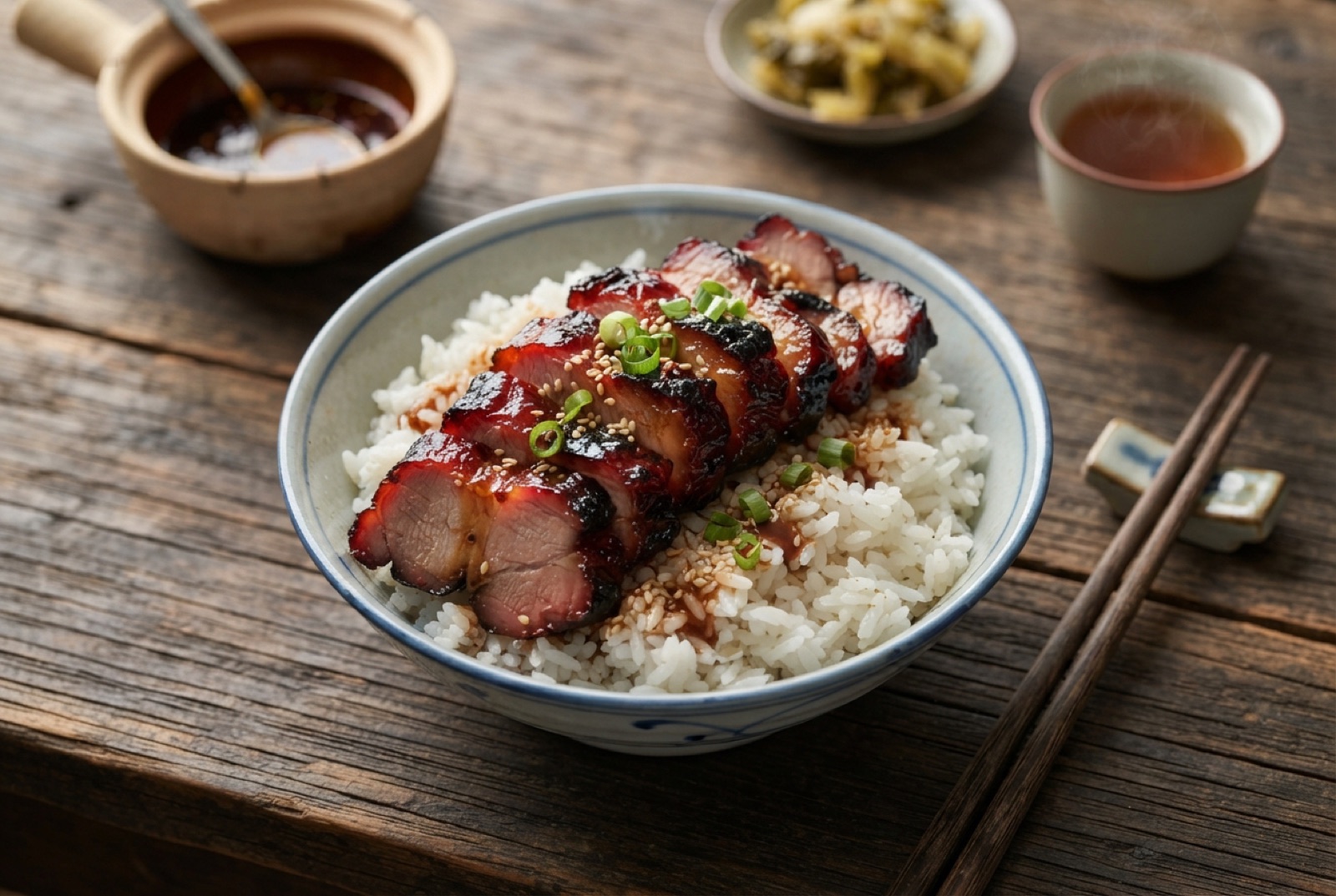
China has 9 more dishes in the atlas — Char Siu and Cong You Bing, and 7 more.
Recipe by The DishRoute Kitchen · published August 19, 2026 · updated August 19, 2026