Karjalanpaisti.
Karelian Three-Meat Oven Stew
Karjalanpaisti · say it: KAR-yah-lahn-PIE-stee
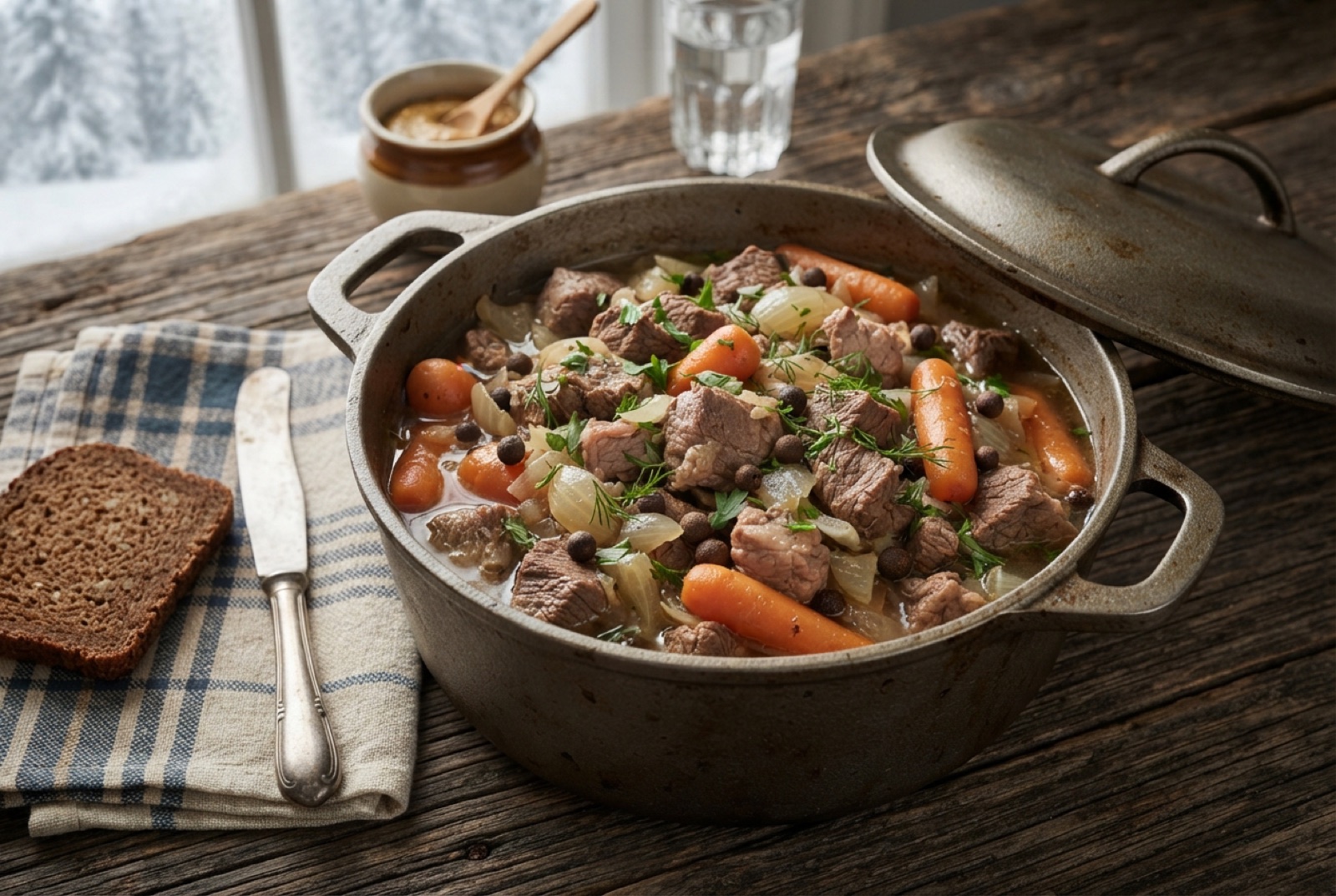
Karjalanpaisti is a stew defined by what it refuses to do. Cubes of pork, beef and lamb are layered raw with onion, carrot, salt and a startling quantity of whole allspice, barely moistened, covered, and left in a low oven for three or four hours. Nothing is seared, no stock is added, no flour goes near it. What comes out is meat collapsing into strands in a small amount of intensely savoury, faintly peppery-sweet liquid, with the allspice reading as warm and resinous rather than sharp. It is the least demanding serious dish in the Finnish repertoire — twenty minutes of chopping, then the oven does everything — and it is the standard Sunday and Christmas roast across eastern Finland.

- Gate
- FinlandKarelia
- Prep
- 25 min
- Cook
- 3 hr 30 min
- Total time
- 3 hr 55 min
- Serves
- 6
- Status
- Easy
- Nutrition / serving · estimated
- Calories 520 kcal
- Protein 47 g
- Carbs 7 g
- Fat 33 g
- Fiber 2 g
- Sodium 780 mg
Why this recipe works.
- True cold-start method: no searing, no stock, no thickener — the pot builds its own liquid, which is exactly what makes this dish taste like itself.
- Honest ratios for three meats, so the lamb reads as depth rather than dominating the pot.
- Allspice is measured in berries, not teaspoons, so you can hit the traditional intensity without guessing.
- Almost entirely unattended — twenty minutes of knife work, then three and a half hours of oven time you can ignore.
Ingredients.
10 itemsEquipment
- Heavy lidded casserole or Dutch oven (3–4 litre)
- Sharp knife
- Oven
Instructions.
Layer the pot cold
Heat the oven to 150°C. Put a third of the onion and carrot in the bottom of a heavy casserole, then add the meats in loose layers, scattering onion, carrot, allspice, peppercorns and salt between them. Do not press anything down — the pot needs air pockets for the steam to move through.
Add the water and cover
Pour the water down the side of the pot rather than over the meat, tuck in the bay leaf if using, and put the lid on tightly. The liquid should barely reach the first layer of meat; it will look far too dry, and that is correct.
Tip If your lid is loose, lay a sheet of baking paper over the pot before pressing the lid down.
Bake low and undisturbed
Slide the pot into the oven and leave it alone for 3 hours. Do not lift the lid to check, stir or top up the liquid — every look costs you steam and roughly ten minutes of cooking time.
Check the meat and the liquid
Uncover and test a beef cube with a fork: it should give completely and pull into strands with no resistance, and the pot should hold a dark, glossy juice reaching roughly halfway up the meat. If it is still firm, cover and give it another 30–45 minutes.
Adjust and rest
If there is more liquid than you want, ladle it into a small pan and boil it hard for 3–5 minutes until it smells concentrated and coats a spoon, then pour it back. Taste and correct the salt — the allspice needs enough salt behind it to read as warm rather than perfumed.
Serve
Let the pot stand off the heat for 10 minutes so the fat rises and the juices settle back into the meat, then bring it to the table in the casserole with potatoes, lingonberry compote and pickles alongside.
Tips from our kitchen.
- Use fatty, collagen-rich cuts only: pork shoulder, beef chuck or shin, lamb shoulder. Lean cuts like fillet or leg turn dry and stringy at this temperature, no matter how long you cook them.
- Cut the meat in generous 4 cm cubes. Small pieces disappear into shreds long before the connective tissue has finished melting.
- Add far less water than instinct suggests — 200 ml for over a kilo of meat. The onions and the meat release a surprising amount, and a flooded pot gives you boiled meat in grey broth.
- Crack a few of the allspice berries lightly with the flat of a knife and leave the rest whole; the cracked ones perfume the liquid, the whole ones stay pleasant to bite.
- Resist the urge to stir. Lifting the lid every half hour vents the steam that is doing the cooking, and each peek adds real time.
- If the finished pot looks too wet, tip the liquid into a small pan and boil it down hard for a few minutes, then pour it back — never thicken it with flour.
Substitutions.
- Lamb shoulder → More pork and beef in equal measure, or a piece of mutton
- A two-meat karjalanpaisti is entirely normal in western Finland. You lose some gamey depth but nothing structural.
- Whole allspice berries → 1½ tsp coarsely ground allspice, added at the start
- Ground allspice fades faster and can taste dusty. If it is all you have, use less than you think and taste before serving.
- Beef chuck → Beef shin or oxtail off the bone
- Both have more collagen and give an even glossier liquid; shin needs the full four hours rather than three.
Variations.
- With root vegetables
- Swede, parsnip and extra carrot cut in large chunks and added for the final hour, so they soften without dissolving. Common in home cooking, less so in the strict Karelian version.
- Overnight version
- Set the oven to 100°C and give the pot eight to ten hours. The meat goes past tender into properly silky, and it is genuinely how the bread-oven original behaved.
- Christmas pot
- Some families add a strip of salted pork belly and a handful of dried mushrooms for a richer, smokier stew served alongside the Christmas ham.
Storage & reheating.
Karjalanpaisti keeps 3–4 days refrigerated and is better on day two, once the fat has set on top and the allspice has spread through the liquid. Reheat covered at 150°C for 30–40 minutes rather than on the hob, where the bottom scorches before the middle warms. It freezes very well for up to three months — cool completely, freeze in its liquid, and thaw overnight before reheating.
Serve with
Boiled or mashed potato, cold lingonberry compote, pickled cucumber or beetroot, and rye bread for wiping the pot.
The story behind Karjalanpaisti.
The dish belongs to Karelia, the region straddling what is now the Finnish-Russian border, and its method is a direct fossil of the wood-fired bread oven. Once the week's rye loaves came out, the oven still held hours of falling heat, and a covered clay or iron pot of chopped meat pushed into that dying warmth needed no attention at all. That is why nothing is browned and why so little liquid goes in: a masonry oven at 120–150°C draws moisture out of the meat and onions slowly enough that the pot effectively cooks in its own juices. Modern recipes simply reproduce the temperature curve in a domestic oven.
The three-meat combination is the part Finns argue about. Pork and beef are near-universal; lamb or mutton is traditional in the eastern and northern versions and is what gives the pot its faintly gamey depth, but plenty of families leave it out, and some add veal or even a piece of kidney. What almost nobody negotiates is the allspice, which goes in whole, in quantity, and stays in — fishing the berries out afterwards is considered fussy, and biting one is part of eating the dish. Salt, onion and water complete the seasoning list. There is no bay-leaf orthodoxy, no garlic, no wine.
Karjalanpaisti travelled west with the more than 400,000 Karelians resettled elsewhere in Finland after the Second World War, which is how a regional oven stew became a national one. Today it turns up on Christmas tables, in school canteens and in the freezers of people who cooked a double batch, and it is one of the few Finnish dishes that genuinely improves on the second day. It is served with boiled or mashed potato, lingonberry compote, and pickled cucumber or beetroot to cut the fat.
Questions, answered.
Why is nothing browned first?
Because the dish is built on a bread-oven method where searing was impossible and unnecessary. Browning would add roasted flavours that cover the clean, sweet meat-and-allspice character Karelians are after. The long low bake still develops plenty of savoury depth, just from a different direction than a seared stew.
How much liquid should be in the pot at the end?
Roughly enough to half-cover the meat — a concentrated, slightly cloudy juice rather than a soup. If you find much more than that, the lid was not tight or the oven ran hot; boil the liquid down separately and return it. If the pot ran dry, add a splash of hot water and give it another twenty minutes.
Do I have to use three different meats?
No. Pork and beef alone make a perfectly traditional pot, and many Finnish families never add lamb. The three-meat version is the eastern standard and gives the most complex result, but the technique matters far more than the exact mix.
Can I make karjalanpaisti in a slow cooker or pressure cooker?
A slow cooker works well on low for 8 hours; use even less water, since almost nothing evaporates. A pressure cooker gets the meat tender in about 45 minutes but produces a noticeably different, more boiled flavour — the slow dehydration of the oven is part of what makes the dish taste the way it does.
Are you supposed to eat the allspice berries?
They are not removed, and biting into one is a normal part of eating karjalanpaisti — it gives a short warm hit of clove and pepper. If you would rather not, they are large and dark enough to push aside easily, or you can tie them into a square of muslin before cooking.
You might also like.
All recipes →
Keep exploring Finland.
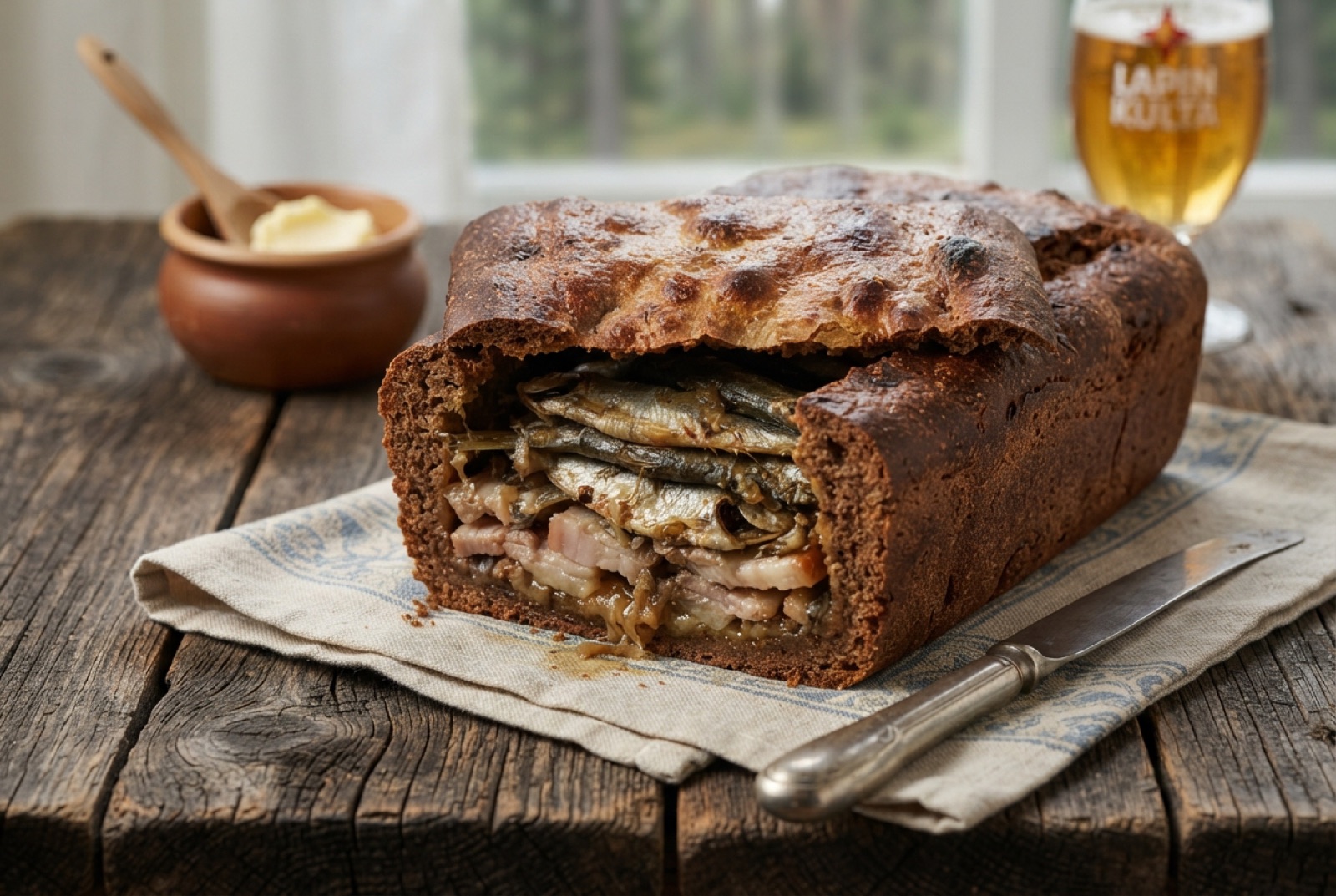
Finland has 9 more dishes in the atlas — Kalakukko and Karjalanpiirakka, and 7 more.
Recipe by The DishRoute Kitchen · published August 19, 2026 · updated August 19, 2026