Libyan Asida.
Wheat Pudding with Date Syrup
عصيدة · say it: ah-SEE-dah
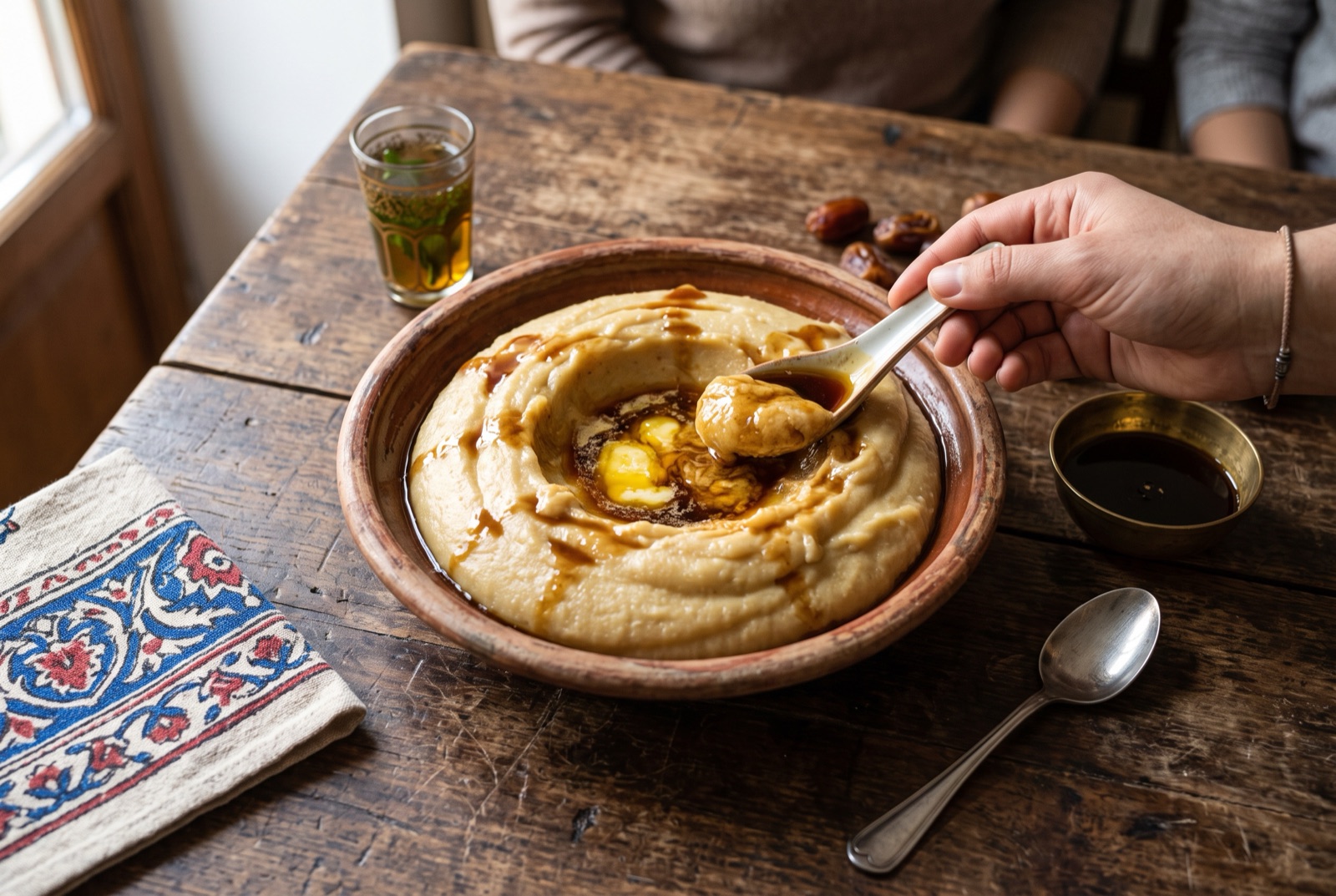
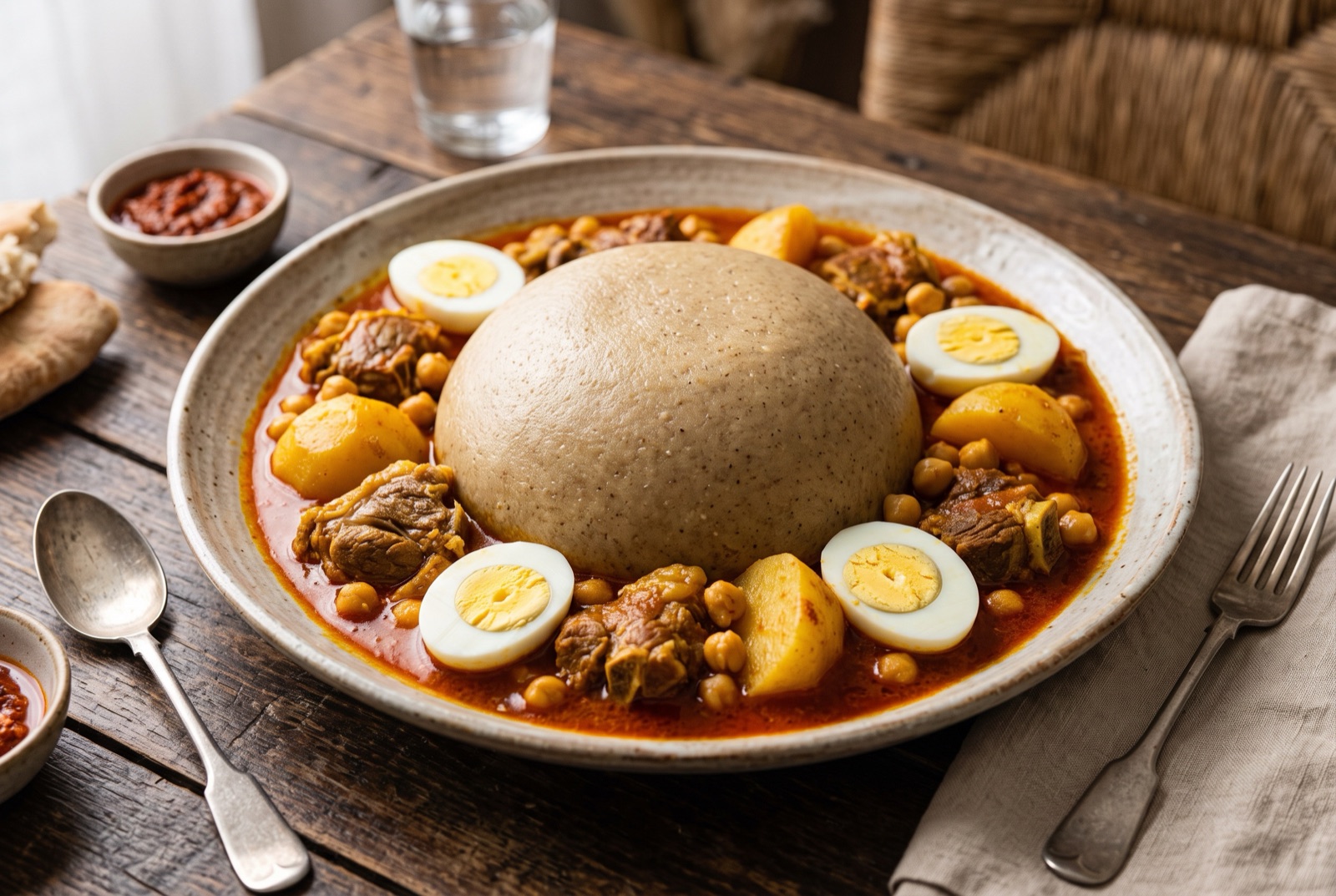
Asida is flour, water and salt turned into something remarkable by nothing but heat and stirring. Cooked and worked until it is completely smooth and slightly stretchy, it is turned into a bowl, dented in the centre with the back of a wet spoon, and the hollow filled with melted butter and rub — the thick, almost black date syrup of the Libyan date belt. You eat it hot with your fingers or a spoon, pulling from the edge and dragging each piece through the pool in the middle. The pudding itself is nearly flavourless; the pleasure is entirely in the contrast between plain warm dough, salty butter and dark caramel sweetness.

- Gate
- Libya
- Prep
- 5 min
- Cook
- 25 min
- Total time
- 30 min
- Serves
- 4
- Status
- Easy
- Nutrition / serving · estimated
- Calories 560 kcal
- Protein 9 g
- Carbs 92 g
- Fat 18 g
- Fiber 3 g
- Sugar 34 g
Why this recipe works.
- Whisks the flour into the water from the very start, which is what keeps asida silky instead of lumpy.
- Cooks the paste long enough past the point of thickening that no raw flour taste survives.
- Gets the texture right for a soft mound that holds a well without setting stiff like bazin.
- Explains what rub is and what to do when you cannot find it.
Ingredients.
6 itemsEquipment
- Heavy saucepan
- Sturdy balloon whisk
- Wooden spoon
- Shallow serving bowl
Instructions.
Boil the salted water
Bring the water and salt to a full rolling boil in a heavy saucepan. Have the flour weighed out and the whisk in your hand before you start, because the next step allows no pauses.
Whisk in the flour
Lower the heat to medium and pour the flour into the boiling water in a thin, steady stream, whisking hard and without stopping. Keep whisking for a full minute after the last of the flour is in, until the mixture is completely smooth and has thickened into a loose paste.
Tip A second pair of hands helps enormously here — one pours, one whisks.
Cook it out
Swap the whisk for a wooden spoon and keep stirring over low heat for 12 to 15 minutes, pressing the paste against the side of the pan as it thickens. It is ready when it comes together as one glossy mass, leaves the sides of the pan clean and no longer smells of raw flour.
Shape the mound
Rinse a shallow serving bowl with cold water and shake it out, then tip in the hot dough and smooth the top with a wet spoon into a rounded mound. Press the back of the spoon into the centre to open a wide, deep well.
Fill the well
Melt the butter until it just foams and pour it into the well, then add the date syrup and the honey if using. The pool should sit in the hollow without immediately running over the sides.
Serve hot
Bring the bowl to the table straight away and eat while it is still hot, each person pulling pieces from the edge of the mound and dragging them through the butter and syrup in the middle.
Tips from our kitchen.
- Add the flour in a steady stream while whisking hard, never all at once, or lumps form instantly and never fully disperse.
- Keep cooking after the mixture thickens — another eight to ten minutes of stirring is what removes the pasty raw-flour flavour.
- Wet the serving bowl and the back of your spoon before shaping, so the hot dough releases cleanly instead of dragging.
- Serve it straight away. Asida stiffens noticeably as it cools and is a different, denser thing after twenty minutes.
- Warm the date syrup slightly before pouring so it flows into the well instead of sitting on top in a lump.
Substitutions.
- Date syrup (rub) → Honey, or silan sold in Middle Eastern shops
- Silan is the same product under a different name and is easy to find. Honey is lighter and more floral, and is a common substitute in Libyan homes too.
- Butter → Ghee, or olive oil
- Ghee is arguably more traditional and browns more readily. Olive oil makes the dish dairy-free and works surprisingly well with date syrup.
- Plain white flour → Fine semolina, or half flour and half semolina
- Semolina gives a slightly grainier, more substantial texture. Use a little more water, since it absorbs more.
Variations.
- Asida with honey and sesame
- Finish with honey instead of date syrup and scatter toasted sesame seeds over the top for a nuttier, less caramel-heavy bowl.
- Individual portions
- Instead of one shared bowl, divide the hot dough between small bowls and make a well in each. Neater for guests, though it loses the communal centre that is part of the point.
- Barley asida
- Replace a third of the wheat flour with barley flour for a darker, earthier pudding closer to the older inland version.
Storage & reheating.
Asida is really a same-hour dish. It firms up as it cools and by the next day it has set into a dense block that will not return to its original softness. If you do have leftovers, break them into a pan with a splash of milk or water and warm gently, stirring until it loosens into something spoonable — good, but visibly not the same. Keep the butter and syrup separate rather than stored on top. Do not freeze.
Serve with
Sweet green tea, and a glass of buttermilk or plain milk if the syrup feels rich.
The story behind Libyan Asida.
Asida marks beginnings. It is the dish made when a baby is born, carried to the new mother's house by relatives and eaten by everyone who comes to visit, and it is the fixed sweet of Mawlid al-Nabi, the Prophet's birthday, when Libyan households make it in large quantities and send bowls to neighbours. That association with birth and blessing is why it turns up at moments of thanks rather than as a dessert at the end of an ordinary meal.
The dish is not exclusively Libyan and nobody in Libya claims it is. Versions of asida are made across Sudan, Yemen, the Gulf, Tunisia and elsewhere, with the same basic method and wildly different toppings — honey, ghee, meat sauce, or nothing at all. What identifies the Libyan bowl is rub, the date syrup boiled down from the country's southern date harvest, poured on generously enough to pool. Where rub is scarce, honey stands in and nobody objects too loudly.
It is worth noticing how close asida is to bazin in principle and how different in practice. Both are flour cooked in water and worked until smooth, but bazin uses barley flour, gets steamed under a lid and then beaten with a stick into a stiff savoury dome, while asida uses white wheat flour, is whisked continuously from the first moment, and stays soft enough to yield to a spoon. One is a plate to build a meal around; the other is a bowl of comfort with butter melting into it. Libyan kitchens produce both from almost the same short list of ingredients.
Questions, answered.
Why is my asida full of lumps?
The flour went in too quickly or the whisking stopped. Pour it into the boiling water in a thin, steady stream while whisking hard and without pausing, and keep whisking for a full minute after the last of it is in. If lumps have already formed, pushing the mixture through a coarse sieve or blitzing briefly with a stick blender will rescue it.
What is rub and where can I buy it?
Rub is Libyan date syrup, made by boiling down date juice until it is thick, dark and almost black, with a deep caramel flavour and very little acidity. Middle Eastern grocers sell the same product as date molasses or silan, and it keeps for a long time at room temperature. Honey is the standard substitute if none is available.
How is asida different from bazin?
They share a method but not a result. Bazin uses barley flour, is steamed under a lid before being beaten stiff with a stick, and forms a firm savoury dome served with lamb sauce. Asida uses white wheat flour, is whisked continuously from the start and stays soft and smooth, and is served sweet with butter and date syrup. One is a main course, the other a celebration pudding.
Can I make asida ahead of time?
Not really, and this is the one genuine limitation of the dish. It sets as it cools and cannot be fully revived, so it should be cooked in the twenty minutes before it is eaten. If you are feeding a crowd, measure everything out in advance and boil the water ahead — the actual cooking takes under half an hour from that point.
Is asida meant to be sweet on its own?
No. The dough itself contains nothing but flour, water and a pinch of salt, and tastes deliberately plain. All the sweetness comes from the date syrup and butter poured into the well in the middle, which each person drags their portion through. That contrast between neutral and very sweet is the structure of the dish rather than a shortcoming.
You might also like.
All recipes →
Keep exploring Libya.
Libya has 9 more dishes in the atlas — Bazin and Bsisa, and 7 more.
Recipe by The DishRoute Kitchen · published August 20, 2026 · updated August 20, 2026