Bsisa.
Toasted Barley Flour Paste with Dates
بسيسة · say it: b-SEE-sah
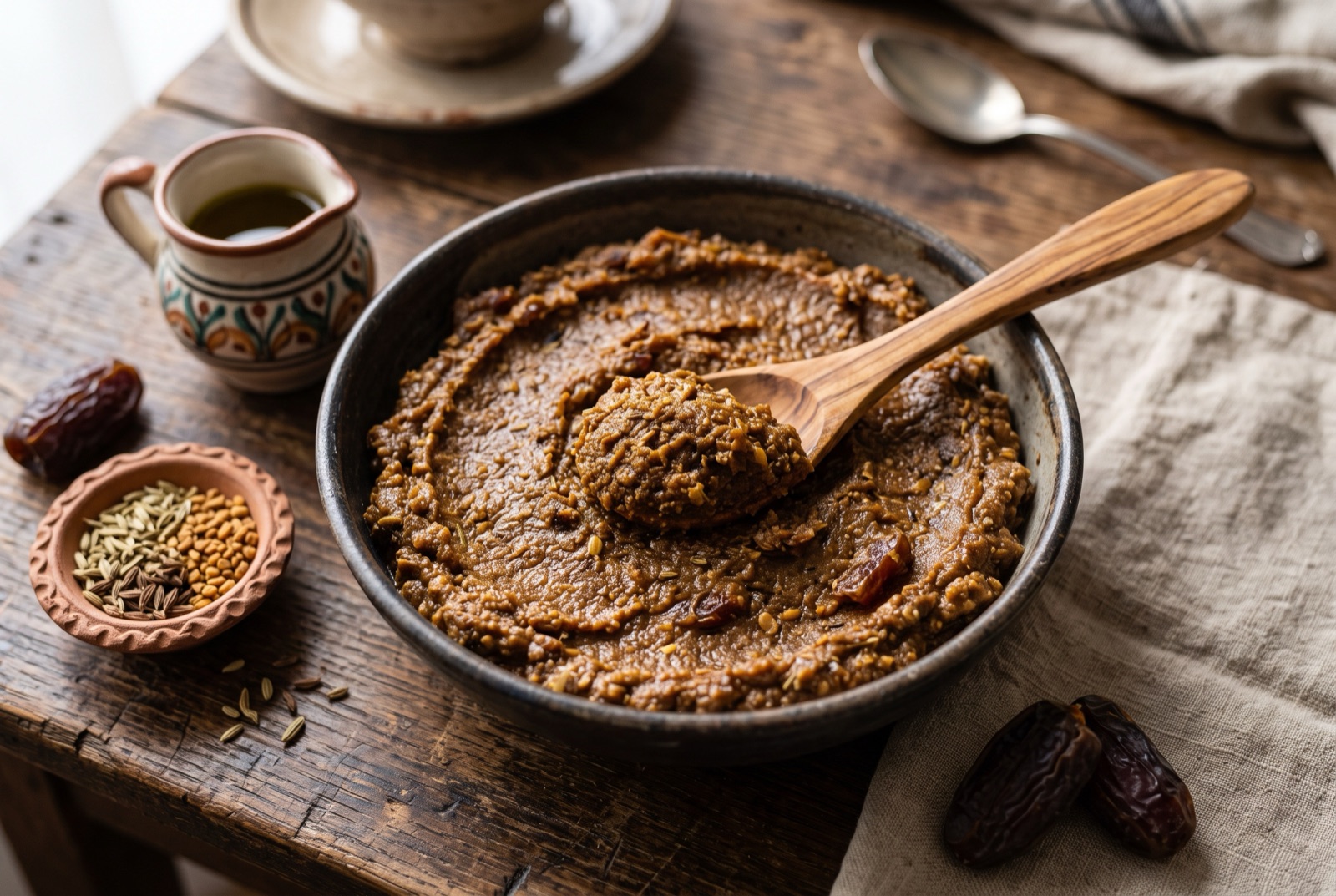
Bsisa is what you get when barley and chickpea flour are dry-toasted with fennel, fenugreek and coriander seed until the whole kitchen smells like a bakery, then bound with good olive oil and mashed dates into a thick paste. It is sweet but only just, nutty from the toasting, slightly bitter from the fenugreek, and heavy in a way that keeps a person going for hours. The toasted flour keeps for months in a jar, so most Libyan households store the dry mix and make up the paste in small quantities as they want it — a spoonful for breakfast, a bowl handed to a child on the way out, a ball rolled and wrapped for a journey.

- Gate
- Libya
- Prep
- 15 min
- Cook
- 25 min
- Total time
- 40 min
- Serves
- 6
- Status
- Easy
- Nutrition / serving · estimated
- Calories 430 kcal
- Protein 10 g
- Carbs 55 g
- Fat 20 g
- Fiber 8 g
- Sugar 22 g
Why this recipe works.
- Toasts the flours and the whole spices separately, because they reach their best point at very different times.
- Gives a dry mix that stores for months alongside the paste it turns into, which is how bsisa is really kept.
- Balances the fenugreek carefully — the ingredient that makes bsisa taste like bsisa and also the one that ruins it if overdone.
- Works without any specialist equipment beyond a dry frying pan and a bowl.
Ingredients.
11 itemsFor the toasted mix
For the paste
Equipment
- Wide dry frying pan
- Spice grinder or mortar and pestle
- Large mixing bowl
- Airtight storage jar
Instructions.
Toast the whole spices
Warm a dry frying pan over medium heat and toast the fennel, fenugreek and coriander seeds for 2 to 3 minutes, shaking the pan constantly, until they darken a shade and smell sharply aromatic. Tip them out immediately so they stop cooking.
Tip Fenugreek turns bitter fast. Pull the pan the moment the seeds smell toasty rather than acrid.
Grind them fine
Grind the warm seeds to a fine powder in a spice grinder or mortar, then stir in the cinnamon and salt. Set the spice mix aside while you deal with the flours.
Toast the flours
Put the barley and chickpea flours in the same dry pan over medium-low heat and stir continuously with a wooden spoon for 12 to 15 minutes. They are ready when the colour moves from pale cream to sandy beige and the smell turns clearly of toast and biscuit.
Tip Never walk away. The last twenty seconds are the difference between toasted and burnt.
Combine and cool
Tip the toasted flour onto a wide tray, scatter the ground spice mix over it and stir through, then spread it out and let it cool completely to room temperature. This is the dry bsisa mix, and it can be jarred at this point and kept for months.
Mash the dates
Mash the pitted dates with the date syrup and 2 tablespoons of warm water in a large bowl, pressing with a fork until you have a rough, sticky purée with only small fragments of fruit remaining.
Work in the flour and oil
Add the cooled flour mix to the dates in batches, alternating with the olive oil added a spoonful at a time, working everything together with a spoon or your hands. Stop when the paste is thick enough to hold a ridge from the spoon and pulls cleanly away from the side of the bowl.
Tip If it turns crumbly, wait five minutes before adding more oil — toasted flour absorbs unevenly and often comes together on its own.
Serve or roll
Spoon the paste into a shallow bowl and make a well in the centre with the back of a spoon, pouring a little extra olive oil into it. Alternatively, roll the mixture into walnut-sized balls, pressing each one firmly so it holds its shape.
Tips from our kitchen.
- Toast the flour over medium-low heat and keep it moving. It goes from pale to burnt in the space of about twenty seconds at the end.
- Go easy on the fenugreek. A single teaspoon is warm and savoury; two make the whole batch aggressively bitter.
- Grind the toasted whole spices while they are still warm — they are far more brittle and release more aroma.
- Let the toasted flour cool completely before adding oil, or the mixture turns pasty and gluey instead of crumbly.
- Add the olive oil a spoonful at a time. The paste tightens suddenly, and it is much easier to loosen than to fix.
- Store the dry mix in a sealed jar away from light and it will stay good for three months or more.
Substitutions.
- Barley flour → Wholemeal wheat flour, or a mix of wheat and semolina
- Wheat is common in coastal Libyan versions, so this is a genuine regional variant rather than a downgrade. Barley is nuttier and slightly more bitter.
- Dates → Date syrup (rub) or honey
- Syrup makes a smoother paste with no fruit texture, and you will need less liquid overall. Adjust the olive oil down slightly.
- Fenugreek → Leave it out and add an extra teaspoon of fennel seed
- Honest note: without fenugreek the mixture is pleasant but loses the bitter backbone that distinguishes bsisa from any other sweet flour paste.
Variations.
- Bsisa balls
- Work the paste stiffer with less oil and roll it into walnut-sized balls, pressing each one firmly so it holds. They keep for a week and travel well in a tin.
- Drinking bsisa
- Whisk two tablespoons of the dry mix into a glass of warm water or milk with a little sugar. Thin, savoury-sweet and traditionally given to people recovering from illness.
- Bsisa with almonds and sesame
- Toast a handful of almonds and sesame seeds with the spices and grind them into the mix for a richer, more festive version often made for celebrations.
Storage & reheating.
Keep the toasted dry mix in an airtight jar in a cool dark cupboard for up to 3 months; it needs no refrigeration and refrigerating it actually dulls the aroma. Once mixed with oil and dates, the paste keeps about 10 days in a sealed container at room temperature, or three weeks in the fridge, where it will firm up considerably — let it come back to room temperature before eating. Rolled balls keep a week in a tin. The mix does not need freezing and gains nothing from it.
Serve with
Sweet mint or green tea, and a glass of cold water — the paste is dense and dry enough to need one.
The story behind Bsisa.
This is one of the oldest things in the North African pantry. Toasted grain flour carried on the road is a pre-modern technology — it keeps without refrigeration, needs no cooking, and turns into food the moment it meets oil or water — and bsisa in its Libyan and Tunisian forms sits directly in that lineage. Amazigh communities across the region have made versions of it for a very long time, using whichever grains grew locally, which is why barley dominates in the drier inland areas and why the spice mix shifts from valley to valley.
It also carries ritual weight. Among Libyan and Tunisian Jewish families, bsisa is associated with a ceremony held on the eve of the month of Nisan, in which the mixture is stirred with a key and blessings are said over it for the year ahead; the tradition continued in Israel after those communities emigrated. In Muslim Libyan households the associations are different but equally domestic — bsisa is fed to new mothers as a strengthening food, sent to families with a new baby, and eaten during Ramadan when something dense and slow-releasing is welcome.
What has changed most in modern kitchens is the milling. Traditionally the grains and pulses were toasted whole and then ground, often at a communal mill, which produced a coarser and more fragrant flour than anything sold in packets. Toasting ready-ground flour at home gets you most of the way there and is what almost everyone now does, but the older method is why bsisa is described in Libya as tasting of the mill as much as of the spices.
Questions, answered.
What does bsisa actually taste like?
Toasted and nutty first, then sweet from the dates, with a distinct bitter-savoury edge from the fenugreek and a clear aniseed note from the fennel. It is not a dessert in the Western sense — the sweetness is moderate and the texture is dense and slightly dry, closer to a very thick nut butter than to a cake or a sweet.
Can I use raw flour without toasting it?
No, the toasting is the entire point. Raw flour tastes chalky and pasty and will not develop the nutty aroma the dish depends on, and it also does not keep nearly as well. Toasting takes about fifteen minutes in a dry pan over medium-low heat and is the step that turns ordinary flour into bsisa.
How do I know when the flour is toasted enough?
Watch the colour and trust your nose. The flour shifts from pale cream to a light sandy beige and starts smelling clearly of toast and biscuit rather than of raw flour. That takes twelve to fifteen minutes with constant stirring. Once it starts smelling nutty, stop within a minute — the gap between properly toasted and burnt is very short.
Is bsisa gluten-free?
No. Barley and wheat both contain gluten, so bsisa as traditionally made is not suitable for coeliacs. A version using only chickpea flour with toasted millet or sorghum flour would be gluten-free and still tastes good, but it is a modern adaptation rather than the traditional mixture.
Why is my paste crumbly instead of smooth?
It needs more fat or more moisture. Add olive oil a tablespoon at a time, working it in thoroughly before judging, and if it is still dry add a little date syrup or warm water. Toasted flour absorbs liquid unevenly at first, so let the mixture stand for five minutes before deciding it needs more — it often comes together on its own.
You might also like.
All recipes →
Keep exploring Libya.
Libya has 9 more dishes in the atlas — Bazin and Couscous bil Bosla, and 7 more.
All Libya recipes Dates recipes Chickpea flour recipes Olive oil recipes snackbreakfastvegetarianvegandairy freeRecipe by The DishRoute Kitchen · published August 20, 2026 · updated August 20, 2026