Mbatten.
Libyan Stuffed Potato Fritters
مبطن · say it: m-BAT-tan
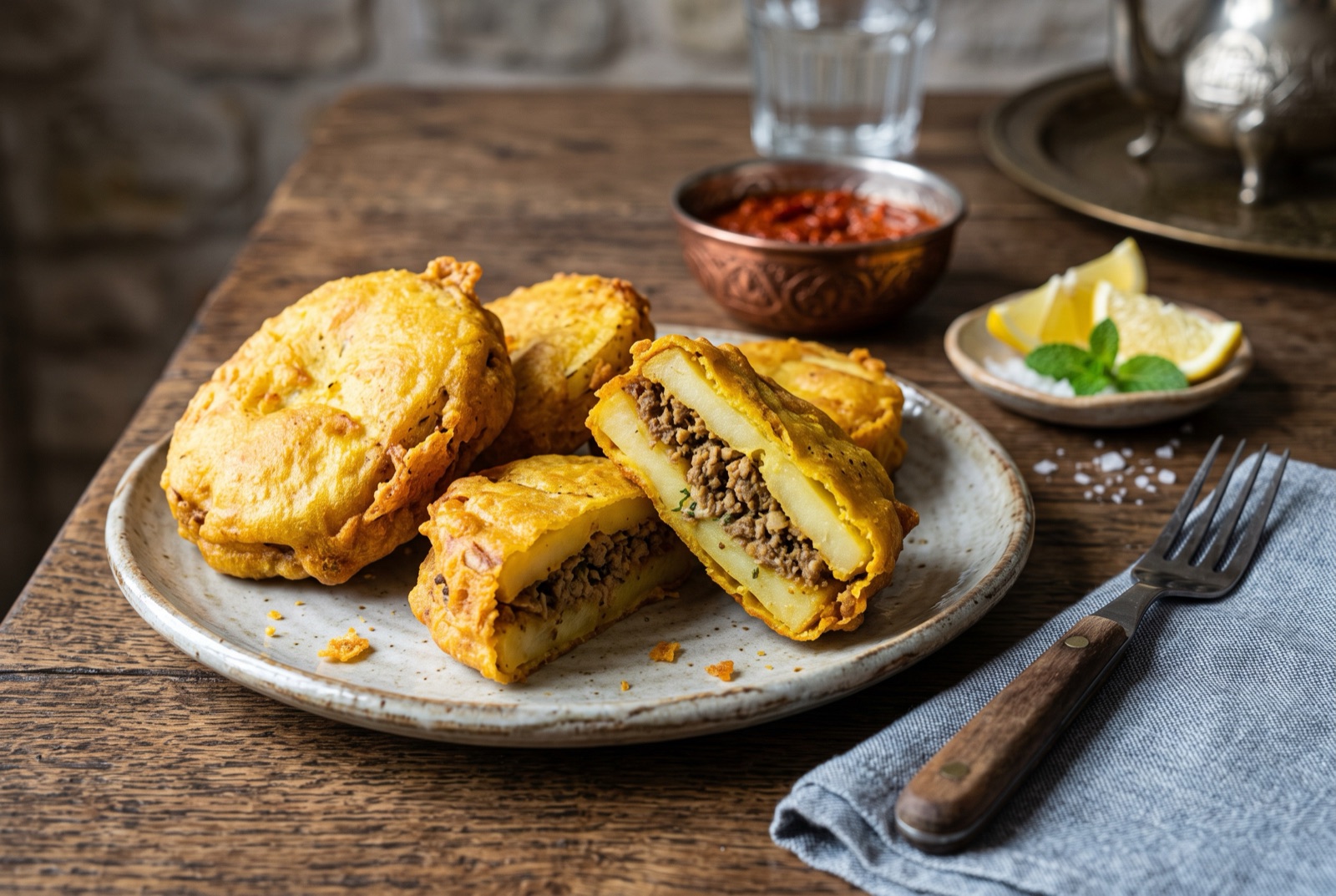
Mbatten is a potato sandwich with the potato on the outside. Thin slices are paired up around a filling of minced meat worked with onion, parsley and hararat, then dropped through a loose chickpea-flour batter into hot oil, where the coating inflates into a blistered gold shell while the potato steams soft inside. Bite one open and you get three distinct textures in a row: crisp batter, yielding potato, and a dense savoury core. The name comes from the Arabic for lined or stuffed, and it is fried in enormous quantities across Libya during Ramadan, when a plate of them lands on the table beside the soup.

- Gate
- Libya
- Prep
- 30 min
- Cook
- 20 min
- Total time
- 1 hr 5 min incl. 15 min rest
- Serves
- 4
- Status
- Medium
- Nutrition / serving · estimated
- Calories 540 kcal
- Protein 24 g
- Carbs 48 g
- Fat 28 g
- Fiber 6 g
- Sodium 760 mg
Why this recipe works.
- Slices the potato thin enough to cook through in the fryer, so nothing has to be par-boiled first.
- Uses a chickpea-flour batter that puffs and crisps rather than a heavy wheat coat that goes soggy.
- Gives both the hinged cut and the paired-slice cut, with an honest account of which is easier.
- Sets a workable oil temperature range, the single thing that decides whether these come out gold or greasy.
Ingredients.
15 itemsFor the fritters
For the filling
For the batter
For frying
To serve
Equipment
- Deep, heavy pan or fryer
- Slotted spoon
- Cooling rack
- Very sharp knife or mandoline
Instructions.
Mix the filling
Combine the minced meat, grated onion, garlic, parsley, hararat, black pepper and salt in a bowl and knead with your hand for a full minute, until the mixture turns sticky and clings together in one mass instead of crumbling apart.
Make the batter and let it rest
Whisk the chickpea flour, plain flour, turmeric, baking powder and a pinch of salt with the cold water until completely smooth. It should coat the back of a spoon and fall in a thick ribbon, not run off like milk. Leave it to stand for 15 minutes.
Tip If it thickens too much while resting, loosen it with a tablespoon of water at a time.
Slice and stuff the potatoes
Cut the potatoes into 4 to 5 mm slices and keep each pair together. Press a thin, even layer of filling onto one slice, stopping just short of the edge, and clamp the matching slice on top, squeezing firmly so the sandwich holds without the meat squeezing out.
Tip For the traditional hinged cut, slice almost through and leave the two halves joined at one edge, then open like a book.
Heat the oil
Pour the oil into a deep pan to a depth of at least 5 cm and bring it to 170°C. Drop in a teaspoon of batter to check: it should surface within two seconds and bubble steadily all around without darkening immediately.
Batter and fry
Lower each stuffed pair into the batter, turn it so the whole surface is coated, lift and let the excess drip back, then slide it carefully into the oil. Fry four at a time for 6 to 7 minutes, turning once, until the shell is puffed, deep gold and firm to the tap of a spoon.
Check and drain
Test the first fritter by pushing a skewer through the middle — it should meet no resistance from the potato. Drain the batch on a wire rack, let the oil return to temperature, then fry the rest and serve hot with lemon wedges.
Tips from our kitchen.
- Slice the potatoes 4 to 5 mm thick. Thicker and the centre is still raw when the batter has already browned.
- Work the mince firmly with your hand for a minute before stuffing — compacted filling stays put, loose filling falls out in the oil.
- Rest the batter 15 minutes before frying. Chickpea flour needs that time to hydrate or it tastes chalky.
- Keep the oil between 165 and 175°C. Too cool and the fritters drink oil; too hot and the shell colours before the potato softens.
- Fry no more than four at a time and let the oil come back up to temperature between batches.
- Drain on a rack rather than on paper, which traps steam and softens the underside within minutes.
Substitutions.
- Chickpea flour → Plain flour with 1 tsp of cornflour per 100 g
- The batter will still crisp but it puffs less and tastes plainer. Chickpea flour is sold in South Asian and Middle Eastern shops as besan or gram flour, usually cheaply.
- Minced lamb → Minced beef, or a mix of the two
- Beef is leaner and slightly drier — add an extra tablespoon of grated onion to compensate.
- Meat filling → Mashed cooked chickpeas with onion, parsley and hararat
- A genuinely good vegetarian version. Mash the chickpeas coarsely so the filling still has some body.
Variations.
- Mbatten with tuna
- Fill with drained tinned tuna mashed with parsley, onion and a spoonful of harissa. Common where fish is cheaper than meat, and it fries a little faster.
- Harissa batter
- Whisk a teaspoon of harissa into the batter for a warmer, redder coating. This is the version people reach for when the fritters are being served as a snack rather than as part of a full meal.
- Aubergine mbatten
- Swap the potato for 5 mm aubergine slices, salted and patted dry first. Softer and richer, and it needs a shorter time in the oil.
Storage & reheating.
These are best within twenty minutes of leaving the oil. Cooked fritters keep 2 days refrigerated and reheat acceptably in a 200°C oven for 8 minutes, though the shell never regains its first crispness. You can assemble the stuffed potato slices several hours ahead and keep them covered in the fridge, battering and frying only at the last minute — that is how large iftar batches are managed. Do not freeze after frying.
Serve with
Lemon wedges, a bowl of harissa, and a plate of olives — and in Ramadan, straight after the soup.
The story behind Mbatten.
Fried snacks are the currency of the iftar table, and mbatten is one of the busiest. In the hour before sunset in Ramadan, Libyan kitchens run batches of them alongside sambusek and other fritters, and street stalls sell them by the paper cone to people who will not be cooking that evening. Outside the fasting month they turn up at parties, at large family lunches, and as the thing made when someone finds half a kilo of mince and a bag of potatoes.
The idea is not unique to Libya. Tunisia fries a close relative, and stuffed-and-battered vegetables appear right across the southern Mediterranean, so treat mbatten as one Libyan expression of a shared North African habit rather than an isolated invention. What is characteristically Libyan is the seasoning of the filling — warm hararat and black pepper rather than chilli heat, with a lot of parsley — and the chickpea-flour batter, which fries lighter and puffs more than a plain wheat one.
Households argue mainly about the cut. The tidy method is to slice the potato right through and pair the slices back together, which is easy and gives even results. The traditional method is to cut a slice most of the way through so it stays hinged at one edge, then open it like a book and pack the filling inside; it holds together better in the oil but takes patience and a very sharp knife. Both are correct, and any Libyan cook will have a firm opinion about which one their mother used.
Questions, answered.
Why did my filling fall out during frying?
Usually the mince was too loose or the slices were not pressed together firmly. Knead the meat mixture with your hand until it becomes sticky and holds together like a paste, spread it right to the edge of the slice but no further, then press the pair hard between your palms before battering. A thick batter also seals the seam and helps hold everything in place.
Do I need to par-boil the potatoes?
No, provided the slices are cut thin — around 4 to 5 mm. At that thickness they cook through in the six or seven minutes the fritter spends in the oil. If your slices came out thicker, either fry at a slightly lower temperature for longer or blanch them for two minutes and dry them thoroughly before stuffing.
What is the right oil temperature?
Between 165 and 175°C. Without a thermometer, drop in a teaspoon of batter: it should sink briefly, rise within two seconds and bubble steadily around the edges. If it browns immediately the oil is too hot and the potato will still be raw; if it sits on the bottom without bubbling, the oil is too cool and the fritters will absorb it.
Can mbatten be baked or air-fried instead?
You can bake stuffed potato slices brushed with oil at 200°C for about 30 minutes, but a wet batter does not work in dry heat — it slides off and dries out rather than puffing. If you want to avoid deep-frying, skip the batter entirely and treat the result as a baked stuffed potato slice, which is a decent dish but not really mbatten.
Can I prepare these in advance for a big gathering?
Yes. Stuff and pair the potato slices up to six hours ahead and keep them in a single layer in the fridge, covered so the cut potato does not discolour. Make the batter an hour ahead and stir it again before use. Fry in batches just before serving, keeping finished fritters on a rack in a low oven for up to twenty minutes.
You might also like.
All recipes →
Keep exploring Libya.
Libya has 9 more dishes in the atlas — Bazin and Bsisa, and 7 more.
All Libya recipes Potato recipes Ground beef recipes Chickpea flour recipes street foodsnackdairy freehalal friendlynut freeRecipe by The DishRoute Kitchen · published August 20, 2026 · updated August 20, 2026