Răcitură.
Moldovan Jellied Pork with Garlic
Răcitură · say it: ruh-chee-TOO-ruh
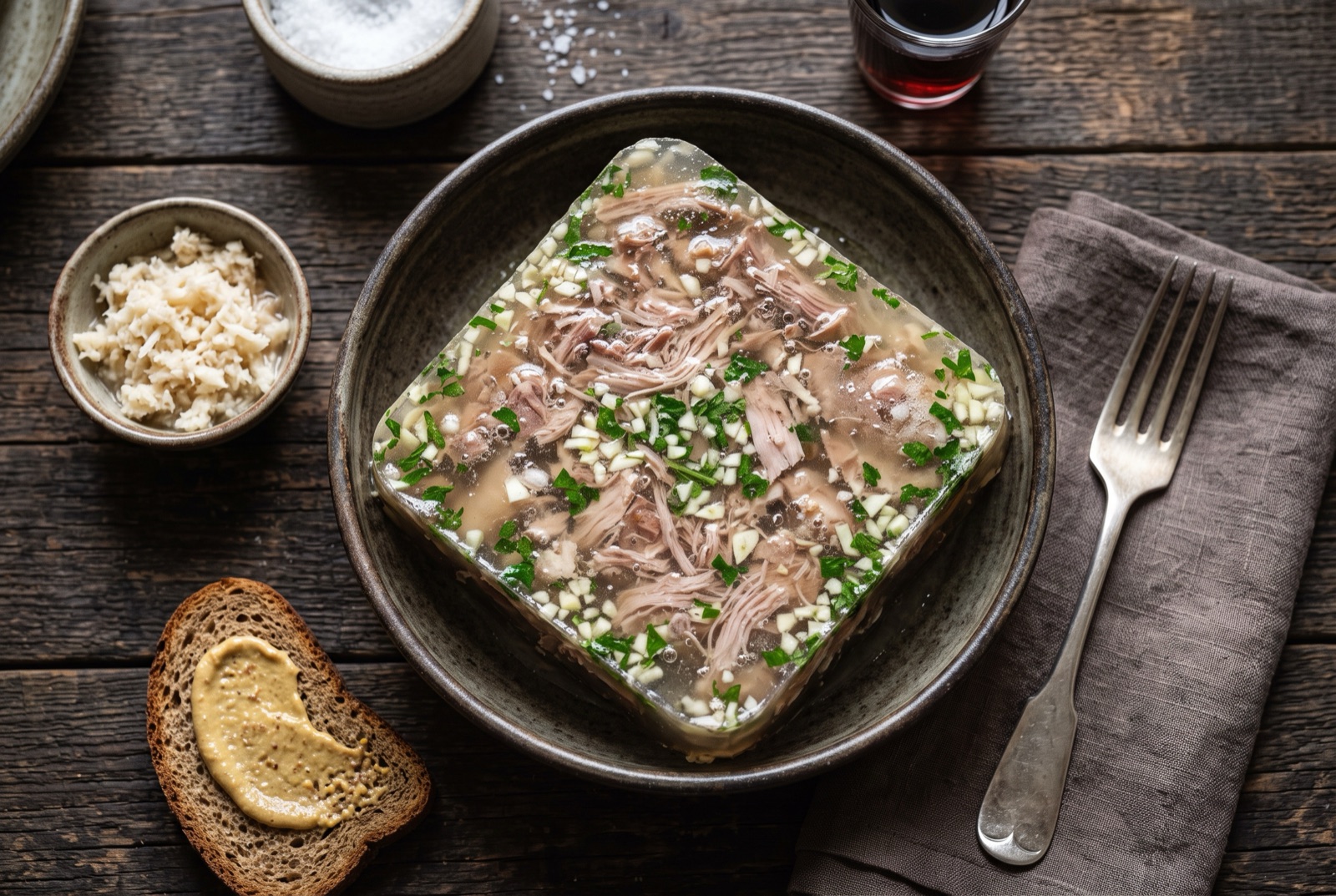
Răcitură is meat jelly, and it sets without a grain of gelatine. Pork trotters, ears and a hock are simmered for five or six hours until the collagen dissolves into the broth, the meat is picked off the bones and packed into shallow dishes, then the strained broth is stirred with crushed raw garlic and poured over. Overnight in the cold it firms into a pale, wobbling slab that you cut in squares and eat with mustard, horseradish and bread. The flavour is clean pork, salt and a lot of garlic; the texture is the point.

- Gate
- Moldova
- Prep
- 40 min
- Cook
- 5 hr 30 min
- Total time
- 16 hr 10 min incl. 10 hr rest
- Serves
- 8
- Status
- Medium
- Nutrition / serving · estimated
- Calories 290 kcal
- Protein 31 g
- Carbs 3 g
- Fat 17 g
- Sodium 820 mg
Why this recipe works.
- No powdered gelatine — the set comes from trotters and skin the way it is supposed to, and the recipe tells you how to test for it.
- A skimming and straining routine that produces clear jelly instead of a cloudy grey block.
- Garlic added raw at the right moment, which is what makes răcitură taste like răcitură.
- Almost entirely unattended cooking, and it must be made a day ahead anyway.
Ingredients.
12 itemsFor the broth
To finish
Equipment
- Very large stockpot
- Fine sieve and a piece of muslin or clean cloth
- Two or three shallow dishes for setting
Instructions.
Soak and rinse
Scrub the trotters, hock and ears, cover them with cold water and leave them for two hours. Drain, discard that water and rinse everything again — this is what gives you clear jelly rather than a murky block.
Bring up slowly and skim
Put the meat in a large pot, cover with fresh cold water by five centimetres and bring it slowly towards a simmer. For the first 30 minutes lift off every bit of grey foam that rises, until the surface stays clear.
Tip Never let it boil. Bubbles should barely break the surface for the entire cook.
Add aromatics and simmer for hours
Drop in the whole onions, carrots, bay, peppercorns, allspice and salt, and hold the pot at the faintest simmer for 5 hours, half covered. The meat should collapse off the bones and the liquid should have reduced by roughly a third.
Test the set
Spoon a little broth onto a saucer and let it cool for a few minutes, then press it between two fingers. If they stick together tackily, it will set; if not, simmer another hour uncovered to concentrate it further.
Tip This finger test is more reliable than any cooking time — trotters vary enormously.
Pick the meat and strain
Lift out the meat and let it cool enough to handle, then pull it into small shreds, discarding bones, gristle and most of the fat. Strain the broth twice through a cloth-lined sieve until it runs clear, and taste it — it should be slightly saltier than you want, since chilling mutes salt.
Garlic in, then pour
Distribute the shredded meat evenly across shallow dishes. Stir the crushed raw garlic and parsley into the warm strained broth, wait two minutes, then ladle it over the meat until everything is just covered.
Tip Raw garlic only. Cooked garlic loses the sharpness the dish is built on.
Chill overnight and cut
Cool to room temperature, then refrigerate uncovered for an hour and covered overnight, at least 8 hours. Scrape off any white fat that has set on top, cut into squares and serve cold with mustard or horseradish.
Tips from our kitchen.
- Ask the butcher to split the trotters lengthwise. Split bones release far more collagen and the broth sets more firmly.
- Soak the trotters and hock in cold water for a couple of hours first, then discard the water — it draws out blood and gives a much clearer jelly.
- Skim relentlessly for the first half hour and never let the pot boil. A rolling boil is what makes the finished jelly cloudy.
- Test the set by dipping two fingers in the cooled broth: if they stick together tackily when you press them, it will set.
- Chill the broth briefly and lift off the fat cap before pouring, or the finished slab will have a waxy white layer on top.
- Pour into shallow dishes, not deep bowls — răcitură is served in flat squares and a deep dish never chills evenly.
Substitutions.
- Pork trotters and ears → Chicken feet plus wings and a turkey drumstick
- The poultry version is common and sets just as well, with a lighter flavour and paler colour. It cooks in about three hours instead of six.
- Pork hock → A piece of beef shank
- Gives a darker, beefier jelly. Combine it with pork trotters, because beef alone sets less reliably.
- Raw garlic in the broth → Garlic crushed with salt and served alongside as mujdei
- For people who find the raw garlic too strong throughout — this way each person adds their own.
Variations.
- Piftie de pasăre
- The chicken and turkey version, lighter and paler, often set with a slice of boiled carrot and parsley leaf arranged at the bottom of the dish.
- With carrot rounds
- Cooked carrot coins laid in the dish before pouring, so they appear suspended in the finished jelly — decorative and traditional at Christmas.
- Sharpened with vinegar
- A tablespoon of wine vinegar stirred into the broth with the garlic, giving a brighter finish that some households insist on.
Storage & reheating.
Keeps five days covered in the refrigerator and firms up further as it sits. Do not freeze — thawing wrecks the gel and leaves you with watery broth and dry meat. Serve it straight from the cold; once it stands warm for an hour it starts to slump and must be re-chilled to recover.
Serve with
Mustard or grated horseradish, black bread, pickled cucumbers and a glass of cold house wine.
The story behind Răcitură.
Every cold-winter cuisine from France to Ukraine arrived at the same discovery: boil the parts nobody wants to roast, and the broth turns solid when it cools. Răcitură — the word comes from a rece, to cool — is the Moldovan and Romanian branch of that family, sibling to Ukrainian and Russian kholodets and Polish galareta. In Moldova it is inseparable from winter, from Christmas, and above all from the pig slaughter, the ignat, traditionally held in the days before Christmas when the household butchers its pig and every part is put to use within days.
The trotters and ears are not a rustic affectation; they are the technical requirement. Collagen from skin, cartilage and joints is what sets the jelly, and no amount of meaty pork shoulder will do it alone. Old cooks judged readiness by touch: dip your fingers into cooling broth and if they stick together tackily, the pot is done. That test still works and remains more reliable than any timer, because trotters vary.
Garlic is the second non-negotiable. It goes in raw, crushed with salt and stirred into the strained broth just before pouring, because cooking would blunt exactly the sharpness that cuts through the fat and gelatine. The result is bracing, and răcitură eaten without garlic is generally considered a mistake rather than a variation. The dish sits on the table for days over the holidays alongside pickles, salted cabbage and a bottle of house wine or ţuică, and it is one of the things Moldovans abroad describe as impossible to explain to people who did not grow up with it. Serving it is simple: cut into squares, offer mustard or grated horseradish, and do not let it warm up, because a slab of răcitură at room temperature slowly turns back into soup.
Questions, answered.
Why did my răcitură not set?
Not enough collagen or too much liquid. You need split trotters, ears or skin in the pot — meat alone will not gel — and the broth should reduce substantially over the long simmer. Test before pouring: cooled broth on your fingers should feel tacky and stick them together.
Can I use gelatine as insurance?
You can, and some modern cooks do, but it changes the texture towards a bouncy commercial jelly rather than the softer natural set. If your broth fails the finger test, the better fix is to reduce it further, or add another split trotter and cook another hour.
Why is my jelly cloudy?
The pot boiled instead of simmering, or the foam was not skimmed off in the first half hour. Fat and proteins emulsify into the broth under a hard boil and cannot be removed afterwards. Soaking the meat in cold water beforehand and straining through cloth both help considerably.
How long does it need to chill?
At least eight hours, and overnight is safer. In shallow dishes it usually sets within six, but the flavour also needs the time — the garlic spreads through the jelly as it firms, and răcitură eaten too early tastes flat and unevenly seasoned.
Is this the same as kholodets or piftie?
Essentially yes. Kholodets is the Ukrainian and Russian name, piftie the alternative Romanian one, and răcitură the term used most widely in Moldova. The differences between them are matters of household preference — the amount of garlic, the choice of pork or poultry — rather than distinct dishes.
You might also like.
All recipes →
Keep exploring Moldova.
Moldova has 9 more dishes in the atlas — Alivenci and Chiftele Marinate, and 7 more.
All Moldova recipes Pork shoulder recipes Garlic recipes Carrot recipes appetizerdairy freegluten freenut freeRecipe by The DishRoute Kitchen · published August 20, 2026 · updated August 20, 2026