Sarmale de Post.
Vine Leaf Rolls with Rice and Mushrooms
Sarmale de post în foi de viță · say it: sar-MAH-leh deh POST
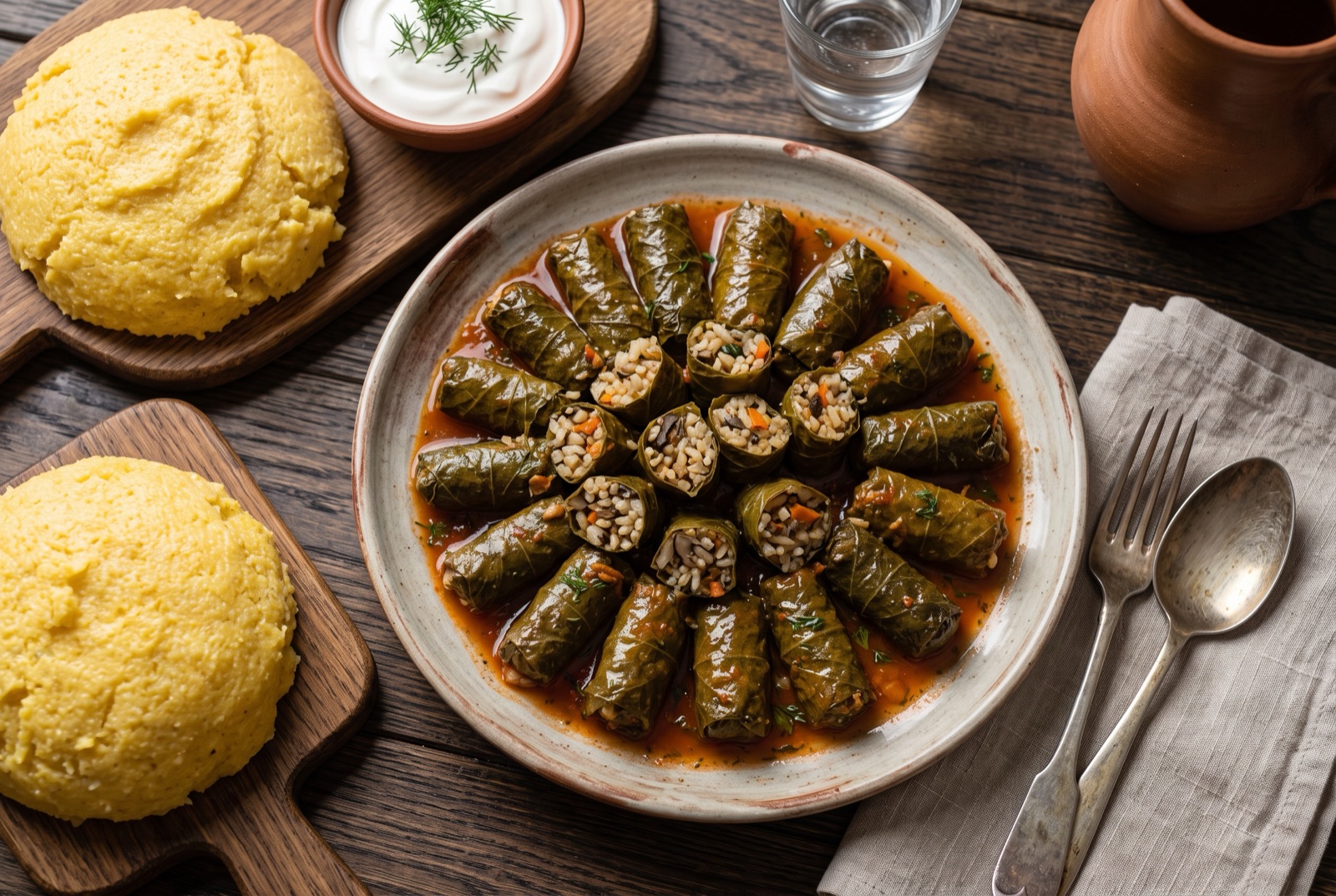
These are sarmale made without meat: rice and finely chopped mushrooms, carrot and onion rolled tightly in brined grapevine leaves, packed into a pot and simmered low in tomato until the rice swells and the leaves turn tender and slightly tart. They are small — a Moldovan sarma is about the size of a thumb, not a cigar — and you eat five or six at a time with a spoonful of mămăliguță beside them. The flavour is sour from the leaves, sweet from the softened onion and carrot, and savoury from the mushrooms standing in for pork.

- Gate
- Moldova
- Prep
- 50 min
- Cook
- 1 hr 40 min
- Total time
- 2 hr 30 min
- Serves
- 6
- Status
- Medium
- Nutrition / serving · estimated
- Calories 380 kcal
- Protein 9 g
- Carbs 52 g
- Fat 15 g
- Fiber 6 g
- Sodium 720 mg
Why this recipe works.
- Mushrooms fried properly dry, so the meatless filling has real savoury depth instead of tasting like plain rice.
- A layering and weighting method that keeps the rolls intact through a long, slow cook.
- Rice quantities calibrated so the rolls swell full and tight rather than bursting or staying hollow.
- Fully vegan as written, and genuinely traditional rather than an adapted meat recipe.
Ingredients.
13 itemsFor the rolls
For the filling
For the pot
Equipment
- Heavy pot or Dutch oven
- Frying pan
- Small plate that fits inside the pot as a weight
Instructions.
Prepare the leaves
Rinse the vine leaves in two or three changes of cold water, then taste one — if it is still very salty, soak them in warm water for fifteen minutes. Snip out any thick stems and set aside the torn leaves for lining the pot.
Fry the mushrooms dry
Heat 2 tablespoons of the oil and fry the mushrooms hard over high heat, stirring occasionally, until they have released their water, the pan is dry again and they begin to stick and brown at the edges. This takes longer than you expect, around 10 minutes.
Tip Wet mushrooms make a bland filling. Wait for the squeak and the browning.
Sweat onion and carrot
Add the remaining oil, the onions and the grated carrot and cook over medium heat for 10 minutes, until the onion is completely soft and just turning gold. Stir in the tomato paste and fry it for one more minute, until it darkens and smells sweet rather than tinny.
Mix the filling
Take the pan off the heat and stir in the rinsed rice, dill, black pepper and a good teaspoon of salt. Let it cool to room temperature — hot filling makes the leaves slippery and impossible to roll neatly.
Roll the sarmale
Lay a leaf vein side up, put a rounded teaspoon of filling near the stem end, fold the sides in and roll it up snugly into a thumb-sized cylinder. Repeat until the filling is gone, keeping the rolls all roughly the same size so they cook evenly.
Pack the pot
Line the base of a heavy pot with torn leaves, then pack the rolls in tight concentric layers, seam down, scattering bay leaves and thyme between them. Pour over the chopped tomatoes and enough hot water to just cover the top layer.
Weight and simmer low
Press an upturned plate onto the top layer to hold everything down, cover the pot and cook at the barest simmer for 90 minutes. They are done when a roll cut open shows plump, fully tender rice and the leaf yields without any grassy chew.
Tip Check once at the halfway point and top up with hot water if the level has dropped below the rolls.
Rest before serving
Turn off the heat and let the pot stand covered for at least 20 minutes so the rolls firm up and absorb the last of the sauce. Lift them out carefully with a spoon and serve with soft polenta and the tomato liquid spooned over.
Tips from our kitchen.
- Rinse brined vine leaves in a few changes of cold water and taste one. If it is still aggressively salty, soak the lot in warm water for fifteen minutes.
- Use only half-cooked rice logic: fill each roll with about a teaspoon of raw rice. It roughly doubles as it cooks, and an overfilled roll will split.
- Roll them tight but not brutally tight, tucking the sides in as you go, and place them seam side down so they cannot unwind.
- Line the bottom of the pot with torn leaves. They take the scorching so the rolls do not, and they are removed before serving.
- Weigh the rolls down with an upturned plate that fits inside the pot, then add liquid to just cover — free-floating rolls collide and unravel.
- Cook at the barest simmer for at least an hour and a half. Sarmale that taste sharp and grassy simply have not cooked long enough.
Substitutions.
- Brined vine leaves → Soured cabbage leaves, or blanched fresh cabbage leaves
- Cabbage rolls are bigger and sweeter; if using fresh cabbage add a splash of lemon or sauerkraut brine to the pot for the sourness the vine leaves would provide.
- Fresh mushrooms → 30 g dried mushrooms, soaked, chopped and their soaking liquid added to the pot
- Dried mushrooms give a deeper, woodier flavour and the soaking liquid is worth more than the mushrooms themselves.
- Short-grain rice → Any medium-grain rice, or half rice and half fine bulgur
- Avoid long-grain basmati — it stays separate and the filling never binds.
Variations.
- Sarmale cu carne
- The everyday meat version: minced pork with a little smoked bacon replacing the mushrooms, rolled and cooked identically but for longer.
- Sarmale în varză murată
- Rolled in whole soured cabbage leaves instead of vine leaves — the winter form, more sour and considerably larger.
- Baked finish
- After simmering, uncover the pot and give it 20 minutes in a hot oven so the top layer browns and the sauce reduces around the edges.
Storage & reheating.
Sarmale are better the next day and keep four days refrigerated in their liquid. Reheat covered over low heat or in a moderate oven with a splash of water — never uncovered on high, which dries the leaves to leather. They freeze well cooked, in their sauce, for up to three months; thaw overnight before reheating so the rice does not go grainy.
Serve with
Mămăliguță (soft polenta) and, outside fasting days, a spoonful of thick sour cream.
The story behind Sarmale de Post.
Sarmale travelled with the Ottoman Empire, and the word itself comes from Turkish sarmak, to wrap. Almost every country between the Balkans and the Caucasus makes a version, and the argument over whose is best is permanent and unwinnable. What distinguishes the Moldovan and Romanian versions is scale and wrapper: they are rolled small, sometimes strikingly so, and while cabbage — fresh in summer, whole-head soured in autumn — is common, vine leaves are the mark of the Moldovan table. That is not decoration. Moldova is a wine country to its bones, and vineyards mean vine leaves, picked young in late spring and packed in brine for the rest of the year.
The meatless version exists because the Orthodox calendar demands it. Fasting periods take up a large share of the year — the long fasts before Easter and Christmas, plus Wednesdays and Fridays — and the culture responded by building a full parallel cuisine rather than simply going without. Sarmale de post are not a diet compromise; they are what appears on the table at Christmas Eve dinner and at memorial meals, made with the same care as the pork version and often preferred by people who grew up with them.
Mushrooms do the heavy lifting. Chopped fine and fried hard until their water has gone and they start to catch on the pan, they supply the savoury depth that would otherwise come from minced pork and smoked bacon. Toasted rice, plenty of onion cooked to sweetness, and a handful of dill or thyme complete the filling. The pot is layered with more leaves top and bottom, weighted so the rolls do not float apart, and left to cook for a long time at a temperature that barely moves the liquid — sarmale reward patience and punish a hard boil, which shreds the leaves and turns the rice to paste.
Questions, answered.
Where do I buy vine leaves and how do I prepare them?
Jars or vacuum packs of leaves in brine are sold in Middle Eastern, Greek and Eastern European shops and keep for a year. Rinse them well in cold water to remove excess salt, cut out any tough stem, and use torn or damaged ones to line the pot rather than throwing them away.
Why did my rolls fall apart?
Usually because the pot boiled instead of simmering, or because the rolls were not packed tightly enough to hold each other in place. Fill the pot snugly in layers, press an upturned plate on top, and keep the liquid at a level where only occasional bubbles break the surface.
Can I make these with meat?
Yes — swap the mushrooms for 400 g of minced pork, or a pork and beef mix, and keep everything else the same. Meat rolls need about half an hour longer at the same low simmer, and a few strips of smoked bacon laid between the layers is the traditional addition.
How small should the rolls be?
Moldovan and Romanian sarmale are notably small — roughly the size of your thumb, using a single leaf and about a teaspoon of filling. Larger rolls are perfectly edible but cook unevenly and are read locally as a sign of a rushed cook.
Can I cook them in the oven instead?
Yes, and many households do. Assemble exactly the same way in an ovenproof pot, cover tightly with a lid or foil, and bake at 150°C for around two hours, checking once that the liquid has not dropped below the top layer of rolls.
You might also like.
All recipes →
Keep exploring Moldova.
Moldova has 9 more dishes in the atlas — Alivenci and Chiftele Marinate, and 7 more.
All Moldova recipes Rice recipes Mushrooms recipes Onion recipes mainveganvegetariandairy freegluten freenut freeRecipe by The DishRoute Kitchen · published August 20, 2026 · updated August 20, 2026