Ruisleipä.
Finnish Sour Rye Bread
Ruisleipä · say it: ROO-iss-LAY-pah
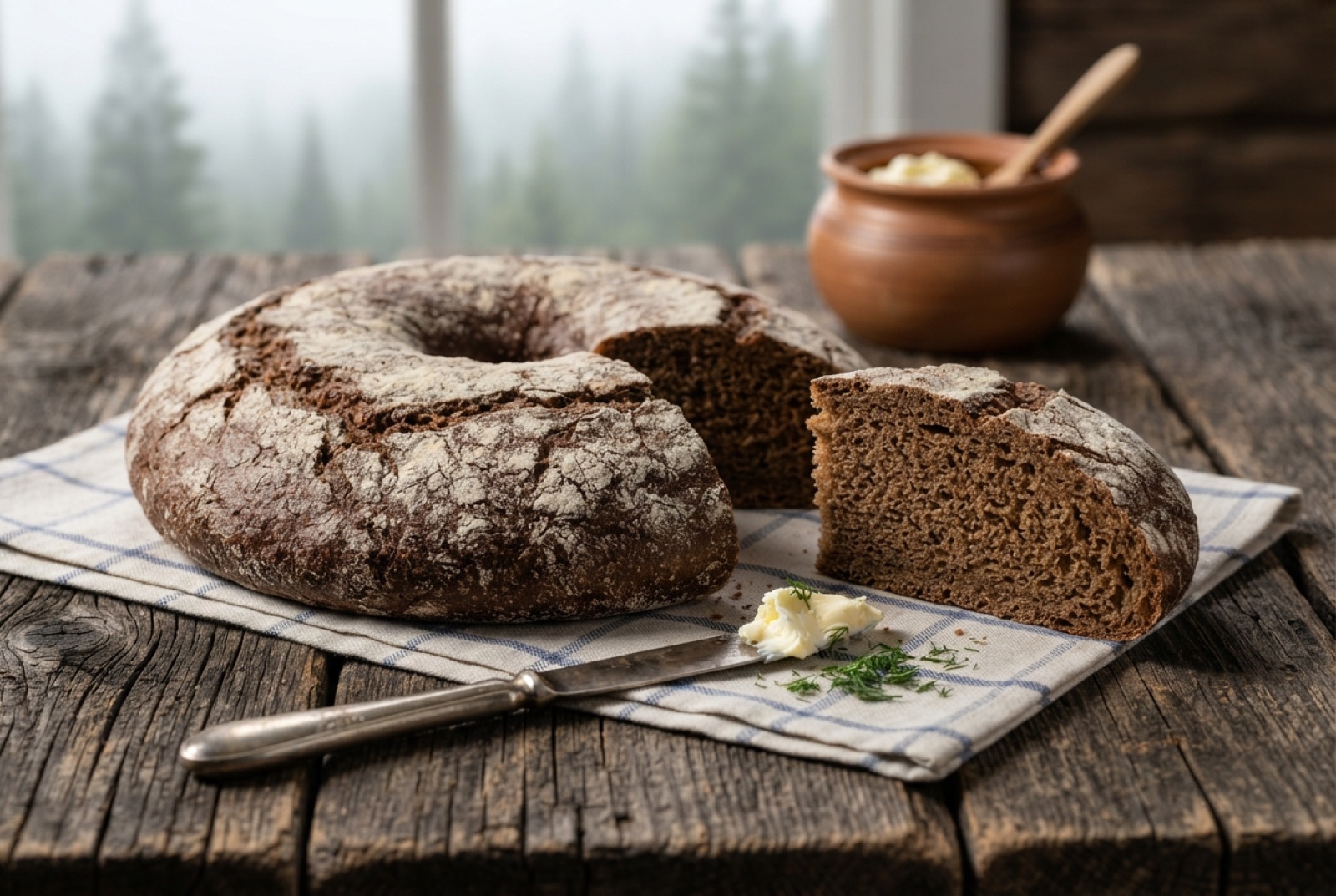
Ruisleipä is 100% wholegrain rye sourdough, and it behaves nothing like a wheat loaf. The dough is a sticky paste rather than something you knead, it ferments for eight to twelve hours until it smells sharply of yoghurt and beer, and it is shaped by patting flat discs on a floured board with wet hands. Baked, it is dense, moist, near-black inside, with an aggressive sourness and a long malty finish. The traditional round has a hole punched through the centre, from the days when loaves were dried on a pole under the ceiling. Finns eat it every day, sliced thin, with a great deal of butter and almost anything on top.

- Gate
- FinlandNationwide
- Prep
- 40 min
- Cook
- 1 hr
- Total time
- 27 hr 40 min incl. 26 hr rest
- Serves
- 12
- Status
- Medium
- Nutrition / serving · estimated
- Calories 190 kcal
- Protein 6 g
- Carbs 38 g
- Fat 1 g
- Fiber 7 g
- Sodium 430 mg
Why this recipe works.
- A true 100% rye method, with the fermentation times that actually develop sourness instead of a wheat loaf with rye in it.
- Explains what rye dough is supposed to feel like, so you stop trying to knead something that will never come together.
- Includes an honest same-day fallback for anyone without a rye starter, and says exactly what you lose.
- Shaped as the traditional flat ring, which bakes evenly and slices thin without crumbling.
Ingredients.
8 itemsStarter refresh
For the dough
Equipment
- Large mixing bowl
- Sturdy wooden spoon or stand mixer with dough hook
- Baking tray
- Kitchen scale
Instructions.
Refresh the starter
The evening before, stir the starter refresh flour, water and starter together in a bowl to a thick paste. Cover and leave at room temperature for 8–12 hours, until it has domed, is riddled with bubbles and smells sharply sour and fruity rather than flat.
Mix the dough
Add the warm water, salt and molasses to the refreshed starter and stir to dissolve, then work in the rye flour with a sturdy spoon or a dough hook until completely uniform. It will be a heavy, sticky paste that clings to the spoon — this is correct, and no amount of mixing will change it.
Tip Stop as soon as there are no dry patches. Over-mixing rye only makes it stickier.
Bulk ferment
Cover the bowl and leave it somewhere warm for 3–4 hours. The dough will rise by perhaps a third, look visibly aerated and smell strongly acidic. It will not double — rye never does.
Shape the rings
Tip the dough onto a generously rye-floured board and divide it in two. With wet hands, pat each piece into a flat round about 20 cm across and 3 cm thick, smoothing the top, then push a hole through the centre with a floured finger and widen it to the size of a plum.
Tip Keep re-wetting your hands. Flour on your palms just gets absorbed and the dough sticks anyway.
Proof until the surface cracks
Lift the rounds onto a floured baking tray, dust the tops with rye flour and leave them uncovered for 1½–2 hours. They are ready when fine cracks have opened across the floured surface, like dried mud, and the loaves feel puffy but not fragile.
Bake hot, then long
Bake at 250°C for 10 minutes to set the crust, then reduce to 190°C and bake for a further 45–50 minutes. The loaves are done when the base sounds hollow under a knuckle and the internal temperature reads 96–98°C.
Cool completely, then wait
Cool the loaves fully on a rack, then wrap them in a cloth and leave them at least 12 hours — ideally overnight — before cutting. Slice thin, and butter generously.
Tip Cutting warm rye is the single most common way to ruin an otherwise perfect loaf.
Tips from our kitchen.
- Refresh the starter 8–12 hours before mixing so it is at its most active — it should have risen, domed and smell sharp and fruity, not flat and vinegary.
- Do not attempt to knead. Rye dough is stirred with a strong spoon or a dough hook until uniform, and that is the entire mixing process.
- Wet your hands rather than flouring them when shaping. Water releases sticky rye dough where flour just gets absorbed into it.
- Judge the second proof by the surface, not the clock: the loaf is ready when fine cracks open across the top like dried mud.
- Bake hot for the first ten minutes, then drop the temperature — a high start sets the crust before the wet crumb can spread outward.
- Wait a full day before cutting. Rye continues to set as it cools, and a loaf sliced warm will be gummy and taste underbaked even when it is not.
Substitutions.
- Rye sourdough starter → 7 g dried yeast plus 200 ml buttermilk, with the bulk ferment cut to 2 hours
- This gives a dark rye loaf in an afternoon, but it is mildly tangy rather than genuinely sour, and the crumb is softer and shorter-keeping.
- Wholegrain rye flour → 80% wholegrain rye with 20% strong wheat flour
- A common commercial compromise. The loaf rises higher and is easier to handle, but the flavour is noticeably milder.
- Molasses → Dark malt extract, or leave it out
- Not traditional in every region; it deepens colour and adds a faint sweetness that balances the acidity. Plenty of Finnish rye contains nothing but flour, water, salt and starter.
Variations.
- Reikäleipä (hole bread)
- The western Finnish flat ring, rolled thinner and baked until quite dry so it keeps for months on a pole. Softened in soup or milk before eating.
- Ruispalat
- Small round rye rolls, the format most Finns actually buy — same dough, portioned into 90 g discs and baked for about 25 minutes.
- Saaristolaisleipä
- Archipelago bread: a much sweeter, darker cousin enriched with malt, syrup, buttermilk and often beer, baked in a tin. A different bread entirely, but from the same rye tradition.
Storage & reheating.
Ruisleipä keeps 5–7 days at room temperature wrapped in a cloth or paper bag, and its acidity makes it far more mould-resistant than wheat bread. Never store it in plastic, which softens the crust and encourages mould. It slices best on the second and third days. For longer keeping, slice the cooled loaf and freeze it — frozen rye slices toast straight from the freezer with no loss of quality, and this is how most Finnish households handle a home bake.
Serve with
Cold salted butter, and then anything: cheese, cold smoked salmon, egg butter, or a bowl of salmon soup beside it.
The story behind Ruisleipä.
Rye arrived in Finland roughly two thousand years ago and turned out to suit the climate better than anything else: it germinates in cold soil, tolerates poor ground and survives a short summer. It became the grain, and sour rye bread became the food that carried households through winter. In western Finland it was traditionally baked only a few times a year in enormous batches — flat rings threaded onto poles slung under the ceiling to dry into hard, keepable discs that were softened in soup or milk before eating. Eastern Finland baked smaller, softer, higher loaves more often, and that regional difference in bread shape still exists.
The sourdough is not a stylistic choice. Rye starch behaves badly in a neutral dough — enzymes break it down during baking and produce a gummy, collapsed crumb — and acidity from a sour starter is what keeps those enzymes in check. Finnish households traditionally kept the culture alive without ever storing it separately: a wooden trough was scraped rather than washed after mixing, and the dried residue in the wood grain seeded the next bake. Some family troughs were reportedly kept going for generations, which sounds like folklore but follows straightforwardly from how the method works.
The modern context is unusual for a traditional food: rye bread did not decline in Finland. It won a national vote as the country's official national food in 2017, it is stocked in every supermarket in a dozen forms, and Finnish per-capita rye consumption remains among the highest anywhere. Ruisleipä is also the reason so many Finnish dishes assume a slice on the side — soups, fish, stews and cheese are all built expecting that sour, dense counterweight rather than a neutral one.
Questions, answered.
Why is my rye loaf gummy inside?
Usually because it was cut too soon. Rye crumb continues to set for many hours after baking and needs a full 24 hours before slicing. The other causes are insufficient acidity — a weak or under-refreshed starter cannot control the enzymes that break down rye starch — and underbaking, which for a dense rye loaf means anything under about an hour.
Can I make ruisleipä without a sourdough starter?
You can make a dark rye loaf with yeast and buttermilk in an afternoon, and it will be good bread, but it will not be sour in the way ruisleipä is. Sourness is not just flavour here: the acidity is what stops rye enzymes turning the crumb gummy, so a yeasted version needs the buttermilk or another acid to work properly.
Why does the dough never come together like bread dough?
Because rye contains almost no functional gluten. There is no network to develop, so kneading is pointless and the dough stays a thick, sticky paste no matter how long you work it. Mix until uniform and stop — the structure of the finished loaf comes from starch and pentosans, not from gluten.
What is the hole in the middle for?
It comes from western Finnish practice of baking rye a few times a year in huge batches and drying the flat rings on a wooden pole hung under the ceiling. The hole let air circulate and made the loaves easy to store. It is decorative today, though it does help a dense loaf bake evenly.
How sour should it taste?
Distinctly sour — closer to a dark sourdough or a sour beer than to a mild wheat loaf, with a lactic tang that lingers. If yours tastes flat, the bulk ferment was too short or the starter was not active. If it tastes sharply vinegary, the dough over-fermented, which usually means a warm kitchen and too many hours.
You might also like.
All recipes →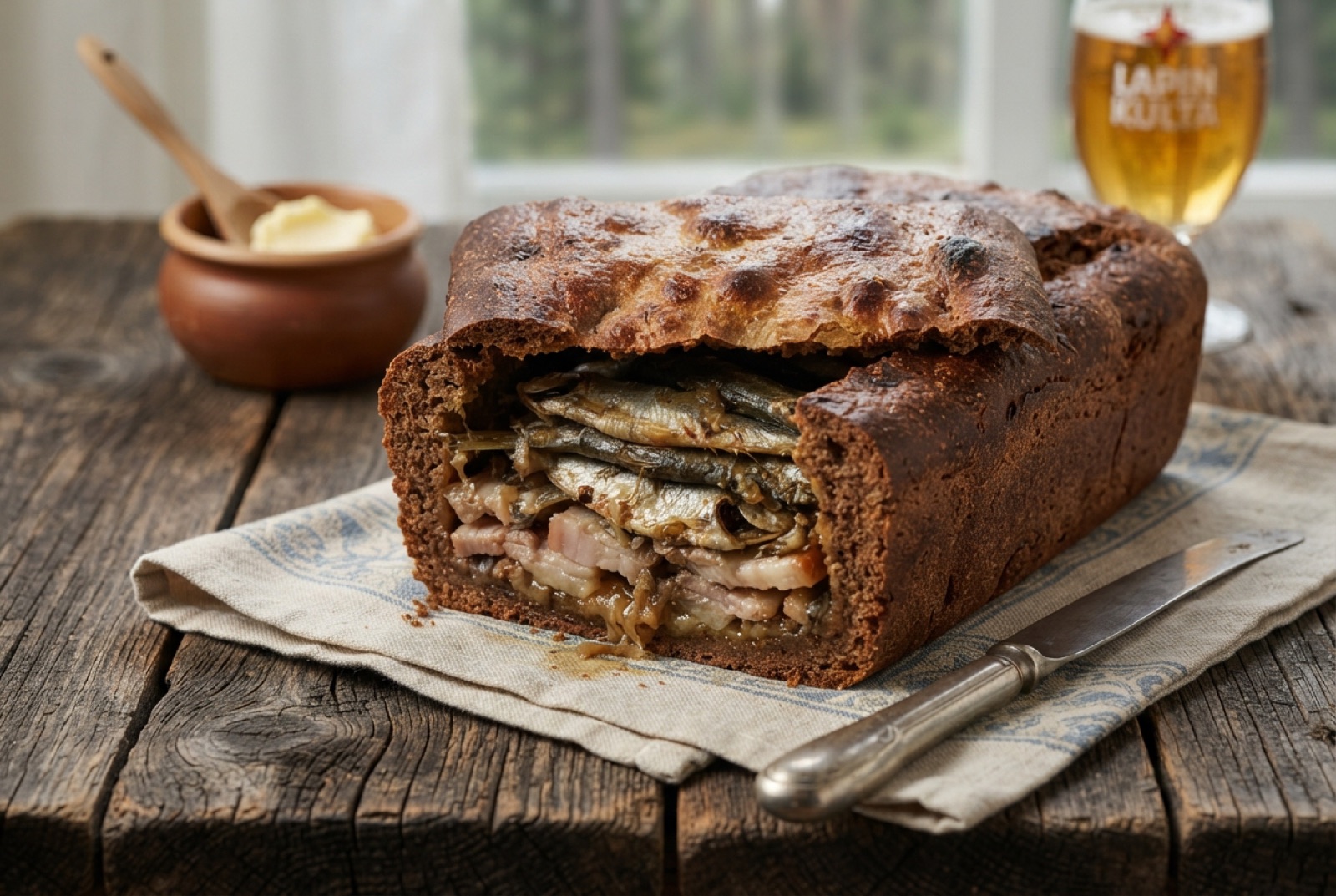
Keep exploring Finland.
Finland has 9 more dishes in the atlas — Kalakukko and Karjalanpaisti, and 7 more.
Recipe by The DishRoute Kitchen · published August 19, 2026 · updated August 19, 2026