Gibanica.
Serbian Layered Cheese Filo Pie
Гибаница · Gibanica · say it: ghee-BAH-nee-tsah
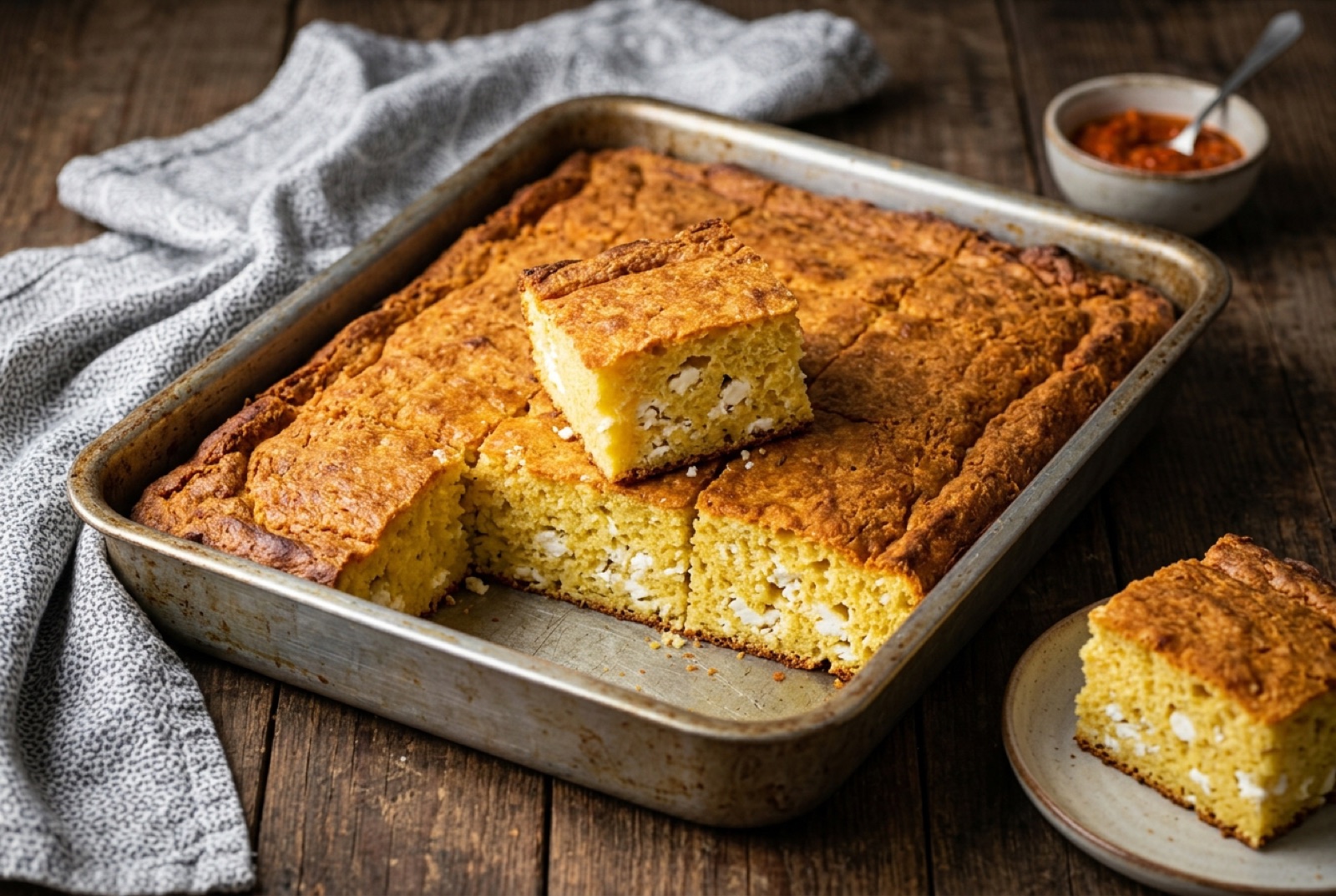
Gibanica is a cheese pie built the opposite way to most pastry: instead of neat layers, the filo sheets are dipped in a loose mixture of white cheese, eggs and kajmak and dropped into the tray in crumpled folds, so the pie bakes into ridges and hollows. The top and edges go blistered, brittle and deep gold, while everything underneath sets into something between a savoury custard and a very soft dumpling — salty, tangy, rich, and much lighter to eat than the ingredient list suggests. It is served warm in big squares, usually as the first thing on the table, and it is one of very few dishes that will silence a Serbian family mid-argument.

- Gate
- Serbia
- Prep
- 30 min
- Cook
- 45 min
- Total time
- 1 hr 30 min incl. 15 min rest
- Serves
- 8
- Status
- Medium
- Nutrition / serving · estimated
- Calories 490 kcal
- Protein 18 g
- Carbs 29 g
- Fat 33 g
- Fiber 1 g
- Sodium 780 mg
Why this recipe works.
- The crumple-and-dip method done properly, so the interior sets in soft folds instead of flat, wet layers.
- A cheese blend that reproduces Serbian mladi sir from ingredients any supermarket carries, salt level included.
- Sparkling water in the mixture — the household trick that lifts and lightens a filling that can otherwise bake heavy.
- Tells you how to judge doneness by sound and wobble, not just by the clock, since filo and trays vary wildly.
Ingredients.
9 itemsFor the pie
For the filling
Equipment
- Deep baking tray, about 30 x 35 cm
- Large mixing bowl
- Pastry brush
- Clean tea towel
Instructions.
Mix the filling
Beat the eggs in a large bowl until loose, then work in the crumbled feta, ricotta and kajmak until you have a lumpy, pourable mixture. Whisk in the sparkling water and 150 ml of the oil. Taste and salt — it should taste slightly too salty on its own.
Tip Keep the lumps of cheese. Pockets of whole cheese through the pie are part of the texture; a smooth blended filling bakes flat and dull.
Prepare tray and sheets
Heat the oven to 200°C. Butter a deep 30 x 35 cm tray. Unroll the filo and keep it under a barely damp cloth so it does not dry out while you work. Lay two whole sheets flat across the base and brush them with oil.
Dip and crumple
Take one sheet at a time, drag it briefly through the cheese mixture so both sides are coated, then lift it out, scrunch it loosely into folds with your hands and drop it into the tray. Carry on until the tray is full and the sheets sit in uneven waves, not flat layers.
Tip In and out in about two seconds. A sheet left in the bowl turns to paste and collapses instead of holding its folds.
Top and soak
Lay the last two sheets flat over the top and pour every last spoonful of the remaining mixture across them, pushing it into the gaps at the edges. Drizzle over the last 50 ml of oil and flick a tablespoon of cold water across the surface with your fingers.
Bake until it crackles
Bake for 45 minutes, until the top is deep gold with blistered ridges, the edges have pulled slightly from the tray, and the centre feels set with only a faint wobble when you press it. You should hear the surface faintly ticking as it comes out.
Tip If the top colours hard before 30 minutes, tent it with foil and keep going — an underbaked centre is a much worse outcome than a pale top.
Cover, rest and cut
Lay a clean tea towel over the hot tray and leave it for 10–15 minutes. The trapped steam softens the crust just enough to cut cleanly. Slice into large squares and serve warm, with cold yoghurt on the side.
Tips from our kitchen.
- Let the filo come to room temperature in its packet for 30 minutes. Cold sheets crack into shards the moment you try to lift them.
- Taste the cheese mixture before it goes anywhere near the tray. It should be a touch saltier than you want the finished pie, because the filo is unseasoned and dilutes it.
- Dip each sheet quickly rather than soaking it — in and out, so it is coated but still holds together. A drowned sheet turns to paste and the pie loses its folds.
- Pour any leftover mixture over the top before baking and finish with a few tablespoons of oil. That surface layer is what crisps into the crackled crust.
- Flick a tablespoon of cold water over the top sheet just before it goes in the oven. It steams under the crust and stops the top drying into cardboard.
- Cover the hot pie with a clean tea towel for 10 minutes out of the oven, then cut. Cutting it straight away shatters the top and the filling runs.
Substitutions.
- Mladi sir (Serbian young white cheese) → 400 g feta plus 300 g ricotta or dry cottage cheese, mashed together
- Rinse the feta briefly and taste before adding salt. The ricotta supplies the mild, milky bulk that feta alone cannot.
- Kajmak → 200 g full-fat sour cream or crème fraîche
- Slightly less rich and less lactic, but it behaves the same in the oven. Do not use single cream — the filling will not set.
- Sparkling mineral water → Plain yoghurt thinned with milk to a pourable consistency
- Yoghurt gives a denser, tangier pie; sparkling water gives a lighter one. Both are traditional and households argue about it.
Variations.
- Gibanica with spinach
- Fold 300 g of blanched, very well squeezed spinach into the cheese mixture. Common in the north and closer to a Greek spanakopita in flavour, though the crumpled build stays the same.
- Slana pita sa sirom
- The flat-layered cousin: sheets laid smooth rather than crumpled, with the mixture spread between them. Neater slices, crisper texture, less of the soft custardy middle.
- Homemade jufka version
- Made with hand-stretched dough instead of shop filo. Thicker, chewier and far more forgiving to handle, and how it was made before packaged sheets existed.
Storage & reheating.
Gibanica keeps 3 days covered in the fridge and is genuinely good cold, eaten with the fingers. To bring it back, reheat uncovered at 180°C for 10–12 minutes so the top re-crisps; a microwave turns the filo to wet paper. Baked gibanica freezes acceptably for a month in portions — reheat from frozen at 170°C for 25 minutes. The unbaked assembled pie does not freeze well, since the soaked filo goes to mush on thawing.
Serve with
Cold drinkable yoghurt or kiselo mleko, and a plate of raw peppers, tomatoes and spring onions.
The story behind Gibanica.
The name comes from gibati, to fold or bend, and it describes the only technique that matters here — the sheets are folded and rumpled rather than laid flat, which is what gives gibanica its uneven, wave-crested interior. Filo pies came into the Balkans with the Ottomans and were absorbed so completely that the whole pita family, gibanica and burek included, now reads as local rather than borrowed. What Serbia added was the dairy: mladi sir, the fresh unripened white cheese sold in wet slabs at every green market, and kajmak, the ripened milk skin that makes the filling taste of more than eggs.
Gibanica belongs to the slava, the family patron-saint day that is the most important meal of the Serbian year, and to Christmas, Easter and every occasion where a house fills up with guests. It is also weekday food, sold by weight in bakeries and eaten warm out of paper with a bottle of drinkable yoghurt. That double life — ceremonial and utterly ordinary — is unusual, and it means every family has a fixed opinion about it: more eggs or fewer, sparkling water or yoghurt in the mixture, whether the top sheets should be laid flat or crumpled like the rest.
One clarification worth making, because search engines confuse them constantly: Slovenia's prekmurska gibanica shares the name and nothing else. That one is a protected dessert of poppy seed, walnut, apple and curd in stacked layers, sweet and dense. Serbian gibanica is savoury, wet-mixed, and built for a crowd. If a recipe asks you for poppy seeds, you are in the wrong country.
The household trick that never appears in restaurant versions is the towel: as soon as the pie leaves the oven it is covered with a clean cloth for ten minutes, which traps enough steam to take the glassy brittleness off the crust without making it soggy. Skip it and gibanica shatters when you cut it.
Questions, answered.
Why is my gibanica soggy in the middle?
Usually too much liquid or too little time. The sheets should be dipped quickly, not soaked, and the pie needs a full 45 minutes at a properly hot oven so the egg sets all the way through. Check by pressing the centre: it should feel set with only the faintest wobble. If the top browns before the middle is done, cover it loosely with foil and keep baking rather than pulling it out early.
What cheese should I use if I cannot find Serbian white cheese?
Blend a salty brined cheese with a mild fresh one — roughly 400 g feta mashed with 300 g ricotta, dry cottage cheese or quark. On its own feta is far too salty and firm, and ricotta on its own is bland and watery. Together they land close to mladi sir, which is mild, wet and lightly sour.
Can I make gibanica ahead of time?
Bake it the same day for the best crust, but you can mix the filling up to 24 hours in advance and refrigerate it. Fully assembled and unbaked, it should not sit longer than an hour or the filo dissolves. If you need it done in advance, bake it fully, cool it, and re-crisp it in the oven for 10 minutes before serving.
Is Serbian gibanica the same as Slovenian prekmurska gibanica?
No, they only share a name. Serbian gibanica is a savoury cheese and egg pie made with crumpled filo. Prekmurska gibanica is a Slovenian dessert with protected status, built from stacked layers of poppy seed, walnut, apple and sweetened curd. If a recipe calls for poppy seeds or sugar in quantity, it is the Slovenian one.
How many eggs does gibanica actually need?
Five to six for 500 g of filo and 700 g of cheese, which is what this recipe uses. Fewer and the filling stays loose and weeps when cut; more and the pie turns rubbery and tastes like a baked omelette. Serbian households genuinely disagree about the exact number, and anything in that range works.
You might also like.
All recipes →
Keep exploring Serbia.
Serbia has 9 more dishes in the atlas — Ćevapi and Karađorđeva Šnicla, and 7 more.
Recipe by The DishRoute Kitchen · published August 19, 2026 · updated August 19, 2026