Utopenci.
Czech Pickled Sausages with Onion
Utopenci · say it: oo-toh-PENT-see
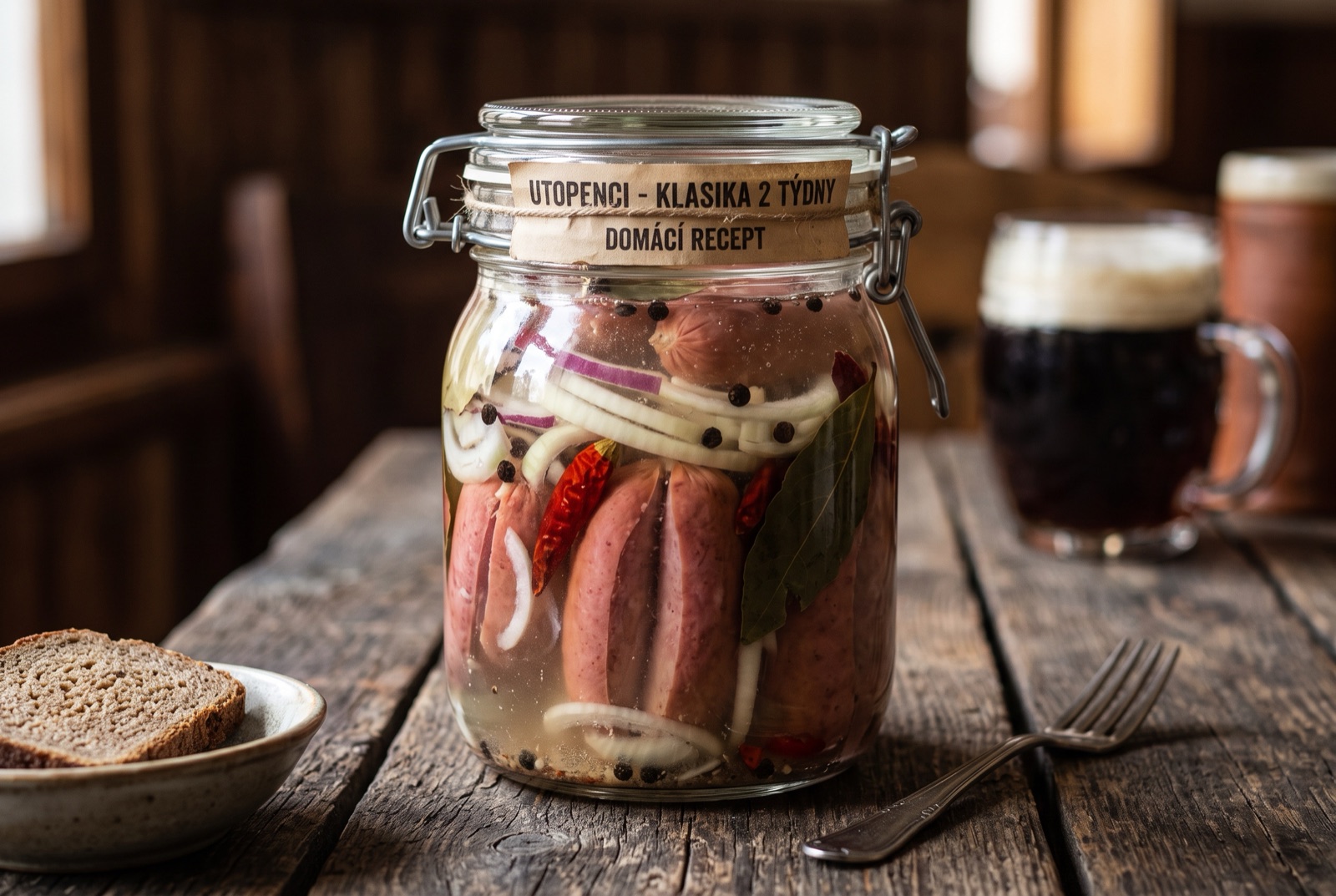
Utopenci are coarse smoked sausages split lengthways, packed into a jar with rings of raw onion, chilli, bay and allspice, and covered with a sweet-sour vinegar brine to sit for at least two weeks. The name means "drowned men", which is a Czech joke about how they look floating in the jar. They come out sharp, garlicky and softened, the onion turned translucent and almost as good as the sausage itself, and they are eaten cold with a slice of dark bread and a beer. There is no cooking beyond boiling the brine, no skill required, and no way to speed it up — the only real ingredient is time.

- Gate
- CzechiaBohemia
- Prep
- 20 min
- Cook
- 10 min
- Total time
- 336 hr 30 min incl. 336 hr rest
- Serves
- 8
- Status
- Easy
- Nutrition / serving · estimated
- Calories 290 kcal
- Protein 13 g
- Carbs 6 g
- Fat 24 g
- Fiber 1 g
- Sugar 4 g
- Sodium 1180 mg
Why this recipe works.
- A brine ratio tested for balance: sour enough to preserve properly, sweet enough that you can eat a whole one.
- The brine is cooled completely before it is poured, so the onion stays crisp rather than turning limp on contact.
- Splitting the sausages lengthways is treated as essential rather than cosmetic — it is how the brine gets inside.
- Honest about the timeline: this is a two-week recipe with fifteen minutes of work, and nothing is gained by rushing it.
Ingredients.
12 itemsFor the jar
For the brine
Equipment
- 1.5 litre glass jar with a tight lid
- Small saucepan
- Sharp knife
Instructions.
Sterilise the jar
Rinse a 1.5 litre jar and its lid with boiling water, then drain them upside down on a clean cloth until completely dry. Anything left inside has two weeks in a warm-ish fridge to make itself known.
Boil and cool the brine
Bring the water, vinegar, sugar and salt to a boil in a small pan, stirring until the sugar and salt have dissolved, then take it off the heat and leave it to cool to room temperature. Do not skip the cooling — hot brine turns the onion limp and grey.
Split the sausages
Cut each sausage lengthways almost through, so it opens like a book but stays in one piece. This is the only way the brine gets to the inside; whole sausages stay bland in the middle no matter how long they sit.
Layer the jar
Build alternating layers in the jar: a handful of onion rings, then sausages cut side up, then garlic slices, chilli, a bay leaf and a scatter of peppercorns, allspice and mustard seeds. Repeat until everything is in, finishing with a thick layer of onion on top.
Cover with cold brine
Pour the cooled brine over until everything is submerged by at least a centimetre, pressing the contents down with a spoon to release trapped air bubbles. Top up with a little extra vinegar and water in the same ratio if anything is still poking out.
Tip Anything above the brine line will spoil. A small saucer or a sealed sandwich bag of water makes a good weight.
Seal and wait
Close the jar tightly and refrigerate for at least 14 days, giving it a gentle turn every few days to move the spices around. The brine will go cloudy after the first week, which is exactly what should happen.
Serve cold with bread
Lift a sausage out with a fork, letting it drain for a second, and serve it cold with a heap of the pickled onion from the jar and a slice of dark rye bread. Eat with a beer and put the jar straight back in the fridge.
Tips from our kitchen.
- Buy coarse-textured smoked sausage, not a fine emulsified frankfurter. Tight-textured sausages repel the brine and stay bland in the middle.
- Split each sausage along its length almost but not all the way through, so it opens like a book and the brine reaches the inside.
- Sterilise the jar with boiling water and dry it completely. Anything left in the jar has two weeks to multiply.
- Pour the brine only when it is fully cold. Hot brine cooks the onion soft and cloudy and dulls the whole jar.
- Everything must stay submerged. Any sausage sticking above the liquid will spoil, so top up with extra brine or weigh the contents down with a small saucer.
- Taste one after two weeks and then decide. Three weeks is better, and most Czech cooks would say a month is when they are properly ready.
Substitutions.
- Špekáčky → Coarse smoked kielbasa, bratwurst-style smoked sausage or Polish biała kiełbasa
- Look for visible fat and a loose grind. Any fully cooked smoked sausage works; raw sausages do not, since nothing here cooks them.
- White wine vinegar → Cider vinegar, or spirit vinegar diluted to 5% acidity
- Keep the acidity around 5%. Weaker vinegar will not preserve safely, and much stronger vinegar overwhelms the sausage.
- Fresh chilli → A teaspoon of dried chilli flakes, or leave it out
- The heat should be a background prickle. Whole dried chillies keep releasing heat over two weeks, so use fewer than you think.
Variations.
- Utopenci with gherkin brine
- Replace a quarter of the water with brine from a jar of pickled gherkins, and tuck a few sliced gherkins between the layers. Sharper and more savoury.
- Sweet Moravian version
- Double the sugar and add a few slices of red pepper. Milder and more approachable, and common in the east of the country.
- Nakládaný hermelín
- The same jar logic applied to Czech camembert-style cheese, layered with onion, garlic and peppers in oil rather than vinegar. The other great Czech bar snack.
Storage & reheating.
Kept fully submerged in a sealed jar in the fridge, utopenci last around 6 weeks and are at their best between weeks three and five. The brine turns cloudy after the first week, which is normal and comes from the sausage fat and onion. Discard the jar if anything smells of yeast or fermentation rather than clean vinegar, if the brine develops a slimy texture, or if any sausage has been sitting above the liquid line. Never store them at room temperature.
Serve with
Dark rye bread, a spoonful of the pickled onion from the jar, and a cold beer — the standard Czech pub order.
The story behind Utopenci.
Every Czech pub has a jar behind the bar. Utopenci belong to the pivní tapas category of Czech drinking food — nakládaný hermelín (pickled soft cheese), pickled sausage, pickled fish, cold cuts with onion — food designed to be salty and sour enough to keep a beer drinker ordering. They are also a preserving technique from before refrigeration, when a strong vinegar brine was how you kept a batch of sausages edible through the weeks after a pig slaughter.
The name is where the folklore lives. Utopenec means a drowned man, and the standard explanation is simply the appearance of pale sausages suspended in cloudy liquid, though there is also a well-known and probably apocryphal tale attached to a pub in Bohemia and a body in a nearby pond. The story is told with a grin rather than as history, and you should treat it the same way. What is documented is that the dish is old, domestic and universal — the recipe is a jar, not a technique, and every household adjusts the sugar, the chilli and the number of days.
The sausage itself matters more than anything else. The classic choice is špekáček, a fat, coarse-textured Czech smoked sausage with visible cubes of fat, protected as a traditional speciality and sold everywhere in the country. It has the loose texture that lets the brine penetrate rather than bouncing off a tight emulsified skin. Outside Czechia, a coarse smoked kielbasa or a similar coarse-ground smoked sausage is the closest available match. Cooks argue about whether to add mustard seed, whether to include a spoon of the brine from a jar of gherkins, and whether two weeks is enough — three is better, and a jar left a month is not a mistake.
Questions, answered.
How long do utopenci need before they are ready?
Two weeks is the minimum for the brine to reach the middle of the sausage. Three weeks is noticeably better, and many Czech cooks leave them a month. Before two weeks the outside tastes pickled while the centre still tastes like plain sausage, so there is genuinely nothing to gain by opening the jar early beyond satisfying curiosity.
What sausage should I use if I cannot find špekáčky?
Any fully cooked, coarse-ground smoked sausage of similar size: smoked kielbasa, a coarse bratwurst, or a Central European smoked pork sausage. The key qualities are a loose texture that lets brine penetrate and visible fat, which softens over the weeks. Avoid fine-textured hot dogs and frankfurters, which stay rubbery and never absorb much.
Is it safe to eat sausages that have only been pickled, not cooked?
Yes, provided you start with sausages that are already fully cooked, which nearly all smoked sausages are — check the label if unsure. The brine is boiled, the jar is sterilised, the acidity is high, and the jar lives in the fridge. What you must not do is use raw or fresh sausages, because nothing in this process cooks them.
Why has my brine gone cloudy?
Cloudiness is normal and expected after a week or so, caused by fat rendering out of the sausage and starch and sugars leaching from the onion. It is not a problem. The warning signs are different: a slimy or ropey texture in the liquid, a smell of fermentation or yeast rather than clean vinegar, or any surface mould. Any of those means throwing the jar out.
Can I make a smaller batch?
Yes, and the ratios scale directly. The only rule is that the sausages and onion must stay fully covered by brine, so use the smallest jar they will fit in rather than a large jar with a lot of headroom. If anything floats above the surface, weigh it down with a small saucer or a sealed bag of water.
You might also like.
All recipes →
Keep exploring Czechia.
Czechia has 9 more dishes in the atlas — Bramborák and Hovězí Guláš, and 7 more.
Recipe by The DishRoute Kitchen · published August 20, 2026 · updated August 20, 2026