Wetha Hnat.
Burmese Pork Belly Curry with Tamarind
ဝက်သားနှပ် · say it: weh-thah NAHT
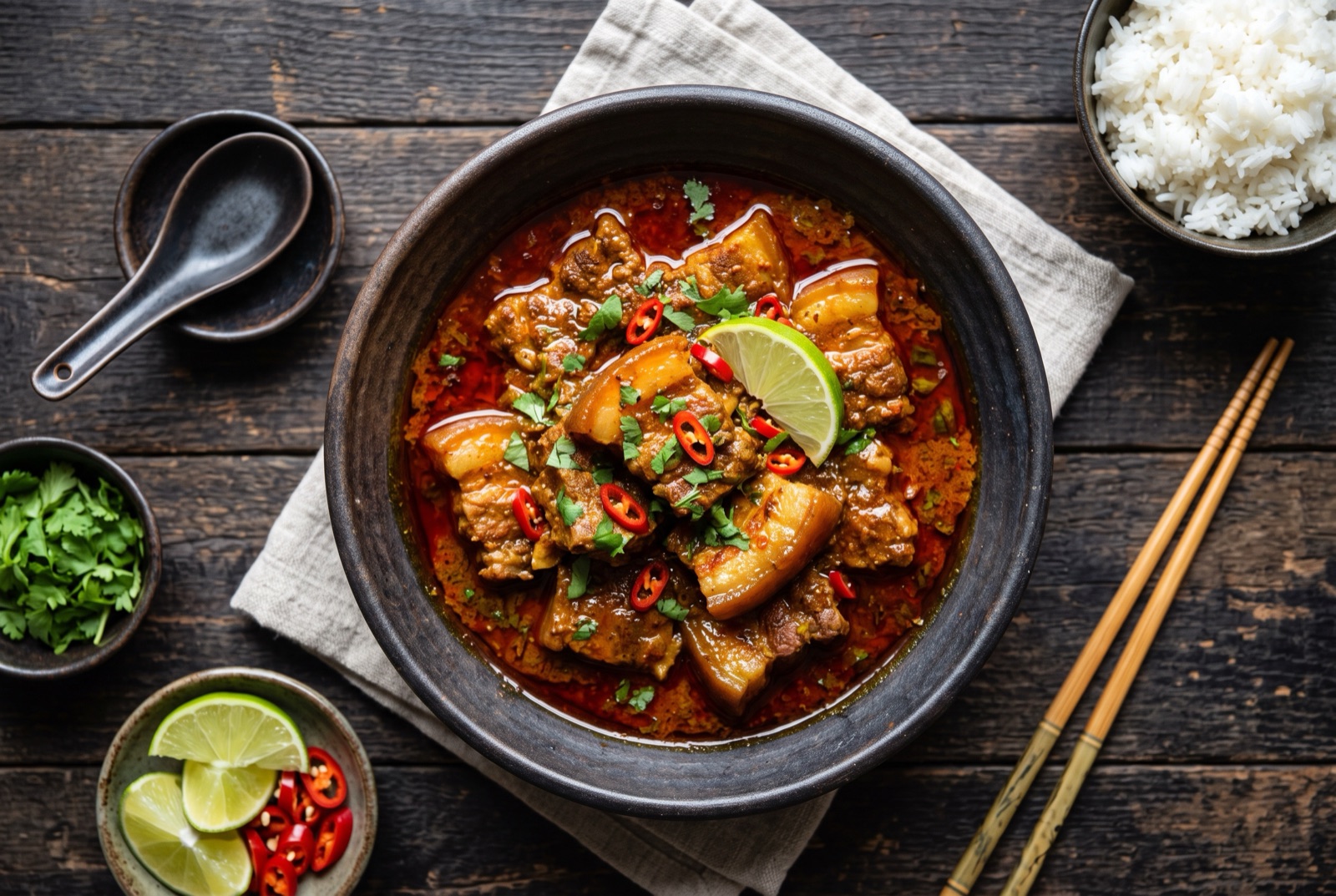
Wetha hnat is the pork curry that turns up at Burmese family tables more than any other: cubes of pork belly cooked slowly in a thick paste of onion, garlic and ginger with turmeric and paprika, soured with tamarind and braised until the meat gives under a spoon and a layer of red-orange oil rises clear on top. That floating oil is not a mistake — Burmese cooks call a curry finished only when it appears, and the technique is called si pyan, meaning the oil has returned. The taste is deeply savory and gently sour rather than hot: no chile heat to speak of, no coconut, just concentrated allium sweetness, the earthiness of turmeric, and tamarind cutting through the fat. Serve it with plain rice and a bowl of clear soup.

- Gate
- MyanmarCentral Myanmar
- Prep
- 20 min
- Cook
- 1 hr 30 min
- Total time
- 1 hr 50 min
- Serves
- 4
- Status
- Medium
- Nutrition / serving · estimated
- Calories 690 kcal
- Protein 34 g
- Carbs 12 g
- Fat 56 g
- Fiber 2 g
- Sodium 1050 mg
Why this recipe works.
- Teaches the si pyan technique properly — the oil separating is the timing signal, not the clock.
- Uses a pounded paste rather than chopped aromatics, which is what gives the sauce its smooth, clinging body.
- Balanced with tamarind rather than chile, so the curry reads Burmese instead of generic Southeast Asian.
- Explains how to skim the oil if you want it lighter without losing the flavor it carries.
Ingredients.
14 itemsFor the curry
For the paste
To serve
Equipment
- Heavy pot or Dutch oven with a lid
- Blender, food processor or mortar and pestle
Instructions.
Marinate the pork
Toss the pork belly cubes with half the turmeric, the fish sauce and the dark soy sauce. Leave for 20 minutes while you make the paste — the turmeric stains the meat yellow and seasons it beyond the surface.
Pound the paste
Blend the onions, garlic and ginger to a smooth paste with 3 tablespoons of water. It should be the texture of thick porridge with no visible chunks, since chunky aromatics never melt into the sauce properly.
Fry the paste until it darkens
Heat the oil in a heavy pot over medium heat and add the paste. Fry for 15–18 minutes, stirring regularly, until the raw onion smell disappears, the mass shrinks by half and takes on the color of wet brick, and oil pools clearly around the edges.
Tip This is the longest step and the one that decides whether the curry tastes finished. Do not cut it short.
Add the spices and pork
Stir in the remaining turmeric, the paprika and the shrimp paste and fry for 2 minutes until the oil turns deep red-orange. Add the pork and turn it in the paste for 5 minutes, until every cube is coated and the surfaces have firmed.
Braise
Pour in 350 ml hot water and add the lemongrass. Bring to a simmer, cover, and cook on low for 55–60 minutes, stirring every 15 minutes, until a spoon pushes through the pork fat with no resistance.
Sour and reduce
Stir in the strained tamarind water and the sugar, then uncover and simmer 12–15 minutes more. The sauce should reduce until it clings to the pork and a distinct layer of red oil floats clear on the surface.
Tip If the oil has not risen, keep reducing. If the pan looks dry before it does, add hot water in small splashes.
Rest and serve
Take the pot off the heat, fish out the lemongrass and let the curry sit for 10 minutes so the oil settles cleanly on top. Taste for salt and sourness, scatter with cilantro, and serve with plenty of steamed rice.
Tips from our kitchen.
- Do not trim the pork belly fat. It renders into the sauce and is the reason the curry ends up glossy rather than dry.
- Fry the paste far longer than feels sensible — 15 minutes minimum, until it stops smelling sharp and turns the color of wet brick.
- Add the tamarind late. Acid slows down the softening of pork, so early tamarind means a longer braise.
- If the curry looks dry before the pork is tender, add hot water a splash at a time; cold water shocks the meat and toughens it.
- Cook it a day ahead if possible. The flavor gains noticeably and you can lift off excess set fat straight from the fridge.
- Serve small portions with a lot of rice. This is a rich condiment in Burmese meals, not a main-bowl stew.
Substitutions.
- Pork belly → Pork shoulder, or bone-in chicken thighs
- Shoulder works but needs a little extra oil since it renders less fat. Chicken cuts the braise to about 30 minutes total.
- Tamarind → Lime juice with a pinch of brown sugar, or a few pieces of green mango
- Lime is sharper and less fruity; add it at the very end rather than during the braise. Green mango is genuinely used in Myanmar in season.
- Shrimp paste → An extra tablespoon of fish sauce
- Loses some of the fermented base note but keeps the salt and savoriness in balance.
Variations.
- Wetha chin hin
- A soupier, more sour version with extra tamarind and more liquid, eaten more like a stew and common in hot weather.
- Mutton hnat
- The same paste and technique with mutton or goat, cooked by Myanmar's Muslim communities and needing about an hour longer on the heat.
- Pork with green mango
- Slices of unripe green mango replace the tamarind, added in the last 15 minutes so they soften but keep their shape and tartness.
Storage & reheating.
Keeps 4 days refrigerated and is better on day two; the set layer of fat on top acts as a seal. Freezes well for 3 months. Reheat gently in a pan with a splash of water, stirring until the oil re-emulsifies into the sauce and the meat is heated through. Do not microwave on high — the fat separates violently and the meat toughens.
Serve with
Plain steamed rice, a clear vegetable broth, and a plate of raw and blanched vegetables with a fermented dipping sauce.
The story behind Wetha Hnat.
Burmese curry is often misread by people expecting Indian or Thai templates. There is no long spice blend and usually no fresh chile in the pot; the flavor comes from an enormous quantity of onion cooked down in oil until it dissolves, plus garlic, ginger, turmeric and paprika for color. Oil is used generously and deliberately, because the finished dish is supposed to sit under a clear layer of it — this both preserves the curry in a hot climate before refrigeration and signals to the eater that the cooking was not rushed. In a traditional Burmese meal the curry is not a soup to be poured over rice but a rich condiment eaten in small amounts with a lot of rice, fresh vegetables and a soup.
Pork belly is the classic cut for hnat, and the reason is structural: the layers of fat render slowly into the sauce and carry the paste, while the lean layers stay in intact bites. Tamarind is the common souring agent in central Myanmar, though some households use green mango, tomato or vinegar depending on season and region. Because Myanmar is majority Buddhist rather than Muslim, pork is widely eaten, unlike in some neighboring cuisines — though the country's Muslim and Indian-descended communities cook the same technique with mutton or chicken.
A proper Burmese meal built around this curry is a spread: rice at the center, the curry, a clear broth called hin gyo, a plate of raw and blanched vegetables with a fermented dip, and often a thoke salad. Nobody eats a bowl of curry alone. The dish also improves substantially overnight, which is why it is frequently cooked in the evening and eaten the next day — the tamarind mellows, the onion sweetness deepens, and the oil sets clean on top in the fridge, easy to skim if you want it lighter.
Questions, answered.
Why is there so much oil floating on top?
That is intentional and is the traditional sign that a Burmese curry is finished, a technique called si pyan or the return of the oil. The paste must fry until the oil it was cooked in separates back out. If you find it too rich, chill the curry and lift off the set fat, or spoon some off before serving — the flavor is already in the sauce.
Is Burmese curry spicy?
Generally no. Most Burmese curries use turmeric and paprika for color and depth rather than chile for heat, and any burn comes from a chile condiment added at the table. This one is savory and sour rather than hot, which surprises people expecting Thai-level heat.
Can I use tamarind paste from a jar?
Yes. Use about 2 tablespoons of concentrated jarred paste in place of the pulp, but taste before adding all of it, since brands vary enormously in strength and some are much more sour than block tamarind.
My pork is still tough after an hour. What now?
Keep going with the lid on and add hot water as needed. Pork belly needs the collagen in it to break down, and depending on the cut that can take 90 minutes or more. If you added tamarind early, acid will have slowed the process — that is a common cause.
What do I serve alongside it?
Plain steamed rice is essential, because the curry is intensely concentrated. A traditional Burmese table adds a clear broth and a plate of raw or lightly blanched vegetables for contrast. A simple cucumber salad works if you want just one side.
You might also like.
All recipes →
Keep exploring Myanmar.
Myanmar has 9 more dishes in the atlas — Balachaung and Danbauk, and 7 more.
Recipe by The DishRoute Kitchen · published August 20, 2026 · updated August 20, 2026