Ohn No Khao Swè.
Burmese Coconut Chicken Noodles
အုန်းနို့ခေါက်ဆွဲ · say it: own-no KOW-sway
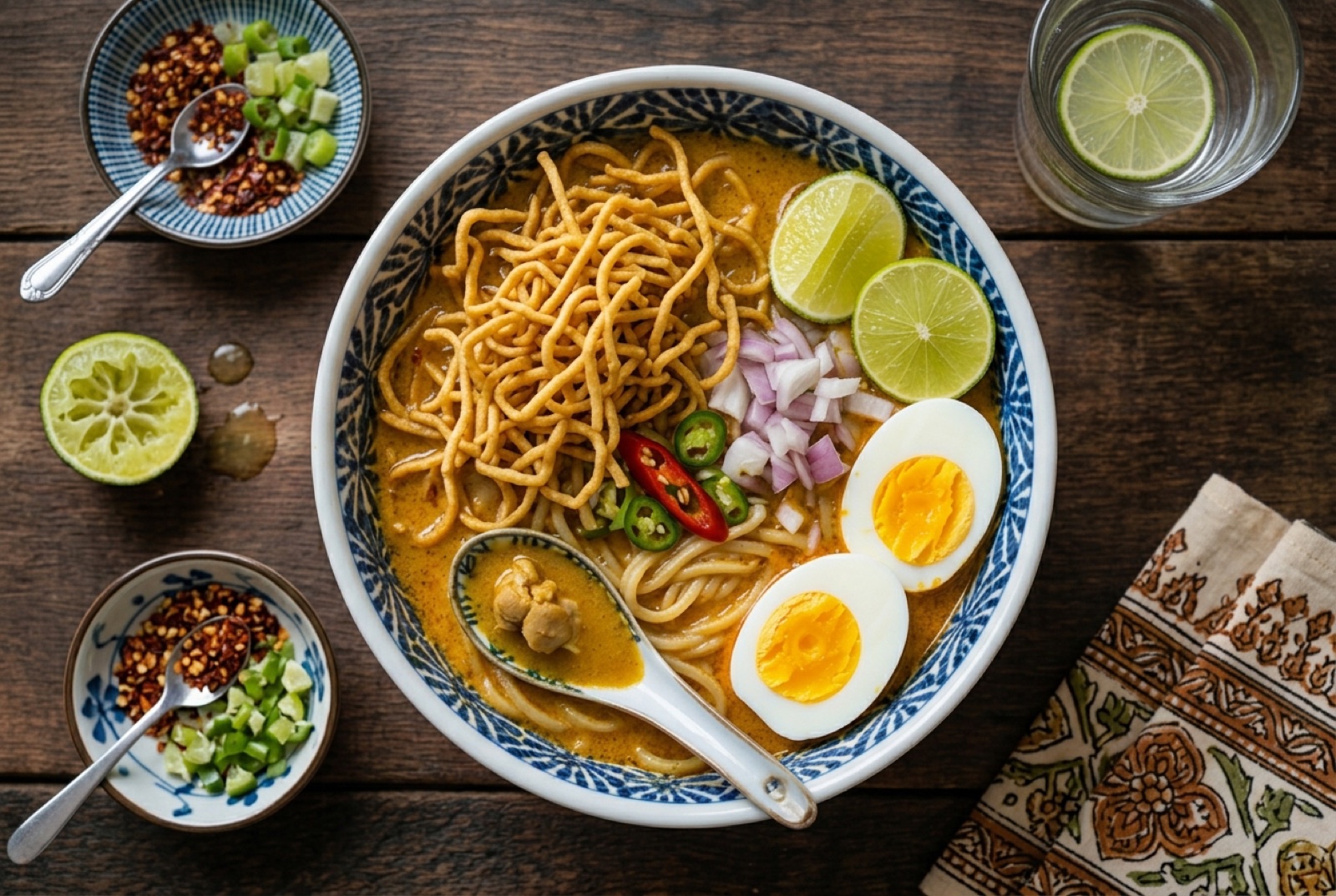
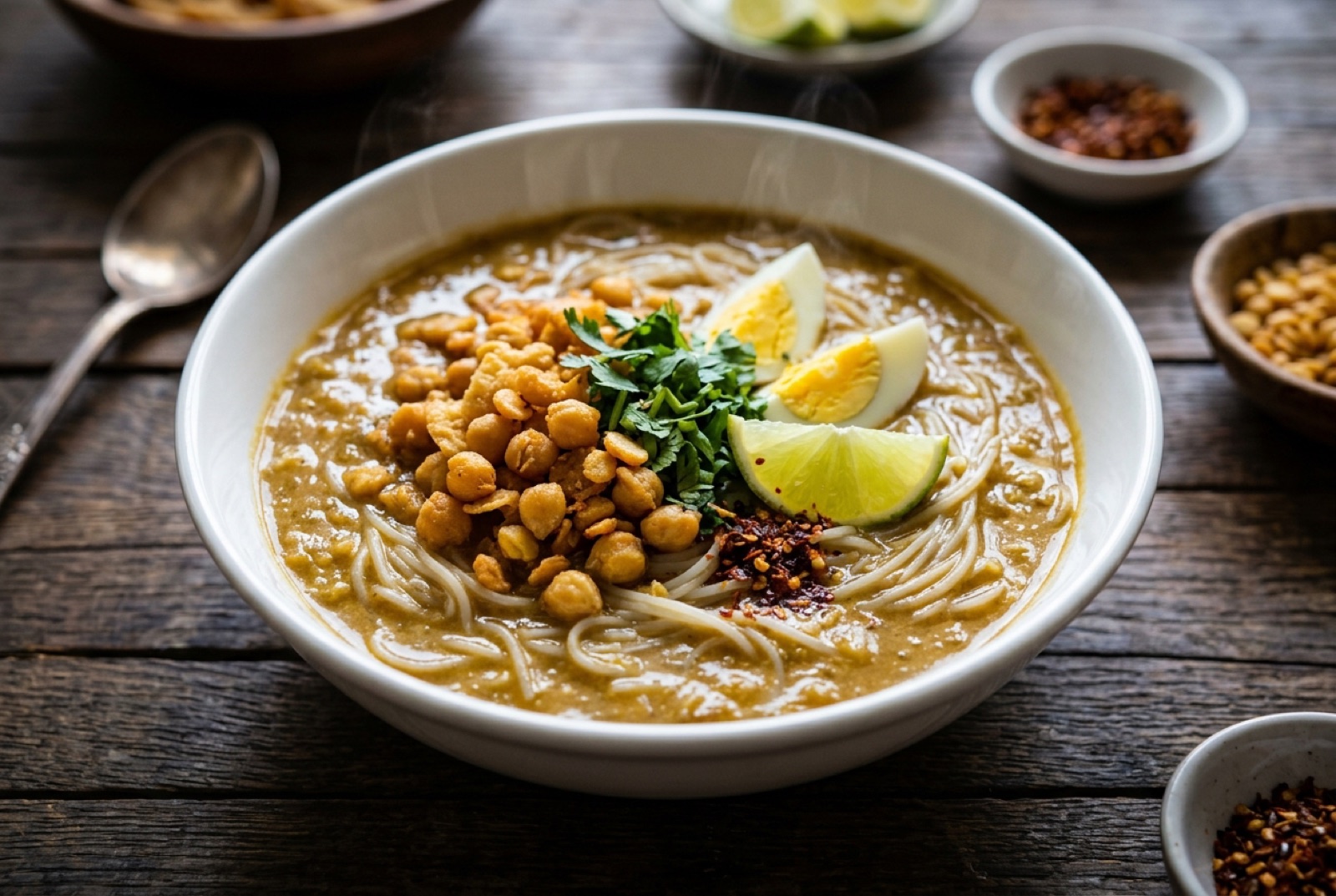
Ohn no khao swè is Myanmar's coconut noodle bowl: chicken simmered with turmeric, onion and garlic, loosened with coconut milk and thickened with chickpea flour into a soup somewhere between broth and light curry, then poured over soft wheat noodles. It is milder and sweeter than mohinga, closer to a comforting curry-noodle than a sour breakfast soup, and its whole personality changes at the table — you crush crisp fried noodles over the top, add raw onion for bite, chile flakes for heat, and lime to cut the coconut fat. The first spoonful is creamy, the second is sharp, and the crunch keeps working against the softness the whole way down. It is a common lunch dish and a standard at family gatherings.

- Gate
- MyanmarYangon
- Prep
- 25 min
- Cook
- 40 min
- Total time
- 1 hr 5 min
- Serves
- 4
- Status
- Medium
- Nutrition / serving · estimated
- Calories 780 kcal
- Protein 42 g
- Carbs 68 g
- Fat 38 g
- Fiber 5 g
- Sodium 1250 mg
Why this recipe works.
- Chickpea flour is used the way Burmese cooks use it, giving body without the gluey feel of a cornstarch-thickened broth.
- The onion-garlic-turmeric base is fried until the oil separates first, so the broth tastes cooked rather than milky.
- Full condiment set included, because the crunch and acid are the dish, not decoration.
- Timed so the noodles and the fried topping are ready at the same moment as the broth.
Ingredients.
18 itemsFor the broth
To serve
Equipment
- Heavy pot or Dutch oven
- Small frying pan for the crispy noodles
- Whisk
- Slotted spoon
Instructions.
Fry the crispy topping
Heat 2 cm of oil in a small pan until a scrap of noodle sizzles on contact. Fry the extra noodles in small handfuls for about 40 seconds each, until pale gold and rigid, then drain on paper towel and set aside uncovered.
Tip They darken after they leave the oil, so pull them while they still look slightly underdone.
Make the aromatic paste
Blend the onions, garlic and ginger to a coarse paste with a splash of water. Heat the 4 tablespoons of oil in a heavy pot and fry the paste over medium heat for 10 minutes, stirring, until it loses its raw smell and turns pale gold.
Bloom the spices and brown the chicken
Stir in the turmeric and paprika and fry for one more minute, until the paste stains deep yellow-orange and the oil at the edges takes on color. Add the chicken and turn it in the paste for 5 minutes, until the outside is opaque and coated.
Build the broth
Whisk the chickpea flour into 200 ml of the cold coconut milk until completely smooth, then pour it into the pot along with the rest of the coconut milk and the stock. Stir constantly as it comes up to temperature so no lumps form.
Simmer gently
Bring to a bare simmer — small lazy bubbles, never a rolling boil — and cook uncovered for 20 minutes, stirring every few minutes. The broth is right when it thickly coats a spoon and a thin ring of orange oil floats at the surface.
Tip If it boils hard the coconut milk will break into oily flecks. Lower the heat the moment it starts to churn.
Season
Stir in the fish sauce and taste. Aim for clearly salty and savory with the coconut sweetness still coming through underneath; the lime at the table will sharpen it further.
Cook the noodles and serve
Boil the wheat noodles until just tender, drain, and divide between four deep bowls. Ladle the hot broth and chicken over, then top with crushed fried noodles, egg halves, raw onion and cilantro. Serve with lime wedges and chile so everyone finishes their own bowl.
Tips from our kitchen.
- Use chicken thighs, not breast. Thighs stay tender through the simmer and give the broth the fat it needs.
- Whisk the chickpea flour into cold coconut milk before it goes near heat — added dry to a hot pot it seizes into lumps instantly.
- Keep the broth below a rolling boil once the coconut milk is in, or it will split into oily flecks and thin liquid.
- Fry the crispy noodle topping first and drain it on paper; it holds for hours and goes soggy in minutes once it hits soup.
- Slice the raw onion paper-thin and soak it in cold water for 10 minutes to take the harsh edge off without losing the crunch.
- Taste for salt only after the lime goes in, since acid makes the broth taste less seasoned than it is.
Substitutions.
- Chickpea flour → Toasted rice flour, or 2 tbsp cornstarch as a last resort
- Rice flour is the closer swap in texture. Cornstarch thickens but gives a slicker mouthfeel and no nutty flavor.
- Fresh wheat noodles → Dried egg noodles or thin spaghetti
- Egg noodles are closest. Cook them a touch under, because they keep softening in the hot broth.
- Fish sauce → Light soy sauce plus a pinch of salt
- Makes the dish pescatarian-free and vegetarian-friendly if you also swap the chicken, though the savory depth drops noticeably.
Variations.
- Duck egg version
- Duck eggs instead of hen eggs, boiled until just past jammy. Richer yolk, and the standard at Burmese celebration tables.
- Extra-thick household style
- Some cooks double the chickpea flour so the broth clings to the noodles like a sauce rather than pooling in the bowl. Serve with more lime to balance it.
- Vegetarian ohn no khao swè
- Fried tofu and mushrooms replace the chicken, with soy sauce standing in for fish sauce. The coconut and chickpea base carries it well.
Storage & reheating.
The broth keeps 3 days refrigerated and reheats well over low heat with a splash of water; do not boil it hard on reheating or the coconut milk separates. Freeze for up to a month, accepting a slightly grainier texture. Store noodles, fried topping and condiments separately — the crispy noodles must stay in an airtight container at room temperature or they go limp.
Serve with
Crushed crispy fried noodles, boiled eggs, thin raw onion, chile oil or flakes, cilantro and plenty of lime wedges.
The story behind Ohn No Khao Swè.
Burmese noodle culture sits at a crossroads. Wheat noodles, called khao swè, came from Chinese trade and settlement, coconut milk cooking is shared with the wider Southeast Asian mainland, and the chickpea-flour thickening is a Burmese habit borrowed from the Indian pulse traditions that arrived in force during the colonial period, when Yangon had one of the largest Indian populations of any city outside India. Ohn no khao swè is what happens when all three meet in one pot: a Chinese noodle, a Southeast Asian broth, an Indian thickener, and a Burmese insistence on finishing everything with lime.
The dish is frequently compared to Thailand's khao soi and Malaysia's laksa, and there is genuine family resemblance across the region's coconut noodle soups — but the differences matter. Khao soi is built on a curry paste and leans on dried spice heat; ohn no khao swè uses very little spice beyond turmeric and relies on the onion base and chickpea flour for its character, and it is markedly less hot. Which came first between these regional cousins is not settled and is probably not settleable; they developed along trade routes that ran in every direction.
In Myanmar it is served as a proper sit-down meal rather than street fare, often at home for guests, because the condiment spread takes real work: fried crispy noodles, hard-boiled or duck eggs, raw onion slices, chile flakes fried in oil, cilantro, and lime. Some households add a pile of fried split-pea crackers. The rule at the table is that no bowl should be eaten as it arrives — the cook expects everyone to build it themselves, and adding too little lime is treated as a small failure of nerve.
Questions, answered.
Why did my coconut broth split into oil and water?
It boiled too hard. Coconut milk emulsions break above a gentle simmer, especially thinner supermarket brands. Keep the pot at a lazy bubble after the coconut milk goes in. If it has already split, whisk in a tablespoon of chickpea flour slurry off the heat, which usually pulls it back together.
How is this different from khao soi or laksa?
All three are coconut noodle soups from mainland and maritime Southeast Asia, but ohn no khao swè uses almost no chile in the broth itself, gets its body from chickpea flour rather than a curry paste, and puts the heat entirely in the table condiments. It is the mildest of the three by design.
Can I make it ahead?
The broth is better on day two, so making it ahead is an advantage. Cook the noodles fresh and fry the crispy topping the same day you serve. Reheat the broth gently and thin it with water, since the chickpea flour continues thickening in the fridge.
Do I have to fry noodles for the topping?
No, but something crunchy is expected. Store-bought fried wonton strips, crushed prawn crackers, fried shallots or even plain fried noodles from a packet all do the job. The contrast between crisp and creamy is the point.
Is this dish spicy?
The broth itself is not spicy at all — it is mild and slightly sweet from coconut. All heat comes from chile flakes or chile oil added at the table, so each person controls their own level and children can eat the same pot.
You might also like.
All recipes →
Keep exploring Myanmar.
Myanmar has 9 more dishes in the atlas — Balachaung and Danbauk, and 7 more.
Recipe by The DishRoute Kitchen · published August 20, 2026 · updated August 20, 2026