Shan Khao Swè.
Shan Rice Noodles with Tomato Chicken
ရှမ်းခေါက်ဆွဲ · say it: shahn KOW-sway
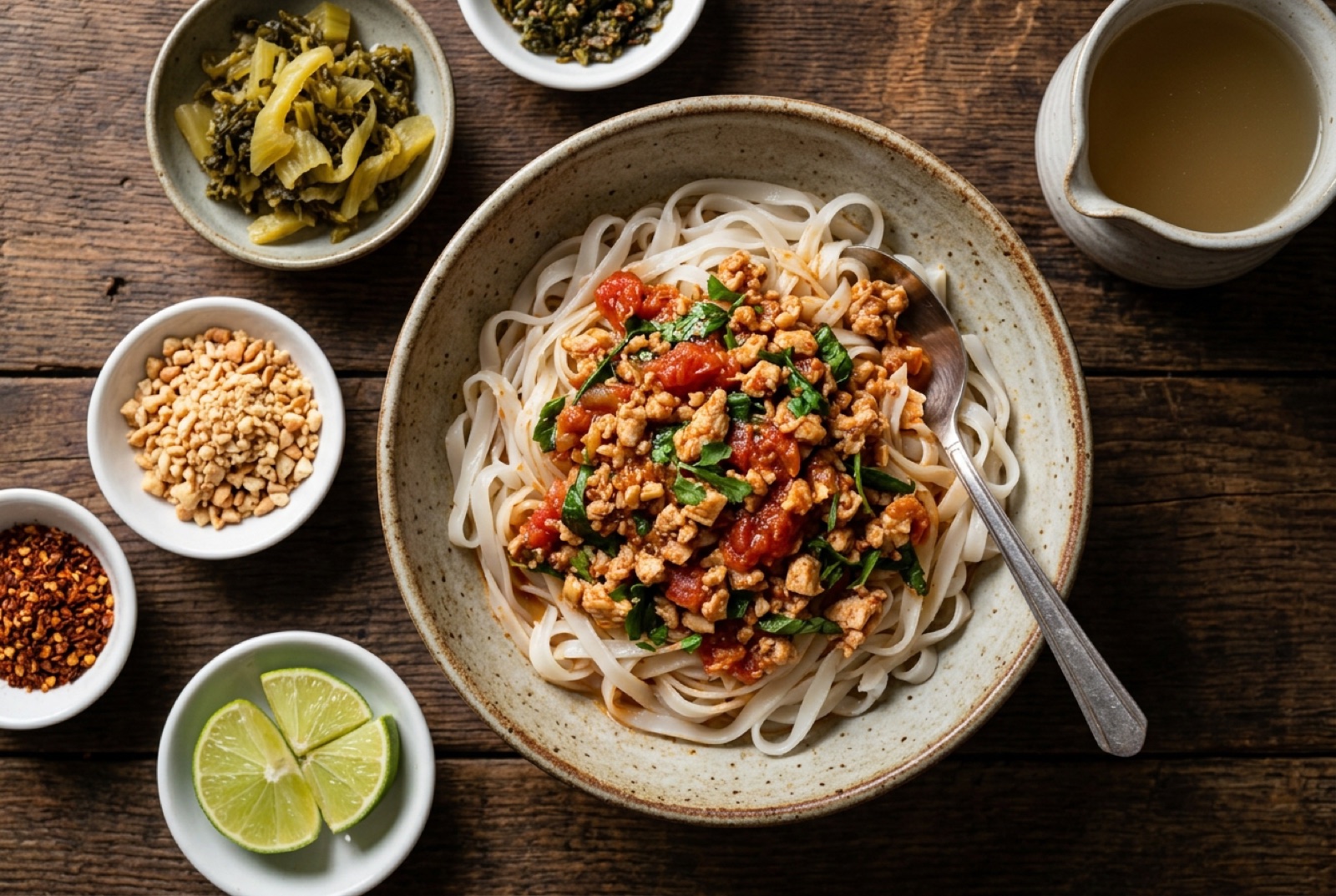
Shan khao swè is the noodle dish of Myanmar's eastern highlands: soft flat rice noodles topped with minced chicken cooked down with tomato, garlic and turmeric until the sauce is glossy and slightly sweet-sour. You order it one of two ways — with a ladle of clear broth poured over so it eats like a soup, or dry, with the sauce tossed straight through the noodles and a small bowl of broth on the side. The flavor is cleaner and more tomato-forward than most Burmese food, with garlic oil doing the heavy lifting and none of the coconut richness of the lowland noodle bowls. What lands it is the side plate: sour pickled mustard greens, crushed peanuts and chile, which turn a simple bowl into something with real contrast.

- Gate
- MyanmarShan State
- Prep
- 20 min
- Cook
- 35 min
- Total time
- 55 min
- Serves
- 4
- Status
- Medium
- Nutrition / serving · estimated
- Calories 610 kcal
- Protein 34 g
- Carbs 66 g
- Fat 24 g
- Fiber 5 g
- Sodium 1150 mg
Why this recipe works.
- Gives both the soupy and the dry service properly, instead of pretending they are the same dish.
- Garlic oil is made separately and used twice, which is the trick that gives shop-made Shan noodles their aroma.
- The chicken is marinated in tomato before cooking, the way Shan cooks do, so the sauce tastes of both from the start.
- Includes a quick pickled mustard green substitute for cooks who cannot find the real jar.
Ingredients.
17 itemsFor the sauce
For the garlic oil
To serve
Equipment
- Wide sauté pan or wok
- Small saucepan for garlic oil
- Colander
Instructions.
Make the garlic oil
Put the sliced garlic and the oil together in a cold small saucepan and set it over medium-low heat. Let it come up slowly and fry for 6–8 minutes, until the slices are pale straw gold, then strain immediately — they keep browning off the heat. Reserve both oil and crisp garlic.
Tip Starting from cold oil is what stops the thin edges of the garlic burning before the centers cook.
Marinate the chicken
Mix the minced chicken with the turmeric, paprika, soy sauce, fish sauce and half the chopped tomato. Leave it for 15 minutes at room temperature — the tomato acid loosens the mince so it breaks into soft crumbles rather than clumps.
Start the sauce
Heat 3 tablespoons of the garlic oil in a wide pan and cook the onion over medium heat for 6 minutes, until soft and translucent with no color. Add the tomato paste and fry for a minute until it darkens to brick red.
Cook the chicken down
Tip in the marinated chicken and break it up with a spatula. Cook for 5 minutes until no pink remains, then add the remaining tomatoes and 150 ml water.
Reduce until the oil separates
Simmer uncovered for 18–20 minutes, stirring occasionally, until the tomatoes collapse completely and a clear rim of red-orange oil pools around the edge of the pan. The sauce should mound softly on a spoon, not run off it.
Tip This oil separation is the doneness marker. Stop before it and the sauce tastes sharp and raw.
Prepare the noodles
Rinse the fresh rice noodles under warm water, separating the strands with your fingers, then blanch for 30 seconds in boiling water and drain well. Divide between four bowls.
Serve soupy or dry
For the soupy version, spoon the sauce over the noodles and ladle hot stock into each bowl until it comes halfway up. For the dry version, toss the noodles with a spoonful of garlic oil and the sauce, and serve the stock in small cups alongside.
Top and finish
Scatter each bowl with the reserved crisp garlic, scallions and cilantro. Bring the pickled mustard greens, crushed peanuts and chile flakes to the table in separate dishes so everyone adds their own sourness, crunch and heat.
Tips from our kitchen.
- Mince the chicken coarsely yourself or ask the butcher to grind it once, not twice — fine mince turns pasty in the sauce.
- Fry the garlic slowly in cold oil brought up to heat, not in already-hot oil; it browns evenly instead of burning at the edges.
- Let the tomato sauce cook until the oil clearly separates and pools red at the sides. That is the doneness signal, not the clock.
- Rinse fresh rice noodles under warm water and separate them with your fingers before they go in the bowl, or they arrive as one block.
- For the dry version, toss the noodles with a spoonful of the garlic oil first so the sauce coats instead of sliding off.
- Serve the pickles cold and the noodles hot. The temperature contrast is part of how the dish reads.
Substitutions.
- Pickled mustard greens → Sauerkraut squeezed dry, or thinly sliced cabbage tossed with rice vinegar, salt and sugar for 20 minutes
- Sauerkraut is closer in sourness; the quick cabbage pickle is milder but gives you the crunch and acid on short notice.
- Minced chicken → Minced pork
- Pork is equally traditional and gives a richer sauce. Reduce the added oil by a tablespoon if you use it.
- Fresh flat rice noodles → Dried flat rice noodles (pad thai width), soaked and boiled briefly
- Dried noodles need a minute less cooking than the packet suggests, since they finish softening in the hot sauce.
Variations.
- Shan khao swè thoke (dry)
- The dry version: sauce tossed through the noodles with garlic oil, no broth in the bowl, and a small cup of clear soup drunk alongside. Common at lunch.
- Fish sauce version
- Around Inle Lake, freshwater fish is cooked into the tomato sauce instead of chicken, giving a softer, flakier topping.
- Served with tofu nway
- Shan shops often pair the noodles with tofu nway, a warm savory chickpea-flour porridge, ladled over the same noodles as a second bowl.
Storage & reheating.
The chicken and tomato sauce keeps 4 days refrigerated and freezes for 2 months — it actually improves overnight as the tomato mellows. Reheat with a splash of water to loosen. Noodles do not store once dressed; cook them fresh each time. Garlic oil keeps 2 weeks in a sealed jar at room temperature and is worth making in double batches.
Serve with
A side dish of cold pickled mustard greens, crushed roasted peanuts, chile flakes and a small bowl of clear chicken broth.
The story behind Shan Khao Swè.
Shan State is Myanmar's largest state, a plateau of cool hills bordering China, Laos and Thailand, and its food is genuinely distinct from the Bamar cooking of the plains — less oil, more sourness, more fermented vegetables, and a preference for tomato where other regions reach for shrimp paste. The Shan are a Tai people, linguistically and culturally close to the Thai and Lao, and their kitchen sits in that overlap: you can taste connections to northern Thai food in the fermented greens and the way heat is kept low and background.
Shan noodles travelled. Migration from the hills to Yangon and Mandalay brought Shan noodle shops to every Burmese city, and today the dish is eaten far more widely than in Shan State alone — it is one of the few regional dishes that became genuinely national. Shops usually serve it alongside its sibling, tofu nway, a warm chickpea-flour porridge poured over the same noodles, and the two are often ordered together.
The details vary by shop and by town. Around Inle Lake the sauce is sometimes made with fish; in other places pork replaces chicken. The noodles may be thin and round or wide and flat, fresh or dried. The one constant is the tray of accompaniments — a dish of pickled mustard greens is not optional and is refilled for free, and a good Shan noodle shop is judged partly on the quality of its pickles. This version keeps the chicken sauce, gives the ratios for both the soupy and dry service, and tells you how to fake the pickles if you cannot find them.
Questions, answered.
What is the difference between the soupy and dry versions?
They use the same noodles and the same sauce. In the soupy version, hot clear broth is ladled into the bowl so you eat it with a spoon; in the dry version the sauce is tossed through the noodles with garlic oil and the broth is served in a separate cup to sip. Shan noodle shops will ask which one you want.
Where do I find pickled mustard greens?
Any Chinese or Southeast Asian grocery sells them in jars or vacuum packs, often labelled as pickled mustard, suan cai or dua cai. Rinse and squeeze them before use if they taste very salty. Sauerkraut is a workable substitute for sourness and crunch.
Why is my sauce watery?
The tomatoes were not cooked down long enough. Keep the pan at a steady simmer and stir until the mixture thickens and a rim of red-tinted oil separates around the edge. That usually takes 15 to 20 minutes with fresh tomatoes, less with canned.
Is Shan food spicy?
Not usually in the pot. Shan cooking keeps heat low and background and puts chile flakes on the table, which is why the same bowl works for a family. Shan State food is generally sourer and lighter than Bamar lowland cooking rather than hotter.
Can I make this vegetarian?
Yes. Crumbled firm tofu or finely chopped mushrooms replace the chicken well, since the sauce carries most of the flavor. Use soy sauce instead of fish sauce and check that your pickled greens do not contain shrimp.
You might also like.
All recipes →
Keep exploring Myanmar.
Myanmar has 9 more dishes in the atlas — Balachaung and Danbauk, and 7 more.
Recipe by The DishRoute Kitchen · published August 20, 2026 · updated August 20, 2026