Danbauk.
Burmese Chicken Biryani with Cashews
ဒံပေါက် · say it: DAHN-bowk
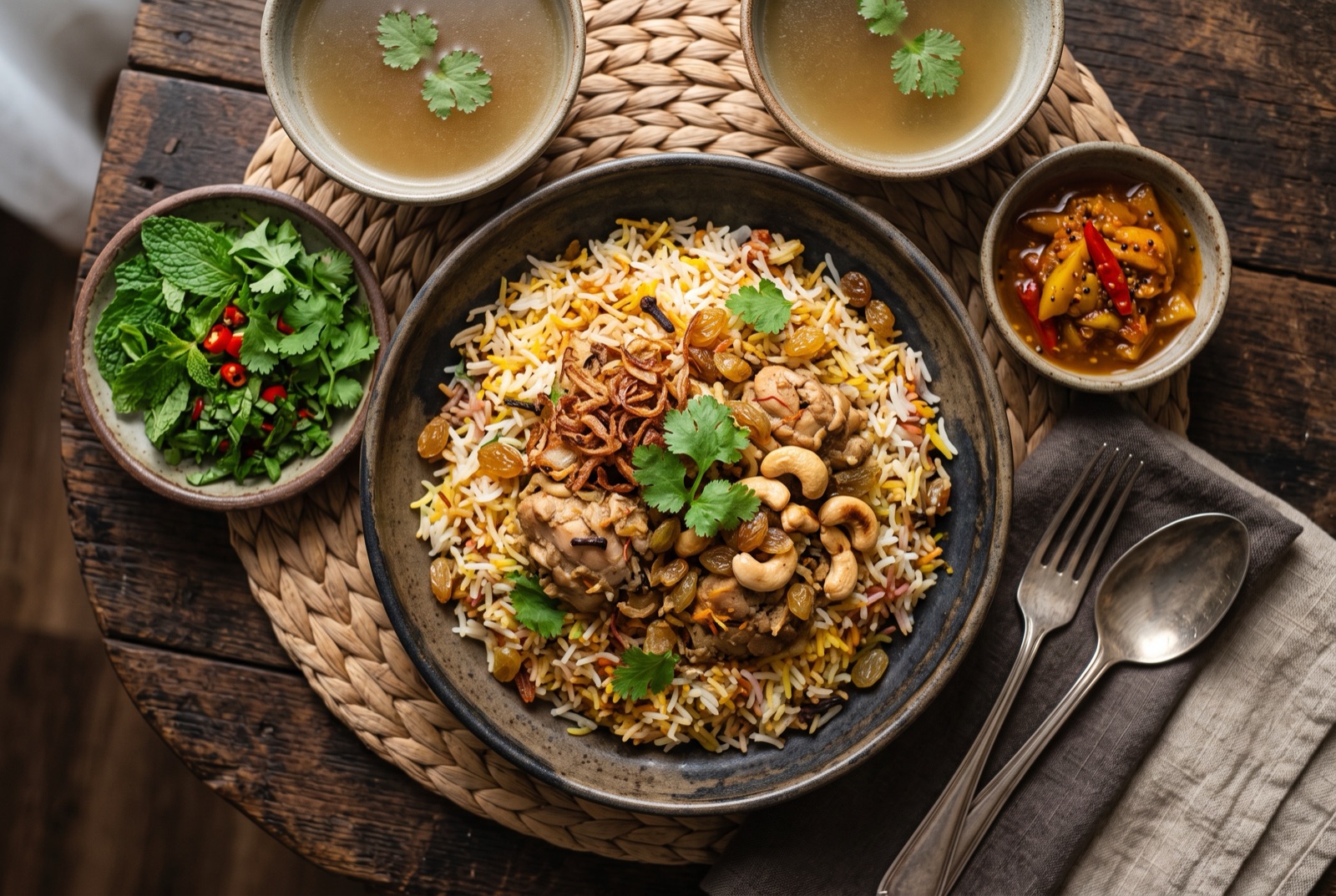
Danbauk is the Burmese take on biryani — rice and chicken cooked together in one pot, but noticeably gentler than its Indian ancestors. The spicing is restrained: cinnamon, cardamom, cloves and bay carry the aroma, turmeric does the coloring, and chile is almost absent. Chicken is marinated in yogurt and browned before it goes in, cashews and raisins are folded through the rice, and ghee gives the grains their gloss. The result is fragrant and mildly sweet-savory rather than fiery, and it always arrives with the same three companions: a heap of fresh mint leaves, a fiercely sour pickled mango or lime relish, and a small bowl of clear broth. Those sides are not garnish — they are what keeps a rich plate of rice moving.

- Gate
- MyanmarYangon
- Prep
- 30 min
- Cook
- 55 min
- Total time
- 2 hr 25 min incl. 1 hr rest
- Serves
- 6
- Status
- Takes skill
- Nutrition / serving · estimated
- Calories 760 kcal
- Protein 44 g
- Carbs 82 g
- Fat 28 g
- Fiber 4 g
- Sugar 9 g
- Sodium 980 mg
Why this recipe works.
- Spiced the Burmese way — aromatic and restrained — instead of borrowing an Indian biryani masala wholesale.
- A workable home method that gets separate grains without needing a sealed dum pot or dough seal.
- The mint, raw onion and sour pickle sides are treated as part of the recipe, because the plate does not work without them.
- Honest about what a home oven cannot replicate from a Yangon danbauk cauldron.
Ingredients.
21 itemsFor the chicken
For the rice
To serve
Equipment
- Heavy pot or Dutch oven with a tight lid
- Fine sieve
- Large bowl for soaking rice
Instructions.
Marinate the chicken
Mix the yogurt with the garlic, ginger, turmeric, garam masala, paprika and 2 teaspoons of salt, then coat the chicken thoroughly. Cover and refrigerate at least 1 hour, ideally overnight.
Soak the rice
Rinse the basmati in several changes of water until the water runs almost clear, then cover with cold water and soak for 30 minutes. Drain thoroughly in a sieve for 10 minutes so no surface water goes into the pot.
Fry the onions and nuts
Melt 3 tablespoons of ghee in a heavy pot and fry the sliced onions over medium heat for 15 minutes, until deep golden brown and shrunk to a fraction of their volume. Lift out half with a slotted spoon for garnish, then toast the cashews and raisins in the same pot for a minute until the nuts turn blond and the raisins puff.
Tip Pull the onions while they are golden, not mahogany. They darken further on the plate and turn bitter if pushed too far.
Brown the chicken
Scrape the nuts and raisins out, raise the heat, and add the marinated chicken in a single layer. Sear for 8–10 minutes, turning once, until the yogurt coating has caught in patches and the surface is browned rather than pale and steamed.
Build the pot
Add the cinnamon, cardamom, cloves, bay leaves and star anise and stir for 30 seconds, until the spices smell warm and fragrant. Spread the drained rice evenly over the chicken without stirring it in, and dot the surface with the remaining ghee.
Steam
Pour the hot stock gently down the side of the pot, taste it for salt, and bring to a boil. Cover tightly, drop to the lowest heat, and cook undisturbed for 20 minutes. Do not lift the lid at any point.
Rest off the heat
Turn the heat off and leave the pot covered for another 10 minutes. The residual steam finishes the top layer of rice and lets the grains firm up so they separate instead of tearing.
Fluff and serve
Uncover, scatter the cashews, raisins and reserved fried onions over the surface, and fluff gently with a fork from the outside in, lifting rather than stirring. Serve with mint leaves, raw onion slices, sour pickle and a bowl of clear broth.
Tips from our kitchen.
- Rinse the basmati until the water runs clear, then soak it 30 minutes. Unsoaked grains break during the layering stage.
- Marinate the chicken in yogurt for at least an hour; the acid and enzymes keep it tender through a long cook that would otherwise dry it out.
- Brown the chicken hard before it goes back in with the rice. Pale chicken makes a pale, flat-tasting danbauk.
- Get the liquid ratio right: about 1.5 parts liquid to 1 part soaked rice by volume, no more, or you end up with pilaf-textured mush.
- Once the lid goes on, do not lift it for 20 minutes. Every peek releases the steam doing the actual cooking.
- Fluff with a fork from the edges inward, never stir with a spoon, or the grains break and the rice turns sticky.
Substitutions.
- Cashews → Blanched almonds or pistachios
- Almonds are firmer and less sweet. Toast whichever you use in ghee first, or they stay soft in the rice.
- Pickled mango → Lime pickle, mango chutney with extra lime juice, or thin slices of raw green mango with salt
- The role is sharp sourness against rich rice. Anything aggressively sour and a little salty fills it.
- Yogurt marinade → Coconut milk with a squeeze of lime
- Makes the dish dairy-free apart from the ghee, which can be swapped for oil. Slightly sweeter result.
Variations.
- Mutton danbauk
- The celebration version, made with bone-in mutton or goat that is braised until tender before the rice goes on. Richer and considered more prestigious than chicken.
- Saffron-tinted danbauk
- Some shops drizzle saffron or turmeric-tinted milk over the top layer before the final steam, producing streaks of orange and white rather than uniform yellow.
- Egg danbauk
- Hard-boiled eggs browned in the spiced oil and buried in the rice — common as an extra rather than a replacement for the chicken.
Storage & reheating.
Refrigerate up to 3 days in a sealed container. Reheat covered with a tablespoon of water per portion, in a low oven or a covered pan over low heat, so the rice re-steams rather than dries out. It freezes acceptably for a month, though the grains soften. Keep the mint and pickle fresh and add them only at serving.
Serve with
A handful of fresh mint leaves, thin raw onion slices, sour pickled mango or lime relish, and a bowl of clear chicken broth to sip.
The story behind Danbauk.
Danbauk arrived in Myanmar with the Indian Muslim communities who settled in Yangon and other cities during the colonial period, when Burma was administered as part of British India and Rangoon was one of the most heavily Indian cities outside the subcontinent. The name descends from the same root as dum pukht, the sealed-pot method where rice and meat finish together in trapped steam. What Burmese kitchens did with it over the following century was to dial the spice down and the aromatics up, producing a biryani that tastes clearly related to Hyderabadi and Persian-influenced versions but is milder, sweeter and less oily on the palate.
In Yangon, danbauk is restaurant food. There are dedicated danbauk shops with cauldrons out front, and they are strongly associated with the city's Muslim community and with celebrations — weddings, Eid, and large family occasions all justify a danbauk. Chicken is by far the most common protein, though mutton danbauk exists and is considered the more festive version. Shops portion it onto plates with a scoop of rice, a piece of chicken, and the standard sides delivered without asking.
The sides deserve their own note. Fresh mint by the handful, thin slices of raw onion, and a sour pickle — usually mango, sometimes lime or a chile-heavy relish — are eaten in the same mouthful as the rice, and the clear soup is sipped throughout. It is a structure the Burmese apply to many rich dishes: something intensely fragrant at the center, something sharp and raw to reset the palate, and something liquid and plain to drink between bites. This version uses a home-scale one-pot method rather than a sealed dum, and it says honestly where that differs from a shop cauldron.
Questions, answered.
How is danbauk different from Indian biryani?
It descends from Indian biryani, brought by Indian Muslim communities during the colonial period, but Burmese kitchens made it milder. Danbauk uses far less chile, leans on whole aromatics like cinnamon, cardamom and cloves, and often includes cashews and raisins for sweetness. It is also always served with mint, raw onion and a sour pickle, which is a Burmese habit rather than an Indian one.
Why did my rice come out mushy?
Almost always too much liquid, or stirring after the rice went in. Soaked basmati needs roughly 1.5 times its volume in liquid, not the 2:1 used for unsoaked rice, and once it is in the pot it should only ever be fluffed with a fork, never stirred.
Do I need a special pot?
No. Any heavy pot with a tight lid works. Shops use large cauldrons and some cooks seal the lid with dough for a true dum, but a heavy Dutch oven with a towel under the lid traps enough steam at home. The difference is subtle rather than decisive.
Can I make it ahead for a party?
Yes. Cook it a few hours ahead, leave it covered off the heat, and reheat in a low oven with a splash of water. Danbauk holds better than most rice dishes because the fat in it protects the grains. Prepare the mint, onion and pickle at the last minute.
Is danbauk spicy hot?
No. It is fragrant rather than hot, and most versions contain little or no chile. If you want heat, serve a chile relish on the side, which is how Burmese shops handle it — the pot stays mild so everyone at the table can eat it.
You might also like.
All recipes →
Keep exploring Myanmar.
Myanmar has 9 more dishes in the atlas — Balachaung and Lahpet Thoke, and 7 more.
All Myanmar recipes Chicken recipes Basmati rice recipes Yogurt recipes mainhalal friendlygluten freeRecipe by The DishRoute Kitchen · published August 20, 2026 · updated August 20, 2026