Nan Gyi Thoke.
Burmese Thick Rice Noodle Salad
နန်းကြီးသုပ် · say it: nahn-JEE toke
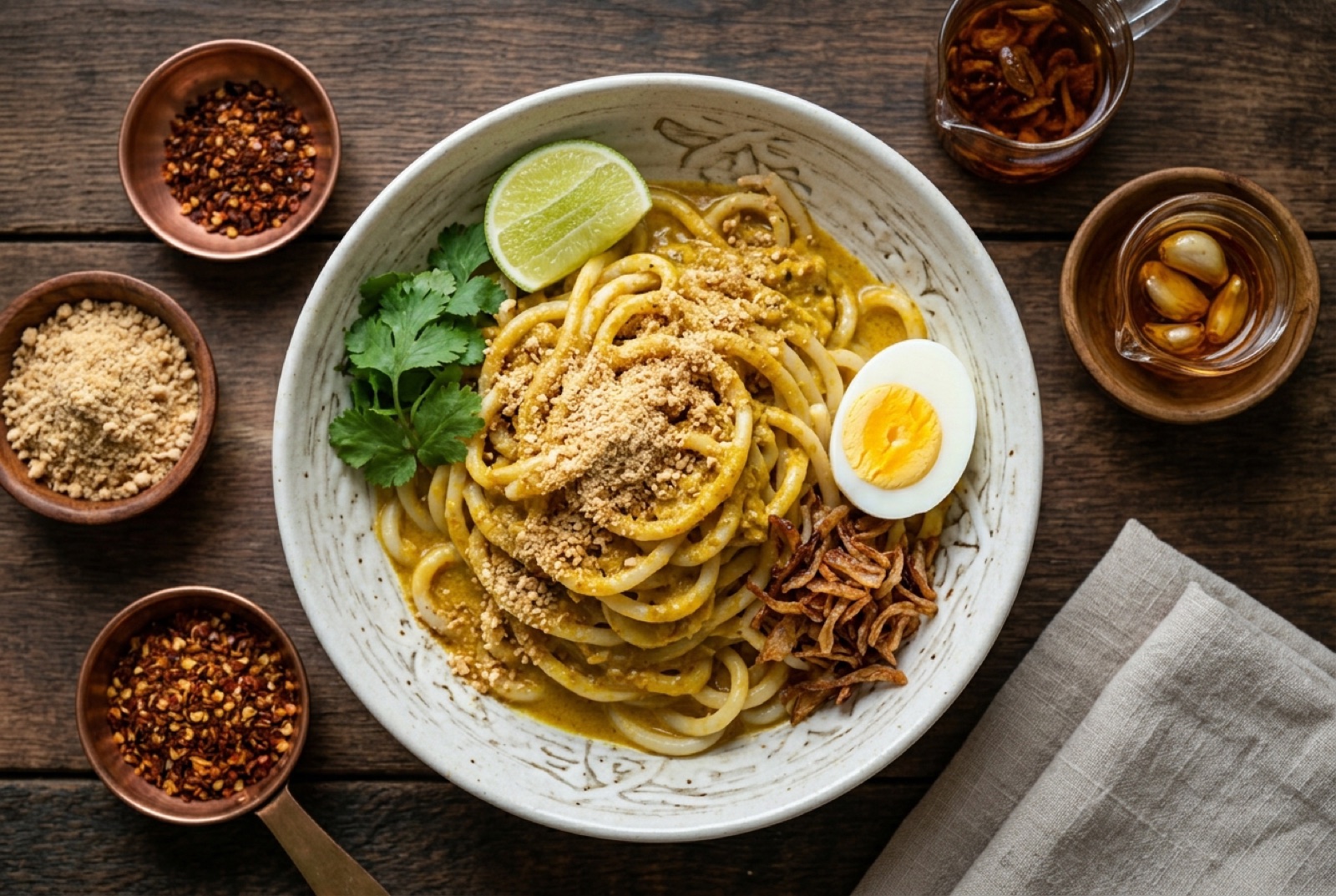
Nan gyi thoke takes noodles as thick as a pencil, cuts them into short lengths, and tosses them by hand with a thick coconut-chicken curry, toasted chickpea flour, fried onion oil, chile and lime until every piece is coated. Nothing about it is cold or leafy despite the word salad — thoke simply means something mixed by hand, and Burmese cooking treats hand-mixing as its own category of dish. The result is chewy, dense and heavily savory, with the chickpea powder soaking up the curry and turning it into a clinging dressing rather than a sauce. It is the standard Mandalay breakfast and lunch, sold everywhere from tea shops to schoolyard stalls, and it eats like a meal that has already decided it is not sharing a plate with anything else.

- Gate
- MyanmarMandalay
- Prep
- 25 min
- Cook
- 45 min
- Total time
- 1 hr 10 min
- Serves
- 4
- Status
- Medium
- Nutrition / serving · estimated
- Calories 720 kcal
- Protein 40 g
- Carbs 74 g
- Fat 30 g
- Fiber 6 g
- Sodium 1100 mg
Why this recipe works.
- Built on a real Burmese chicken curry rather than a thin sauce, which is what makes the dressing cling.
- Explains the toasted chickpea powder step properly — it is the difference between a coated noodle and a wet one.
- Designed as a leftover-friendly dish: make the curry once, eat it twice, exactly as households do.
- Includes the side broth, which is part of how the dish is actually eaten in Mandalay.
Ingredients.
17 itemsFor the curry
For the salad
To serve
Equipment
- Heavy pot for the curry
- Wide mixing bowl
- Dry skillet for toasting flour
Instructions.
Make the curry paste
Blend the onions, garlic and ginger to a coarse paste with a splash of water. Heat the oil in a heavy pot and fry the paste over medium heat for 12 minutes, stirring often, until it dries out, turns golden and the oil begins to pull away at the edges.
Bloom the spices
Add the turmeric and paprika and stir for a minute, until the paste stains a deep orange and smells toasted rather than raw. Add the chicken and turn it thoroughly in the paste until every piece is coated and opaque.
Braise until the oil rises
Pour in 200 ml water, cover, and simmer for 20 minutes. Uncover, add the coconut milk and fish sauce, and cook another 10–12 minutes at a gentle bubble until the sauce is thick enough to mound on a spoon and a slick of orange oil floats on top.
Tip The floating oil is the classic Burmese sign that a curry is finished. Do not stir it back in — it becomes part of the dressing.
Shred and reduce
Break the chicken pieces apart with the edge of a spoon so they shred into the sauce, then reduce a few minutes more if it looks at all soupy. The curry must cling, not pour.
Toast the chickpea flour
While the curry cooks, stir the chickpea flour in a dry pan over medium heat for 4–5 minutes, until it darkens a shade and smells like roasted nuts. Tip it out onto a plate straight away so it stops cooking.
Cook and cut the noodles
Boil the thick rice noodles until springy but still firm at the center, drain, and rinse briefly under warm water. Toss with a spoonful of oil and cut into 5–7 cm lengths with scissors.
Mix by hand
Put the warm noodles in a wide bowl. Add the curry, most of the toasted chickpea flour, the lime juice, sliced onion and chile flakes, and mix hard with your hands for a full minute, until no dry powder is visible and every noodle carries an orange coating.
Tip Taste as you go. It should be savory, faintly sweet from the coconut, and sharp with lime.
Serve
Divide between bowls, scatter with cilantro, the last of the chickpea flour and the egg slices if using, and serve with lime wedges, extra chile and a small bowl of hot broth on the side.
Tips from our kitchen.
- Toast the chickpea flour in a dry pan until it turns a shade darker and smells nutty. Raw chickpea flour tastes chalky and will ruin the dressing.
- Cut the noodles into 5–7 cm lengths before mixing. Long strands cannot be tossed by hand and end up unevenly dressed.
- Dress the noodles warm, not hot and not cold — warm noodles absorb the curry, cold ones repel it and hot ones go mushy.
- The curry should be thick enough to sit on a spoon. If it is soupy, reduce it further before it meets the noodles.
- Add the lime last and taste immediately; the chickpea powder keeps absorbing liquid, so a dish that seems balanced dry will need more acid in five minutes.
- Use your hands to mix if you can. A spoon leaves clumps of powder and pockets of undressed noodle.
Substitutions.
- Thick round rice noodles (nan gyi) → Fresh udon noodles, or thick rice noodles from a Vietnamese grocer
- Udon has the right chew and thickness even though it is wheat. Avoid thin vermicelli, which collapses under the dressing.
- Toasted chickpea powder → Toasted rice flour, or finely ground roasted peanuts
- Rice flour gives similar body with less flavor; ground peanuts add richness and are used in some shops anyway.
- Fried onion oil → Shop-bought fried shallots plus their oil, or plain oil warmed with a sliced shallot
- The aroma of alliums fried in oil is a Burmese signature; plain neutral oil works but the dish loses a layer.
Variations.
- Nan gyi thoke with egg
- A sliced hard-boiled or duck egg laid on top, which is standard at most Mandalay stalls and makes the bowl considerably more filling.
- Fish version
- Some shops dress the noodles with a fish curry instead of chicken, giving a sharper, more savory result.
- Vegetarian thoke
- Chickpeas or fried tofu replace the chicken and a coconut-tomato base replaces the curry, with soy sauce standing in for fish sauce.
Storage & reheating.
Keep the curry and the noodles separate. The curry holds 4 days refrigerated and freezes for 2 months, improving on day two. Dressed noodles do not keep at all — the chickpea powder keeps absorbing and the dish turns stodgy within a couple of hours, so mix only what you will eat immediately. Toasted chickpea powder stores a month in a sealed jar.
Serve with
A small bowl of hot clear chicken broth to sip between mouthfuls, plus extra lime and chile flakes on the table.
The story behind Nan Gyi Thoke.
Thoke is a whole family of Burmese dishes rather than a single recipe: tea leaves, green mango, ginger, tofu, noodles and rice can all be turned into thoke, and the technique is always the same — ingredients laid out separately, then mixed hard by hand in a wide bowl so that the fat, acid and dry powder distribute into every crevice. Burmese cooks are specific that fingers do this better than tongs, and street vendors mix in front of you with one hand while holding the bowl with the other.
Nan gyi thoke belongs to Mandalay in particular, the old royal capital in upper Myanmar, and it is the dish most associated with the city's breakfast culture. The thick noodles are the point: nan gyi are round and dense, closer to a Japanese udon in bite than to the thin vermicelli used in mohinga, and they need a heavy dressing to stand up to them. Traditionally they are sold fresh, cut into short lengths in the shop, and cooks judge quality by whether the noodle holds a springy chew rather than going soft.
The curry that dresses them is a proper Burmese chicken curry, cooked until the oil separates and then thinned with coconut milk, so nan gyi thoke is really two dishes stacked — many households make the curry for dinner and turn the leftovers into thoke the next morning. The finishing elements are non-negotiable at a stall: toasted chickpea powder for body, fried onion or shallot oil for aroma, chile flakes, a hard squeeze of lime, and a bowl of thin clear broth on the side to drink between mouthfuls, because the noodles are rich enough to need it.
Questions, answered.
Why is it called a salad if it is served warm?
The Burmese word thoke means a dish mixed by hand, not a cold leafy dish. Burmese cuisine has a whole family of thoke — tea leaf, ginger, green mango, tofu, noodle — and they are served at room temperature or warm. Salad is just the nearest English word, not a description of temperature.
My noodles clumped together. What went wrong?
Thick rice noodles stick as they cool. Rinse them briefly after cooking, toss them with a spoonful of oil right away, and mix them while still warm. If they have already set into a block, dip them in hot water for 20 seconds to loosen before dressing.
Can I use leftover curry from another meal?
Yes, and that is how many Burmese households make it. Any thick chicken curry with a coconut or oil-separated base works, as long as you reduce it so it clings rather than pools. This is the practical origin of the dish.
What does the chickpea powder actually do?
It absorbs the loose curry liquid and turns it into a coating that sticks to each noodle, while adding a toasted, nutty flavor. Without it the curry slides to the bottom of the bowl and the dish reads as noodles in sauce rather than as thoke.
Is nan gyi thoke spicy?
Only as spicy as you make it. The curry base is mild, dominated by onion, turmeric and coconut, and heat comes from chile flakes added during mixing or at the table. Most versions sold in Mandalay are moderately mild by regional standards.
You might also like.
All recipes →
Keep exploring Myanmar.
Myanmar has 9 more dishes in the atlas — Balachaung and Danbauk, and 7 more.
All Myanmar recipes Chicken recipes Rice noodles recipes Coconut milk recipes maindairy freegluten freeRecipe by The DishRoute Kitchen · published August 20, 2026 · updated August 20, 2026