Faloodeh.
Shirazi Frozen Rose and Noodle Sorbet
فالوده · Faloodeh · say it: faa-loo-DEH
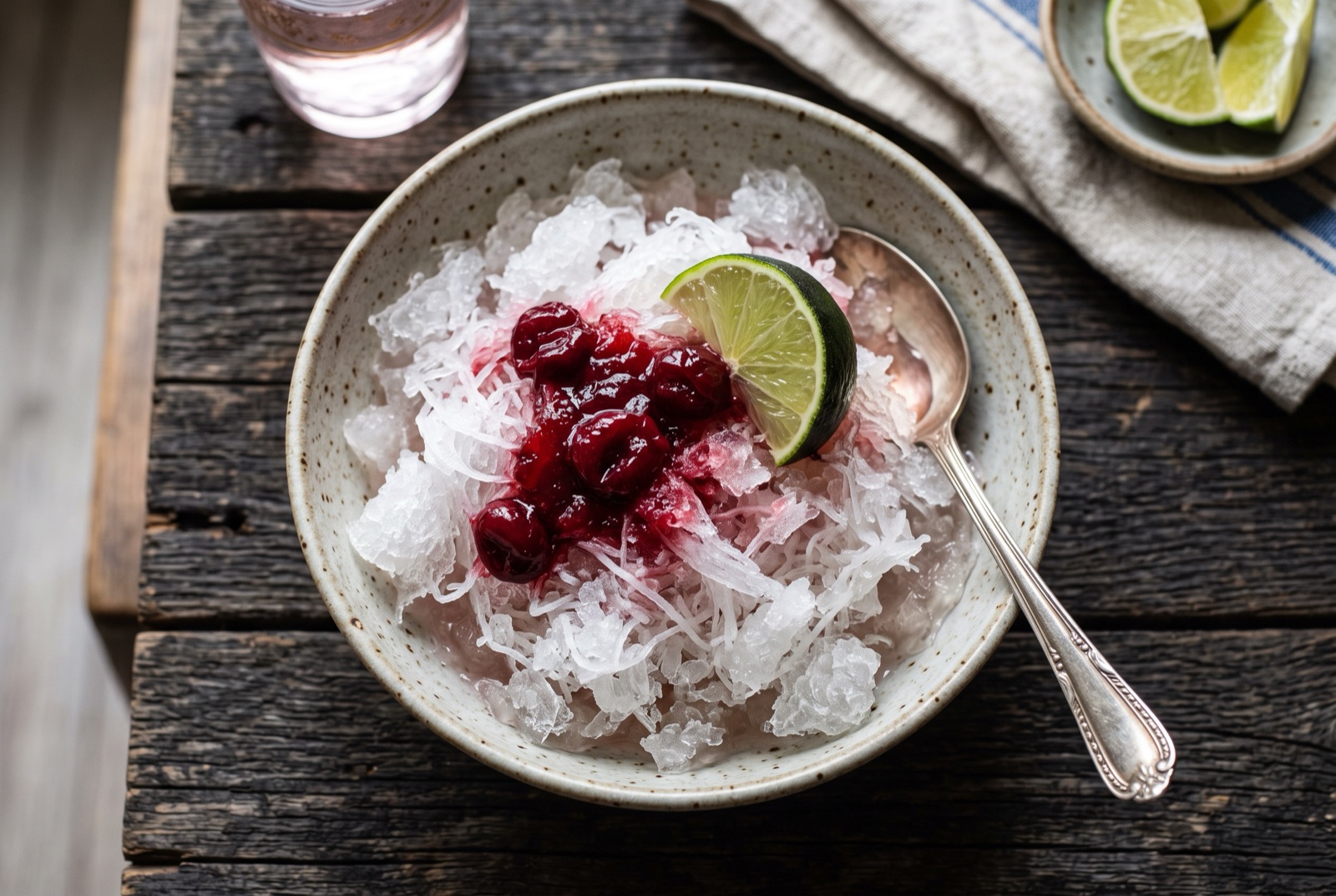
Faloodeh is a sorbet with texture in it. Short white noodles made from cooked starch are frozen into a lightly sweetened rosewater syrup, and the mixture is scraped repeatedly as it sets so it stays loose and granular rather than freezing into a block. Eating it is unlike any Western frozen dessert: the ice is coarse and melts fast, the rose comes through as perfume rather than sweetness, and the noodles stay slightly chewy and cold between your teeth. It is barely sweet on its own, which is why it is almost always served under lime juice or thick sour cherry syrup — the acid is not a garnish but the balancing half of the dish. Shiraz is where you go for it, and it is eaten in the heat of the afternoon.

- Gate
- IranShiraz, Fars province
- Prep
- 30 min
- Cook
- 20 min
- Total time
- 5 hr 50 min incl. 5 hr rest
- Serves
- 6
- Status
- Easy
- Nutrition / serving · estimated
- Calories 250 kcal
- Protein 1 g
- Carbs 61 g
- Fat 1 g
- Fiber 0 g
- Sugar 46 g
- Sodium 25 mg
Why this recipe works.
- Cooks the starch paste to the right stage and tells you what translucent actually looks like in the pan.
- Gives three practical ways to form the noodles without owning a Persian faloodeh press.
- Uses a scrape-and-freeze method that produces the correct granular ice without an ice cream machine.
- Keeps the syrup deliberately under-sweet, because the lime and sour cherry on top are part of the recipe.
Ingredients.
10 itemsFor the noodles
For the syrup
To serve
Equipment
- Heavy saucepan
- Colander with small holes, potato ricer or piping bag
- Large bowl of iced water
- Shallow freezer-safe container
- Fork for raking
Instructions.
Make the syrup and cool it
Dissolve the sugar in the water over medium heat, bring to a boil and let it bubble for 3 minutes, then take it off the heat and cool completely. Only once it is cold, stir in the rosewater and the tablespoon of lime juice.
Tip Rosewater added to a hot syrup loses most of its perfume within a minute.
Set up the ice bath
Fill a large bowl with cold water and a full tray of ice cubes, and set a colander with small holes, a potato ricer or a piping bag fitted with a fine nozzle beside it. Everything must be within arm's reach before the starch goes on the heat.
Cook the starch to a gel
Whisk the cornstarch, cold water and salt in a saucepan until completely smooth, then cook over medium heat, stirring constantly. It will thicken suddenly and go from milky white to a translucent grey paste that pulls away from the sides in one mass — about 5 minutes.
Tip Do not stop stirring. Starch catches on the bottom in seconds and burnt specks show up as grey threads.
Press out the noodles
While the paste is still hot, push it in batches through the colander, ricer or piping bag straight down into the iced water. The threads will firm up on contact and drop to the bottom as short white noodles. Leave them in the ice water for 10 minutes.
Combine and start freezing
Drain the noodles well and stir them into the cold rosewater syrup in a shallow freezer container. Spread the mixture out so it is no more than 4 cm deep, which lets it freeze evenly instead of setting solid at the edges first.
Rake as it sets
Freeze for about 5 hours, dragging a fork through the mixture every 30 minutes for the first 3 hours to break up the crystals. Finished faloodeh should be scoopable and grainy, like fine shaved ice with noodles suspended through it.
Serve with acid on top
Scoop into chilled glasses, squeeze a lime wedge generously over each one and pour a tablespoon of sour cherry syrup on top. Scatter with pistachios if using and eat straight away, before the ice slackens.
Tips from our kitchen.
- Have a bowl of water with plenty of ice in it ready before you start cooking the starch. The paste has to hit genuinely cold water or the threads fuse.
- Cook the starch until it turns from milky white to translucent grey and pulls away from the sides in one mass. Stopping while it is still opaque gives noodles that dissolve in the syrup.
- Press the paste through while it is hot. Once it cools it becomes stiff and rubbery and will not extrude at all.
- Add the rosewater only after the syrup has cooled completely. Its aroma is volatile and boiling it away leaves you with sugar water.
- Scrape the freezing mixture with a fork every 30 minutes for the first three hours. Skip this and you get a solid slab instead of the loose crystals the dish is built on.
- Serve it in chilled glasses or metal bowls. Faloodeh melts noticeably faster than dairy ice cream and turns to sweet soup in a warm bowl within minutes.
Substitutions.
- Cornstarch for the noodles → Wheat starch, or rice vermicelli soaked and cut into 3 cm lengths
- Wheat starch is closer to the original and gives clearer threads. Rice vermicelli is the common shortcut abroad and is genuinely acceptable, though softer and less springy.
- Rosewater → Orange blossom water, or half rosewater and half lime zest
- Orange blossom pushes the dessert towards a Levantine flavour rather than a Persian one. It is good, but it is no longer faloodeh in any strict sense.
- Sour cherry syrup → Extra lime juice, or pomegranate molasses thinned with water
- The point is sharp acidity against the rose. Anything sweet-sour and dark works; a fruit syrup without acidity makes the whole bowl cloying.
Variations.
- Faloodeh ba bastani
- A scoop of saffron and pistachio bastani served in the same bowl. The classic Shirazi counter order, and the contrast between dense cream and loose ice is the reason it exists.
- Faloodeh with sour cherry
- Drowned in albaloo syrup and topped with a few preserved sour cherries, which stains the white noodles pink and takes the sweetness up considerably.
- Faloodeh Kermani
- A different dish sharing the name, from Kerman: a thick cooked starch cream served warm or cold with rosewater and sugar rather than frozen. Not interchangeable with the Shirazi version.
Storage & reheating.
Faloodeh keeps a week in a sealed container in the freezer but hardens into a block after the first day, so break it up with a fork and let it stand for five minutes before serving. It does not survive a thaw and refreeze — the noodles go slimy and the ice crystals turn coarse and gritty. The noodles alone can be made a day ahead and held in cold water in the fridge, drained just before they go into the syrup. The syrup keeps two weeks refrigerated, though the rose aroma fades after about four days.
Serve with
Lime wedges and a jug of sour cherry syrup on the table, so everyone dresses their own bowl.
The story behind Faloodeh.
Faloodeh belongs to a Persian tradition of iced sweets made possible by yakhchal, the domed mud-brick ice houses that stored winter ice through the summer in a desert climate. Frozen desserts appear in Persian sources far earlier than in most of Europe, and faloodeh is regularly described as one of the oldest of them, which is plausible given the infrastructure but hard to pin to a date — the sensible thing to say is that it is very old and that Iran had the ice for it long before anyone else in the region.
Shiraz owns the dish in the way that specific Iranian cities own specific sweets, and faloodeh-ye Shirazi is the version that gets exported to the rest of the country. Shops there sell it by weight from steel tubs, and the standard order is with a wedge of lime crushed over the top or with a slug of sour cherry syrup, sometimes both. The other classic pairing is bastani — the saffron, rosewater and pistachio ice cream sold from the same counters — served side by side in one bowl as faloodeh ba bastani, where the dense creamy ice cream plays against the loose icy noodles.
The noodles themselves are the whole technical problem. Traditionally a starch paste is cooked to a thick translucent gel and then pushed through a perforated plate directly into iced water, where it sets instantly into short white threads. Home cooks in Iran often own the specific sieve for it; everyone else improvises with a colander, a potato ricer or a piping bag. Wheat starch was the original choice and cornstarch is now common, and the difference is mainly one of translucency. What is not negotiable is the ice water underneath the sieve — drop the paste into anything warmer and it slumps into a single blob rather than separating into strands.
Questions, answered.
What are faloodeh noodles made of?
Cooked starch, not flour or egg. A paste of cornstarch or wheat starch and water is heated until it gels and turns translucent, then forced through small holes into ice water where it sets into short white threads. The result is chewy and neutral in flavour, which is why the syrup does all the work.
Why did my noodles dissolve in the syrup?
The starch paste was undercooked. If it is still opaque and soft when it goes into the ice water, the threads never fully set and they break down once they sit in liquid. Cook the paste until it is uniformly translucent and thick enough to hold a shape on the spoon before pressing it through.
Do I need an ice cream machine?
No, and a churning machine is actually wrong for this. Faloodeh should have distinct coarse ice crystals rather than the smooth texture a churn produces, so the traditional approach of freezing in a tray and raking it with a fork every half hour gives the better result and needs no equipment.
Is faloodeh very sweet?
Less sweet than most frozen desserts, deliberately. The syrup is light, the noodles are neutral, and the lime juice or sour cherry added at the table is what balances it. If you taste the base syrup and find it pleasantly sweet on its own, it is probably too sweet for the finished bowl.
Is faloodeh vegan and gluten-free?
Made with cornstarch it is both — there is no dairy, egg or wheat anywhere in it, which is unusual for a frozen dessert. If you use wheat starch instead it is still dairy-free but no longer gluten-free. Adding pistachios on top obviously makes it unsuitable for nut allergies.
You might also like.
All recipes →
Keep exploring Iran.
Iran has 9 more dishes in the atlas — Ash-e Reshteh and Fesenjan, and 7 more.
All Iran recipes Cornstarch recipes Lime recipes Sour cherry recipes dessertveganvegetariangluten freedairy freeRecipe by The DishRoute Kitchen · published August 20, 2026 · updated August 20, 2026