Mtewem.
Algerian Garlic Meatball and Lamb Stew
مثوم · Mtewem · say it: m-TAW-em
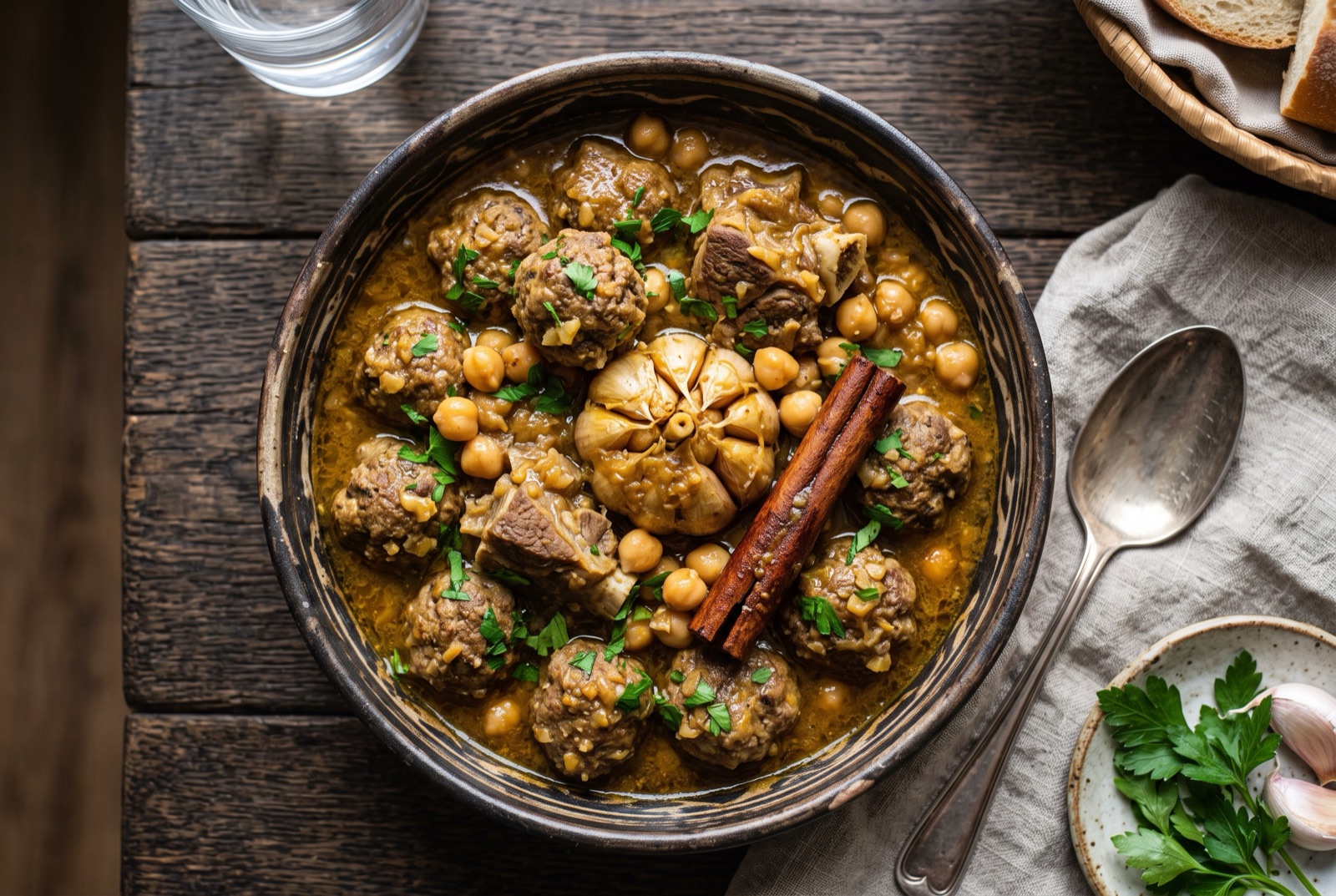
Mtewem is a garlic dish that happens to contain meat. The name comes from toum, the Arabic word for garlic, and the recipe uses it at a volume that reads as a typo until you taste the result — half worked raw into tiny meatballs, half simmered into the sauce until it loses all its aggression and turns sweet and almost creamy. Around that sit pieces of lamb, chickpeas, cinnamon and a lot of black pepper. Long cooking is what makes it civilised: nothing about the finished stew is harsh, and the garlic ends up as a warm, rounded background rather than a punch. Bread is mandatory.

- Gate
- AlgeriaAlgiers
- Prep
- 30 min
- Cook
- 1 hr 15 min
- Total time
- 1 hr 45 min
- Serves
- 4
- Status
- Medium
- Nutrition / serving · estimated
- Calories 610 kcal
- Protein 42 g
- Carbs 32 g
- Fat 34 g
- Fiber 9 g
- Sodium 700 mg
Why this recipe works.
- Garlic used two ways in one pot — raw in the meatballs, long-simmered in the sauce — which is the whole architecture of the dish.
- Meatballs briefly fried for a light crust, so they hold their shape through an hour in the sauce.
- Lamb and chickpeas simmered together long enough for the chickpeas to thicken the liquid naturally, with no flour needed.
- Written as the white version with a clear route to the red one, since Algerian families are split between them.
Ingredients.
17 itemsFor the meatballs
For the stew
Equipment
- Heavy casserole or Dutch oven
- Mortar and pestle or fine grater
- Frying pan
Instructions.
Mix and roll the meatballs
Work the minced meat together with the garlic paste, parsley, breadcrumbs, egg, ground cinnamon, salt and pepper until the mixture is uniform and slightly sticky. Roll into balls about 2 cm across with damp hands — you should get around thirty — and chill them for 15 minutes.
Build the pale base
Melt the butter in a heavy casserole over low heat, add the grated onion with a pinch of salt, cover and cook for 10 minutes until soft and translucent with no browning. Add the lamb, whole garlic cloves, cinnamon stick and black pepper and stir until the meat turns from red to grey-pink on the outside.
Simmer the lamb and chickpeas
Add the drained soaked chickpeas and pour in 1.2 litres of water. Bring to the boil, skim, then reduce to a slow simmer and cook covered for 50 minutes, until the chickpeas are creamy in the centre and the garlic cloves collapse when pressed against the side of the pot.
Fry the meatballs
While the stew simmers, heat the olive oil in a frying pan and roll the chilled meatballs around over medium heat for about 90 seconds, until they are lightly gold on all sides and hold their shape firmly. They should still be raw in the middle.
Tip Do them in two batches. A crowded pan steams them grey instead of colouring them.
Finish together
Slide the meatballs into the stew and simmer uncovered for 20 minutes. The sauce should reduce until it just coats the meat, turn a soft ivory, and taste sweetly of garlic with no raw edge left. Crush a few chickpeas against the pot if you want it thicker.
Rest and serve
Fish out the cinnamon stick, taste for salt and let the pot sit off the heat for 5 minutes so the sauce settles around the meatballs. Serve straight from the casserole with bread torn at the table.
Tips from our kitchen.
- Pound or grate the garlic for the meatballs to a paste rather than chopping it. Visible pieces stay sharp and give unpleasant hot spots.
- Roll the boulettes small — 2 cm across, about the size of a large marble. They are meant to be eaten several at a time.
- Fry them only until a pale gold crust forms, roughly a minute of rolling around the pan. They finish cooking in the sauce, and over-frying makes them dry.
- Do not rush the sauce garlic. Whole or halved cloves need a full hour of gentle simmering to go soft, sweet and spreadable.
- A stick of cinnamon rather than ground keeps the flavour clean. Ground cinnamon clouds the sauce and can turn dusty over a long cook.
- If the sauce has not thickened by the end, crush a few chickpeas against the side of the pot with a spoon. They will do the job in five minutes.
Substitutions.
- Lamb shoulder → Beef chuck, or chicken thighs
- Beef needs an extra 30 minutes before the meatballs go in. Chicken thighs cut the total simmer to about 35 minutes and make a lighter pot that suits summer better.
- Dried chickpeas → Two 400 g tins, drained
- Add tinned chickpeas for only the last 20 minutes, otherwise they disintegrate. Dried ones soaked overnight give a better sauce because they release starch as they cook.
- Fresh garlic → There is no substitute here
- Powdered or jarred garlic will not survive an hour of simmering and does not soften the way whole cloves do. If you do not want a garlic-forward dish, cook a different recipe rather than reducing the quantity below one head.
Variations.
- Mtewem hamra
- The red version: two tablespoons of tomato paste fried in the fat before the liquid goes in, plus a teaspoon of paprika. Heartier and more rustic, and the more common version outside the capital.
- Mtewem with egg and lemon
- Finished like tadjine zitoun, with two yolks whisked into lemon juice and stirred in off the heat. Gives the white sauce a glossy body and a bright edge.
- Mtewem with dried meat
- Made with a piece of preserved lamb alongside the fresh, an older habit from before refrigeration. Very savoury, very salty, and best made without adding any salt until the end.
Storage & reheating.
Refrigerates well for four days and the garlic mellows further each day, so the second-day pot is arguably the better one. Reheat covered over low heat with a splash of water, since the chickpeas keep absorbing liquid. It freezes for three months without any loss — this is one of the few dishes here that comes out of the freezer indistinguishable from fresh, provided you did not finish it with egg.
Serve with
Khobz dar or any soft semolina bread, and a bowl of lben or plain yogurt to drink alongside.
The story behind Mtewem.
Mtewem is Algiers home cooking, the sort of dish that rarely makes it onto restaurant menus because it is understood as something a family cooks for itself. It is built the way a lot of the capital's food is built — a modest quantity of meat stretched with chickpeas and turned into something substantial by technique rather than expense. The two-part structure, small hand-rolled boulettes alongside larger pieces of stewing meat in the same pot, recurs across the cuisine algéroise and gives every serving both textures.
Like most Algerian stews it exists in a white and a red version, and households are usually loyal to one. The white mtewem keeps the onion pale and relies on garlic, cinnamon and pepper alone, sometimes finished with beaten egg and lemon. The red version adds fried tomato paste and paprika and produces a heartier, more rustic pot. Neither is more authentic; the split follows family and region more than any rule, and cooks will tell you their mother's version with complete confidence and no interest in yours.
What is not negotiable is the garlic quantity. Two heads for four people sounds alarming to anyone who has only met garlic raw, but the transformation it undergoes over an hour of simmering is the entire point of the dish — the sulphurous bite cooks off, the sugars come forward, and what remains gives the sauce a body and depth that no amount of stock would provide. The portion pounded into the meatballs behaves differently, staying sharper and more direct because it is protected inside the meat, which is why the dish tastes of garlic in two distinct registers at once. Serve it in the middle of the table with a lot of bread and expect the pot to be scraped.
Questions, answered.
Is two heads of garlic really correct?
Yes, for four servings. Roughly half goes into the meatballs as paste and half into the sauce as whole or halved cloves. An hour of simmering removes almost all of the pungency and leaves sweetness and body, so the finished dish tastes deeply savoury rather than sharp. If it is your first time, one and a half heads is a reasonable compromise.
Why did my meatballs fall apart in the sauce?
Usually the mixture was too wet or was not bound. Squeeze the grated onion dry before adding it, include the egg and breadcrumbs, and chill the rolled balls for fifteen minutes before frying. The brief fry also matters — it sets a skin that holds everything together during the simmer.
What is the difference between white and red mtewem?
White mtewem keeps the onion uncoloured and seasons only with garlic, cinnamon and black pepper, sometimes finished with egg and lemon. Red mtewem adds fried tomato paste and paprika, producing a darker, more robust stew. Both are traditional, and which one a household makes tends to follow family habit rather than any regional rule.
Can I cook this in a pressure cooker?
Yes, and many Algerian cooks do. Give the lamb and sauce garlic 20 minutes under pressure, release, then add the fried meatballs and chickpeas and finish uncovered for 15 minutes so the sauce reduces. Do not pressure-cook the meatballs; they turn spongy.
What do I serve with mtewem?
Bread, and not much else. The sauce is the reason the dish exists and a soft semolina loaf is the correct tool for it. Some households serve it over plain couscous or with a simple green salad on the side, but rice and potatoes both fight with the chickpeas.
You might also like.
All recipes →
Keep exploring Algeria.
Algeria has 9 more dishes in the atlas — Algerian Chorba Frik and Bourek, and 7 more.
All Algeria recipes Garlic recipes Lamb recipes Ground beef recipes maindairy freehalal friendlynut freeRecipe by The DishRoute Kitchen · published August 20, 2026 · updated August 20, 2026