Nkate Cake.
Ghanaian Peanut Brittle
Nkate cake · say it: n-KAH-teh cake
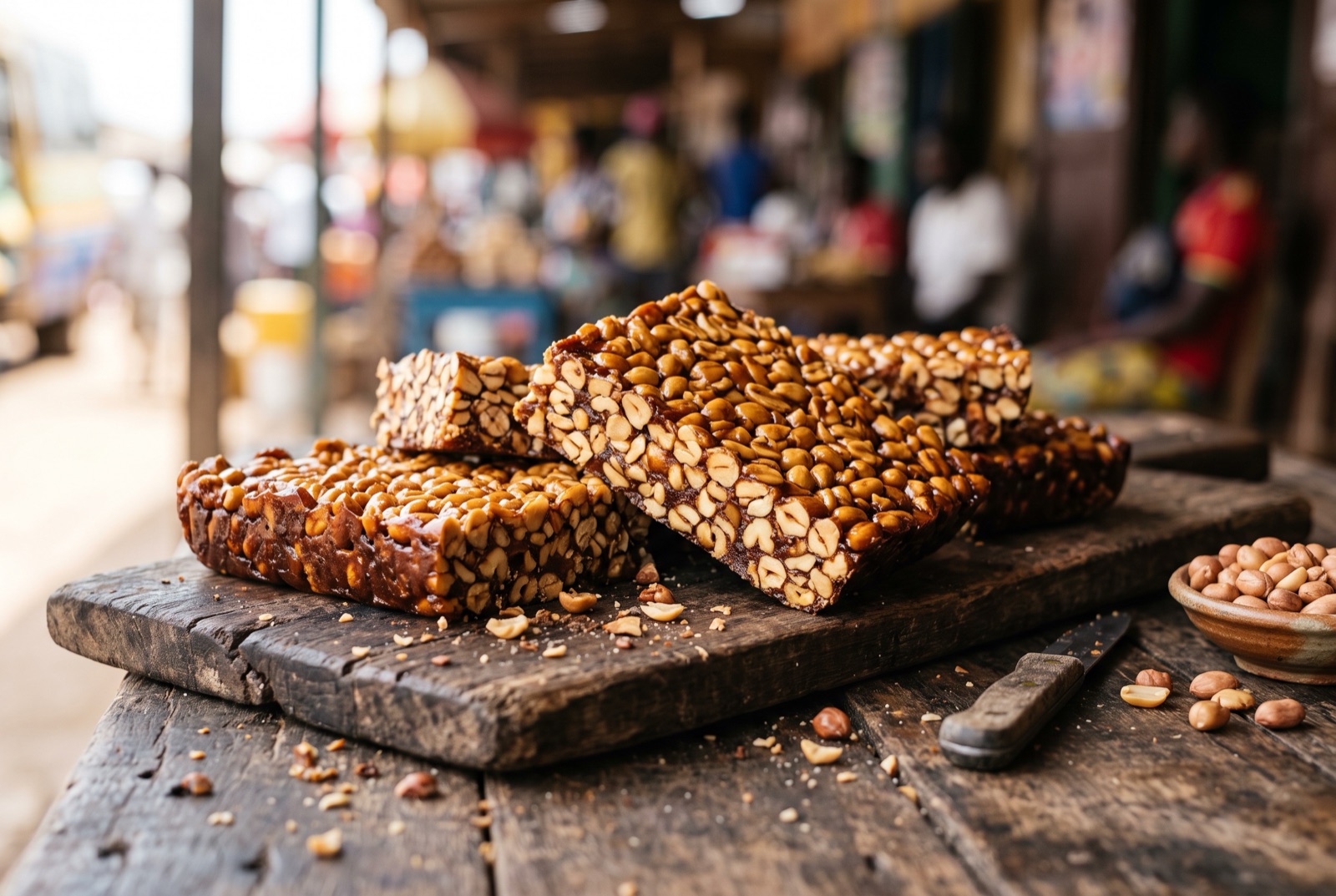
Nkate cake is groundnuts and sugar, and that is the whole list. Roasted peanuts are folded into caramel taken to a deep amber, tipped out, pressed flat and cut into rectangles before they set hard. The result snaps rather than chews, tastes strongly of toasted peanut with a slightly bitter caramel edge, and is sold in cellophane-wrapped slabs by hawkers at traffic lights and lorry stations across Ghana. It is not a cake in any sense — nkate means groundnut in Twi and the English word came along afterwards — and the absence of butter or syrup is exactly what makes it snap so cleanly.

- Gate
- GhanaNationwide
- Prep
- 15 min
- Cook
- 15 min
- Total time
- 1 hr 10 min incl. 40 min rest
- Serves
- 12
- Status
- Easy
- Nutrition / serving · estimated
- Calories 265 kcal
- Protein 8 g
- Carbs 30 g
- Fat 14 g
- Fiber 3 g
- Sugar 26 g
- Sodium 30 mg
Why this recipe works.
- Warms the groundnuts before they meet the caramel, which stops the sugar seizing the moment they go in.
- Keeps to the two-ingredient Ghanaian formula instead of quietly adding butter and corn syrup like most brittle recipes.
- Gives the caramel colour to look for, since dark amber is what supplies the slight bitterness that stops it tasting only sweet.
- Sets out a cutting window and a way to hit it, because the difference between neat slabs and a shattered sheet is about ninety seconds.
Ingredients.
4 itemsFor the brittle
For shaping
Equipment
- Heavy-based saucepan
- Baking tray
- Baking paper
- Rolling pin
- Large knife
Instructions.
Set everything up first
Line a baking tray with baking paper and brush it with oil, oil a rolling pin and a large knife, and lay them all within reach of the stove. Nothing about this recipe waits for you once the sugar is molten.
Warm the groundnuts
Spread 400 g of groundnuts on a second tray and warm them at 150°C for 10 minutes, until they are hot to the touch and smell strongly nutty. Keep them in the oven until the moment they are needed.
Tip Cold nuts seize the caramel on contact. This step is the difference between spreadable and unusable.
Make the caramel
Tip the sugar into a heavy dry pan in an even layer over medium heat. Leave it alone until the edges begin to melt into clear syrup, then swirl the pan gently and keep swirling until the whole lot is liquid and has gone the colour of strong tea, about 8 minutes.
Tip Swirl, never stir. A spoon drags sugar crystals back in and turns the caramel grainy.
Fold in the nuts
Take the pan off the heat, add the salt and tip in the hot groundnuts all at once. Stir fast with an oiled spoon until every nut is coated and the mass starts to pull together — you have about thirty seconds here.
Pour and flatten
Scrape the mixture onto the oiled paper and press it out immediately with the oiled rolling pin to an even slab about 1 cm thick. Work from the centre outward and do not stop to tidy the edges.
Score into slabs
After a minute or two, when the surface has firmed but the knife still passes through with pressure, score the slab into rectangles roughly 8 cm by 4 cm. Press right down to the paper on each line.
Cool and break
Leave the tray undisturbed for at least 40 minutes, until the brittle is completely cold and hard with no give at all. Snap along the scored lines and wrap the pieces individually.
Tips from our kitchen.
- Have the tray lined and oiled, the rolling pin oiled and the knife oiled before you start heating sugar. Once the caramel is ready there is no time to look for anything.
- Warm the roasted peanuts in a low oven and add them hot. Cold nuts drop the caramel temperature instantly and it stiffens into a lump you cannot spread.
- Rub the skins off the roasted groundnuts between your palms and blow them away. Left on, they burn in the caramel and add a papery bitterness.
- Do not stir the sugar while it melts — swirl the pan instead. Stirring throws crystals up the sides and the caramel goes grainy.
- Take the caramel to a deep amber, the colour of strong tea. Pale caramel makes a brittle that tastes flatly sweet and nothing else.
- Score the slab into rectangles while it is still slightly pliable, then break along the lines once cold. Trying to cut set brittle just shatters it at random.
Substitutions.
- Roasted groundnuts → Roasted cashews or a mixture of peanuts and sesame seeds
- Cashew versions are sold in Ghana too and work identically. Sesame makes a thinner, more fragile slab, so press it out a little thicker than you would with peanuts.
- Dry caramel → Wet caramel — 300 g sugar with 60 ml water, boiled without stirring until amber
- A wet caramel is slower and easier to control, which suits anyone who has not made caramel before. The finished brittle is indistinguishable.
- White sugar → Half white sugar, half soft brown sugar
- This gives a darker, more molasses-heavy bar. It is a deviation rather than the standard, and it browns faster, so watch the pan closely.
Variations.
- Nkate cake with ginger
- A teaspoon of ground dried ginger stirred through the caramel with the nuts, giving a warm burn behind the sweetness.
- Salted nkate cake
- A generous pinch of flaky salt scattered over the slab before it sets. Not traditional, but it sharpens the caramel considerably.
- Thin nkate cake
- Rolled out to half the usual thickness for a more delicate snap. This is the style often cut into smaller squares for sharing.
Storage & reheating.
Wrapped individually in cellophane or greaseproof paper and kept in an airtight tin, nkate cake holds 3 weeks at room temperature. Humidity is the real enemy — caramel draws moisture from the air and the slabs go tacky and soft within a day in a damp kitchen, so add a sachet of silica or a few grains of rice to the tin if that is a problem where you live. Never refrigerate it; condensation on the surface dissolves the caramel and makes it sticky. It does not freeze usefully.
Serve with
A glass of cold sobolo or plain water. It is sweet and dense enough that most people want something unsweetened alongside.
The story behind Nkate Cake.
Groundnuts grow well across the Ghanaian savanna, and nkate cake is one of the simplest things that can be done with them: roast, caramelise, cut, sell. It belongs to the roadside economy rather than the home kitchen. Sellers work the queues at lorry stations and the gaps between moving traffic, carrying trays or plastic tubs of wrapped slabs alongside plantain chips, bofrot and sachet water, and a bar of it is the standard thing to buy for a long bus journey.
It is worth noting how different this is from the peanut brittle sold in Europe and North America. Those recipes almost always include corn syrup to stop the sugar crystallising, butter for richness, and bicarbonate of soda to aerate the caramel into something light and porous. Nkate cake has none of that. It is dense, hard and glassy, the caramel is taken darker than most Western brittle would dare, and the peanut flavour dominates because nothing else is competing. That also makes it slightly less forgiving to cook, since there is no syrup acting as insurance against the sugar seizing into crystals.
The cutting is the part that catches people out. The caramel sets from the edges inward and stays workable for only a minute or two after it comes off the heat, so the pouring, flattening and scoring have to be done quickly and without stopping to think. Sellers manage this with practised speed and an oiled blade. At home, the honest advice is to have everything laid out before the sugar goes on the heat, because there is no way to slow the caramel down once it is in the pan.
Questions, answered.
Why did my caramel turn grainy?
Sugar crystals formed, usually because the mixture was stirred while melting or crystals on the side of the pan fell back in. Swirl the pan rather than stirring, and brush the inside walls with a wet pastry brush if you see crystals forming. A wet caramel made with a little water is more forgiving if this keeps happening.
Why is nkate cake so much harder than peanut brittle?
Because it has no bicarbonate of soda, no butter and no corn syrup. Western brittle uses soda to aerate the caramel into a light porous sheet and butter to soften the bite. Nkate cake is only sugar and groundnuts, which sets dense and glassy and snaps rather than crumbles. That hardness is the intended texture, not a fault.
When exactly should I cut it?
About one to two minutes after pouring, while the surface has firmed but the slab still gives slightly under an oiled knife. Score it into rectangles at that point and let it cool fully, then snap along the lines. Cut too early and the caramel flows back together; wait too long and it shatters unpredictably.
Can I make nkate cake with raw peanuts?
Roast them first. Raw peanuts have a green, beany flavour and they will not toast properly in caramel, which coats them too quickly. Spread them on a tray at 180°C for 10 to 12 minutes until they smell nutty and the skins loosen, then rub the skins off before they go into the pan.
Is nkate cake actually a cake?
No. Nkate means groundnut in Twi, and the English word cake was attached to a sugar-and-nut slab that has nothing to do with baking. It is closest to a brittle or a praline slab. Ghanaians use the name without any confusion about what they are getting.
You might also like.
All recipes →
Keep exploring Ghana.
Ghana has 9 more dishes in the atlas — Banku and Fufu, and 7 more.
Recipe by The DishRoute Kitchen · published August 20, 2026 · updated August 20, 2026