Pkhali.
Georgian Walnut and Vegetable Pâtés
ფხალი · say it: PKHAH-lee
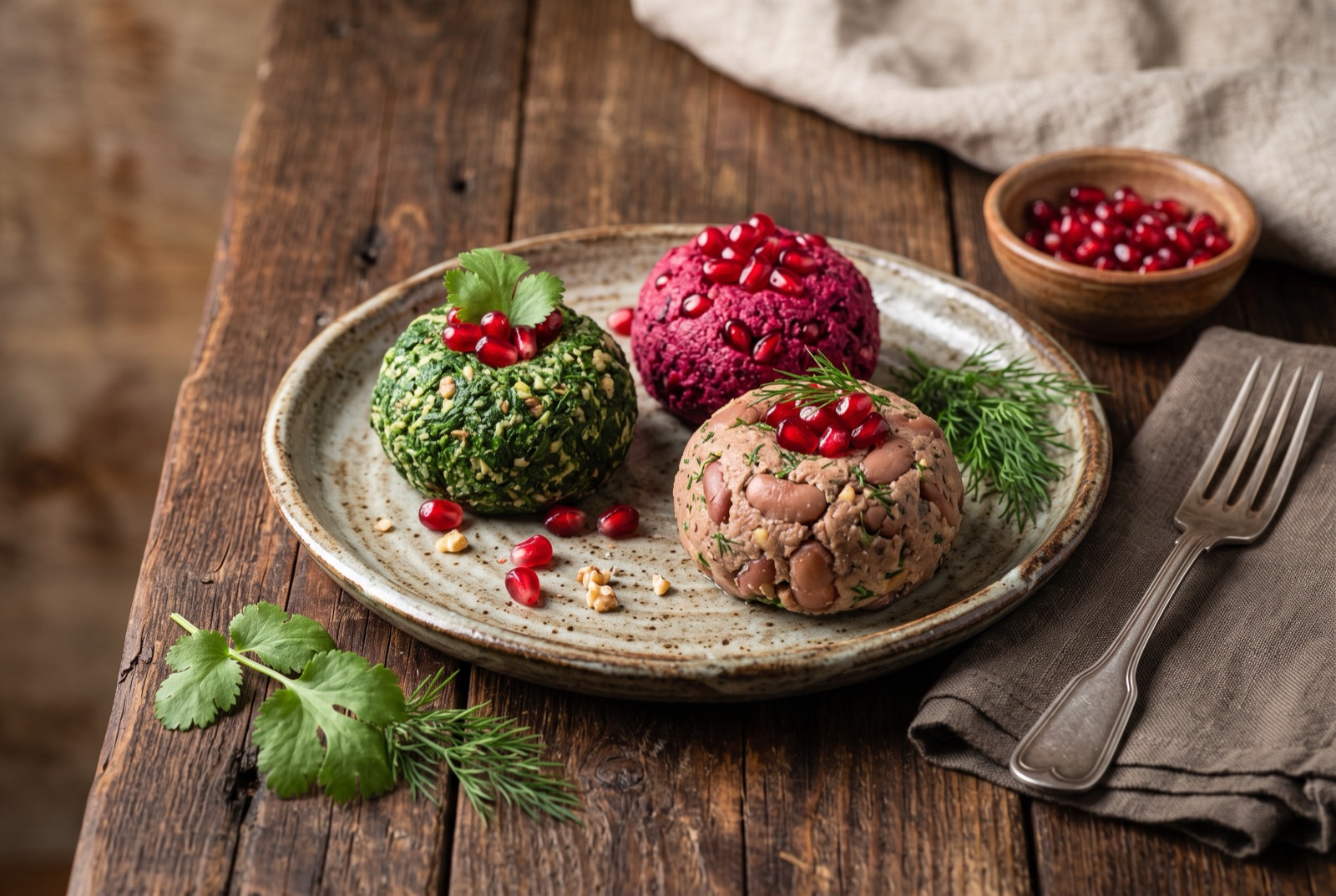
Pkhali is the trio of small vegetable pâtés that opens almost every Georgian table. A cooked vegetable — most often spinach, beetroot or beans — is squeezed dry, chopped fine and worked into a paste of ground walnuts, garlic, coriander and vinegar until it holds together in a ball. Each one tastes distinctly of its vegetable with the same nutty, sharp, garlicky backing behind it, and the three colours together are half the point. They are eaten cold, scooped onto torn bread, and the pomegranate seeds scattered on top are not decoration so much as bursts of acid that reset the palate between mouthfuls. Nothing here is cooked once assembled, and everything improves after a night in the fridge.

- Gate
- GeorgiaImereti
- Prep
- 45 min
- Cook
- 45 min
- Total time
- 5 hr 30 min incl. 4 hr rest
- Serves
- 6
- Status
- Easy
- Nutrition / serving · estimated
- Calories 380 kcal
- Protein 13 g
- Carbs 22 g
- Fat 28 g
- Fiber 9 g
- Sugar 9 g
Why this recipe works.
- One walnut base, divided three ways, so you get three distinct pâtés for barely more work than one.
- Every step where water ruins the texture is called out, which is the difference between balls that hold and paste that slumps.
- Seasoning is adjusted per vegetable — beetroot needs more vinegar, beans need more garlic — instead of applying one mix to all three.
- Entirely vegan, made a day ahead, and it travels to a party better than almost any other dip.
Ingredients.
15 itemsFor the walnut base
For the green pkhali
For the red pkhali
For the bean pkhali
To finish
Equipment
- Food processor
- Clean tea towel for wringing
- Three mixing bowls
Instructions.
Cook the beetroot
Simmer the whole unpeeled beetroot in salted water for 40–45 minutes, until a knife slides in with no resistance. Drain, cool under cold water and rub the skins off with your thumbs. Grate them coarsely and press out the juice in a sieve.
Wilt and wring the spinach
Drop the spinach into a large pan of boiling water for 60 seconds, until it collapses and turns dark green. Drain, refresh under cold water, then wring it in a clean tea towel until no more liquid comes out — twist hard, unwrap, and twist again.
Tip You should end up with a dense green ball roughly the size of a fist. Anything wetter will slump.
Make the walnut base
Pulse 350 g of walnuts with the garlic in a food processor until they clump into a damp, glossy paste that holds together when pressed. Add the coriander seed, blue fenugreek, marigold, chilli, fresh coriander, chopped onion, vinegar and salt and pulse to a thick, fragrant green paste.
Tip Stop as soon as the walnuts release oil — over-processing heats them and turns the paste dull and pasty.
Divide and combine
Split the walnut base equally between three bowls. Chop the wrung spinach finely and work it into the first, add the pressed beetroot to the second, and mash the drained beans coarsely with a fork into the third. Mix each until the paste is evenly coloured and stiff enough to hold a shape.
Season each one separately
Taste all three and adjust individually: the beetroot will need extra vinegar to cut its sweetness, the beans extra salt and often another crushed clove of garlic, and the spinach usually needs only salt. Each should taste sharp and garlicky rather than merely nutty.
Roll and chill
With wet hands, roll each mixture into 6 walnut-sized balls, flatten the tops slightly and set them on a plate. Cover and refrigerate at least 4 hours or overnight so they firm up and the garlic settles.
Finish and serve cool
Take the plate out 20 minutes before eating. Press a few pomegranate seeds into the top of each ball, scatter the rest around the plate, and serve with cornbread or torn white bread as part of a cold table.
Tips from our kitchen.
- Squeeze the cooked spinach in a clean towel until no more liquid comes out, then squeeze again. Almost every failed pkhali is a wet one.
- Grind the walnuts until they clump and turn glossy with their own oil — that oil is what binds the vegetable, so a dry powdery grind will not hold.
- Chop the cooked vegetables by hand or pulse them briefly. Fully blended pkhali has the texture of baby food and loses all its character.
- Season each batch separately and taste as you go: beetroot is sweet and takes more vinegar, beans are bland and take more salt and garlic.
- Wet your hands with cold water before rolling the balls, or the paste sticks to your palms and tears apart.
- Make them the day before. Overnight the garlic mellows, the fenugreek spreads and the pastes firm up enough to hold a clean shape.
Substitutions.
- Blue fenugreek and dried marigold → 2 tsp khmeli suneli blend, divided between the three batches
- The pre-mixed blend contains both and is the practical single purchase. Without any of them the pkhali is still good, just less specifically Georgian.
- White beans → Cooked green beans, chopped, or roasted aubergine flesh
- Both are traditional pkhali vegetables. Green beans need blanching until fully soft, and aubergine must be drained hard as it holds a surprising amount of water.
- Red wine vinegar → Pomegranate juice, or the juice from the seeds you are using as garnish
- Softer and fruitier. You will need roughly double the volume to get the same cut through the walnut fat.
Variations.
- Leek pkhali
- Boiled leeks squeezed dry and pounded with the same base — sweeter and milder than the spinach version, and a common winter option when greens are scarce.
- Cabbage pkhali
- White cabbage boiled soft, chopped and bound with walnut paste, sometimes with a pinch of extra chilli. Rustic, cheap, and the version most often made at home.
- Nadughi with walnut
- Not pkhali but its usual tablemate: fresh curd cheese rolled with mint and walnut, served alongside on the same plate. Dairy, so it belongs to non-fasting days only.
Storage & reheating.
Pkhali keeps 3 days refrigerated in a covered container and is better on days two and three. Press cling film onto the surface so the exposed sides do not dry and darken, and add the pomegranate seeds only just before serving, since they weep pink juice into the paste overnight. Take the pâtés out of the fridge 20 minutes ahead — served fridge-cold they taste muted and stiff. They do not freeze well, as the vegetables release water on thawing and the paste separates.
Serve with
Mchadi cornbread or torn white bread, alongside badrijani rolls and pickles as part of a cold Georgian table.
The story behind Pkhali.
Pkhali is fasting food that outgrew its purpose. The Orthodox calendar strips meat, dairy and eggs from Georgian tables for a very large part of the year, and a cuisine that observed this seriously had to build a full repertoire of vegetable dishes that could carry a meal rather than decorate one. Walnut paste was the answer: it supplies fat, protein and enough flavour to make a bowl of boiled spinach into something people actually want. What began as a constraint became the most recognisable part of the Georgian cold table, eaten year round by people who have not fasted in decades.
The word itself refers to leafy greens, and the original pkhali were made from whatever grew wild or in the garden — nettles, beet tops, chard, purslane, young cabbage. The three-colour set of spinach, beetroot and white bean that appears on restaurant menus is a modern arrangement, chosen because the plates look striking, but the method is old and completely elastic. Georgians make pkhali from leeks, aubergine, green beans, cabbage and carrot with no change to the technique at all: cook the vegetable, wring it dry, and bind it with the same walnut base.
That base is worth understanding on its own. Walnuts ground until they release oil, raw garlic, ground coriander seed, blue fenugreek, dried marigold, wine vinegar and a great deal of fresh coriander leaf — it is essentially the same seasoning that appears in satsivi and bazhe, adjusted for a colder, sharper dish. Two things govern whether pkhali works. The vegetable must be squeezed genuinely dry, because water thins the paste and the balls slump into puddles on the plate. And the vinegar must be enough to cut through the walnut fat; a pkhali that tastes rich and heavy has simply been under-soured. Georgians serve the three side by side with mchadi cornbread, and no one considers this a starter in the Western sense — the plates stay on the table all evening.
Questions, answered.
Why did my pkhali fall apart instead of holding a ball?
Too much water in the vegetable or too little oil released from the walnuts. Squeeze cooked greens in a towel until they are genuinely dry, not just drained, and grind the walnuts long enough that they clump and glisten. If the paste is still loose, add another handful of ground walnuts rather than breadcrumbs.
Can I use frozen spinach?
Yes, and it is arguably easier, since frozen spinach is already broken down. Thaw it completely and squeeze it very hard in a towel — frozen spinach holds far more water than fresh, and a wet batch is the main way pkhali goes wrong. Use about 400 g frozen to replace 800 g of fresh leaves.
What else can I make pkhali from?
Almost any cooked vegetable that can be squeezed dry: leeks, cabbage, carrot, green beans, aubergine, beet tops, nettles or chard. The walnut base and method stay identical. Adjust the seasoning to the vegetable — sweet ones like carrot and beetroot need more vinegar, bland ones like beans need more salt and garlic.
Is pkhali served hot or cold?
Always cold or at cool room temperature, as part of the spread of cold dishes that stays on a Georgian table throughout the meal. It is never heated. Make it a day ahead if you can, because it needs the resting time to firm up and for the raw garlic to stop dominating.
How much does this recipe make?
Roughly 18 small balls, six of each colour, which serves six people as part of a larger table or four as a substantial starter with bread. The three batches share one walnut base, so scaling up is straightforward — just keep the vegetables in similar weights so the base divides evenly.
You might also like.
All recipes →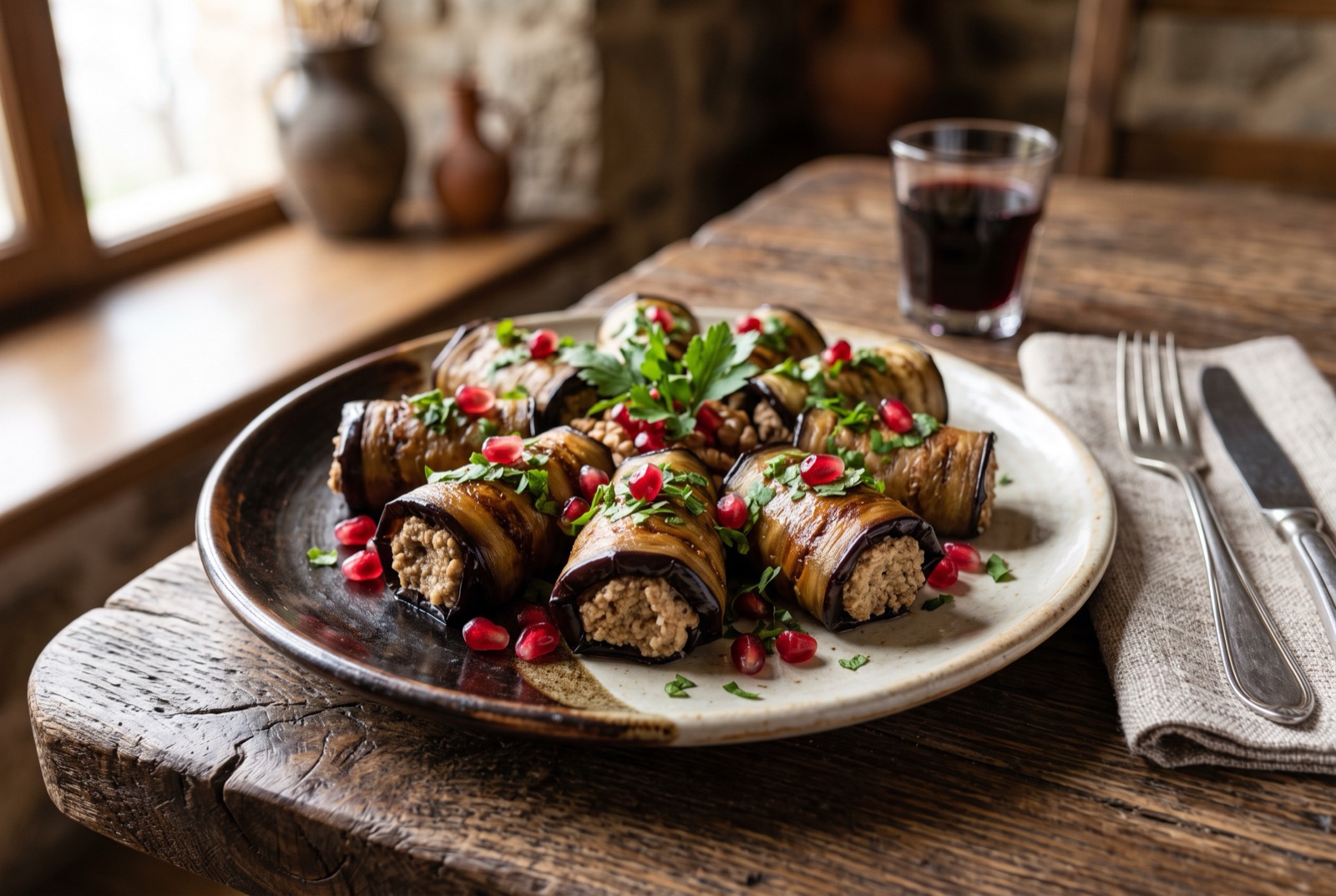
Keep exploring Georgia.
Georgia has 9 more dishes in the atlas — Adjarian Khachapuri and Badrijani Nigvzit, and 7 more.
All Georgia recipes Walnuts recipes Spinach recipes Garlic recipes appetizerveganvegetariangluten freedairy freeRecipe by The DishRoute Kitchen · published August 20, 2026 · updated August 20, 2026